Holy Well of Isle Maree, Loch Maree, Ross & Cromarty

Holy Well:  OS Grid Reference – NG 9310 7236

Also known as:

  1. Canmore ID 12049
  2. Mourie
  3. St. Maelrubha’s Well

Getting Here

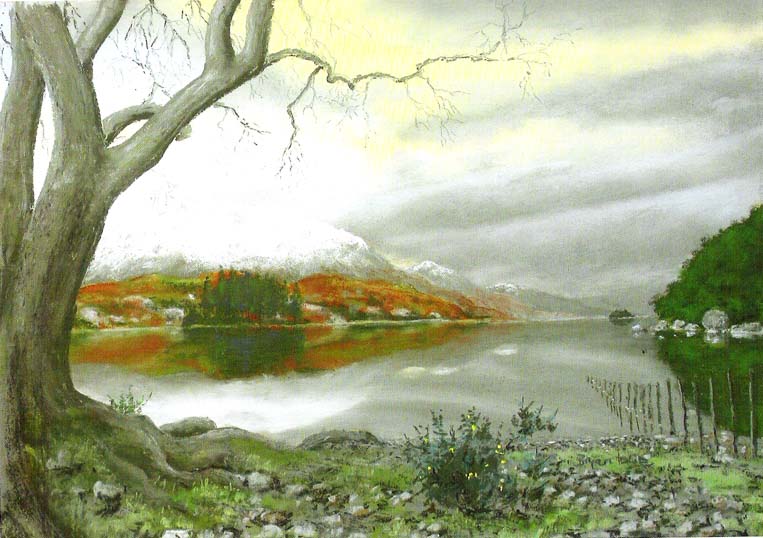
Loch Maree, looking south. Painting © Bryan Islip
Loch Maree, looking S. Painting © Bryan Islip

We were up here again in July 2009, but I’ve still not been across onto the island itself — just stared from the lochside, dying to swim across and spend a night or three alone on the island amidst this legendary landscape.  Basically, get to Talladale on the A832 (halfway between Gairloch and Kinlochewe), then walk up to the loch-side to your right (east) for a mile till you reach the small wooded outcrop.  Look north, betwixt the two isles and its the one in the middle with the Crag of the Bull and Maire’s Cairn rising up the mountain face behind.  But you can reach it via a boat trip from one of the local harbours.  Staying there overnight however, would seem more troublesome.  It seems that a winter visit seems best!

Folklore

This ‘holy well’ has a prodigious occult history which, sez my nose, is still maintained by one or two old Highland folk up here.  This small island (one of many in this long loch) was the Isle of the Druids in old days: legend telling it to be the teaching ground of these shady priests. Even the Iona druids came here. The main relics on on the island are the old holy well, accompanied by an old legendary tree into which all local people flocked and wedged coins at least once in their life. This devotional rite eventually took its toll, with so many of the coins covering the old tree with metallic scales to a height of nine feet, eventually killing it.

The well itself was said to cure insanity — no doubt the remedial quality given to the waters after neophyte druids had spent many days of ritual solitude here, eventually sipping its life-giving fluid to revive them from their ordeal.

It eventually became sanctified by the Church: legend saying it was St. Maelrubha (the same dood who turned the healthy Applecross heathens into church-goers) who was the guilty party.  Indeed, the name Maree itself, was proclaimed as deriving from this old saint, though local lore tells it to derive from the pagan ‘ane god Mourie.’

Elizabeth Sutherland (1985) reported that remains of the sacred tree were still visible. It is also said that no-one makes ritual commemmoration here anymore. Hmmmm… don’t always believe what you read.

In the 18th century, when Thomas Pennant visited this sacred well, he described that,

“in the midst is a circular dike of stones… I expect the dike to have originally been druidical, and that the ancient superstition of paganism had been taken up by the saint (Maelrubha) as the readiest method of making a conquest over the minds of the inhabitants.”

References:

  1. Dixon, John, Gairloch in North-west Ross-Shire, Co-op: Edinburgh 1886.
  2. MacKenzie, Kenneth C., Loch Maree: The Jewel in the Crown, privately printed 2002.
  3. MacKinlay, James M., Folklore of Scottish Lochs and Springs, William Hodge: Glasgow 1893.
  4. Morris, Ruth & Frank, Scottish Healing Wells, Alethea: Sandy 1982.
  5. Pennant, Thomas, A Tour in Scotland and Voyage to the Hebrides, MDCCLXXII, John Monk: Chester 1774.
  6. Polson, Alexander, Gairloch, George Souter: Dingwall 1920.
  7. Sutherland, Elizabeth, Ravens and Black Rain, Constable: London 1985.
  8. Watson, W.J., Place-Names of Ross and Cromarty, Northern Counties Printing: Inverness 1904.

* This beautiful painting is one of many done by local artist, Bryan Islip.  It is taken from his 2010 Calendar, Scotland’s Wester Ross, and is available direct from him. If you’d like to know more, or want copies of his calendar or other artworks, email him at:  pico555@btopenworld.com – or check his website at www.picturesandpoems.co.uk

© Paul Bennett, The Northern Antiquarian

Painting © Bryan Islip
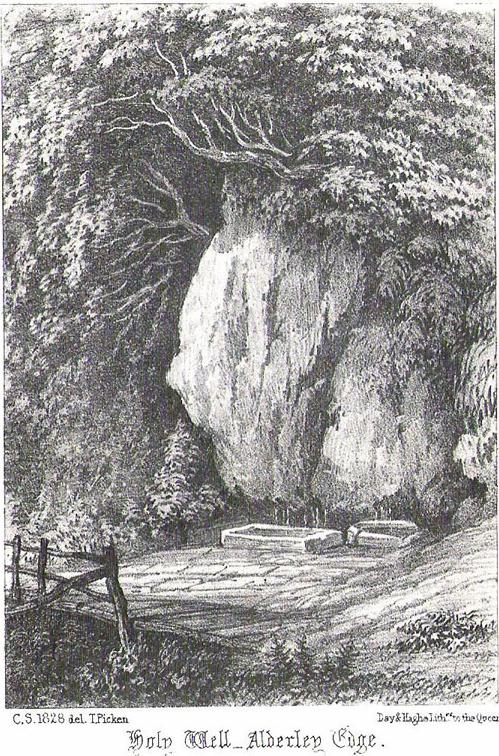

Holy Well, Alderley Edge, Cheshire

Holy Well:  OS Grid Reference – SJ 8590 7786

Archaeology & History

In Roeder & Graves’ (1906) analysis of the neolithic remains surrounding this geological arena, they told there to have been “at least nine wells at different parts of the Edge” — this and the Wizard Well being the ones of greater local renown. Flints and the remains of neolithic man were found all round here.  Obviously the water from this well here would have been of primal use.

Alderley Edge's Holy Well in 1828

Folklore

In 1843, Robert Bakewell told how the waters from this famed well, “are said to be a cure for barrenness.” As well as this he reported how a large boulder fell from the Holy Well Rocks above it around 1740, and “a woman and a cow are said to have been buried under it.”  But a lengthier description came from Roeder & Graves’ archaeological essay, where they told how both the Wizard Well and this site, “were in ancient times connected with well worship.”  They continued:

“Their healing powers were considered to be unfailing: the barren, the blind, the lame, and bodily-afflicted constantly made their way thither; maidens whispered their vows and prayers over them, their lovers and their future lives being their theme.  Crooked silver coins were dropped into the well, but these have been cleared out long ago.  At present time the devotees are satisfied, in their economical habit, to offer mere pins and hairpins; the custom is not yet dead, for some of the immersed pins are still quite corroded and bright.  Some of the sex deposit the pins in their straight and original form, others bend them only at right angle, and as many again seem to consider the charm alone to act effectively when carefully and conscientiously doubled-up.  Maidens of a more superficial cast just the slightest twist to the object.  To judge from the state of corrosion and the old-fashioned, thick globular heads, some of these pins must have been in the well for at least sixty years… There are occasionally to be seen also a few white pebbles in the two wells.”

References:

  1. Bakewell, Robert, Alderley Edge and its Neighbourhood, J. Swinnerton: Macclesfield 1843.
  2. Roeder, C. & Graves, F.S., ‘Recent Archaeological Discoveries at Alderley Edge,’ in Trans. Lancs & Cheshire Antiq. Soc., 1906.

© Paul BennettThe Northern Antiquarian


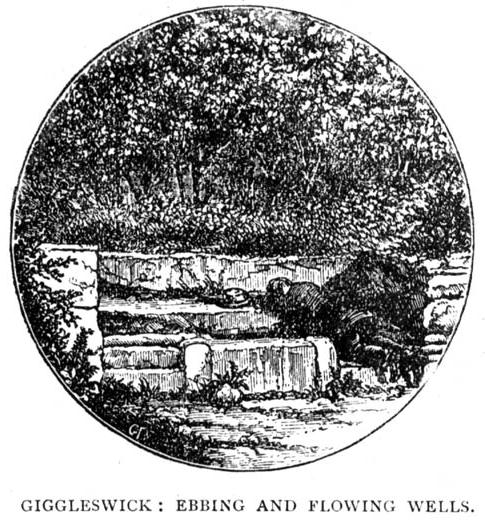
Ebbing & Flowing Well, Giggleswick, North Yorkshire

Holy Well:  OS Grid Reference – SD 8039 6538

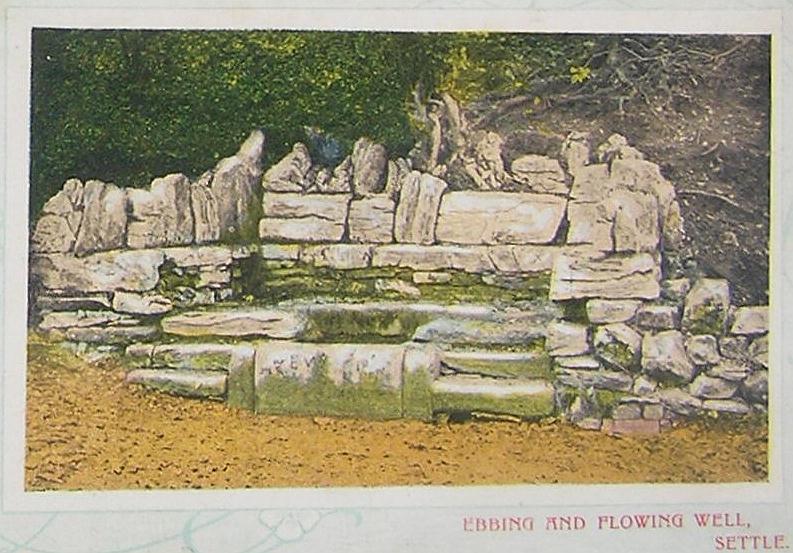
Early postcard of this famous well

Getting Here

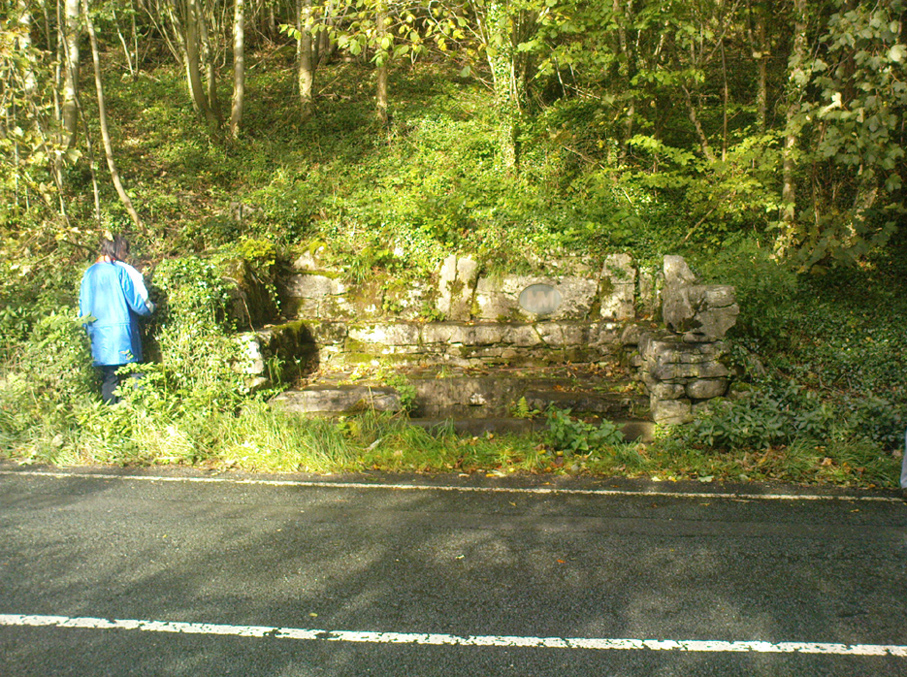
This famous old site can be found right by the roadside—the B6480—as you head out of the northern end of the town, beneath Giggleswick Scar.  It’s less than a mile along the old main road, just as you start to climb up the hill, just across from the entrance to Huntworth.  It is in reasonable condition and has long been thought of as a holy and magickal well.  Edna Whelan and Ian Taylor included it their fine work, Yorkshire Holy Wells. (1989)

Archaeology & History

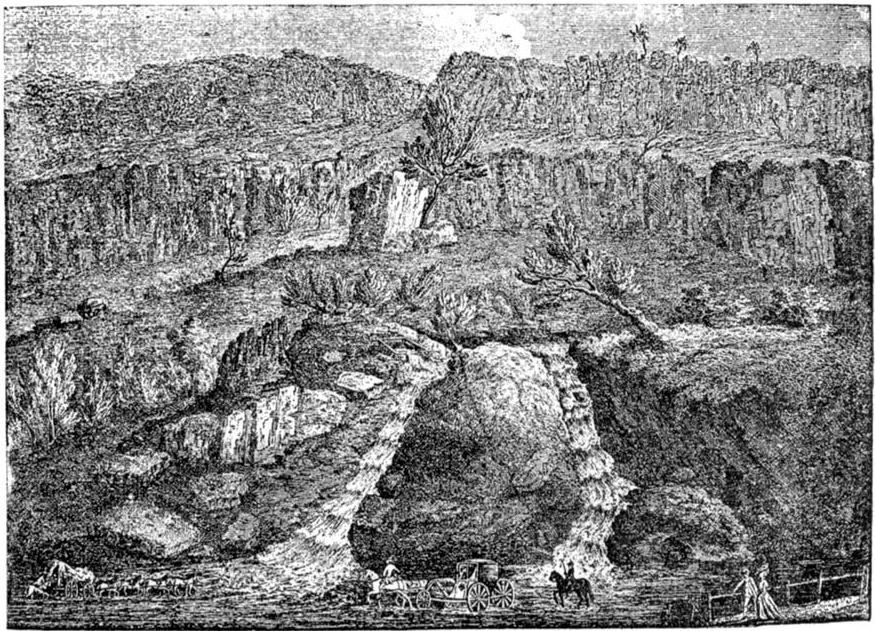
The site as we see it today is but a shadow its former self.   Although the stone trough that we look at seems to be the site, this once great great well originally emerged up from the ground a good hundred yards further up the steep hill slope above us, as the early illustration here clearly shows.

Ebbing & Flowing Well (Whitaker, 1878)

Just above where the Ebbing & Flowing Well first appeared an excessive amount of flints were found in earlier years; and just above that, early human habitation in the caves to the back; along with ancient burials nearby — as well as numerous other neolithic, Bronze- And Iron Age remains all round here.  This peculiar water supply was obviously of considerable importance to our pre-christian ancestors…unless you’re an idiot that is!

The site’s name comes from the very action of the waters here, which have sadly long-since been stopped. The well could suddenly overflow very rapidly and the next minute subside, with seemingly little rational explanation.  As such, it was seen to be miraculous.  It was first described by one John Speed in 1627 (England and Wales Described), where he said,

“At Giggleswicke…there are certain small springs not distant a quaits cast from one another; the middlemost of which doth at every quarter of an houre (?) ebbe and flowe about the height of a quarter of a yard when it is highest, and at the ebbe falleth so lowe that it be not an inch deepe with water.”

Ebbing & Flowing Well

Though Harry Speight (1900) reckons such rapid undulations were slight exaggerations on Speed’s part.

Nearby we also find the Bank Well, where old lead goddess figurines were deposited around Romano-British times.  Archaeologist Alan King (1970) saw such deposits as important to the spirit of the waters, saying,

“The wells at Giggleswick, especially the Ebbing and Flowing Well, would be considered entrances to the Underworld and suitable sites for making offerings.”

It seems more likely however, that the Ebbing and Flowing Well would have a more pronounced oracular nature; though Underworld aspects would be prevelant, though would be the province of selected priestesses (whose folklore is found nearby, albeit in distorted form).

The waters themselves today flow quite well, but are close to freezing when you immerse your hands therein.  They also taste very good indeed and are most refreshing – better than any of the alleged ‘spring water’ people today buy in plastic bottles.  It’s gorgeous water here!

Folklore

Early drawing of the Well

An undoubted oracular site: the ebbing and flowing actions of the waters giving the well the distinct characteristic as a place used for prophecy and divination in very ancient times.  I have little doubt that this was a place used by shamans.  It was likely to have been a dreaming site aswell. (it would be good to know if there is any old witchcraft lore still left here)

The waters themselves are supposed to be a manifestation of a local female spirit, who was transformed into the waters by a woodland spirit. Also here, a local highwayman called Nevison was being chased by the local cops, when his horse stopped at the waters desparate for a drink. While here, Nevison prayed to the water spirit for help. She duly obliged, giving him a magic bridle, enabling his horse to run and jump over the high moors to escape his pursuers: a place called Hell Ghyll being one of the places he was said to have cleared.

References:

  1. Bord, Janet & Colin, Sacred Waters, Granada: London 1985.
  2. Hope, Robert Charles, The Legendary Lore of the Holy Wells of England, Elliott Stock: London 1893.
  3. King, Alan, Early Pennine Settlement, Dalesman: Clapham 1970.
  4. Ross, Anne, Pagan Celtic Britain, RKP: London 1967.
  5. Speight, Harry, The Craven and Northwest Yorkshire Highlands, Elliott Stock: London 1892.
  6. Whelan, Edna, The Magic and Mystery of Holy Wells, Capall Bann: Chieveley 2001.
  7. Whelan, Edna & Taylor, Ian, Yorkshire’s Holy Wells and Springs, Northern Lights: Pocklington 1989.
  8. Whitaker, T.D., The History and Antiquities of the Deanery of Craven, Joseph Dodgson: Leeds 1878.

© Paul Bennett, The Northern Antiquarian


Lister Well, White Moor, Barnoldswick

Healing Well:  OS Grid Reference – SD 8695 4412

Getting Here

Lister Well on 1853 map

You’re a bit spoilt for choice in terms of how your reach this spot, high upon White Moor – which is south of Barnoldswick, west of Salterforth, northwest of Foulridge, north of Barrowford, or northeast of Blacko.  Whichever route you end up taking, you’re going uphill onto the heights near Weets Hill – and find the old trackway which bisects White Moor and has the rather tell-tale name of Lister Well Road!  It’s roughly halfway along the route, right by the trackside.

Archaeology & History

Lister Well, White Moor

History and folklore here have long been silent (though I aint checked the Annals of Barrowford, which may prove useful).  A local land-owner told us that the original trough had been uprooted a few decades back when the gas- or electricity-board (he can’t remember which) did some work hereabouts and uprooted the stone trough into which the waters ran and, for sometime, caused the complete destruction of the supply.  But its waters eventually re-emerged from the Earth, trickling into the grassy drainage line on the southern-edge of the track before going under the wall and down the moorland slope.

If you like a good walkabout with good views to behold, get y’self up here and have an amble.  Tis a damn fine place, with a lot of forgotten history embedded in the landscape.

© Paul Bennett, The Northern Antiquarian