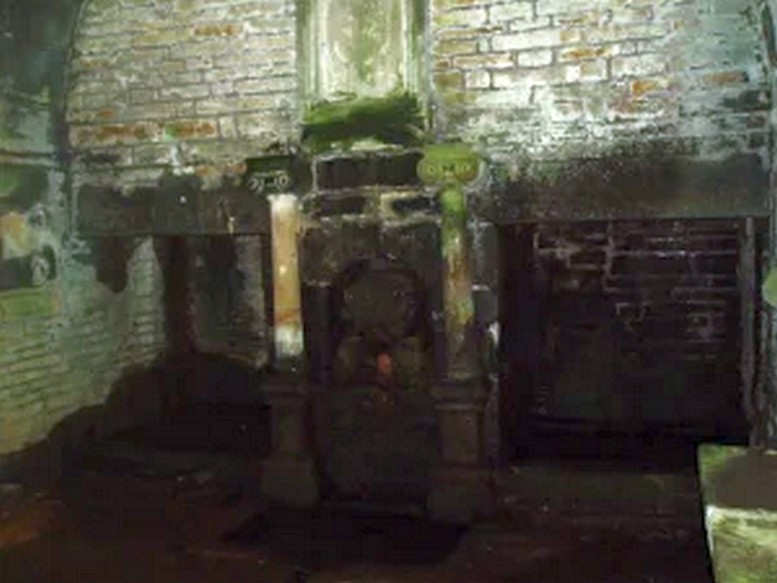
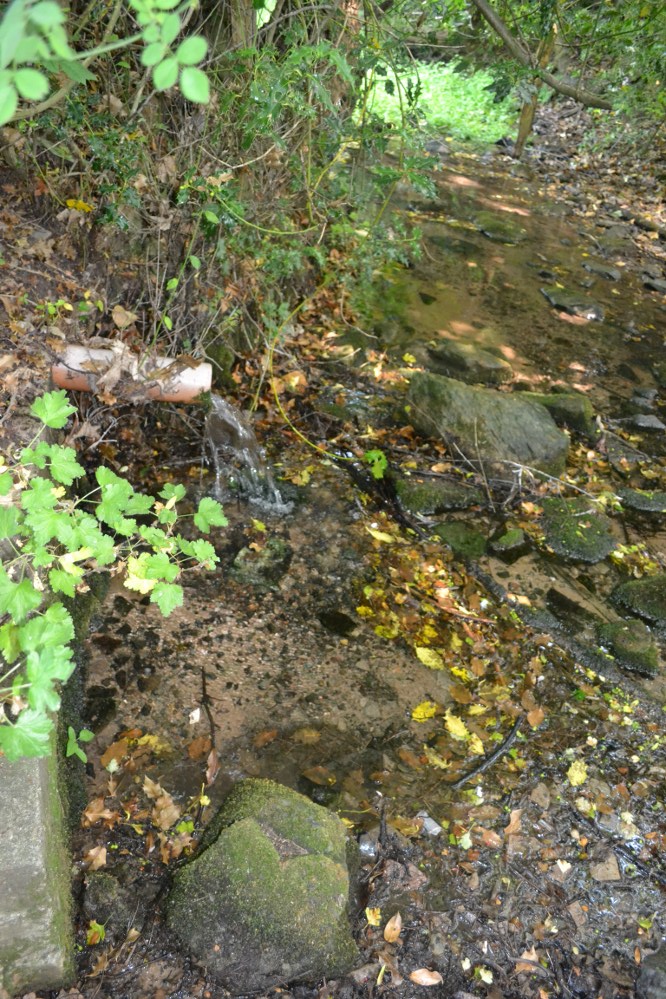
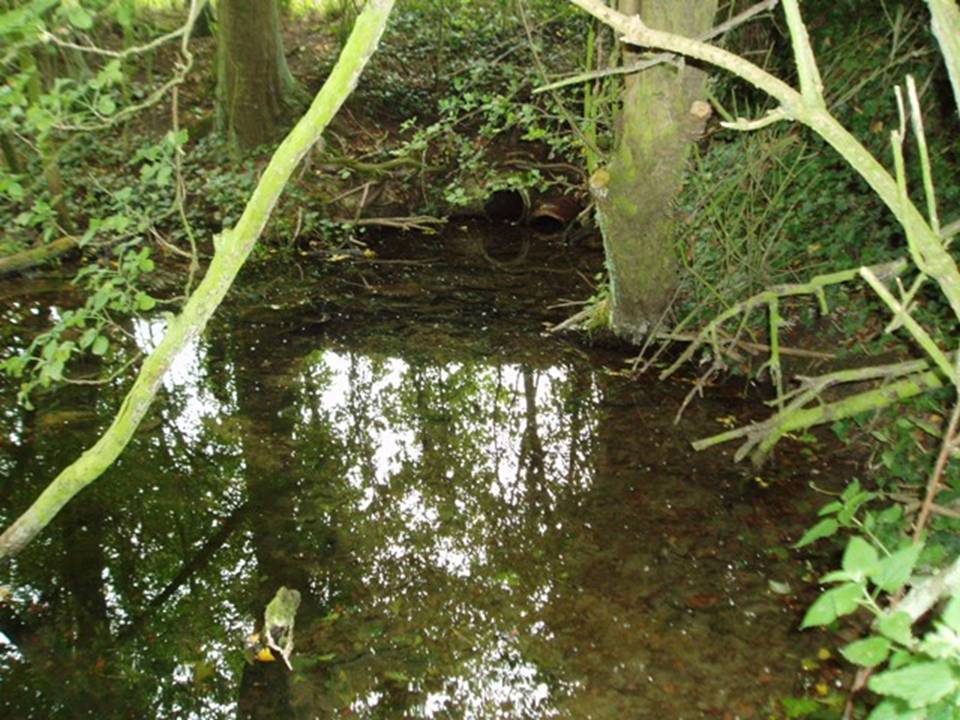
This curiously-named and long lost well would almost have us believe that the Greek poet and philosopher himself was a-wandering in this neck of the woods. But that sadly wasn’t the case. It seems to have been mentioned just once in Looe’s early Town Books:
“In 1621 that part of West Looe Down which lieth on the West part of the Homer Well, was let to rent, for two crops, at 6s.8d. per acre”
In Courtney & Couch’s (1880) Cornish dialect work, the word homer is said to mean “homeward”; this is also echoed in Wright’s (1905) magnum opus. It seems to imply that it was a drinking well used by folk traveling the short distance from Looe village, across the river and onto or over West Looe Down towards their cottage or farmhouse; akin to a refreshing resting place halfway home, so to speak. Sometimes the word homeward can be taken to simply mean “at home,” in which case it would suggest that the Well was simply next to someone’s house. We may never know…
References:
Bond, Thomas, Topographical and Historical Sketches of the Boroughs of East and West Looe, J. Nichols: London 1823.
Courtney M.A. & Couch, T.Q., Glossary of Words of Use in Cornwall, English Dialect Society: London 1880.
Wright, Joseph, English Dialect Dictionary – volume 3, Henry Frowde: London 1905.
Take the A675 road to Bolton from Abbey Village, going up the track opposite Piccadily farmhouse until you reach the ruins in the woods. The site can also be reached by going south down the Tockholes Road car park following the sign for Hollinshead Hall on your right.
Archaeology & History
Hollinshead Hall
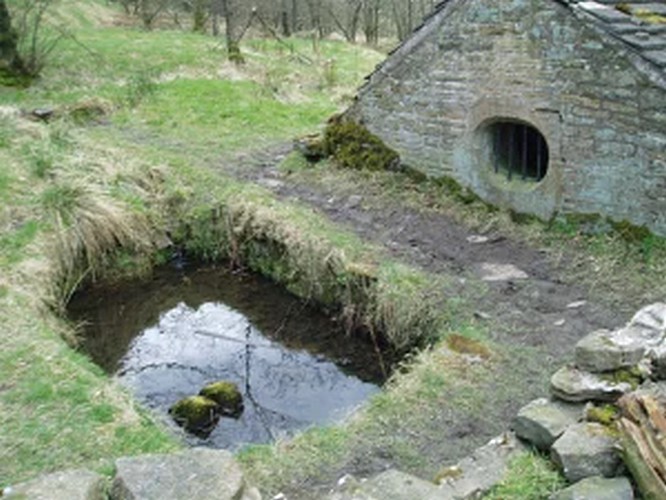
Associated with Hollinshead Hall, which is now a ruin, the well is made of the same sandstone rubble as the hall with a stone slate roof. The building a single cell is built into a slope from which the spring arises and is encapsulated by it. Either side a high walls creating a sort of forecourt with side benches with inward-facing chamfered piers with ball finials at the ends. The well house itself is quite an attractive building and is certainly not thrown up, having a symmetrical facade with chamfered unglazed widows which are fitted with spear-headed iron bars and clearly the building has never been glazed. The gable end has a large oval opening with a matching one at the rear. In the centre is a heavy board door with a chamfered doorway. This doorway unfortunately is locked baring any entrance to the well house.
Peering in through the windows one can see how strong the vaulted roof is, adorned by a pendent ball in its centre. The spring’s water flows from a crudely carved lion’s head, either side of a reredo of Ionic colonnettes, with a sunken stone tank beneath or each side a rectangular recess which enclose rectangular pools. There is a diamond-paved floor with a central gutter draining from this well or trough at centre of rear wall.
Local tradition accounts that there was a site here from Medieval times and indeed, that the name Hollinshead was derived from a version of holy well although O.E hol, for hollow is more likely although there is a Halliwell Fold Farm nearby being derived from O.E halig for healing. The pool with steps down above the well house may be the original well of course. The discovery of a hoard of medieval coins in 1970s would support the date and perhaps they were an offering.
Folklore
Abram’s Blackburn (1877) is perhaps the first to state that the water was curative. However, anonymous quote in Nightingales History of Tockholes describes the well as:
“Here no less than five different springs of water, after uniting together and passing through a very old carved stone representing a lion’s head, flow into a well. To this Well pilgrimages were formerly made and the water which is of a peculiar quality, is remarkable as an efficacious remedy for ophthalmic complaints.”
Another tradition is that the site was a resting place for pilgrims to Whalley Abbey and that the trough was used as baptistery, however, this would be more likely to be the spring above the well house. It is probably a spring house, a structure built over a natural source of water for the storage of dairy products and other foods that needed to be kept fresh.
Reculsancy was very prevalent in Lancashire and the well house does the bear the coat of arms of the Radcliffes. It would suggest why the structure is so ornate and suggest a 1600s date—although many authorities suggest an 18th century origin. The site would be a secret baptistery and its design as a dairy would also help as well as being still function, certainly the presence of benches suggest this functionality. It appears to be too close to the house to be a garden folly such as a grotto! The suggestion of stained glass in the windows suggests something more significant discovered during the present stone roof’s construction. Indeed, the choice of the lion’s head is possibly that of the ‘Lion of Judah’, meaning Jesus providing rich and valuable water, although this is a common motif on many drinking fountains of course! Interesting, Cramshaw (1994) tells us that the site was in the 1980s the site of a well dressing, although what type is unclear and no other author has mentioned it as far as I am aware. Perhaps we shall never know the real origin of this delightful building.
A stone’s throw from Ikea and found off the B600 main road. Travelling to Greasley from Watnall, take first turning on the left after Royal Oak Wood. Travel up Trough Road, past the woods where it is best to park, then walk up Trough Lane and the well can be found on the right hand side, opposite a house called The Springs.
Archaeology & History
I am of the opinion that the ‘holy’ element of this well is a romanticism of the 1800s, but there is a possible record in the ‘The Manor of Bevall in the County of Nottingham’ document, commissioned by the Honourable Dame Elizabeth Capell in 1653. Amongst the records it appears a number of times as:
‘Holy Well Furlong 2 lands bounded with John Richards west and William Hickton east’.
Plaque at the wellFront of the well
A 1724 Capps Survey of Watnall Cantelupe notes that Joseph Richards had some lands lying in a close called the Flatts or Holliwell, which understandably relates to ‘Holy Well’. There is also note of a Holwell Croft field name in the 1500s at Greasley, which again may describe this site or another and such suggests that it derives from O.E. hol, meaning ‘hollow’, a common misconception when identifying prospective holy wells. Jeremy Harte (2008) in his English Holy Wells suggests that those sites called ‘Holy Well’ are pre-Medieval in origin so perhaps this site is one of the most ancient in the county.
The sacred waters
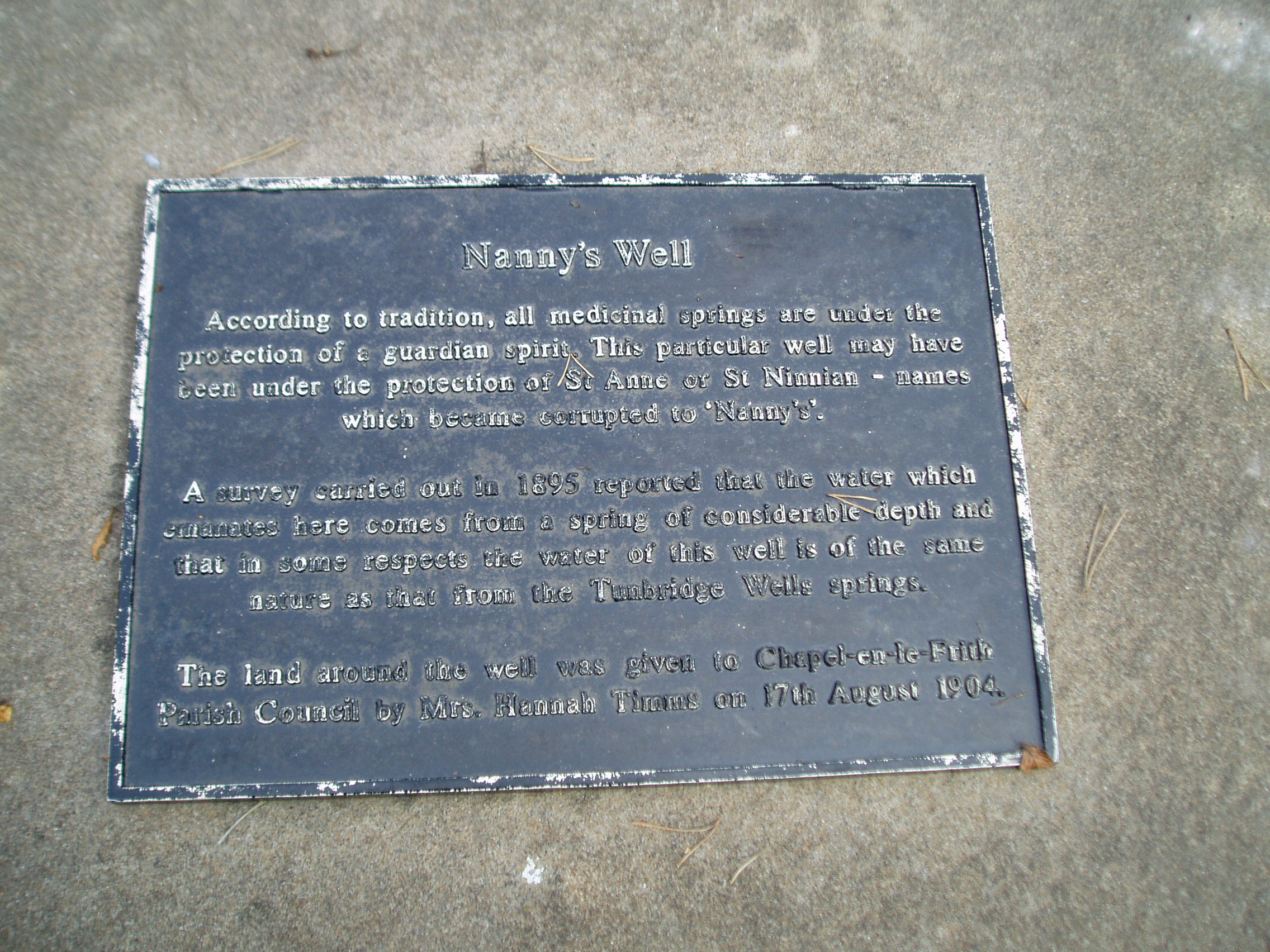
On my first visit to this site I was told by an elderly man that he was baptised there (or water used from it used for his baptism), before attempting inexplicably in trying to discourage me from finding it (due to his wariness of me I failed to discover the nature of his baptism or of what denomination). According to locals in the lane the plaque and present state of the well dates from the 1980s and was done in partnership with the local council.
The house opposite is called ‘The Springs’ was this name of the well before the ‘present’ name and so it is ‘modern’ holy well per se, although I think the 18th century survey is significant.
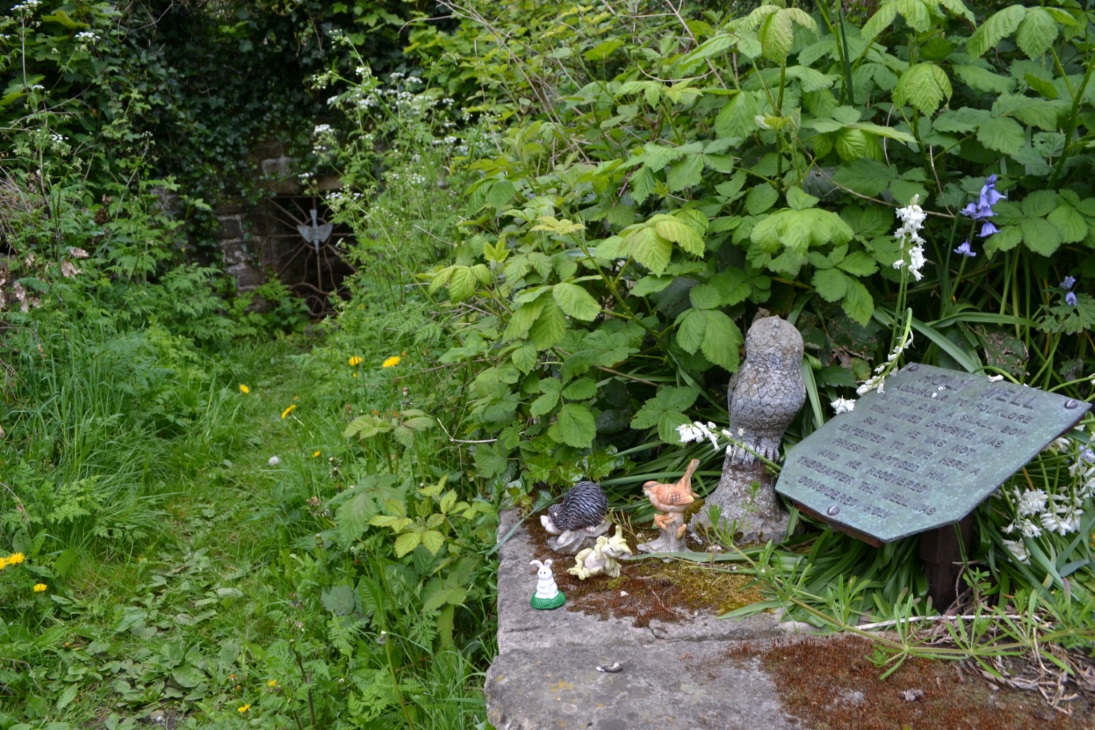
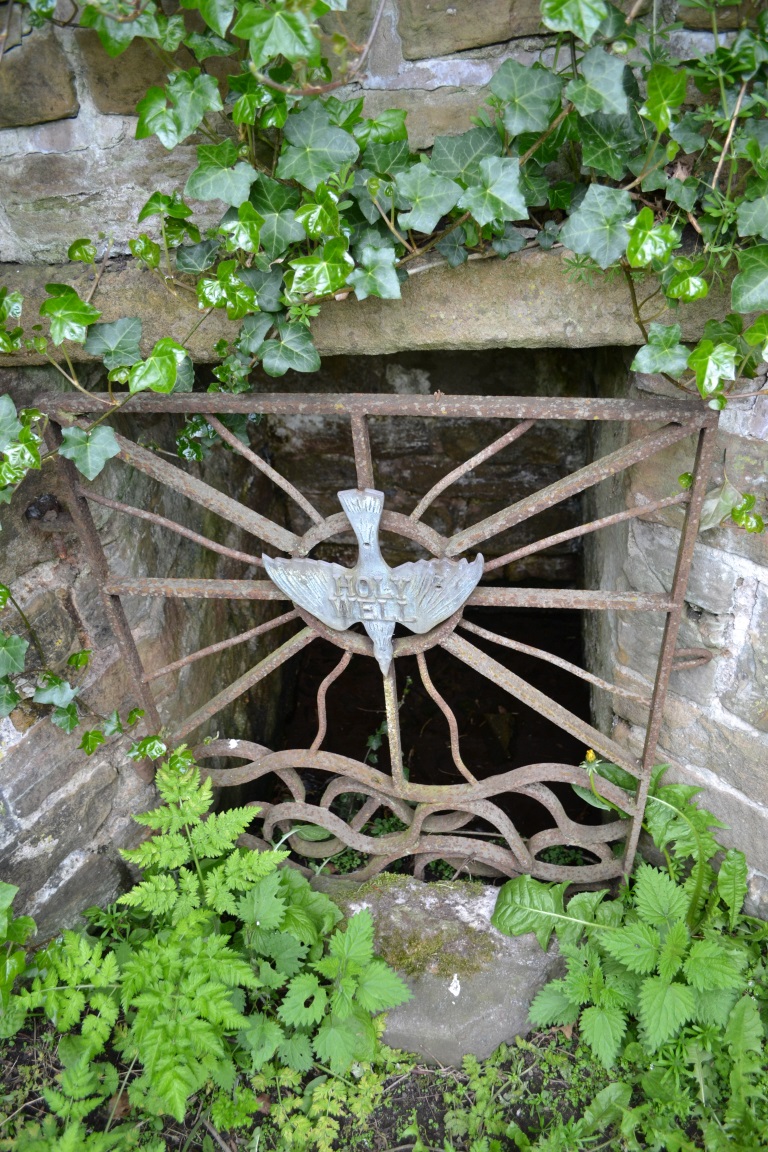
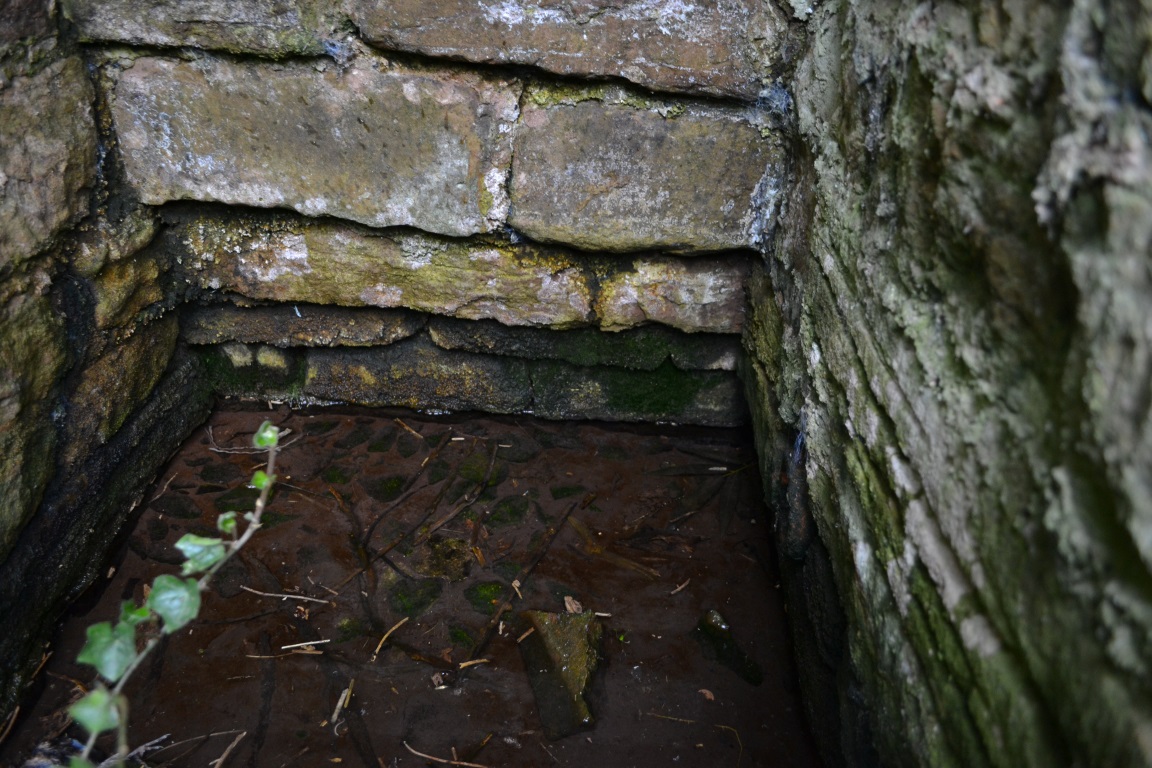
The well itself, is enclosed in a stone recess with a rusty iron gate with a dove affixed on it bearing the legend Holy Well. It is approached by a path walled along both sides which are adorned by a wide range of gnomes and garden ornaments..almost so you could be pixy led!
Folklore
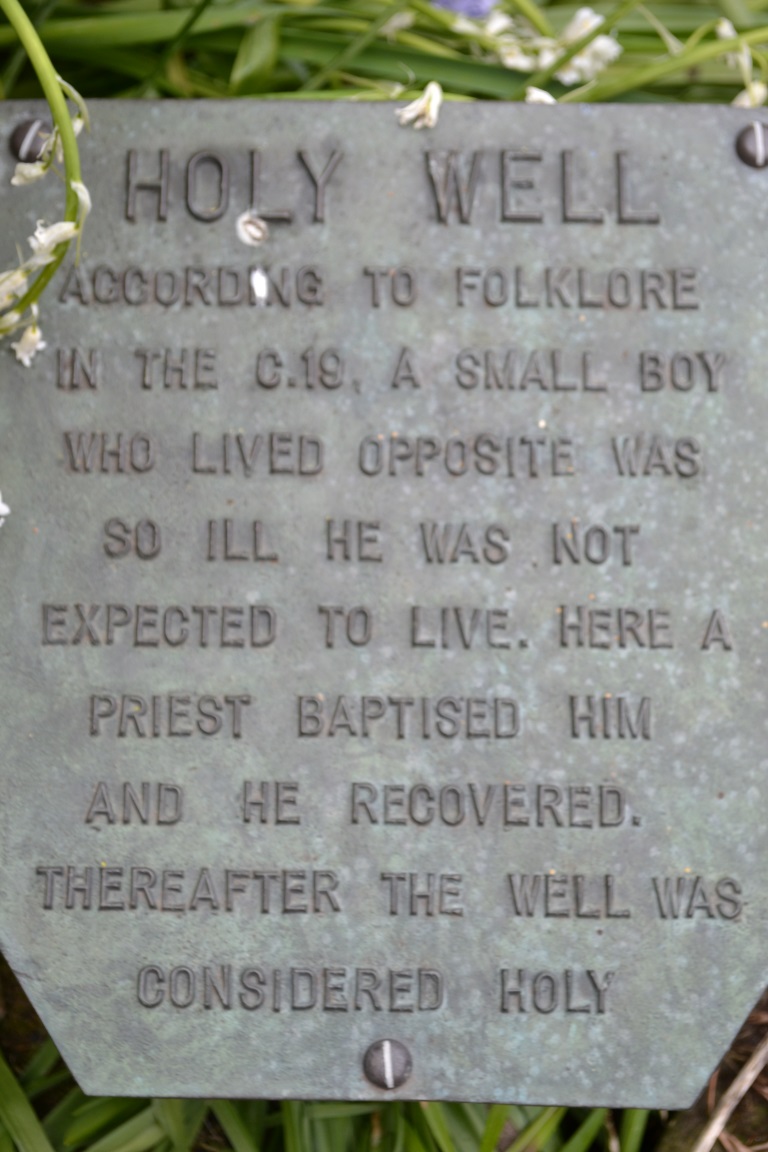
A plaque near the well’s entrance has a local piece of folklore recorded. This relates that a local boy who lived opposite was very ill and bedridden. A local priest called for water to be drawn for the boy from the well. This was done and the boy became well.
Interestingly it’s the only legend of this type—one which records a cure—in all the Nottinghamshire holy wells. It is a shame one cannot find a date or check its provenance, a fact supported by local history author Mr. John Lee. The use of priest is significant. Does the story may indicate the Catholic revival in holy wells in the 19th century? However, the only Catholic associations locally are that of Hilltop at Greasley for there was, and is, only a Methodist chapel in Watnall.
Extracted from Parish, R.B (2008) Holy Wells and healing springs of Nottinghamshire
To find Nanny’s Well, take B5474 out of Chapel and take the right hand turning called Crossings road (which goes to Chinley) which is before Frith view on the left. Continue until the small wall surrounding the site can be seen on the right.
Archaeology & History
The name it is said to be either from St Ninian (less likely) or St Anne (more likely as she is also considered the mother of Mary and thus Grandmother of Jesus).
The Nanny well pump
It is described in M.J.B Baddeley’s Peak district of Derbyshire (1913) and the neighbourhood as:
“a valuable but neglected spring of chalybeate water.”
Yet in 1895, a Manchester firm of Grace, Calvert and Thompson analysed it and found it:
“not polluted to any extent with organic matter of animal or vegetable origin and comes from a spring of considerable depth and that no surface water has become mixed with it’…in same respects the water of this well is of the same nature as that from the Tunbridge Wells springs.”
The site is now an iron pump by the side of Crossings Road, known as Nanny Well Road, enclosed in a low wall along which. The pump no longer works and the well capped but it can be heard and just about seen through a crack beneath.
A peer through the crack shows running water!
Folklore
Nanny well plaque
It was visited on Easter Morning, with sugar or licorice to make Spanish Water, and then the bottles were hung around their necks. The site is one of four wells dressed annually since the 1980s in July and the site is blessed.
Extracted from Parish, R. B., (2008) Holy Wells and Healing springs of Derbyshire
The well depicted in Hope’s (1893) Legendary lore of holy wells, sadly he says nothing about it!
The Holy Well is signposted off the road to Castle Donington on the left hand side as you near a small brook, past new bridge and it will be seen down the track. It can be muddy, so bring some boots!
Archaeology & History
It is first noted in 1366 as ‘Halywalsiche.’ The purchase of the lands of St Catherine’s Chantry, lately dissolved, in 1564, refers to lands here at ‘Holy well hedge’ and ‘Hollywell siche.’ A carved inscription over the well read:
“Fons sacer hic strvitvr Roberto Nominus Hardinge 16xx“
translating as:
“this Holy well was built by Robert named Hardinge 16xx“.
Briggs suggested the date of 1660, which is quite likely, as it coincides with the Restoration of Charles II as the family at the nearby hall. The aforementioned Hardinge, were staunch Royalists, and of course puritans disliked holy wells as many other so called ‘popish’ things. However, its restoration may have been for little more than to maintain a good water supply. Later depictions such as pre-war postcards show the date to be quite clearly 1662.
The restored holy well today, original stonework to rear with newer stone at the front
The present condition of the well is tribute to its local community. The arch survived for nearly 300 years but a combination of vandals and the roots of the nearby ash tree caused the arch fall down and it lay in pieces in the 1950s. Sadly the original inscription appears to have been stolen or entirely broken to pieces. However, unlike many similar sites, this was not the final fate of the well. In the 1980s it was restored using as many of the old stones as possible. The landowner was happy to sell the land and Melbourne Civic Society donated money for its restoration. No artifacts were found, apart from 17th century Ticknall ware pottery, later tiles, and drainpipes fragments. Most of the original stones were recovered, but the job of reconstructing them appeared to be a large task and new stone was required. The arch over the well was left blank as it was thought misleading to re-inscribe it. Usher (1985) notes that on the first Sunday after Ascension Day, May 19th 1985, over a hundred people gathered for the opening ceremony when the plaque was unveiled by the Society’s President, the Marquees of Lothian, of Melbourne Hall. It is delightful to see it restored and celebrated by the community.
Folklore
There appears to be no records regarding its properties baring its ‘superior excellence of its waters‘, and being noted as a mineral spring. Interestingly, its waters are said to flow towards the rising sun.
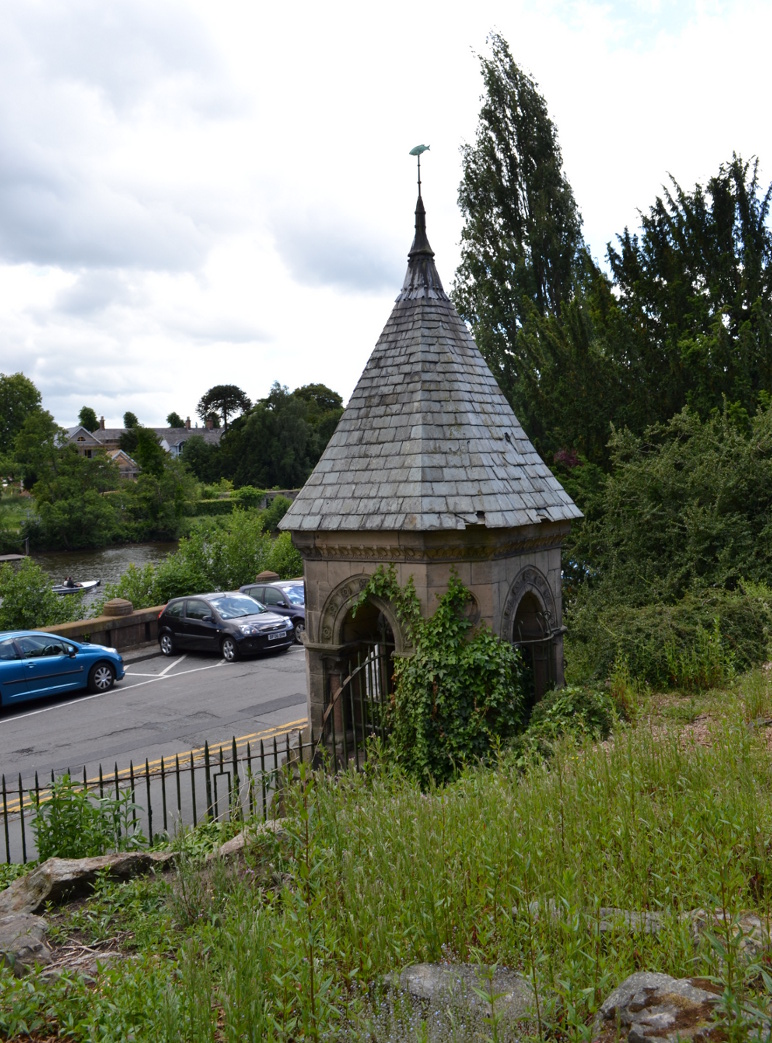
The well is found on the south-east corner edge of Grovesnor Park, which is the south-east of the city beside the River Dee.
Archaeology & History
Billy Hobbys Well, Chester
An early reference to this site is in the place-name of Billy Obbies Field, marked in 1745, with an accompanying spring marked at 1791. This would appear to suggest that the spring gained its name from the field and not vice versa, with the name possibly representing a local person. Yet the name may hide a much earlier origin. The name ‘Hobby’ derives from hobb, a name for a devil or demon – and where the name hobgoblin derives from. It may be possible that the area was a marshy waste and to warn people away a legend of a demon was introduced. More interesting is the idea that as the name ‘Hobb’ is synonymous with Puck, and Puck possibly having a Roman origin, that the site could be a much earlier Pagan site. This might explain the fertility ritual found here (see Folklore, below) if it has a greater age. It may be significant that when the park was developed, a long line of Roman earthenware water pipes were found. Did they draw water from the spring?
Internal Structure
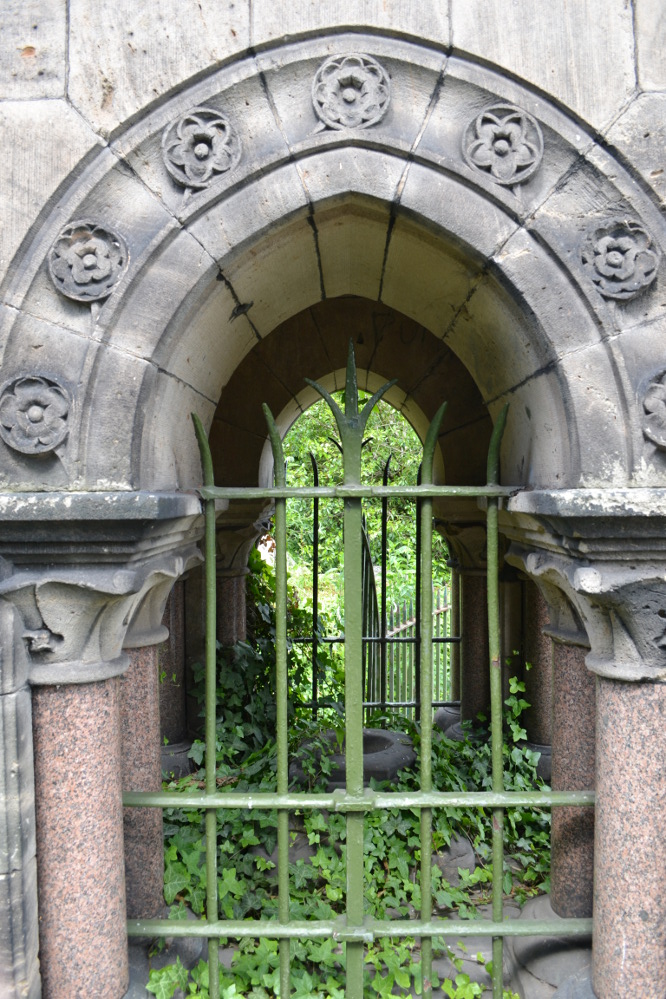
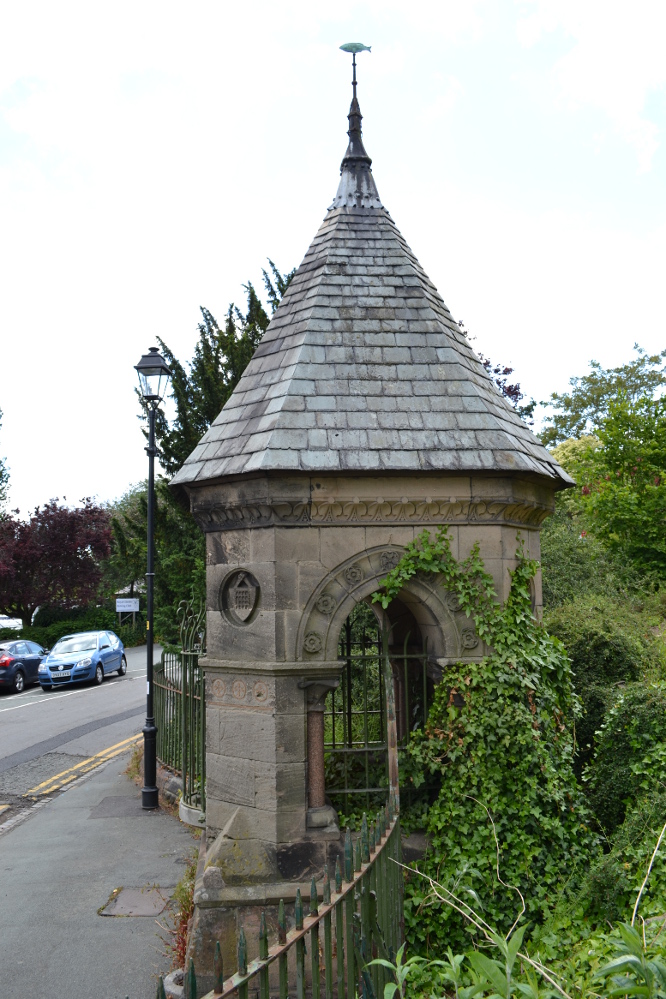
Whatever the origin, when the garden was developed in the 1860s by the 2nd Earl of Westminster, Richard Grosvenor, a rather grand and impressive red and buff sandstone ashlar well house was erected. This was designed by John Douglas, a local Chester architect, who was not forthcoming in making this well grand with canted corners, pointed arches flanked by a granite columns with wrought iron bars. At each corner is a small carved circle containing carved sheafs and portcullis and the voussoirs contain carved roses. A tiled spired roof sits upon the structure with an apex surmounted by a copper fish weathervane. All in all, rather ostentatious for a well – especially as access to the well chamber has not been made very easy by the enclosure. Whether the improvements were done to develop some sort of spa well is unclear, but it is known that the when Canniff Haight (1904) visited for his United Empire, the spring was still flowing and noted, for he records:
“Billy Hobby’s Well,” a spring of excellent water, where we have a drink.”
Folklore
This was a local wishing well. A local anonymous rhyme records:
“I lov’d the tales that idle maids do tell,
Of wonders wrought at Billy Hobby’s Well,
Where love-sick girls with leg immured would stand,
The right leg ’twas – the other on dry land,
With face so simple – stocking in the hand –
Wishing for husbands half a winter’s day.
With ninety times the zeal they used to pray”
This old rhyme despite some pedigree suggested I have been able to date only to 1823. It appears to record a ritual undertaken at the well, a similar ‘one part of the body in, one out’ was done at Walsingham by lovelorn maidens, but it does look to be Victorian in origin there (or at least post Reformation). The only problem with the practice being undertaken then is that the present structure dates from that period.
From the forthcoming work on Holy wells and healing springs of Cheshire
References:
Dodgson, J.M., The Place-Names of Cheshire – Part 5, English Place-Name Society: Cambridge 1981.
Park by the church, which has a Sheela Na Gig and some roman stones. Walk back to the A153 (Ancaster Cross roads), turn left and cross the road. Take the footpath which is on the south side of the A153 and bear right into the nature reserve. The well – a large pool – is on private land, but it can be seen to the right of the entrance to the reserve.
Archaeology & History
This spring was possibly known in Roman and pre-Roman times, as there is a Roman station settlement hereby. Roman credentials have been strengthened since Time Team’s research which found that the site was the focus of a cult. There was an inscribed stone, found in the church and originally part of an archway, which says:
DEO VIRIDIO TRENICO ARCVM FECIT DE SVO DON
Translated to:
‘For the god Viridius, Trenico made this arch, donated from his own funds.”
The Time team archaeologists found a late Roman or early Dark Age burial with a similar inscription ‘DEO VRIDI SANCTO – ‘To the holy god Viridius.” The show thought that the God was associated with agriculture, but with the proximity of the spring nearby, perhaps they missed an obvious connection. It seems very likely that the Romans would have known of the spring as the valley beside it is thought to be a Roman raceway and the town was only a few yards away.
The spring is not mentioned historically; for example Leland (1535-43) notes a chapel and hermitage, but no well:
“The area wher the castelle stoode is large, and the dikes. In the highest ground of the area is now an old chapel dedicate to S. Marie, and there a her(em)ite.”
Lady Well on 1858 map
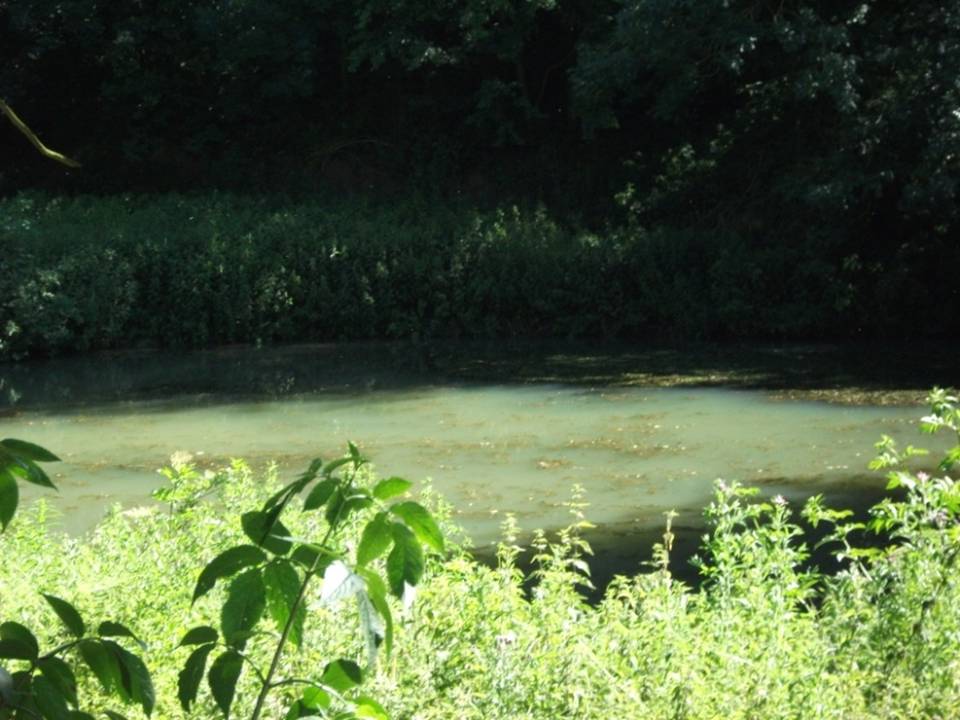
In Victorian times the water was tapped as a source of water for the village and a large cistern and pipe system established. According to Thompson (1999) in his work on Lincolnshire springs and wells, this was later removed and the well had become a boggy area, before finally being restored and clay-lined to be stocked with fish and prevent water loss. Its water now appears to be a light greeny-blue as a result. One cannot directly reach the edge of the water as it is enclosed in fencing but it can clearly be seen from the footpath.
Folklore
No tradition appears recorded regarding it properties. However, it appears likely that this is the spring Rudkin (1936) notes as St. Helen’s Well or Mucky Pool in the legend of Byard’s Leap, the famed story associated with a local witch as the story has association with Ancaster – although this could record another site.
References:
Parish, R. B., (2012) Holy wells and healing springs of Lincolnshire
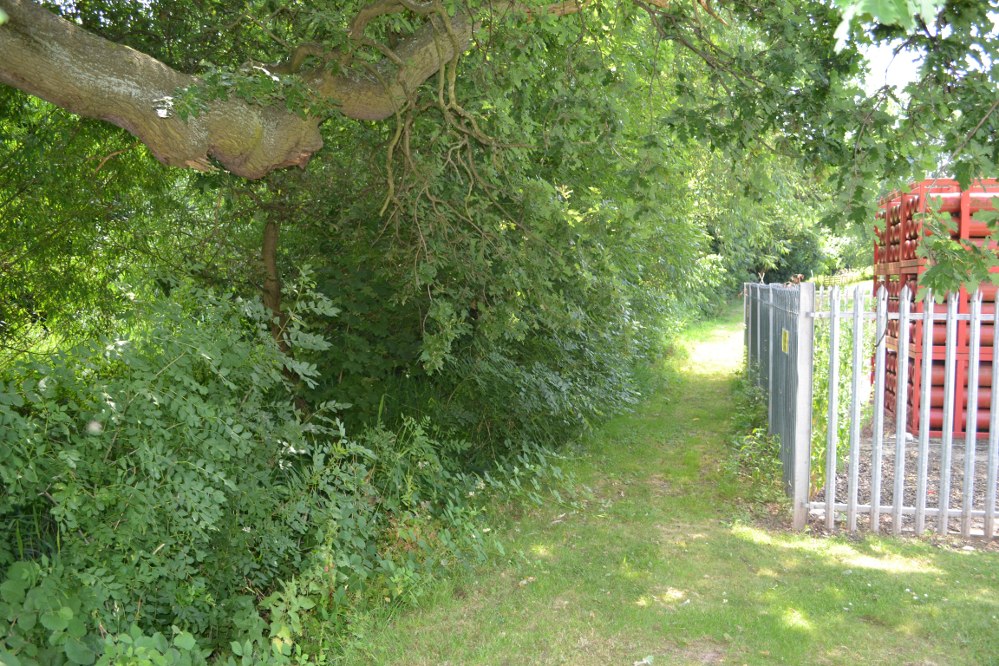
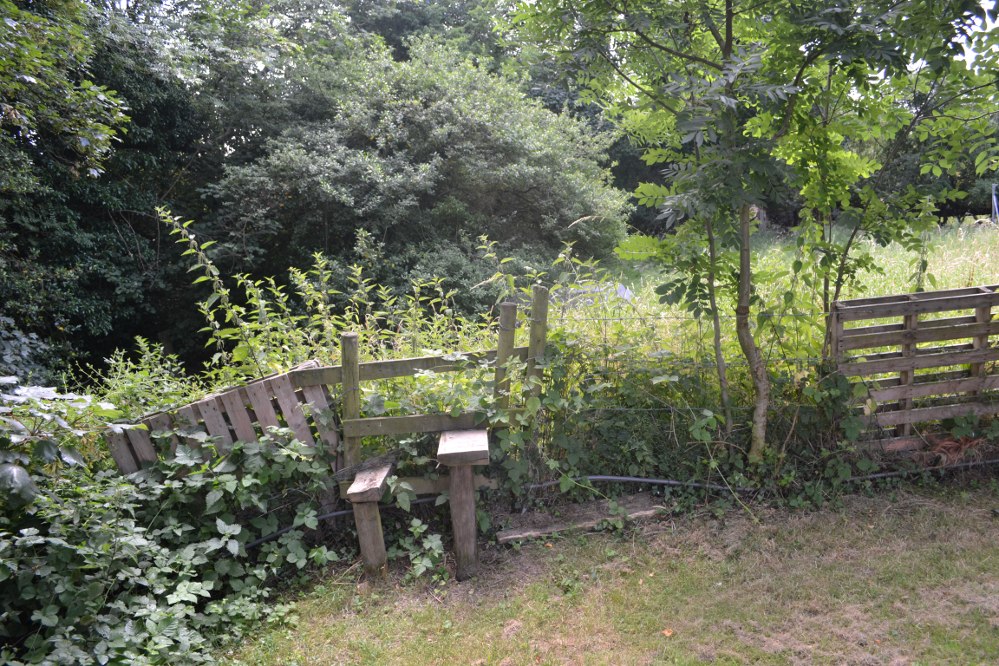
On the outskirts of Loughborough is an area called Holywell, but pronounced ‘holly’. The holy well can be found at the furthest north west part of the park, behind the large Garendon block of the Holywell complex. Here behind some hydrogen cylinders (!) follow the brook on the left until you reach a stile. Climb over this and the well in front of you. It is unclear what the access rights are, but there are no private signs.
Archaeology & History
The stile with the well in the background
Virtually swallowed up by Loughborough University is the estate of Holywell Haw, the present farmhouse taking its name from a spring nearby. Of the house itself: it probably began life as a hostel for those lost in the most substantial Charnwood Forest, which has since retracted around it. However by 1180, it had become a hermitage owned by Garendon Abbey and is then first noted by the name of ‘Holywell Haw’, the latter word deriving from haw meaning enclosure, the same origin as hawthorn. Potter, in his History and Antiquities of Charnwood Forest (1842), notes it was mentioned in a grant by Robert de Jort to the abbey, with the site being described as heremitorium de Halliwellhaga.
Later, the 13th century Testa de Nevill, records ‘a dairy, with a small wood, called Haliwelle Hawe’, which by the 14th century the Leicester Abbey purchased from a Henry Lord Beaumont “a certain parcel of wood called Holy-well Haw for £28.” It was they who appeared to have developed the area to what can be seen today: fishponds and moats, and probably used the site as a grange and possible a diary. What remains today is mainly 15th century, with fragments of a medieval structure such as gothic doorways and timbers. Whether it was Holywell Haw or Hall is unclear. This discrepancy has been blamed on the Ordnance Survey—and indeed, some blunders have been done by them in the past. However, it is possible that a 19th century owner, March Philips, had some sort of pretensions for the building and thought the name was better. By the 18th century, the name Holywell Dyke was an eighteenth-century boundary mark for Charnwood Forest.
The spring is icy cold and never run dry, and produces—according to Bob Trubshaw (1990)—20,000 galloons a day and is one of the only non-incorporated spring in the Severn Trent catchment classed as A1 Drinkable.
The Site Today…
The not-very-interesting looking site today
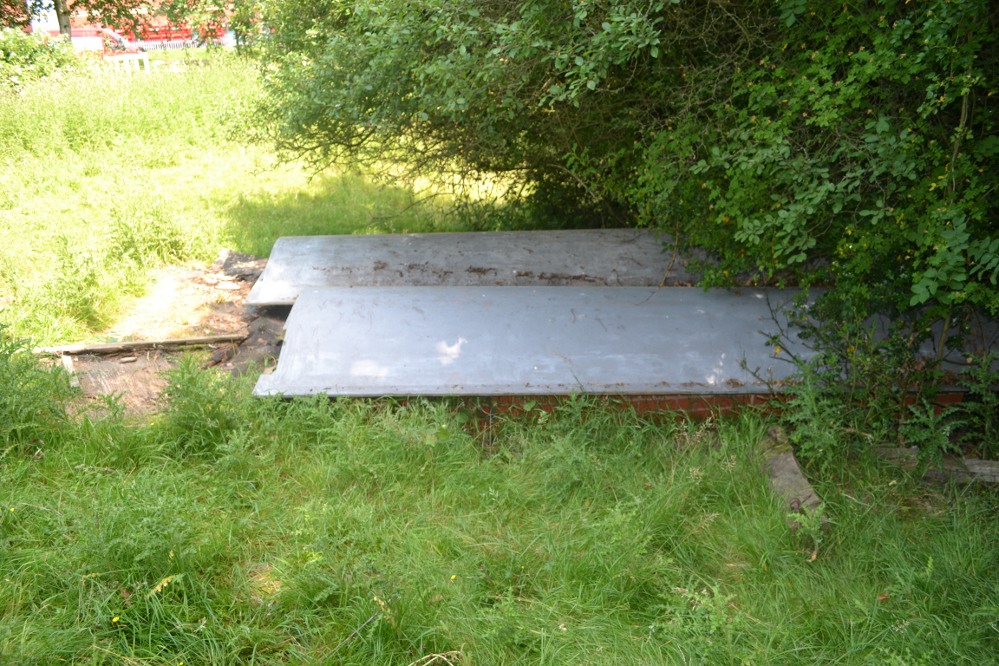
Despite a leaflet mentioning the well from the University (available as a pdf-file), it is a little reticent as regards to whether it can be visited. However, exploring around the back of the enormous Holywell complex, a small path passes some gas cylinders and then to a stile. No keep out signs are present so I assumed it was okay to jump over. There almost in front of me is a large brick chamber covered by two large fibre glass up turned boats. These appear to cover the well.
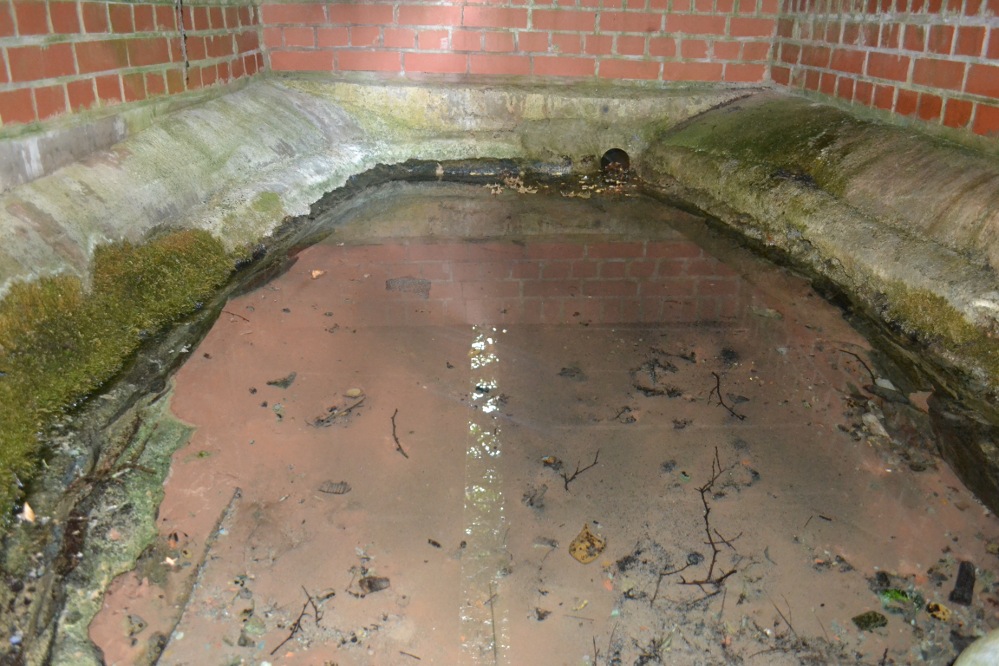
Within, with natural rock & medieval stonework?
Peering between a gap however, this rather unpromising edifice reveals something more interesting. The brick chamber encloses an elliptical natural stone or possibly medieval basin, into which a copious flow enters and fills and then flows through a pipe into the brook below. Despite the rather ugly surrounds there is still something ancient and mysterious about this most well-known of Leicestershire sacred springs. The local farm, the Holywell Haw, still apparently uses the water and it is regularly checked by the University authorities. One hopes it can get a better cover. Surely the university could afford a metal grid more worthy of this venerable site.
Folklore
Local tradition states that it has medicinal qualities. Nichols (1795–1815) notes:
“The excellent spring is yet preserved.”
Potter (1852) notes that it:
“derives part of its name from a well, to the waters of which, even in recent times, considerable virtues have been attributed.”
However, its most famous legend is said to date from the 15th century. Potter (1852) notes that:
“The popular idea seems to be, that the Comyns (of Whitwick Castle) were great giants. One of them, said my informant, attempted to carry off one of the Ladies of Groby Castle, who left that place for security, intending to take sanctuary at Grace Dieu. Going, however, by a circuitous route, to avoid Charley and Whitwick, she was benighted, and would have perished in the Outwoods, but for one of the Monks of the Holy Well.”
The overflow runs into a delightful brook
The legend tells how after a considerable pursuit, she upon reaching the hermitage, collapsed and died. A monk then used the water to bring her back to life. Potter (1942) tells the story in verse:
“The oaks of the forest were Autumn-tinged,
And the winds were at sport with their leaves
When a maiden traversed the rugged rocks
That frown over WOODHOUSE EAVES.
The rain fell fast – she heeded it not
Though no hut or home appears;
She scarcely knew if the falling drops
Were rain drops or her tears.
Onward she hied through the OUTWOODS dark
(And the Outwoods were darker then)
She feared not the Forest’s deepening gloom She feared unholy men.
Lord Comyn’s scouts were in close pursuit,
For Lord Comyn the Maid had seen,
And had marked her mother’s only child
For his paramour, I ween.
A whistle, a whoop from the BUYK HYLLS side,
Told Agnes her foes were nigh:
And screened by the cleft of an aged oak,
She heard quick steps pass by.
Dark and dread fell that autumn night:
The wind-gusts fitful blew:
The thunder rattled: – the lightning’s glare
Showed BEACON’s crags to view.
The thunder neared – the lightning played
Around the sheltering oak;
But Agnes, of men, not God afraid,
Shrank not at the lightning’s stroke!
The thunder passed – the silvery moon
Burst forth from her cave of cloud,
And showed in the glen “Red Comyn’s” men,
And she breathed a prayer aloud:-
“Maiden mother of God! Look down
List to a maidens prayer:
Keep undefiled my mother’s sole child
The spotless are thy care”
The sun had not glinted on BEACON HILL
Ere the Hermit of the HOLY WELL
Went forth to pray, as his wont each day,
At the cross in Fayre-Oke dell.
Ten steps had he gone from the green grassy mound
Still hemming the HOLY WELL HAW,
When, stretched on the grass – by the path he must pass
A statue-like form he saw!
He crossed himself once, he crossed himself twice,
And he knelt by the corse in prayer:
“Jesu Maria! cold as ice –
Cold – cold – but still how fair!”
The Hermit upraised the stiffened form,
And he bore to the HOLY WELL:
Three Paters or more he muttered o’er,
And he filled his scallop shell.
He sprinkled the lymph on the Maiden’s face,
And he knelt and he prayed by her side
Not a minute’s space had he gazed on her face
Ere signs of life he spied…..
Spring had invested the CHARNWOOD oaks
With their robe of glistening green,
When on palfreys borne, one smiling morn,
At the HOLY WELL’s HAW were seen.
A youth and a Lady, passing fair,
Who asked for the scallop shell:
A sparkling draught each freely quaffed,
And they blessed the HOLY WELL.
They blessed that Well, and they fervently blessed
The Holy Hermit too;
To that and to him they filled to the brim
The scallop, and drank anew.
“Thanks, Father! Thanks! – To this well and thee,”
Said the youth, “But to Heaven most,
I owe the life of the fairest wife
That CHARNWOOD’s bounds can boast.
“The blushing bride thou seest at my side.
(Three hours ago made mine)
Is she who from death was restored to breath
By Heaven’s own hand and thine”.
“The Prior of ULVERSCROFT made us one,
And we hastened here to tell
How much we owe to kind Heaven and thee,
For the gift of the HOLY WELL”.
“In proof of which – to the HOLYWELL HAW
I give as a votive gift,
From year to year three fallow deer,
And the right of the Challenge drift”.
“I give, besides, of land two hides,
To be marked from the Breedon Brand:
To be held while men draw from the Well in this Haw
A draught with the hollow hand”.
The Hermit knelt, and the Hermit rose,
And breathed “Benedicite!
And tell me”, he said, with a hand on each head,
“What heaven sent pair I see!”
“This is the lost de Ferrers’ child,
Who dwelt at the Steward’s Hay;
And, father, my name – yet unknown to fame
Is simply EDWARD GREY”.
It is thought that after being revived she gave her name to God and became a prioress and some historians link it to a real life account of Eleanor Ferrars whose was carried off. It also has similarity to legends associated with Essex’s Running Well and Kent’s St. Thomas’s well at Singlewell.
References:
Hope, R. C, 1893, Legendary Lore of the Holy Wells of England, London: Elliot Stock.
Nichols, J.,1795-1810, History and Antiquities of the County of Leicester, London: Nichols
Potter, C.1985, ‘The holy wells of Leicestershire and Rutland’, in Source, 1st series, 1:15–17.
Potter, T. R 1852, History and antiquities of Charnwood Forest
Rattue, J., 1993, ‘An inventory of ancient, holy and healing wells in Leicestershire’, Tr. of the Leicestershire Arch. & Hist. Soc. 67: 59–69. Richardson, L. R., 1931, Wells and Springs of Leicestershire, Memoirs of the Geological Survey.
Trubshaw, B., 1990, Holy Wells and Springs of Leicestershire and Rutland, Heart of Albion, Wymeswold.
Follow the road around from Headon village to the Ladywell estate and on the left hand side is a small copse and footpath. It is near the junction of Greenspotts Lane and Lady Well Lane. Park carefully near here and walk down the small ravine to the well.
History & Archaeology
Close-up of the well
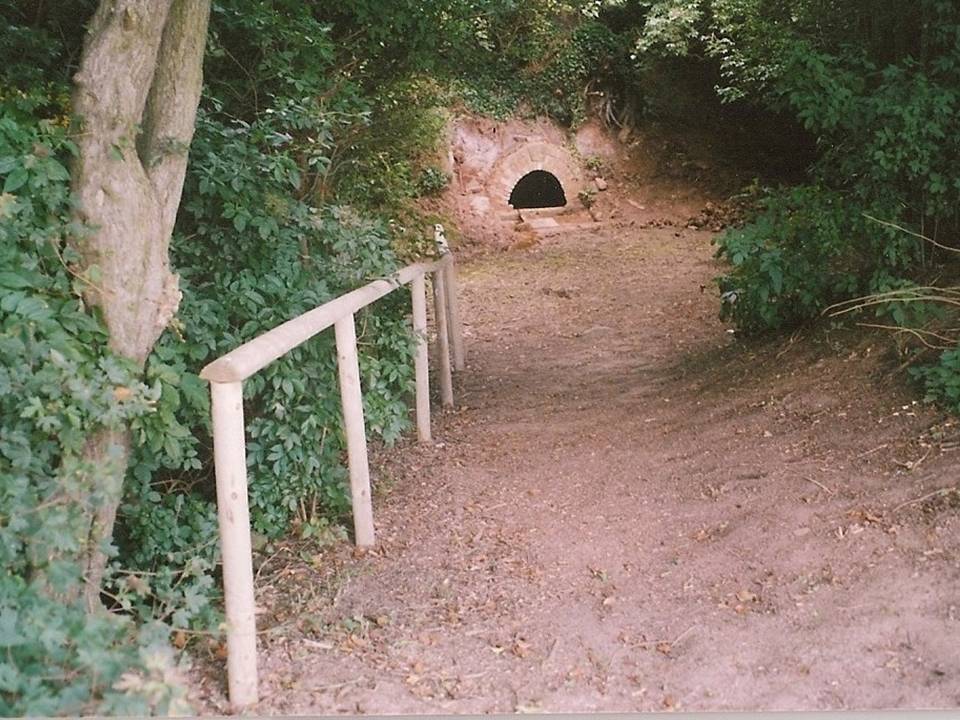
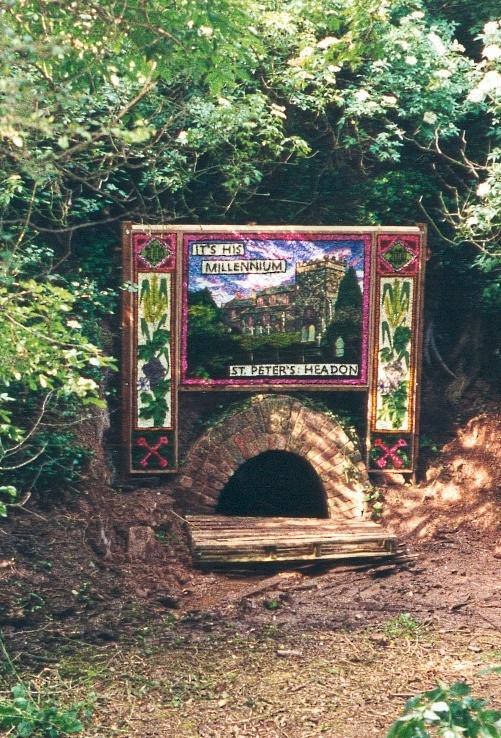
Only two dates can be confirmed of this site. One a reference in County records of mending a bridge to a ‘Ladyewell‘ in the nearby Markham parish, but this could easily be another site. A better date is that 1718 which is carved on its arch. It was used as a source of water until the 1930s. One of the most atmospheric and pleasantly situated sites, the spring is located in a small wooded dell and arises from the rock in a small alcove or cave. This is fronted by a red brick arch, and the water fills a trough set partly into the ground with a small overflow lip and a channel to fill it, presumably this was for animals. On the key stone of the arch are the initials ‘HW’ and a date which possibly reads 1718.
Dressed for 2000AD
Folklore
I have found no traditions of healing or other folk belief. However, the site was one of the few Nottinghamshire well dressing sites. This began in 1981 and continued until 1991, and there was a one-off occurred in 2000 AD. It was done on the weekend of the churches Patronal festival—St. Peter’s—and was used to use to pay for the church repairs. The well dressing boards were of a Derbyshire tradition, as can be seen here to the right.
Often noted under Lower Burnham, although this is a hamlet and not strictly the parish, is in Haxey. The spring can be found by taking the footpath after Starkey’s farm, top of Holy Well lane, with Holy Well House the nearest dwelling.
Archaeology & History
Holy Well, Haxey
Potentially if Hunt (1923) quoted in Hills (1967) is to be believed, this is the most famed holy well in the county, as he believes that this was the site where King Oswald—later St Oswald—was slain and here the well was St Oswald’s Well rather than at Oswestry. He notes that:
“The Holy Well at Lower Burnham in the parish of Haxey is supposed to mark the site where King Oswald fell. People took away the soil until a deep hole was formed which filled with water…It has been known for 1300 years as the Holy Well, and annual feasts were held near it until recent years. This confirms the Ven. Bede’s statement about the sanctity of the soil in the eyes of the people.”
According to Garner (1991) by the early 19th century the well’s popularity had waned and the spring fell into private ownership and the water was used to run two water mills, and as such a gully of considerable depth constructed. However the spring did not produce enough continuous water and the scheme failed. A similar attempt was made by Rev. Thomas Skipworth Rector of Belton was more successful but only because a dam was constructed although still the power was not great enough. Interest in the well had not completely disappeared, and an announcement in 1875, in the Epworth Bells stated:
“Firmly believing in the efficacy of the Burnham water in the cure of some outward bodily complaints, we sometime since urged the importance of making that water once more available to the public, and at the same time we urged the desirability of the public availing themselves of the water.”
Responding to this plea, a group of local men, Cooper, Starkey, Ducker, Skelton, Meggitt and Templerton came together to ‘re-open the well’ It had been for years only a dry, roughly rectangular, hollow but ‘within minutes of digging, water gushed out, and the hollow filled.’ No evidence of constructional material was seen but the landowner, Mr. Lockwood, agreed to allow the well to be kept open and the water to be freely available when he did not have cattle in the field, as such the well was fenced in probably as local people reported in the Crowle Advertiser (1960) with white railings. Indeed, up until the 1940s the well remained fenced off with barbed wire as a cattle water place and at some point it was filled in.
This meant that the well had again fallen into disused and its exact location was perhaps becoming unclear, when in the 1960s when three Epworth men, Frank and David Lindley with Jack Warriner. A report in the Crowle Advertiser of 1960 noted that:
“At a spit depth, what seem to be known locally as water stones began to be turned up; at about two feet six there was a promising slab, followed by another, at a little deeper level; and after discovery of several hand-made bricks had dispirited the diggers somewhat, three more irregular shaped stones of considerable size were scraped clean of the mud that overlaid them. By now there was bared to view what could have been the stepped entrance to the well which from visual testimony of old residents, the explorers hoped to find.”
This stepped entrance consisted of eight steps according to local people. The group then discovered at about four feet timber was found and on this two corner stones were found rested. This was thought to have been the remains of the enclosure which went around the well.
In March 1961 another attempt was made to open the well in view of a pilgrimage by the Lincoln Diocesan Youth Pilgrimage, this time the excavators had gone twice as deep and the strata of waterstone was hit, but no evidence of a constructed well. This was not a concern of the Vicar of Owston Ferry, Canon L. D. Ravins who was of the opinion that an actual construction would have been unlikely if the above description by Hunt was to have happened. This time according to the Crowle Advertiser:
“Both he and Canon Ravins feel that the water may well have medicinal qualities (they noticed they say an unmistakably sulphurous smell from it during the excavations) and they are intending to have the chemical analysis made.”
However, the analysis did not reveal any sulphur but it did have Magnesium and Calcium sulphates and Calcium bicarbonate all linked to spa waters and hence verifying its medicinal role. The well was visited by the pilgrimage and Garner (1991) recollects that a white timber enclosure was placed around the site with a sign proclaiming ‘The Holy Well’ according to him the ‘whole site now barely discernible save for a lone willow sentinel-like over the place revered by myriad generations in days long since past.’
However, this was not the case when I visited the site and found a large pool with a pipe at one end, from which a channel appeared to flow. Although Garner (1991) noted a ‘few elder citizens of Burnham strongly favour its position a few metres south of the spot popularly referred to”.
Folklore
However this name has not been recorded and the site is best known simply as the holy well. This site was, according to Gutch & Peacock (1908),
“ …dedicated to the ever-blessed Redeemer, and on the festival of His Ascension was supposed to possess the power of healing all sorts of deformities, weaknesses, and cutaneous diseases in children, numbers of which were brought from all parts to be dipped in it on that day.”
The earliest mention appears to be Peck (1809) who stated:
“a Spring called the Alley Well of very cold water which was very much resorted to by the people in their neighbourhood, being very proper for those of a weakly habit.”
Stonehouse (1839) notes:
“about one hundred and twenty years ago, the concourse of visitors was so great that a Village Feast was held at the same time… and at a much later period conveniences were annually made for the use of the bathers, and gingerbread-stalls and other slight reflections were provided on the spot. This practice has, however, of late years fallen altogether into disuse… The spring now appears in a dirty and neglected state.”
The fame of the spring led to it being immortalised in Hamilton’s novel Captain John Lister where the titular hero watches during the early morning of Haxey Fair, a melancholy procession through the main street of women, accompanied by diseased and deformed children. In the book, the innkeeper explains by saying:
‘They are going to the Holy Well at Nether Burnham. ‘Tis a famous spring, and has been many ages, and on this day there is virtue in the water to cure almost any disease or sickness in a child, if be dipped before noon…out of Nottinghamshire and Yorkshire and I don’t know where all.’
(Essay taken from R.B. Parish Holy Wells and healing springs of Lincolnshire)
References:
Garner, J. R. (1991) Burnham – the story of an Axholme village.
Gutch, E. & Peacock, M. (1908) Country Folklore Vol. VI: Folklore of Lincolnshire
Hills, P.J. (1967) The Holy Well of Burnham the site of the Battle of Maserfield-the identification re-examined.
Stonehouse, W.B. (1839), The History and Topography of the Isle of Axholme.
Various anonymous cuttings from Crowle Advertiser (1960)