Shorey Well, Burnley, Lancashire

Healing Well:  OS Grid Reference – SD 844 330

Also Known as:

  1. St. Audry’s Well
  2. Whitaker’s Well
  3. Whittaker’s Well

Archaeology & History
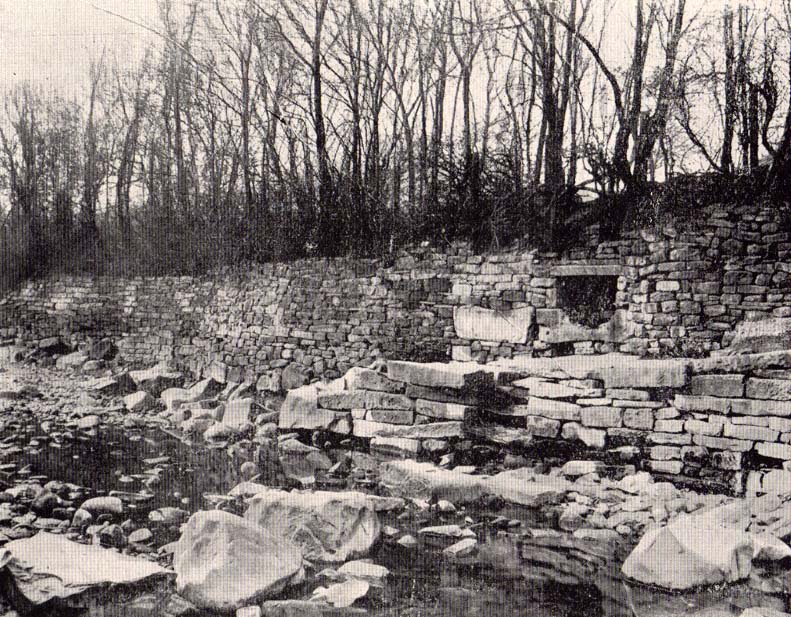
Shorey Well, Burnley (T.Ormerod, 1906)

Recently a good turn of fortune has brought about the discovery of a number of previously unpublished manuscripts detailing a number of prehistoric remains, holy wells and old stone crosses that existed in and around east Lancashire, Burnley, Cliviger and Todmorden.  Many of these papers are the all-but-lost writings of historian and antiquarian Clifford Byrne of Nelson.  Having never previously been published, I think his works deserve greater attention and so I’ll be slowly, gradually, sticking them on the internet and give them the wider audience they deserve.  Not all of his notions are necessarily accurate, but the extent of this mans local history knowledge on the sites he describes in his essays is considerable.  The following is his short essay—with minimal editing—on this all-but-forgotten site:

“Shorey Well, or rather its stone housing, was originally situated in the bank of the River Brun slightly upstream of the parish church at Burnley, at a spot now within the grounds of the Burnley Technical College.  From within the stone housing issued the spring proper, which then ran down the brookside into the river.

“From time immemorial until the late 19th century, Shorey Well supplied part of the town of Burnley with its drinking water, then the water was impounded into a pipe and the stone housing removed to a place of safety.  This housing was thought by our Victorian forebears to have sufficient merit to save it for posterity, and this act I feel implies more than a certain interest in the old stones which I suggest the movers of the Well probably did not themselves fully understand, and it is with this concept that I hope now to deal.

“The present location of the stones of Shorey Well is in the little triangle of greenery outside Prestige Ltd at Burnley.  This spot is bounded on Colne Road and Bank Parade.  Behind it squats the base of Burnley Market Cross and the remains of the stocks with — a little to one side — the shaft of the Godley Lane Cross standing out of a huge square pedestal.

“An old map in Burnley Library shows Shorey Well in situ with a well-defined row of stepping stones crossing the river directly in front.  This line of stones went to the site of a still existing property called Shorey Fold — a spot that was probably once called St. Audry’s Fold, as we shall see.

“Godly Lane Cross is an Anglo-Saxon monolith with a somewhat damaged head.  This damage was probably done around the time of the Reformation in the 16th century, when the anti-Catholic movement was at its height.  The name Godly implies a god-like, or god-inspired or religious tone to the area, and Godly Lane — now Ormerod Road — certainly lived up to its name for there stood the parish church, the Cross itself, the Market Cross, another cross dedicated to a priest in the 16th century and now standing in the rear of Townley Hall, “Foldy’s Cross”, with nearby Shorey Well.

“There is a strong possibility that the Godly Lane Cross — sometimes called the Paulinus Cross — was a preaching cross and that it also marked the way to Shorey Well which issued close by.

“No one to the knowledge of the writer has attempted to explain the name Shorey Well.  I therefore suggest that the Well was used for baptism and that it was dedicated to St. Audry.  The parish church was erected prior to the Reformation and thus certainly had its Holy Well close by, from which the priests obtained water for baptism and blessings, etc.  Because of its propitious nature and close proximity to the church, such a Well would almost certainly have been the Shorey Spring.

“A study of the name may be fruitful.  Holy wells are almost always dedicated to some christian saint.  However, many of them have undergone a slight change in name over the centuries, so that it is not always easy to recognise the dedication.  For instance, the Ransible Well near Colne was dedicated to Our Lady of Ransome, or the Virgin Mary; Stellern Well was dedicated to St. Helen; Maudlin Well near Lathom House was dedicated to St. Mary Magdalen; Pewter Well at Sabden  would be St. Peter’s Well; Mattus Well at Sawley Abbey is St. Matthew’s Well; whilst Cooks Well at Colne was surely dedicated to St. Luke the physician.  Thus Shorey Well in the same context is almost certainly dedicated to St. Audry, and this saint we find was one of the most revered saints in Anglo-Saxon times, from which date the Godly Lane Cross stems.

“The close proximity of church, well and cross surely imply that one showed the way to the other, and that all three were at one period of time one unit: the Cross being a preaching place prior to the Church, and the holy well being a place of baptism and healing.”

Mr Byrne’s etymological reasoning may or may not be right here (Mr Ekwall says nothing in his place-name survey and I’m unaware of local dialect analysis that may account for the word), but the description of this and numerous other lost and forgotten sites in his various papers is hugely worthwhile and is a source of considerable study for us over the coming months.

Ormerod (1906) described the site in his tome, but even in his day this once great well with its “abundance of sparkling water” was “disused and neglected.” (the image above is taken from his work) However, as if to dispel any notions of an earlier saintly dedication, we find that in Walter Bennett’s (1948) magnum opus, the site had a more prosaic title in bygone years:

“Whittaker’s Well, or Shorey Well as it was later known, was situated on the riverbank opposite Dawson Square, and was apparently the only public source of drinking water for the inhabitants of tge Top o’ th’ Town.”

References:

  1. Bennett, Walter, The History of Burnley – volume 3, Burnley Corporation 1948.
  2. Byrne, Clifford H., “A Short Study of Shorey Well, Burnley,” unpublished manuscript 1976.
  3. Ormerod, T., Calderdale, Lupton Bros: Burnley 1906.

© Paul Bennett, The Northern Antiquarian 


Cliviger Law, Mereclough, Burnley, Lancashire

Cairn (destroyed):  OS Grid Reference – SD 872 302

Also Known as:

  1. Law House

Archaeology & History

In days of olde this once proud tomb stood upright on the slopes below the more prominent Cliviger Laithe tumulus above.  But, like many of the ancient ancestral tombs of this region,  its days seem long gone.  Although we’ve found what may be some traces of the outline of the cairn (further analysis required!), when the legendary Lancashire historian Thomas Dunham Whitaker (1872) wrote about the place, he was already writing about it in the past tense.  He said briefly, that “this heap of stones was removed as materials for building a turnpike road” in 1763.  The archaeologist Bernard Barnes (1982) told us that “a cist with an inhumation was found. In 1766 another tumulus was removed and an urn found. An axe-hammer is said to have been associated” here.  The most lengthy description of this site can be found in Mr Booth’s (1899) short work where, in his summary of various prehistoric sites in this region, he told that,

“The first find recorded in this locality took place at Law House, near Mereclough, in the year 1763, when a mound was opened which covered a kistvaen, or stone cist, which, upon being opened, was found to contain a human skeleton.  The information concerning this ancient burial is very meagre, and we have no information as to who were the discoverers of the mound.  It may be noted that nearly 70 years before (in 1695) a number of Roman coins were found close to this barrow.  The mound also contained a rude earthware vase filled with calcined bones.”

It’s unlikely that the earthworks by the walling hereby represent the denuded remnants of the monument in question, although the rise in the field here may be some remnant of the place, but without further excavation we might never know for sure. However, the recent discovery of what may be remnants of the cairn in an adjacent field requires further analysis.  WATCH THIS SPACE – as they say!

References:

  1. Barnes, B., Man and the Changing Landscape, University of Liverpool 1982.
  2. Bennett, Walter, History of Burnley, volume 1, Burnley 1946.
  3. Booth, Thomas, Ancient Grave Mounds on the Slopes of the Pennine Range, R. Chambers: Todmorden 1899.
  4. Whitaker, T.D., History of the Original Parish of Whalley, London 1872.

© Paul Bennett, The Northern Antiquarian

Annot Cross, Brierfield, Lancashire

Cross (destroyed):  OS Grid Reference – c. SD 881 353

Archaeology & History

Not included in the magnum opus of Henry Taylor (1906), the exact position of this long lost site remains unknown, as even the investigative abilities of Clifford Byrne couldn’t track it down!  It was erected in a region full of pre-christian remains and (at the time) living remnants of heathen folklore and practices between Worsthorne and Nelson.  Mr Byrne (1974) described his search for the place, saying:

“This cross is of ancient origin and no part of it now remains as far as can be ascertained by investigation, although the memory of it certainly remains, for an elderly gentleman living in the cottages of Holt Hill, Briercliffe, said instantly on being asked about he cross that he had often heard it referred to by older people when he was a boy, although he could not say exactly where in the hamlet the monolith had stood.  We are told that the cross is mentioned in a document in the year 1313 when Robert Briercliffe granted away the Sene intacks in the Holt Hill as it lay by Annot Cross on the south side.  This implies that it stood on the south side of the road (between) Thursden and Haggate, which is an old road from Burnley to Halifax…”

This would give a rough grid reference for its position around SD 881 353, but nothing appears to be there.  However, Byrne told of another intriguing bitta folklore a short distance away which may have had some relevance to the positioning of the cross.

“Down the road to Lane Bottoms, behind some bungalows, is a stone shaft in a depression in a meadow which we are told is an ancient standing stone.  Whether this is so is not easy to ascertain for the stone has apparently been used as a gatepost at some time, and further gives indication of having been utilised as a cattle rubbing post.”

Below here we find the old place-name ‘Burwains,’ which clearly indicate a site of a prehistoric burial, though nothing remains of such a place — officially at least.  Perhaps a couple of ventures in and around this area need to be done!  One final note that Byrne made related to the title of this lost cross, saying:

“The name “Annot” may be of Saxon origin, for the Saxon word annet means solitude, and this would have certainly fitted the area in ages past.”

References:

  1. Byrne, Clifford, A Survey of the Ancient Wayside Crosses in North-East Lancashire, unpublished report 1974.
  2. Taylor, Henry, The Ancient Crosses and Holy Wells of Lancashire, Sherratt & Hughes: Manchester 1906.

© Paul Bennett, The Northern Antiquarian


Ring Stones, Worsthorne, Lancashire

‘Stone Circle’:  OS Grid Reference – SD 886 330

Also Known as:

  1. Ringstones

Getting Here

Ring Stones plan (after Bennett 1946)

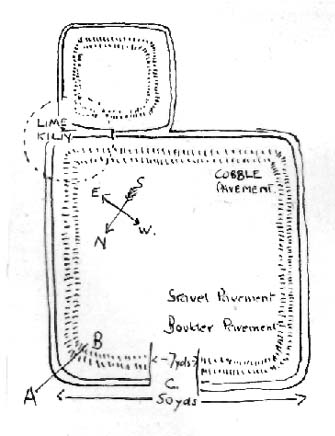
Various ways to get here. From Worsthorne village, go east, up past the church, uphill following the dead straight path.  After about 600 yards there’s a crossing in the footpath: go left here and walk another coupla hundred yards, over 2 walls, and after you’ve past the second wall you’ll notice the earthworks in the ground to your right.  That’s it!

Archaeology & History

There’s nowt much to see here to be honest.  It was included in Walter Bennett’s (1946) survey of ROMAN remains (oh dear) in the region — and his archaeological description of this place certainly seems to imply it was those doods (the Romans) who built this structure and not our neolithic ancestors.  He wrote:

“Ringstones is a rectangular enclosure 50 yards square, surrounded by a mound or rampart 2 yards wide and one yard high, and an outer ditch two yards wide. Sepereated from the main enclosure by the ditch on the southeast side is another enclosure 18 yards square. Excavations made in 1925 gave the following information: a gateway, seven yards wide, was paved with boulder stones regularly laid on a gravel foundation, and on the south side of the gateway flat stones were sunk below the general floor level to act as a drain; a regular course of large stones flanked the gateway entrance on either side, and a foundation or irregular boulder stones was laid outside the gateway between the rampart and the ditch: inside the enclosure and 9 inches below the present grass surface., a floor had been made of gravel in some places and of flat stones or cobbles in others; the rampart was of earth and stones; a well-constructed road, 7 feet wide, ran from the earthwork in the direction of Bottin Farm, wich is situated on the Worsthorne-Roggerham road.”

There used to be a rough circle of stones on top of the site (probably giving the place its name), but these were apparently from the old remains of a lime-kiln from the 16th or 17th century — not prehistory.  There is, therefore, a case that this site may not be prehistoric as archaeologists have classed it — and if the ground-plan above is anything to go by, you’d have to say it looks less than promising.  More diggings are needed!

References:

  1. Abraham, John Harris, Hidden Prehistory around the North West, Kindle 2012.
  2. Bennett, Walter, History of Burnley – volume 1, Burnley Corporation 1946.

© Paul Bennett, The Northern Antiquarian


Hameldon Pasture, Worsthorne, Lancashire

Cup-Marked Stone:  OS Grid Reference – SD 891 327

Archaeology & History

Hameldon Pasture cup-marked stone

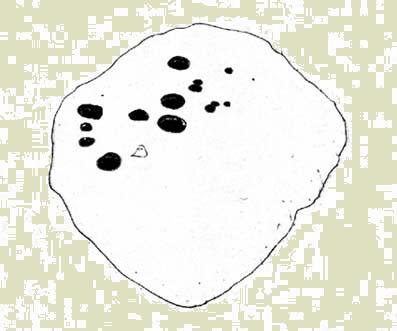
In the vicinity of the denuded ring-cairn and old tumulus of Wortshorne Hill, the Calderdale historian Mr J.A. Heginbottom (1979) described finding this simple cup-marked rock, a hundred yards or so northwest of the old circle. In my ambles here I was unable to locate it. The stone may have been reburied or destroyed.  Prehistoric cup-marked carvings are (officially at least) rare things in Lancashire – and usually where you find one, others lurk close by.  Do any local folk out there know anything more about this site?

References:

  1. Heginbottom, J.A., The Prehistoric Rock Art of Upper Calderdale and the Surrounding Area, YAS: Leeds 1979.

© Paul Bennett, The Northern Antiquarian