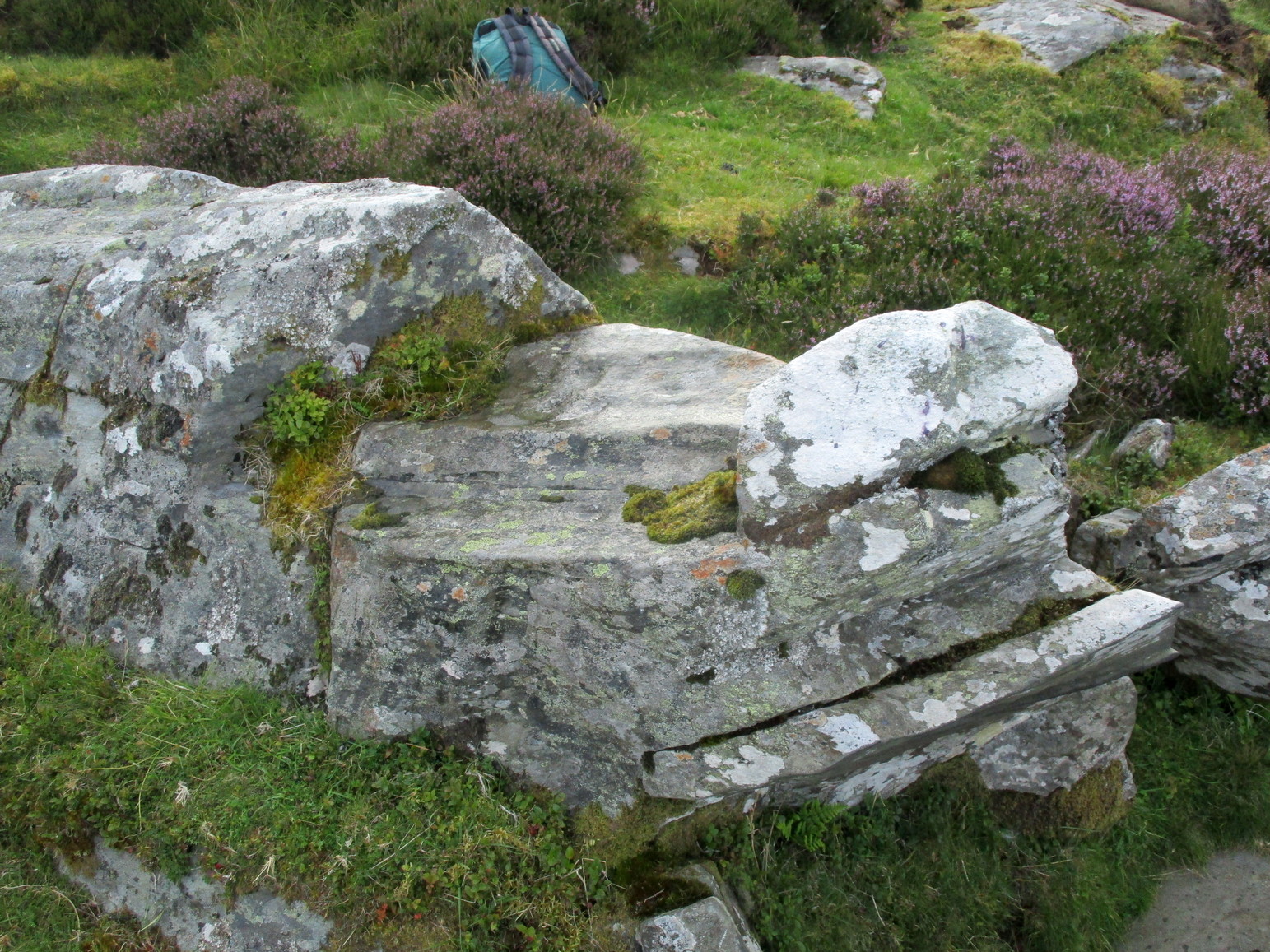
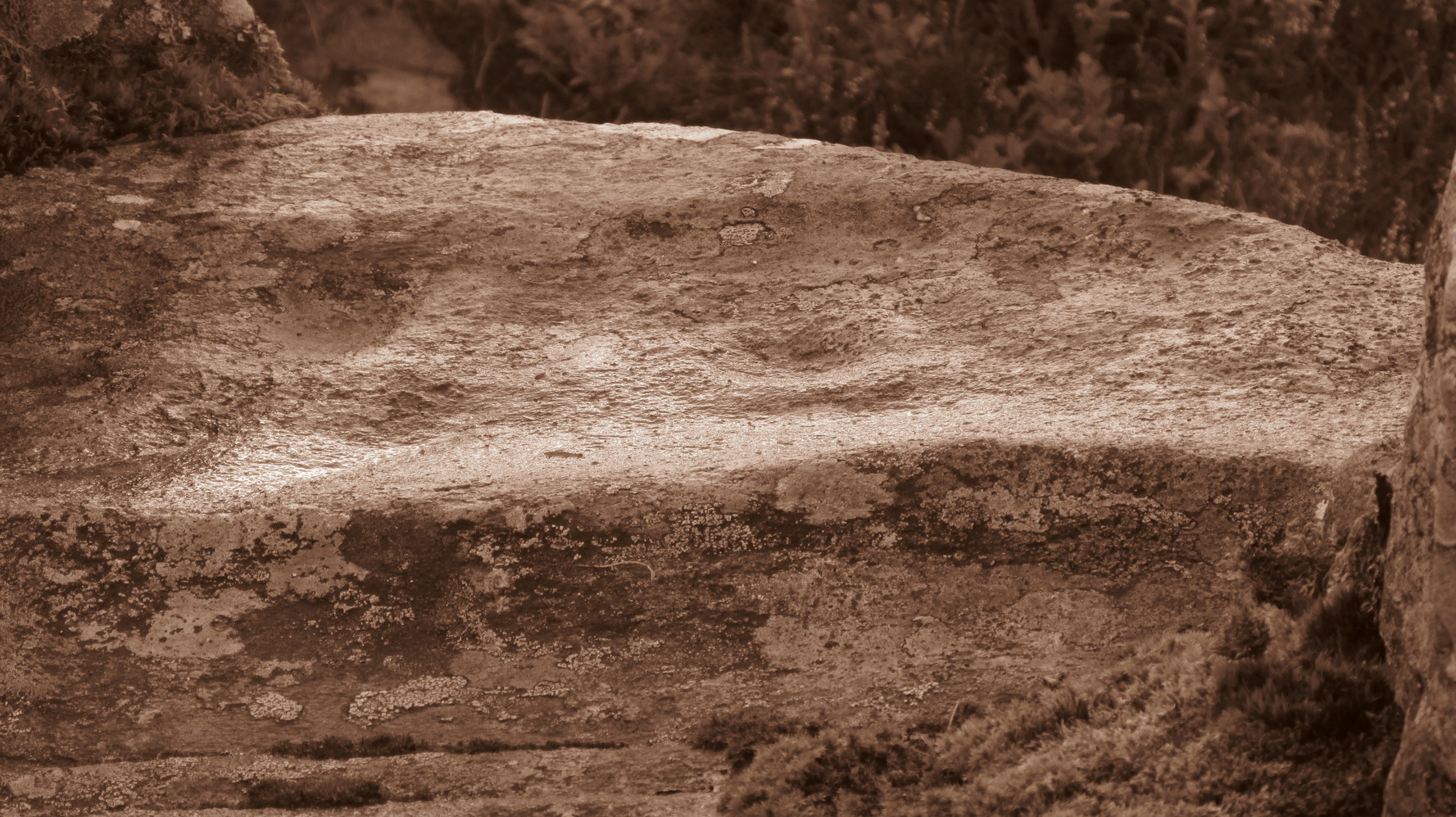
Clach Mhor, Aberfeldy, Perthshire

Cup-Marked Stone (destroyed):  OS Grid Reference – NN 8575 4901

Also Known as:

  1. Clachmore

Archaeology & History

The Clach Mhor, or the Big Stone, is all but forgotten as an antiquarian relic in Aberfeldy.  It’s history is somewhat piecemeal.  First described in Hugh MacMillan (1884)’s essay on local cup-and-ring stones, he told that:

“A short distance above the village of Aberfeldy, where General Wade’s old road emerges from the houses, a huge stone, called the Clach Mhor, lies on the left-hand side in a slanting position half  erect, as if supported by the garden wall of which it forms a part. …In all likelihood it originally stood erect, and formed one of a group of similar stones, its companions having been broken up in the formation of the road. …On the upper face there are some small cup-markings, not quite so well formed as usual, owing to the hardness of the material… The fact that they occur on only one side of the stone, and are scattered indiscriminately all over its surface, are sufficient to convince any one who is skilled in the subject that they are genuine specimens of prehistoric sculpture.”

Nearly thirty years after this initial description, MacMillan (1901) found that it had previously been a part of The Tullich stone circle, and following its destruction the Clach Mhor was moved and used as “part of a garden wall on the old military road passing along its base.”

More than fifty years later, the Aberfeldy historian N.D. Mackay (1954) told that up to 1910 the Clach Mhor was a conspicuous object, standing “as it were overlooking and to some extent overhanging the roadway down near the Square.” However, it

“was blasted and broken up in 1910 in the course of road widening operations, but a considable part of it was built into, and still forms the lower corner of, the garden boundary wall, nearest The Square, of the house which bears its name, ‘Clachmhor’.  Its present position is slightly east of the site it occupied when I first knew it and, unless Wade’s men did actually move it, the site it occupied for centuries.”

Mackay also mentioned what he called the “indentations” on the stone which MacMillam deemed as cup-marks, but he pointed out that one Rev. John MacLean “believed they were made by the levers, jacks, etc, of (General) Wade’s men” when they cut the road into Aberfeldy in the 18th century, whilst

“A third solution was given by the son of a one-time local strong man called Big Robert, “What a strong man my father was,” he said, “he lifted that stone. Don’t you see the marks of his fingers on it?””

It’s not known what became of the Clach Mhor and whether it remains hiding in some walling, or whether it has met its demise….

References:

  1. Mackay, N.D., Aberfeldy Past and Present, Town Council: Aberfeldy 1954.
  2. MacMillan, Hugh, “Notice of Cup-Marked Stones near Aberfeldy”, in Proceedings Society of Antiquaries Scotland, volume 18, 1884.
  3. MacMillan, Hugh, The Highland Tay, Virtue: London 1901.

© Paul BennettThe Northern Antiquarian
The Tullich, Aberfeldy, Perthshire

Stone Circle (destroyed):  OS Grid Reference – NN 857 489

Archaeology & History

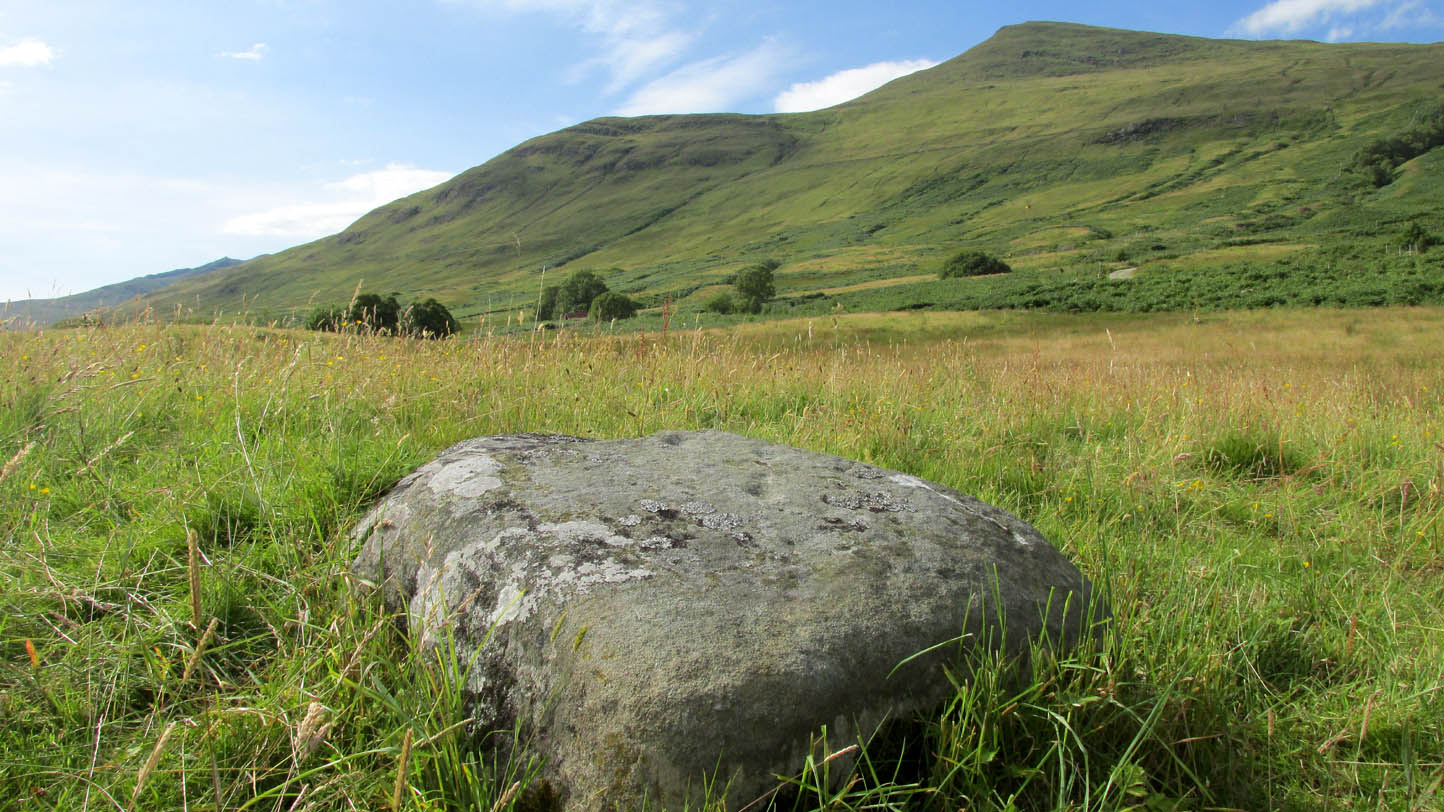
In an early essay on the rock art around Aberfeldy, Hugh MacMillan (1884) remarked on what he thought was a tumulus on the southern slope above the town and where a large old petroglyph once lived.  Subsequently (MacMillan 1901), in his beautiful artistic foray through upper Tayside, he revised his earlier remarks telling that:

“On the side of a high, tree-covered hillock, rising up abruptly behind the central part of Aberfeldy, called the Tullich, there was once a Druidical circle, one of the huge stones of which, called the Clachmore, forms part of a garden wall on the old military road passing along its base.”

The circle was mentioned in Mackay’s (1954) excellent work, albeit in the past tense, and he could add no more to it other than his memory of the whereabouts of the Clach Mhor (as it was more accurately known), on which were numerous cup-markings. (Note: the grid-reference to this site is an approximation)

Folklore

In bygone times the people of Aberfeldy observed the celebration of Samhain, the old pre-christian New Year’s Day—a.k.a. Hallowe’en—on November 11th.  Interestingly for us, “bonfires were numerous and there was always a great blaze on the Tullich,” said Dr John Kennedy. (1901)  Considering the small area of The Tullich, it would be unusual if such festivities did not have some relationship with the stone circle.  Samhain relates primarily to the passing over of the dead in the cycle of the year: the spirits of the ancestors moving through the worlds.  If this circle had such a relationship with the bonfires, it may have been a ring cairn and not a free-standing stone circle.

References:

  1. Kennedy, John, Old Highland Days, Religious Tract Society 1901.
  2. Mackay, N.D., Aberfeldy Past and Present, Town Council: Aberfeldy 1954.
  3. MacMillan, Hugh, “Notice of Cup-Marked Stones near Aberfeldy”, in Proceedings Society of Antiquaries Scotland, volume 18, 1884.
  4. MacMillan, Hugh, The Highland Tay, Virtue: London 1901.

© Paul BennettThe Northern Antiquarian
Balnabeggan, Grandtully, Aberfeldy, Perthshire

Cup-Marked Stone (lost):  OS Grid reference – NN 918 524

Archaeology & History

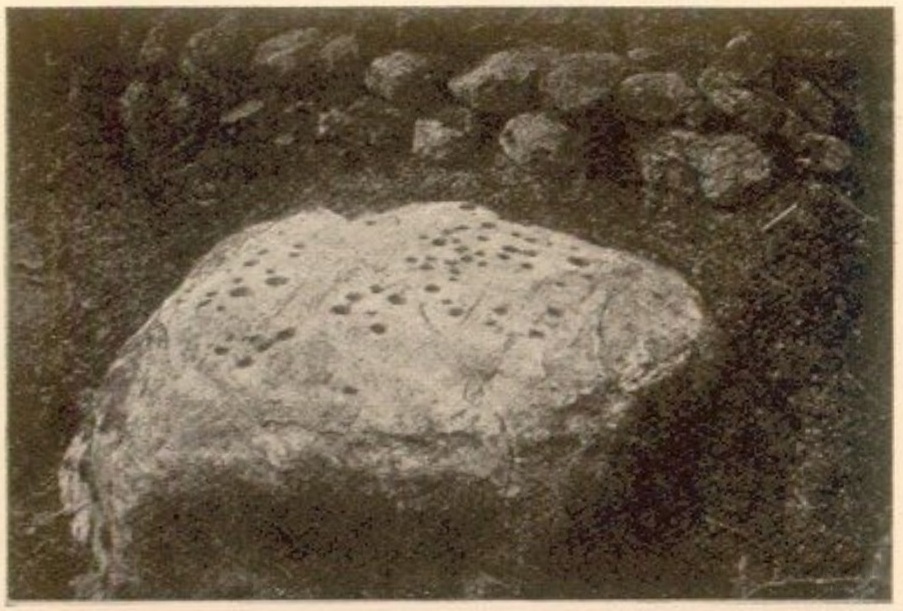
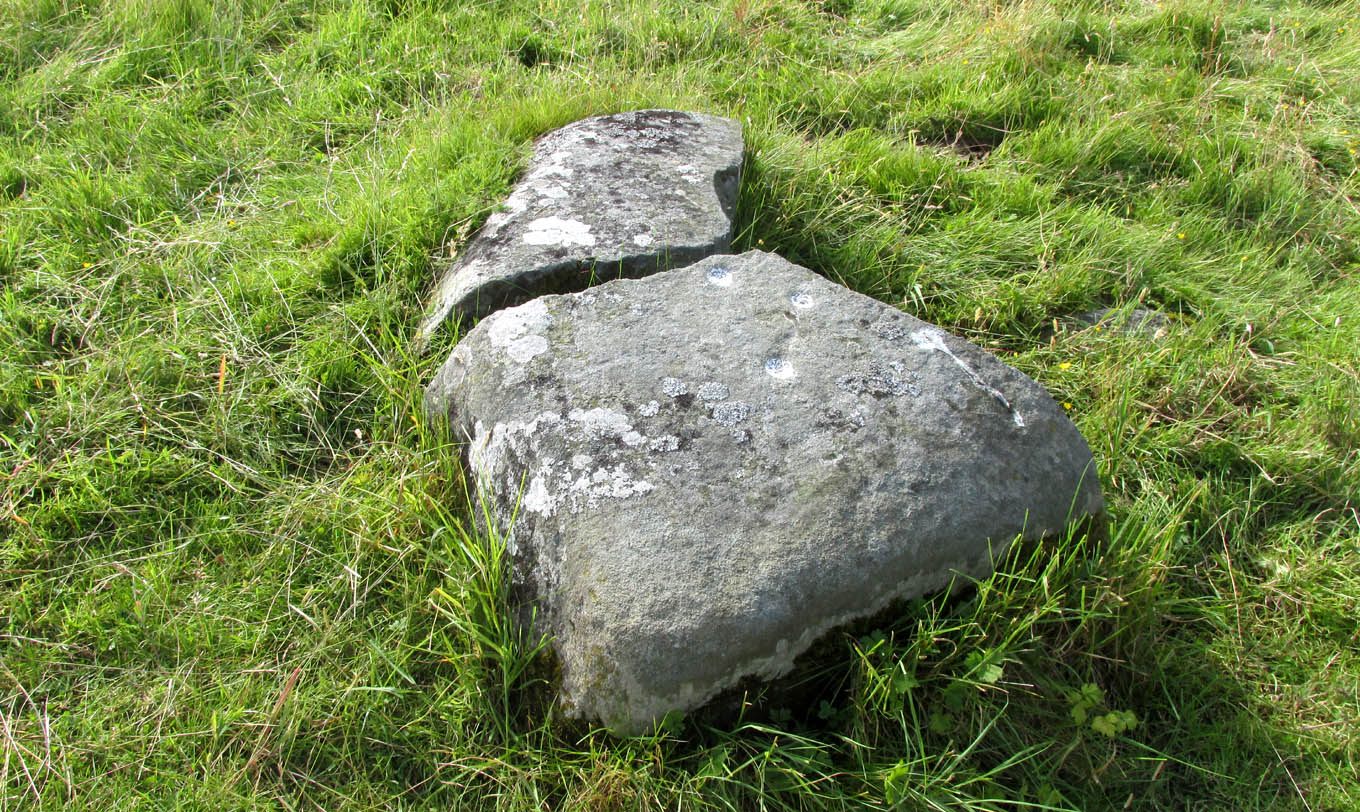
On the hillside a short distance (probably) south of old Balnabeggan farmhouse, up against some walling at the edge of some natural birch wood, could once be seen—some fifty or sixty years ago—a large, ornately inscribed, quartz-enriched cup-marked stone.  And, although seemingly lost, it shouldn’t be too hard to uncover with a  little bit of bimbling and dedication.  It was described in some considerable detail in John Dixon’s (1922) survey of the Strathtay petroglyphs as being,

Balnabeggan stone, c.1920
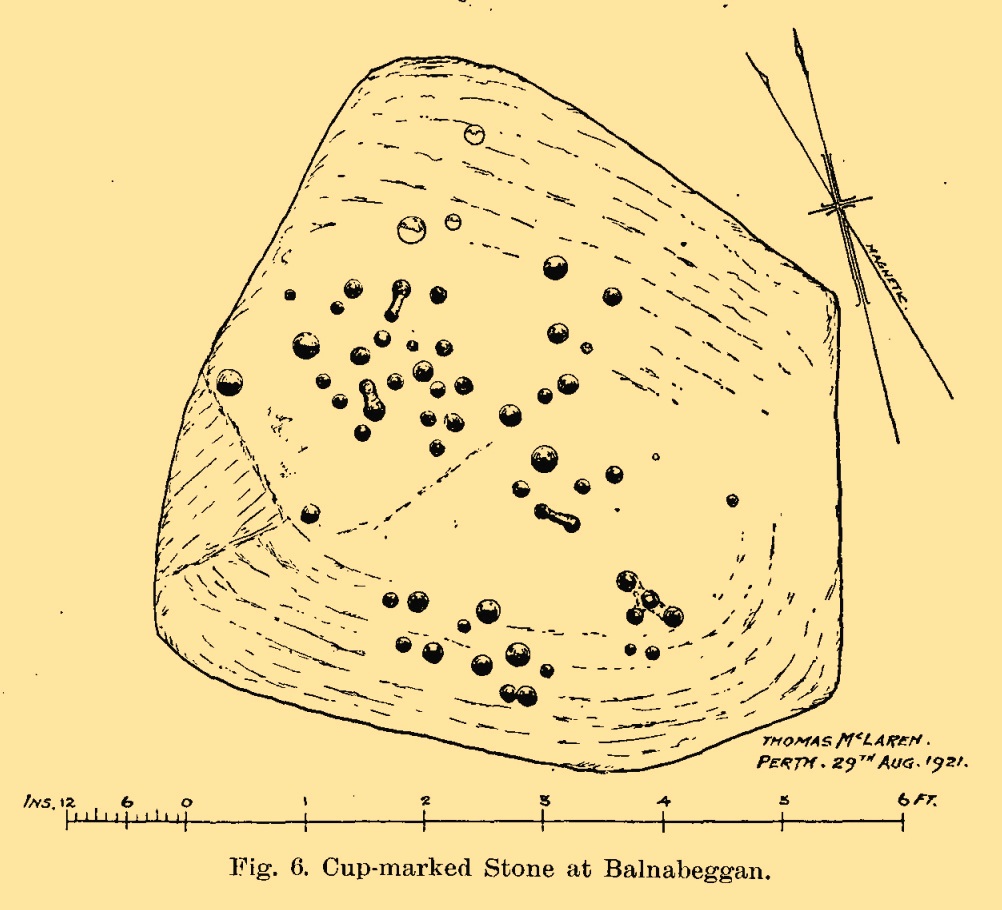
1921 sketch of the stone

“roughly hexagonal in shape, but one side is partly hidden by an old dry-stone wall built above it.  The greatest width is 7 feet, whilst a diameter at right angles measures 6 feet.  The thickness or depth of the stone is at least 2 feet, but it may be more underneath, as the stone stands in a wet place in which it may have settled down.

“On the upper surface of the stone are fifty-nine cups of various sizes, the largest measuring 2½ inches in diameter, and from 1 inch to ½ inch, or less, in depth.  A special feature is that four equidistant cups (three in a row and the fourth at a right angle to the centre of the row) are connected by grooves slightly less broad and deep than the cups.  Three pairs of cups are also similarly connected.  The cups connected as described are discernible, but the group of four cups on the low left side of the stone does not appear in the photograph to have its fourth cup (the lowest)  connected, as it really is, with the central cup of the group.”

Mr Dixon’s additional clue as to its whereabouts is that it’s “about 500 feet above sea level.”  So what, pray, has become of it…?

References:

  1. Dixon, John H., “Cup-Marked Stones in Strathtay, Perthshire,” in Proceedings Society Antiquaries, Scotland, volume 56, 1922.
  2. Kennedy, James, Folklore and Reminiscences of Strathtay and Grandtully, Munro Press: Perth 1927.

© Paul BennettThe Northern Antiquarian
Tobairandonaich, Strathtay, Aberfeldy, Perthshire

Cup-Marked Stone (lost):  OS Grid reference – NN 8866 5320

Also Known as:

  1. Sunday Well
  2. Tobar an Donich

Archaeology & History

Tobairandonaich stone, c.1920

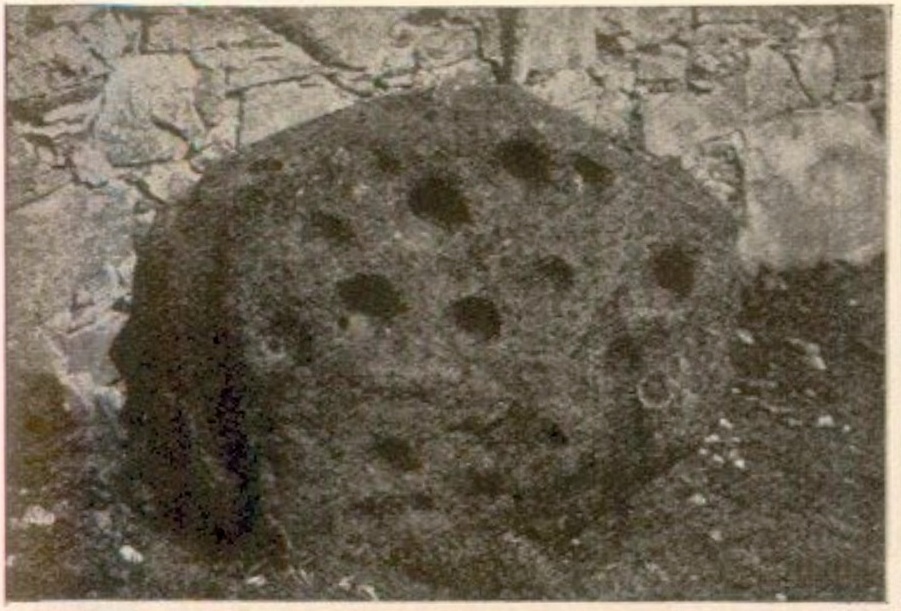
Located some 30 yards south of a holy well known (in English language) as the Sunday Well, this carving was rediscovered shortly before John Dixon (1922) wrote his survey of petroglyphs in the Strathtay region.  It would seem to have been a large “portable” cup-marked stone that had been placed, face-downward, into an old doorstep at the stable at Easter Tobairandonaich and forgotten about, long long ago.  Then, at the beginning of the 20th century when the people living here had to clear a drain beneath the stable, the stone was moved and the cup-markings were noticed.  The carving was a pretty simplistic design, as you can see, which was described by Mr Dixon as follows:

“The stone…has nineteen cups all on the same face.  The largest cup is 3¾ inches in diameter and 2 inches deep.  The next largest has the same diameter, but is 1½ inch deep.  Other five of the cups are very nearly the same size.  The smallest cup is 1¾ inch in diameter and ½ inch deep, but weathering has effected much towards almost obliterating some of the smaller cups.  The stone is of whinstone with slight veins of quartz.  It is oval in form and varies in thickness from 2½ inches to 4 inches.  Its greatest diameter is 3 feet 2 inches, and its least diameter 2 feet 8 inches.”

Tom MacLaren’s 1921 sketch

The stone would seem to have disappeared as no one has seen it for fifty years or more.  It may (hopefully) be in one of the walls, or perhaps buried somewhere under the soil.  Or maybe, tragically, some fuckwit has destroyed it.  Twouldst be good to find out one way or the other.  The photograph above, taken by Mr Dixon sometime around 1920, is the only thing that remains of the carving.

In this small part of Strathtay we are fortunate in finding a cluster of petroglyphs with folklore about them relating to our faerie and witch folk. Some larger man-made stone “bowls” in the area were also used as “praying stones.”  I have little doubt that the people who originally used this carving as a doorstep were fully aware of the cup-marks—and I’d suggest that they even put it here on purpose, probably as a form of protection from the fairies who might have stolen or caused sickness to the horses.

References:

  1. Dixon, John H., “Cup-Marked Stones in Strathtay, Perthshire,” in Proceedings Society Antiquaries, Scotland, volume 56, 1922.
  2. Kennedy, James, Folklore and Reminiscences of Strathtay and Grandtully, Munro Press: Perth 1927.
  3. Yellowlees, Walter, Cupmarked Stones in Strathtay, Scotland Magazine: Edinburgh 2004.

© Paul BennettThe Northern Antiquarian
Craig Hill cluster (5), Kenmore, Perthshire

Cup-and-Ring Stone:  OS Grid Reference – NN 81305 44422

Getting Here

Craig hill cluster (5) stone

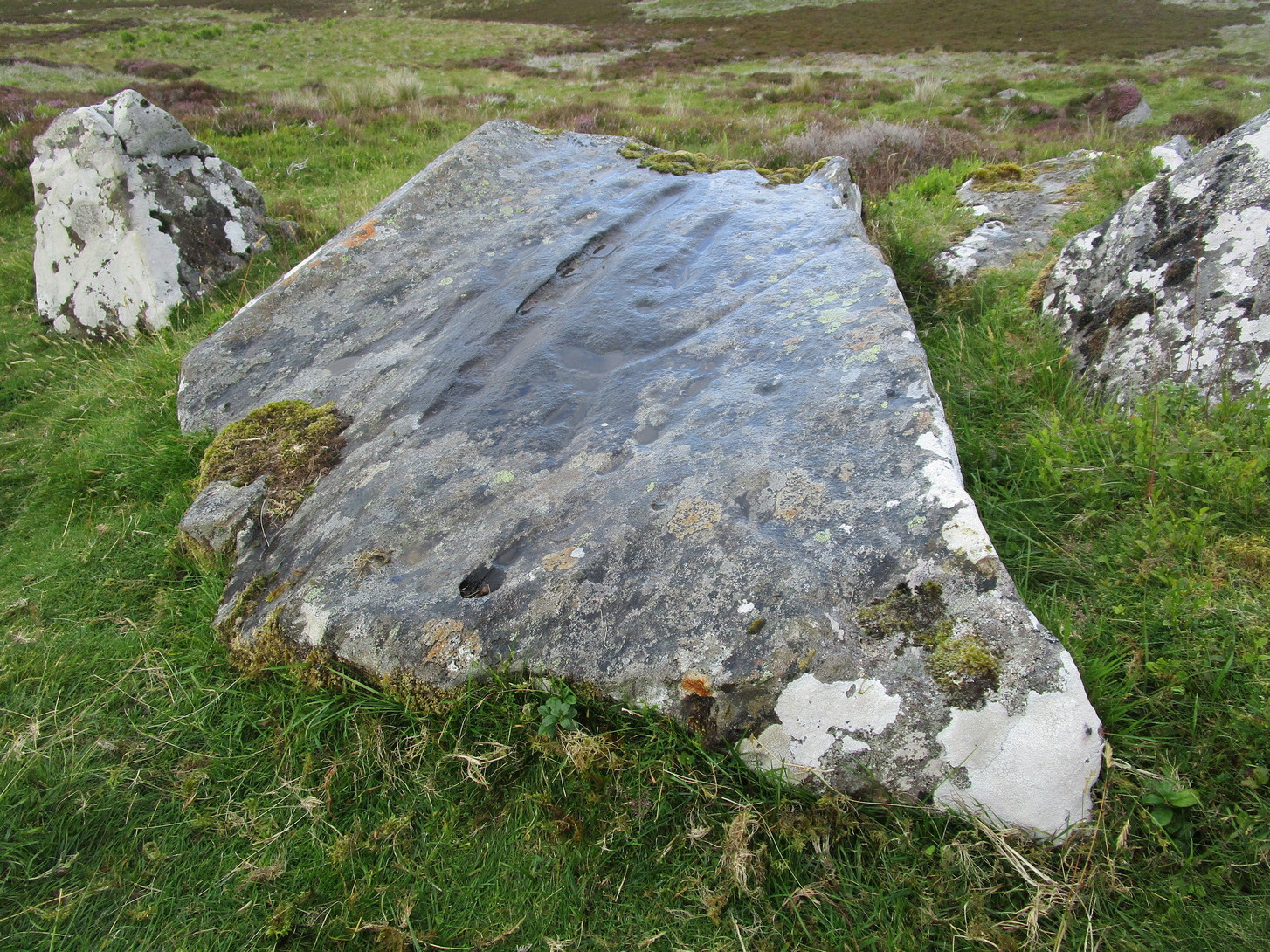
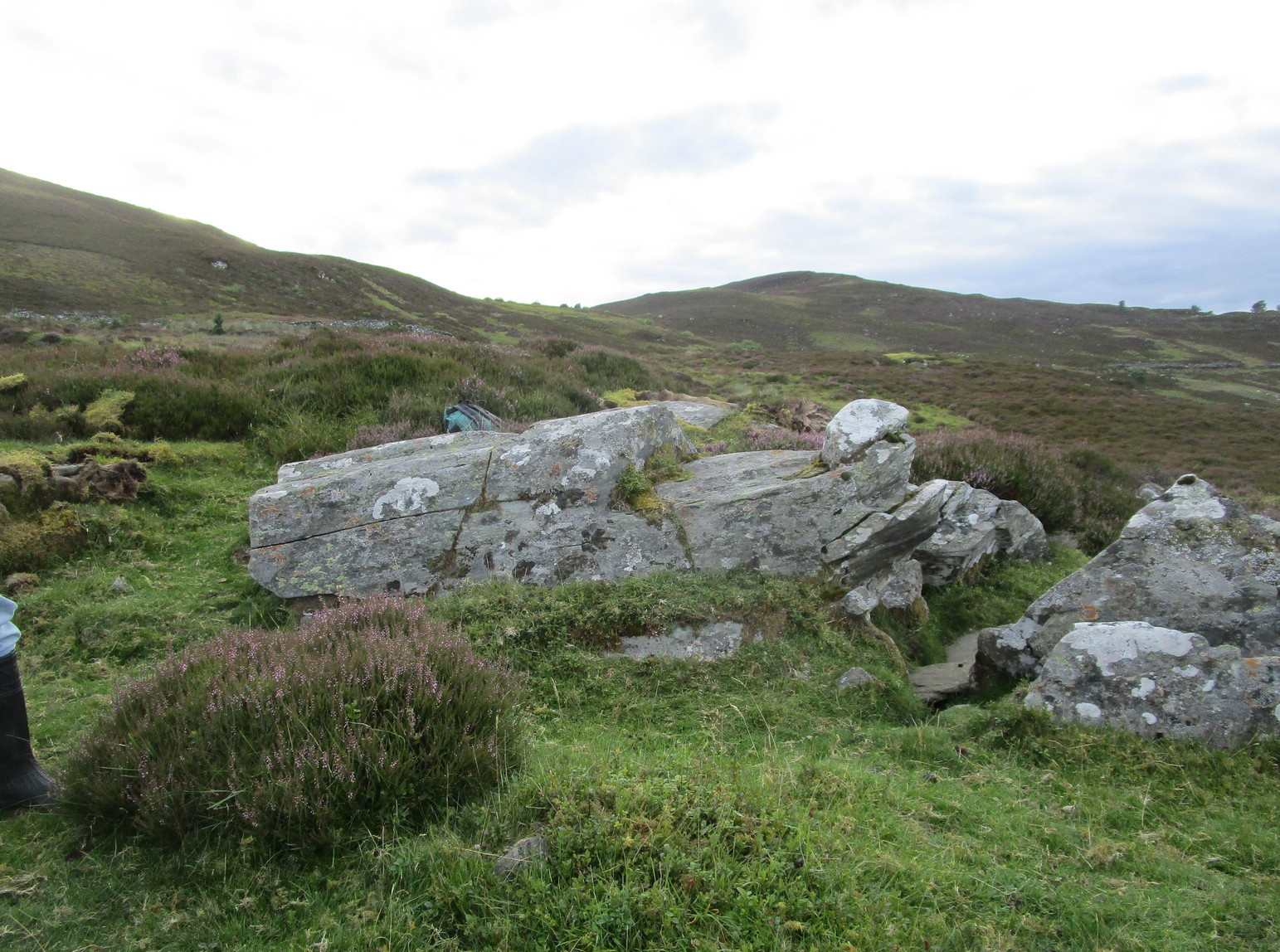
From Kenmore go east up the steep mountain road towards Glen Quaich, or if you’re coming from Amulree, go west along the same glen.  After 2½ miles (4km) up the Kenmore route (nearly 9 miles on the Amulree route) you’ll reach a small lochan on your left (you’ve got a very small parking spot a coupla hundred yards before the loch).  A gate and stile past the loch takes you east along a track into the moors.  More than a mile on, the track splits, but you need to keep to the left and follow the track along the wall-side for another 400 yards or so, where you’ll see a small crag of rocks 100 yards down the slope on your right. Once here, the deformed triangle-shaped stone to the left-side of the cluster is the one you’re looking for.

Archaeology & History

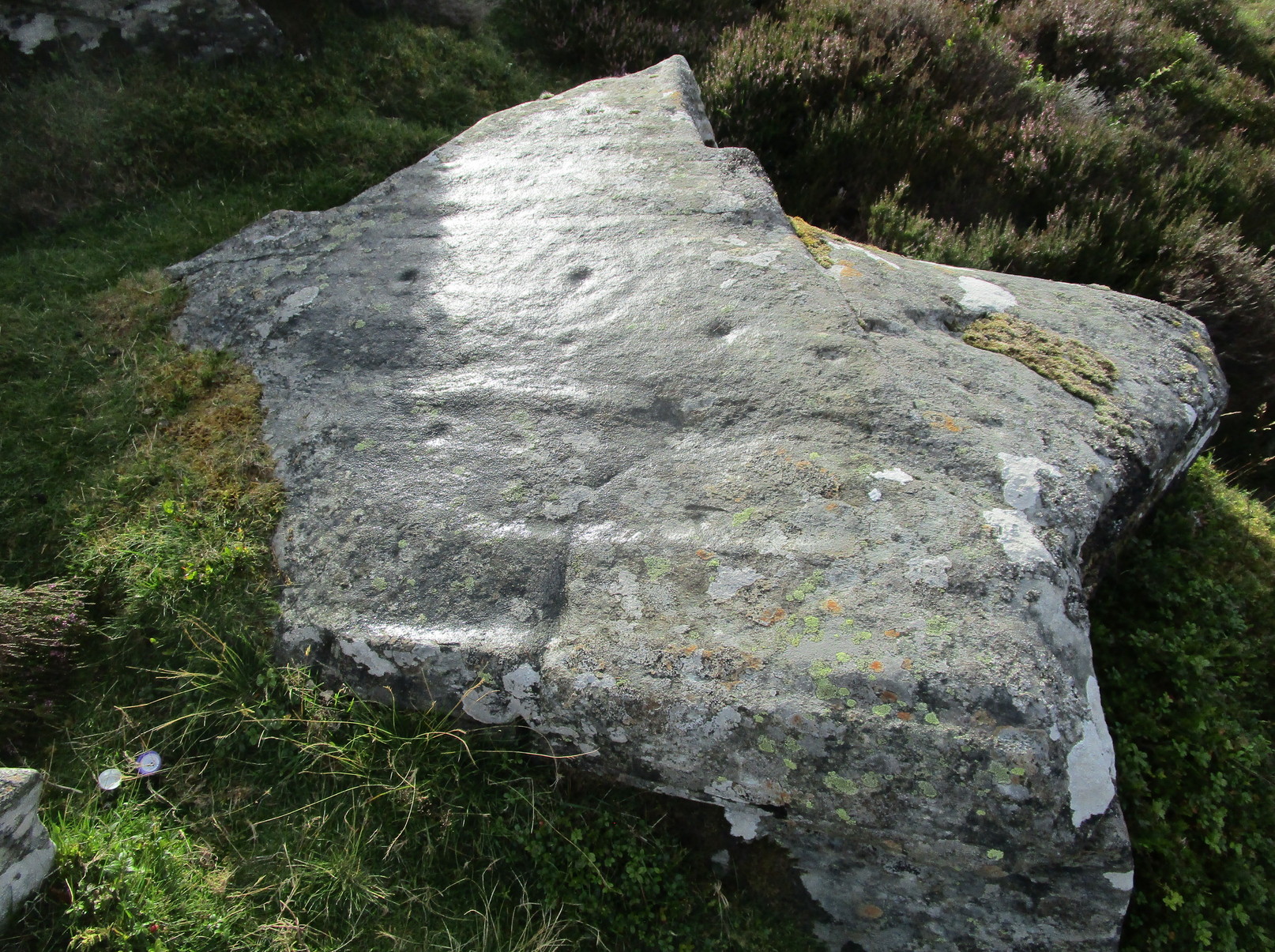
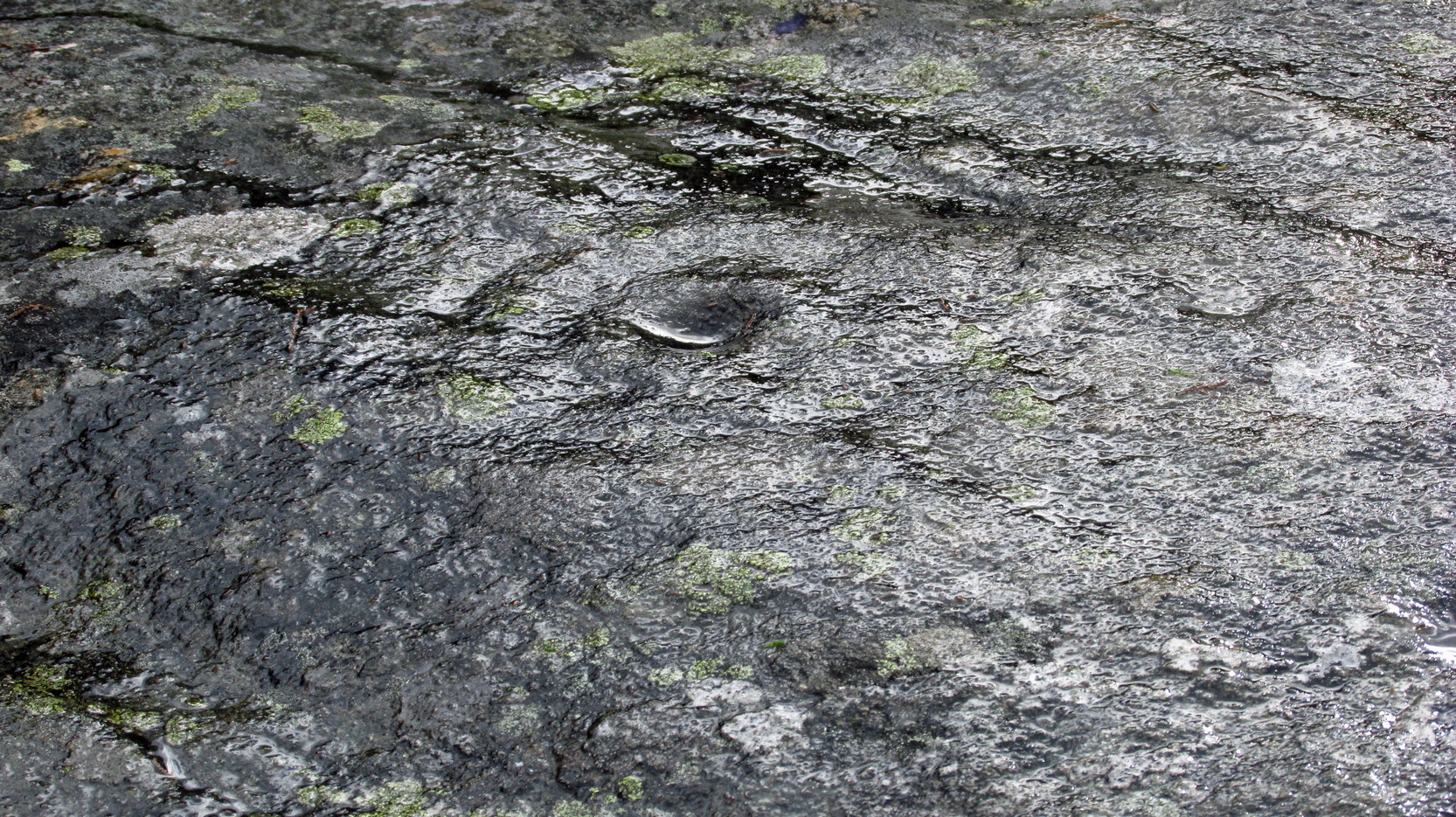
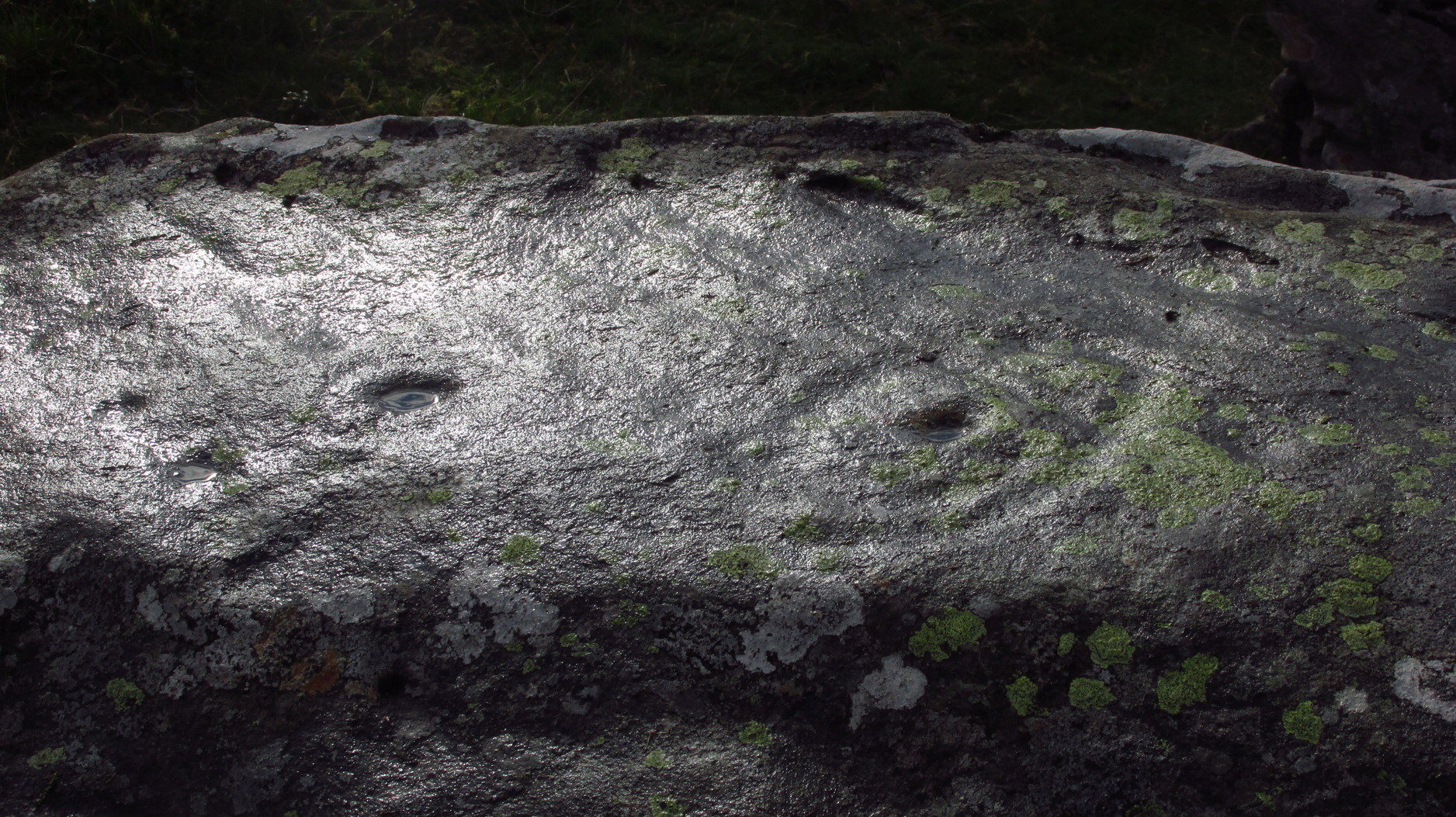
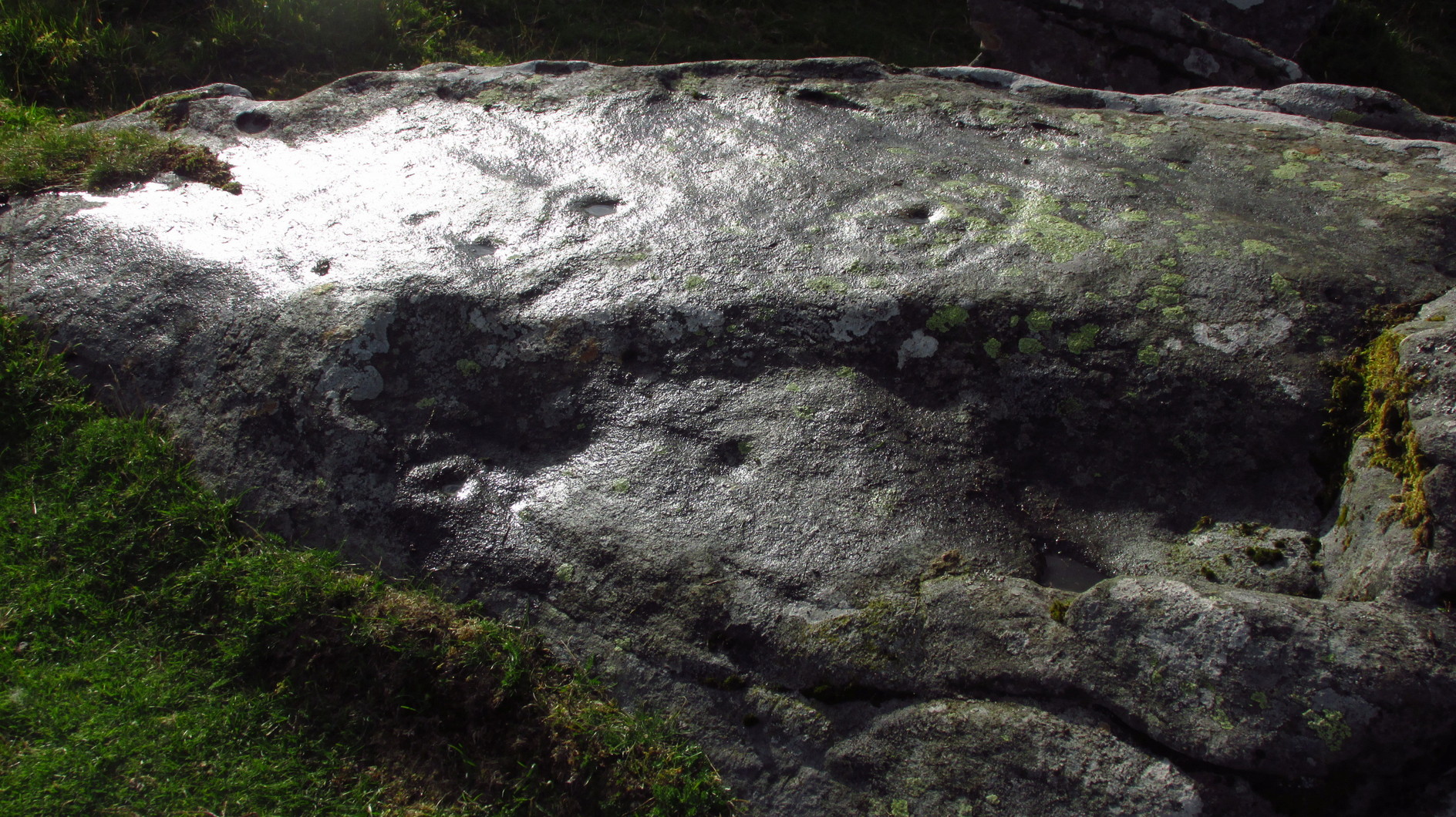
About four yards west of the Craig Hill cluster (3) carving, this gently smooth sloping rock was initially noted to have between six and seven cup-marks on it.  Under the grey skies it was difficult to see any of this clearly, and so we wet the surface when Nature gave us some short bursts of light through the clouds which then enabled us to get a much better look at the design—but it’s still far from clear.

Curious eye motif
Central elements of carving

We found at least eight cups on here, two of which had single rings: the one near the top of the stone seems to be complete, whilst the other nearest the bottom of the stone looks to be incomplete.  Another cup had a curious double ring; whilst the one nearest the middle of the stone has what may be three rings, with what could be a carved line running from its centre—but it’s very difficult to say with certainty until we’ve made another visit.  I have little doubt that there’s more to this petroglyph than we could make out beneath the grey skies.  On the west-side of the stone, the “curious” double-ring has, as its outer surround, an “eye” motif, or lozenge, which is also found on the Craig Hill cluster (3)  stone a few steps away.  The eye motif on both stones have the same levels of erosion and, I would suggest, were carved within a century or two of each other; perhaps even around the same time.

This one’s well worth checking out!

Acknowledgements:  Huge thanks to Prof Paul Hornby for use of his photos in this site profile; and to Myrna Hurley for getting us up there.  Cheers doods. 😉

© Paul BennettThe Northern Antiquarian

Craig Hill cluster (3), Kenmore, Perthshire

Cup-and-Ring Stone:  OS Grid Reference – NN 81307 44419

Getting Here

Craig Hill petroglyph cluster

From Kenmore go east up the steep mountain road towards Glen Quaich, or if you’re coming from Amulree, go west along the same glen.  After 2½ miles (4km) up the Kenmore route (nearly 9 miles on the Amulree route) you’ll reach a small lochan on your left (you’ve got a very small parking spot a coupla hundred yards before the loch).  A gate and stile past the loch takes you east along a track into the moors.  More than a mile on, the track splits, but you need to keep to the left and follow the track along the wallside for another 400 yards or so, where you’ll see a small crag of rocks 100 yards down the slope on your right. That’s your target!

Archaeology & History

The stone in question

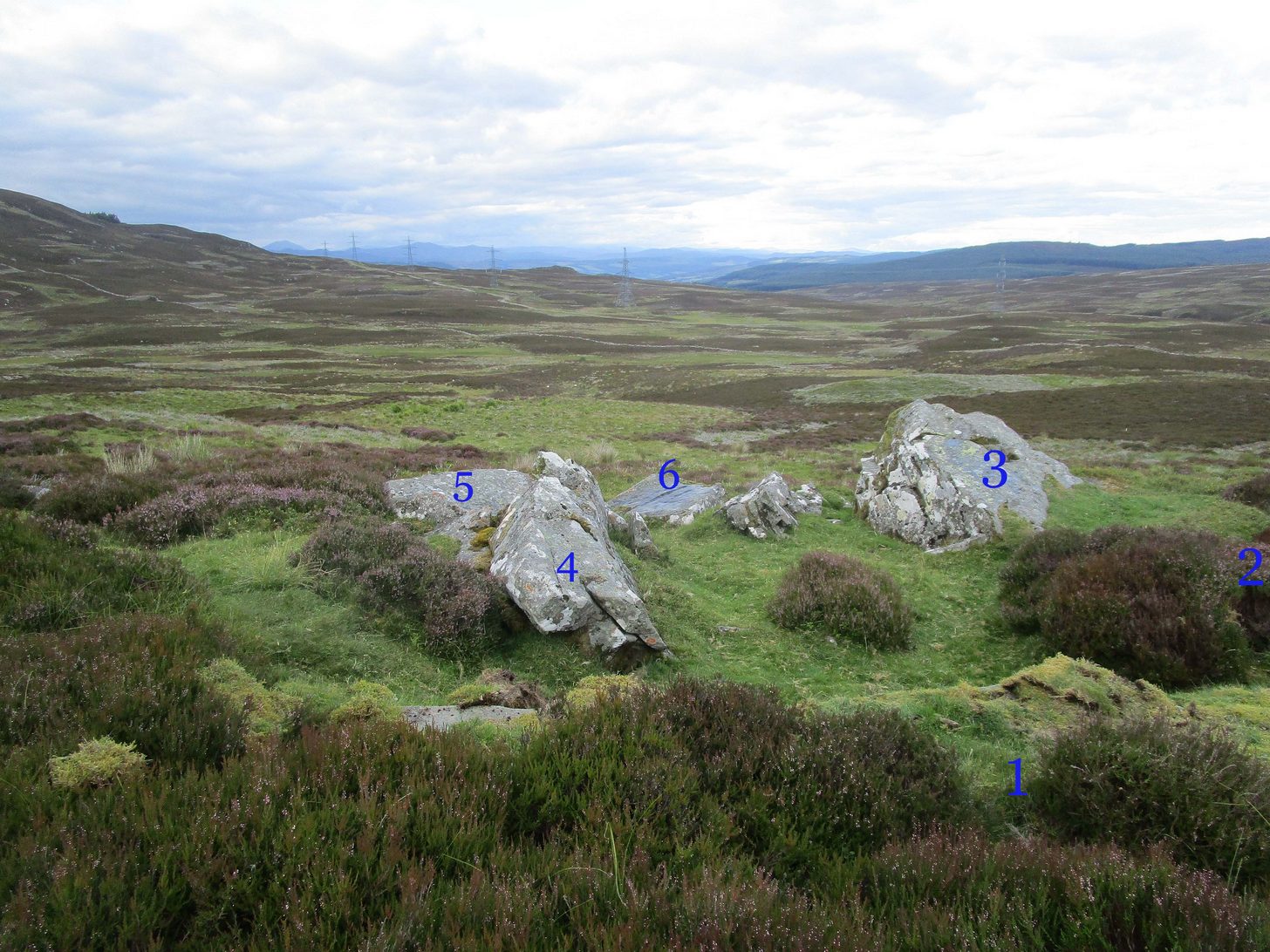
One of at least six rocks next to each other that possess cup-and-rings, this is the most notable of the bunch inasmuch as it’s the one that stands out above all the others.  At first sight it doesn’t look impressive: a shallow scatter of nine or ten cup-marks can be seen when the light’s alright, but that’s about it.  This is what George Currie (2005) noticed when he first came across it in 2004, describing it simply as “a boulder with 10 cups” a few yards away from one of it’s fellow petroglyphs (CR19, or the Craig Hill cluster-2 carving).  But there’s much more to it than that.  Unfortunately when we visited here, we weren’t blessed with good daylight, so were unable to get a decent appraisal of the entire design and have most probably missed some elements.

Curious double-ringed eye
General overview of design

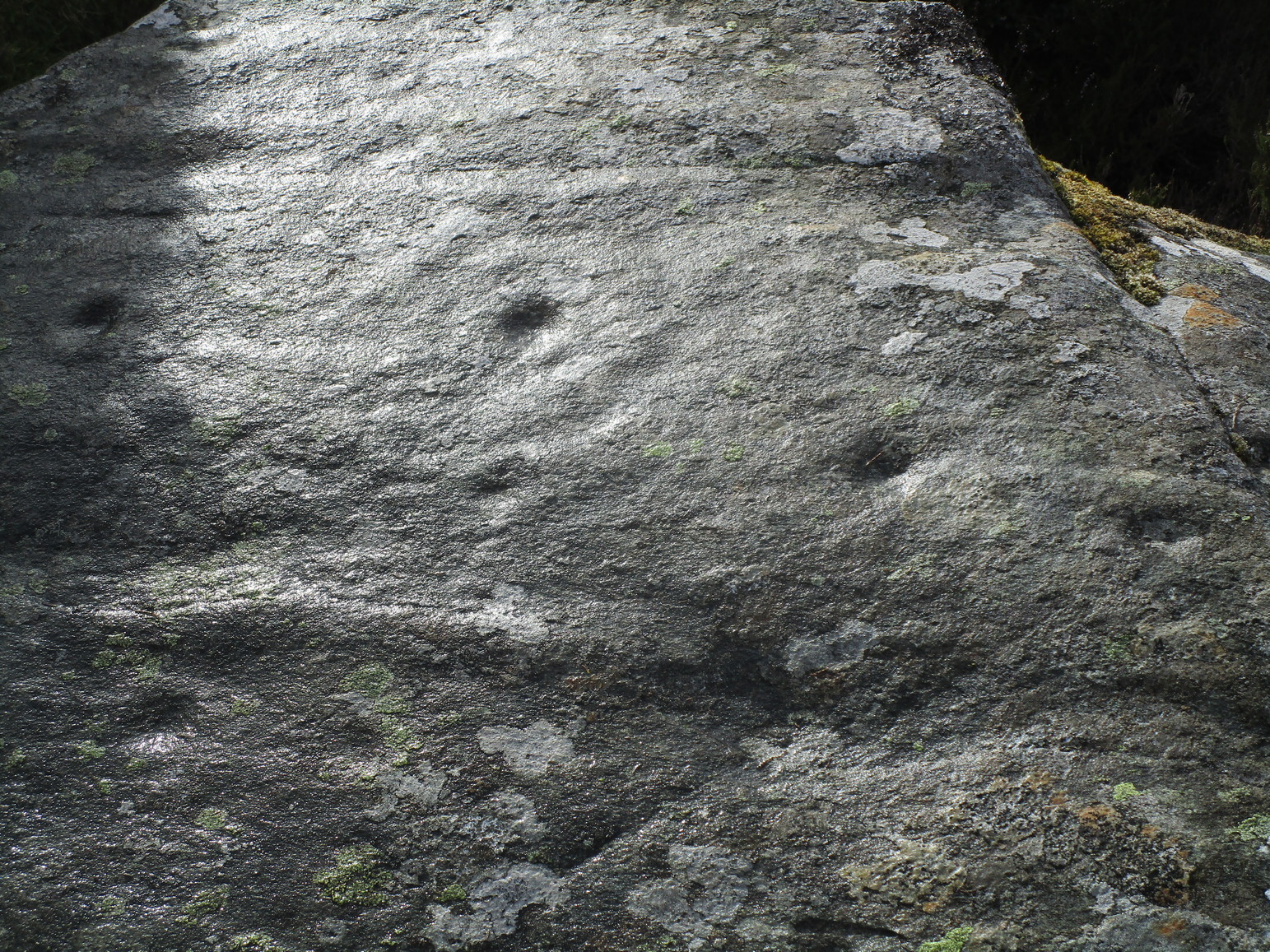
On the top sloping surface are  six or seven cup-marks; another two or three are on a secondary lower level of the stone.  Of those on the top, at least two of them have surrounding rings: one with a carved line coming out to the south-east; the other having a more extravagant appearance, surrounded by what looks like a secondary outer “oval”, or eye-shaped design.  It’s unusual.  Other lines intersect these cup-and-rings, but it was difficult to say with any certainty whether they were Nature’s handiwork, or had been modified by humans.  Below these on a slightly lower level are two or three single cup-marks, one of which, close to the edge of the rock, appears to have an incomplete ring round it—but this might have just been a trick of the light.  Another visit is required for a better appraisal…

References:

  1. Currie, George, “Craig Hill (Dull parish): Cup-and-Ring Marked Rocks,”in Discovery & Excavation Scotland, NS Volume 6, 2005.

Acknowledgements:  Huge thanks to Prof Paul Hornby for use of his photos in this site profile; and to Myrna Hurley for getting us up there.  Cheers doods. 😉

© Paul BennettThe Northern Antiquarian

Craig Hill cluster (6), Kenmore, Perthshire

Cup-and-Ring Stone:  OS Grid Reference – NN 81307 44422

Getting Here

Craig Hill cluster (6) stone

Follow the same directions to reach either the Craig Hill cluster (3), no.4 or no.5 carvings.  Once here, looking at the sloping moorland ahead of you, the elongated stone that’s closest to where the moorland slopes downhill is the one you’re after.  Y’ can’t really miss it!

Archaeology & History

The sixth carving in this small close-knit cluster and, design-wise, the least impressive of the bunch.  There are three distinct cup-marks on the rock: two on its more southern side and one near the middle of the stone.  There may be another two cups, but these may have been part of the curious long, naturally-eroded line running along the length of the stone.  Other man-made elements may have been cut into the stone, but it needs to be seen in perfect low light to tell us one way or the other.

References:

  1. Currie, George, “Craig Hill (Dull parish): Cup-and-Ring Marked Rocks,”in Discovery & Excavation Scotland, NS Volume 6, 2005.

© Paul BennettThe Northern Antiquarian

Craig Hill cluster (4), Kenmore, Perthshire

Cup-and-Ring Stone:  OS Grid Reference – NN 81303 44419

Getting Here

Craig Hill cluster (4) stone

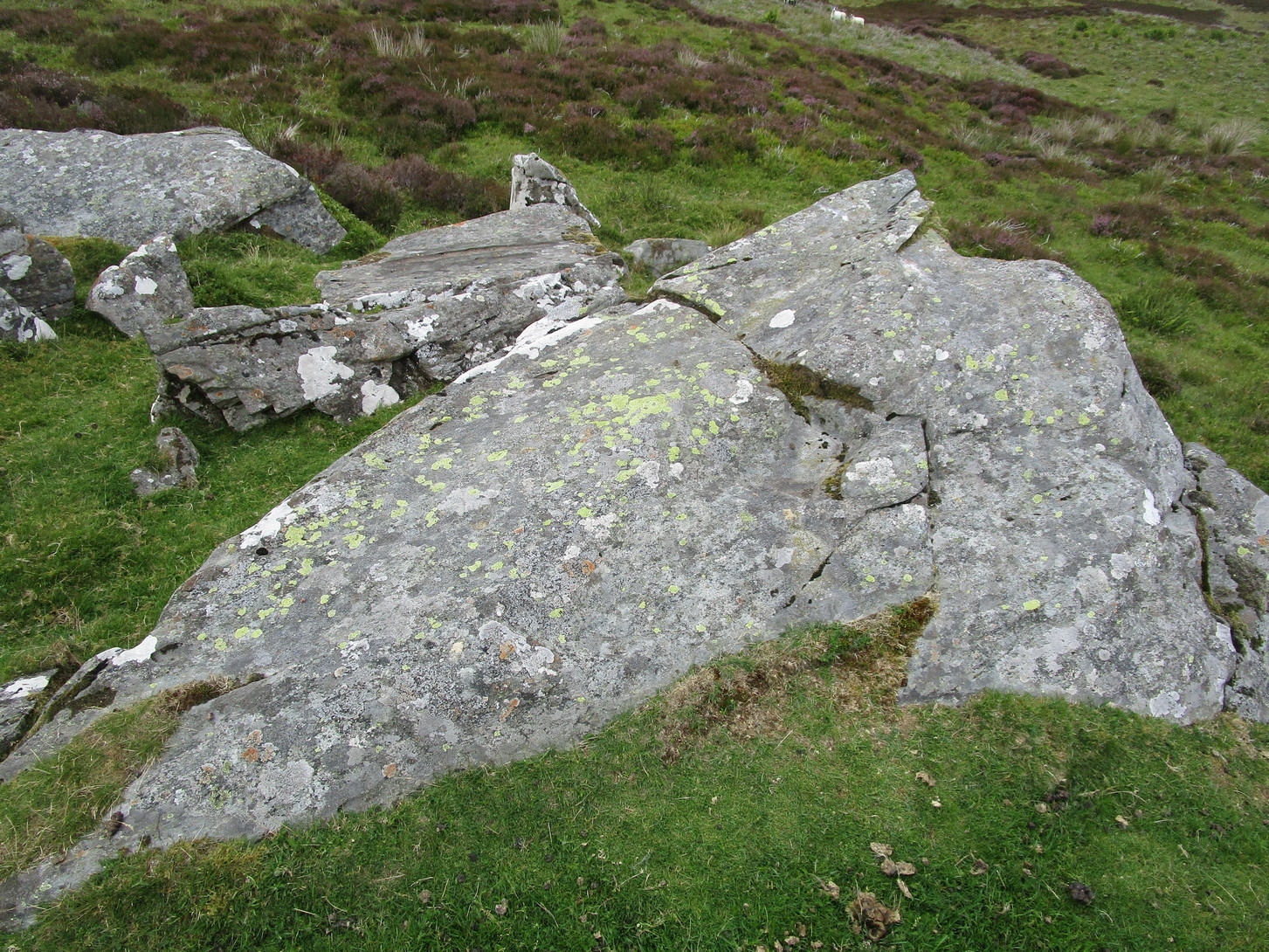
From Kenmore go east up the steep mountain road towards Glen Quaich, or if you’re coming from Amulree, go west along the same glen.  After 2½ miles (4km) up the Kenmore route (nearly 9 miles on the Amulree route) you’ll reach a small lochan on your left (you’ve got a very small parking spot a coupla hundred yards before the loch).  A gate and stile past the loch takes you east along a track into the moors.  More than a mile on, the track splits, but you need to keep to the left and follow the track along the wall-side for another 400 yards or so, where you’ll see a small crag of rocks 100 yards down the slope on your right. Once here, the elongated rock with a “seat” that you can sit in is the stone in question.

Archaeology & History

At first sight this stone doesn’t seem to have anything petroglyphic about it, and—as when we visited the other carvings in this Craig Hill cluster—the weather was grey and overcast, so it was difficult to discern anything at first.  But as we walked round and round inspecting the Craig Hill cluster-5 carving, a glance at this adjacent stone seemed to indicate one or two cup-marks within the curious chair-like aspect of the rock, but we couldn’t initially work out whether they were simple geophysical elements or not.

Very faint cup-&-half ring near the centre
Close-up of the C&R

So we poured water onto the stone in the hope that something might show up.  And the more we walked round and round, bending down, looking from as many angles as possible, not only did we see what looked like several cups, but one of them had a half-ring that curved round what may or may not be a natural cupmark.   You can see it pretty clearly in the attached photos.  In other photos that we took, the faint cup-and-half-ring seems to plays its part in a line of three or four other cups; although in order to ascertain whether these elements are man-made or not, we could do with the help of a good geomorphologist.

Acknowledgements:  Huge thanks to Prof Paul Hornby for use of his photos in this site profile; and to Myrna Hurley for getting us up there.  Cheers doods. 😉

© Paul BennettThe Northern Antiquarian

Tombreck (15), Kenmore, Perthshire

Cup-Marked Stone:  OS Grid Reference – NN 64894 38308

Getting Here

Tombreck (15) carving

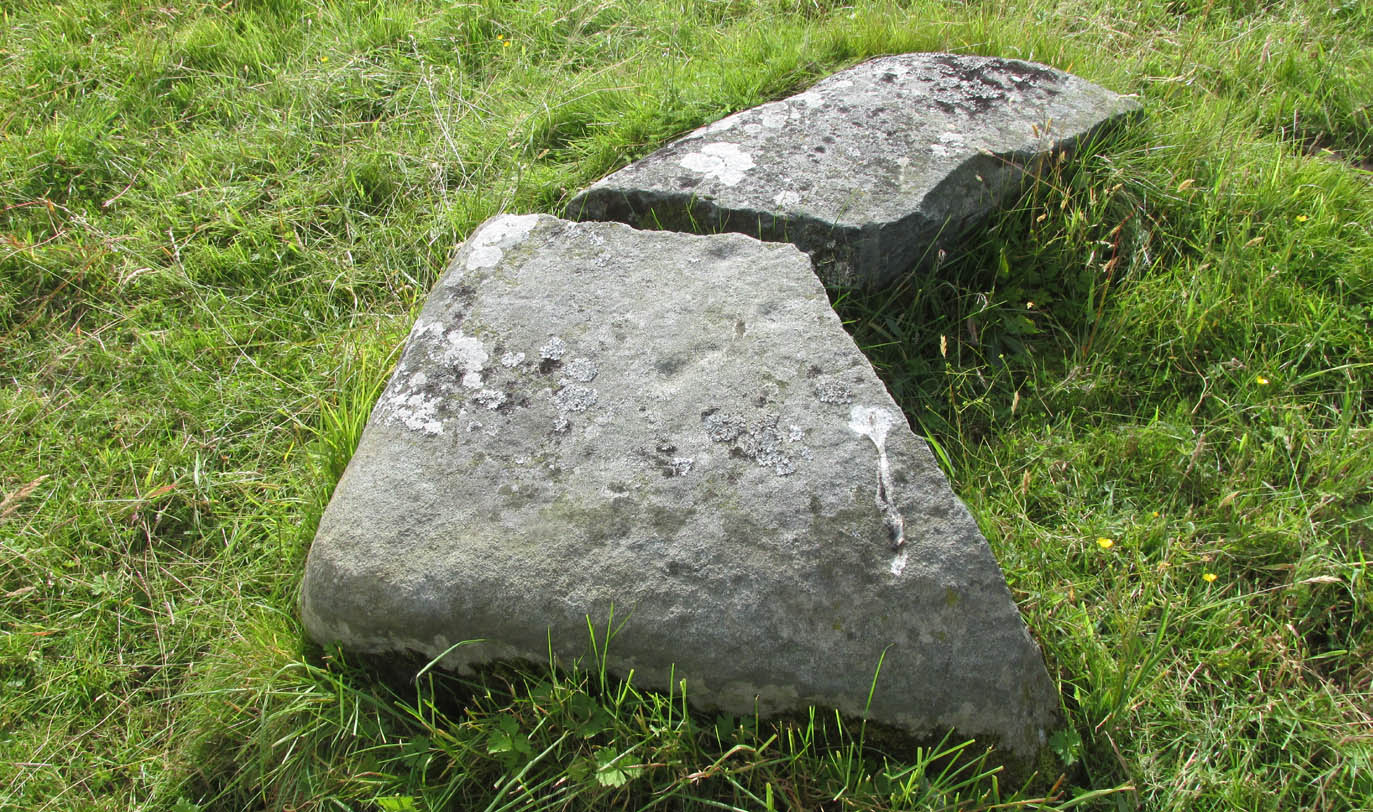
Along the A827 Loch Tay road between Morenish and Lawers, take the track uphill where Carie farmhouse and Tombreck are either side of the road. Walk up this track 2-300 yards till you go through the gate just past the sheep-folds on your left.  Ahead of you is a small grassy hillock on your right upon which you’ll find the unimpressive Tombreck-1 carving.  Walk down the grassy-slope to the boggy stream and then up the rounded knoll on the other side, where you’ll find a stone that’s been split in two.  You’re here!

Archaeology & History

This is another unrecorded carving, found amidst this already large petroglyphic cluster on August 9, 2020.  Carved on a stone that’s been spilt in half, three simple cup-marks can be seen on the larger easternmost section, with the lowest of them having a possible short line running towards the cup on the right.  It seems that the right-hand (north) side of the stone has also been cut, but there is no trace of this part of the stone on the ground.  Additionally, there is the possibility that this stone once stood upright, as evidenced by its very worn rounded top and the larger bottom end of the stone being distinctly lower compared to the ground all round it. But this is speculative.

The 3 cups, highlighted
3 cups on the lower stone

Although the rock is close to being on the top of a rounded knoll, giving good visibility both east and west for a few miles along the extensive grassy ridge (where many other petroglyphs exist), the grandeur of Loch Tay  in the glen below is not and could never have been visible from this, or indeed many other carvings on this ridge.  I mention this due to the fact that some students are positing that the existence of so many carvings along here may relate to some sort of deification of Loch Tay.  But here and at many others along this ridge, the idea simply aint valid, unfortunately.

© Paul BennettThe Northern Antiquarian

Brae of Cultullich (6), Aberfeldy, Perthshire

Cup-and-Ring Stone:  OS Grid Reference – NN 8818 4906

Getting Here

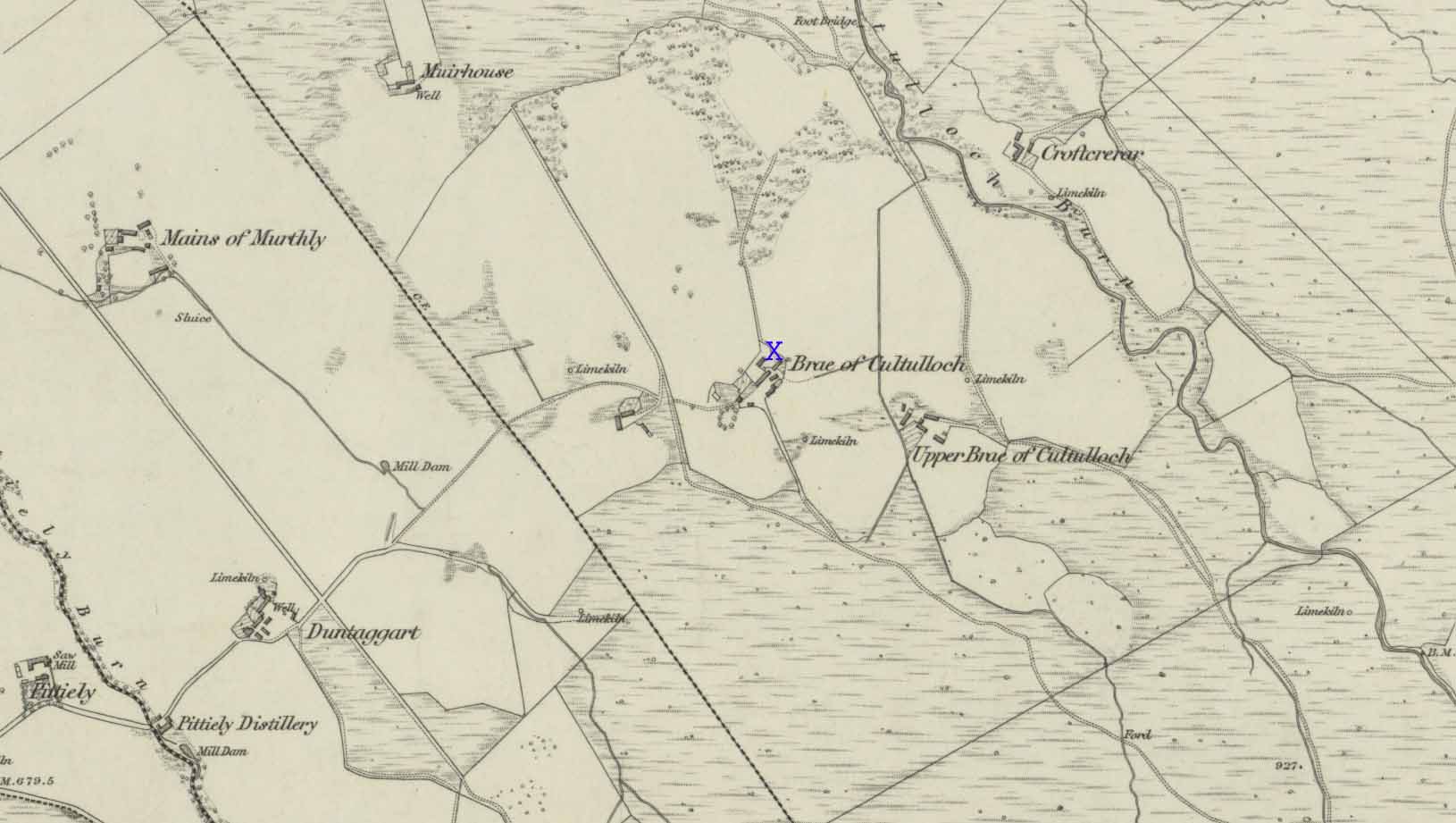
X supposedly marks the spot

Out of Aberfeldy, take the A826 road as if you’re going up Glen Cochill.  Not far up, just where the housing of Aberfeldy itself ends and the green fields open up either side of you, keep on the road for a half-mile where you meet a small copse of trees on your left, with a dirt-track that runs down the slope.  Go along the track for 0.8 miles (1.3km), past the Ursa Major Stone and where the track splits, go left past the Quartz Stone and follow the track through the farmyard.  It’s somewhere there – or is supposed to be!

Archaeology & History

On our visit here, we couldn’t locate the cup-and-ring stone that’s described in Sonia Yellowlee’s (2004) regional rock art survey.  She described it, as archaeologists always do, in the briefest manner, telling us simply:

“Leaning against a pile of rubble in the farmyard there is a split boulder bearing eighteen cupmarks, one of which is ringed.”

It may have been destroyed, as we were told by a couple of locals that there used to be “a real miserable sod” living there.  When we visited the place and tried to ask the present farm owner, sadly he wasn’t to be found.  If any rock art explorer manages to locate this seemingly lost cup-and-ring, please let us know – and mebbe send us some photos so that we can add them to this site profile. 😉

References:

  1. Yellowlees, Sonia, Cupmarked Stones in Strathtay, RCHAMS 2004.

Acknowledgements:  Big thanks to the crew – this time being Neens Harris, Paul Hornby & Frank Mercer.  And the stunning resource of Scotland’s 1st edition OS-maps is Reproduced with the kind permission of the National Library of Scotland

© Paul BennettThe Northern Antiquarian