Intake Farm, Hawksworth, West Yorkshire

Cup-Marked Stone:  OS Grid Reference – SE 15867 41244

Getting Here

Intake Farm carving

In Hawksworth village, less than 100 yards past the primary school, take the footpath on your left into the open fields.  200 yards down the fields, go over the stile on your right, into the next field and walk diagonally across it (SW) for 250 yards until you reach the wall; then walk alongside it, west, for another 150 yards where the walling goes due south and walk down here for 135 yards, going through the gate at the bottom into the next field and, at the bottom of this one go through the gate and bear right.  OK, now walk along the wall-side for 55 yards and you’re just about standing on it!  Alternatively you can reach it via the Hawksworth Spring (1) and (4) carvings, following the wall along for roughly 150 yards till you reach the gate. Go through here and walk diagonally NNW across the field for nearly 150 yards where you’ll see the stone stuck out in front of the wall.

Archaeology & History

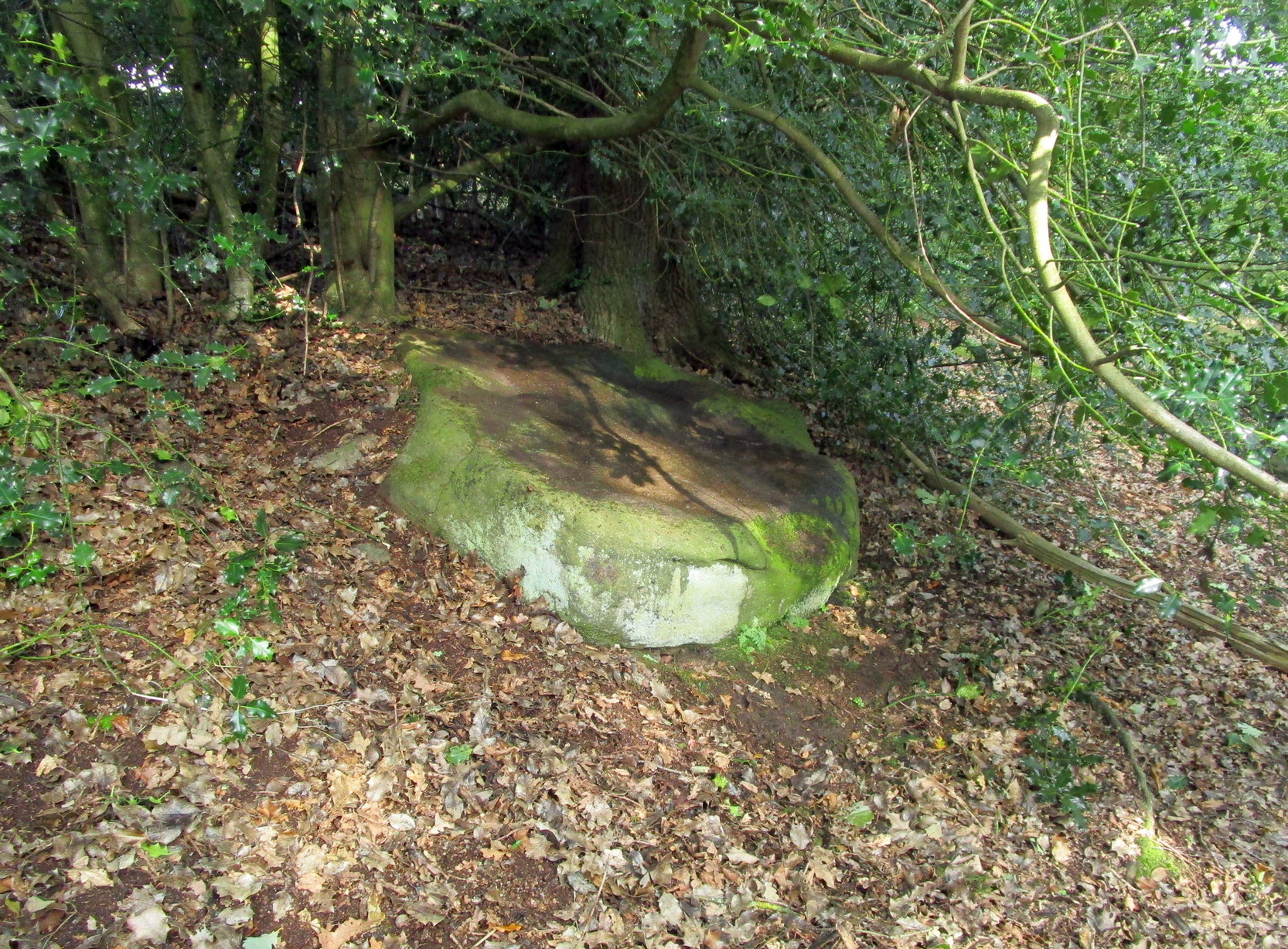
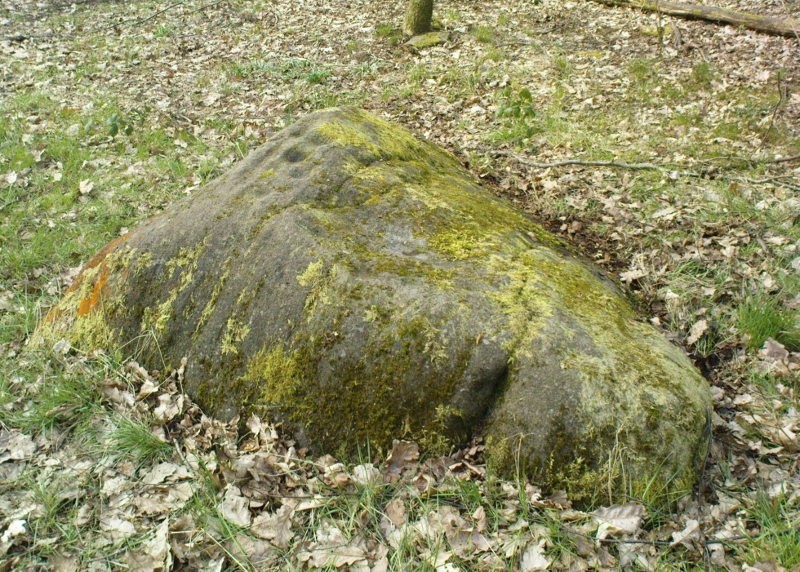
My first sight of this came about as I walked alongside the walling.  Approaching the stone, I noticed what looked like a recent cup-like marking with a curved line emerging from it on its eastern surface; but it didn’t look too old and was more like the scratch-marks you see sometimes when farmers have been dragging rocks along to be used in walling.  So I shrugged in slight disappointment—until the far-side, the western-side of the stone came into view.
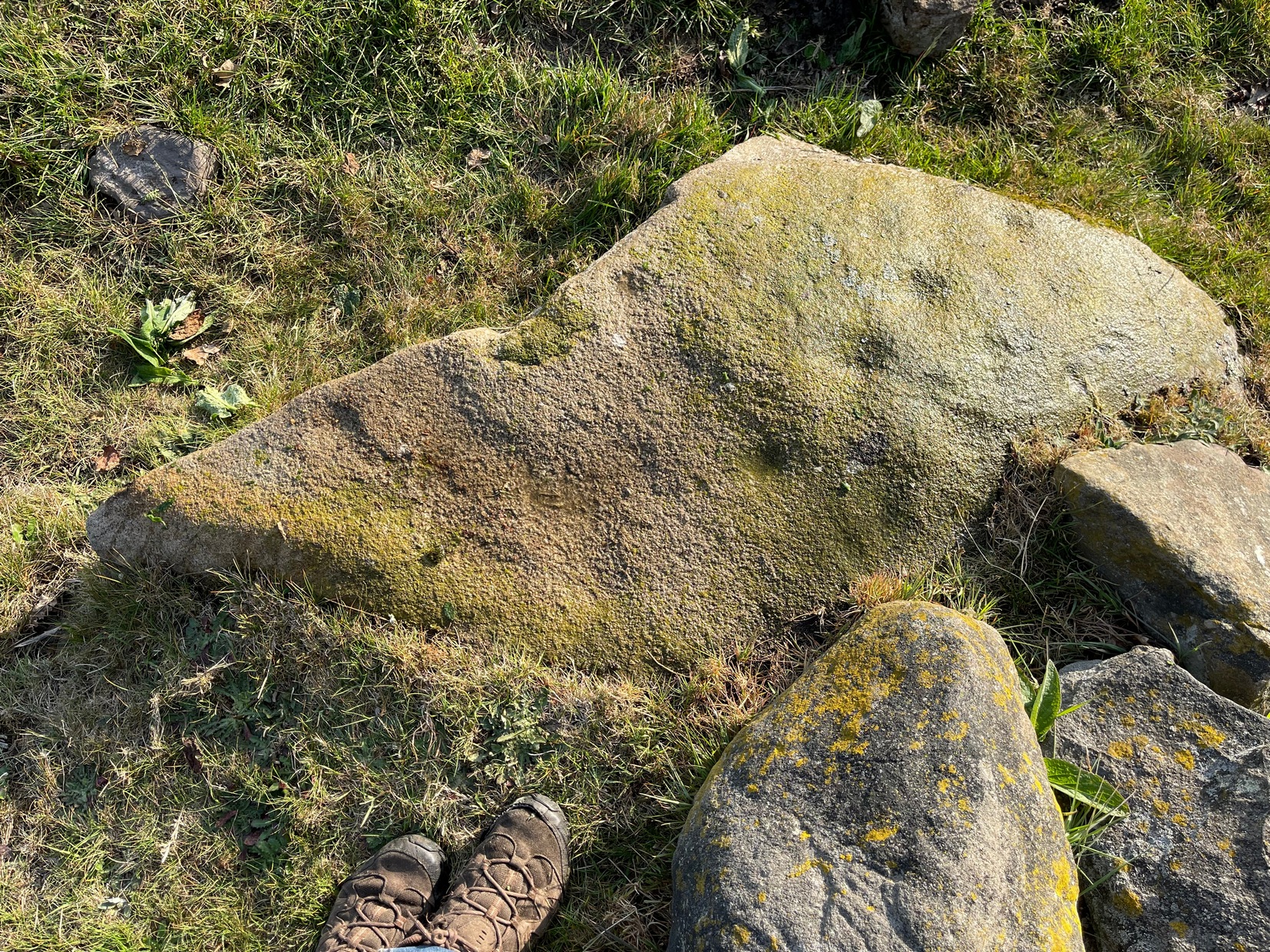
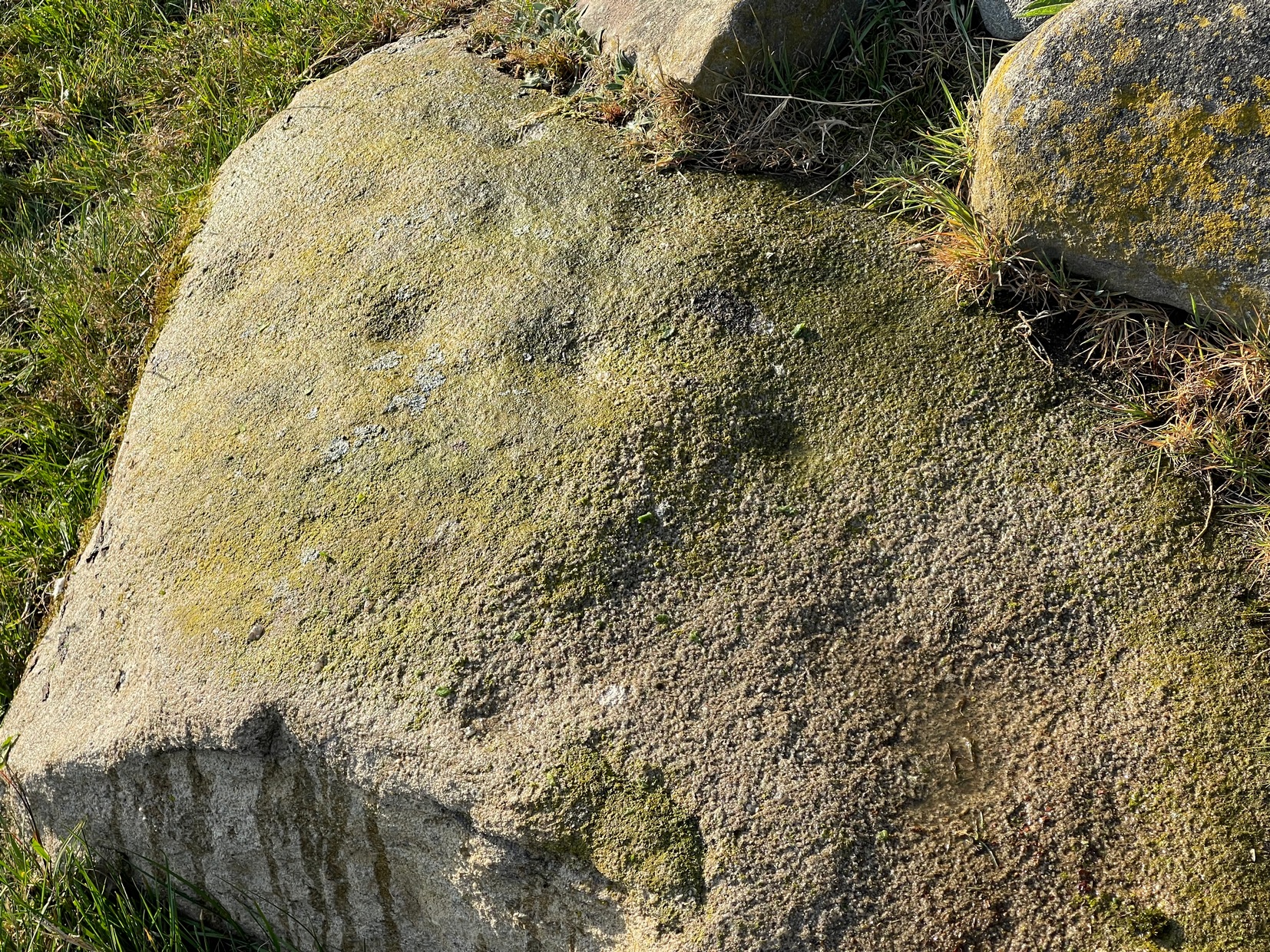
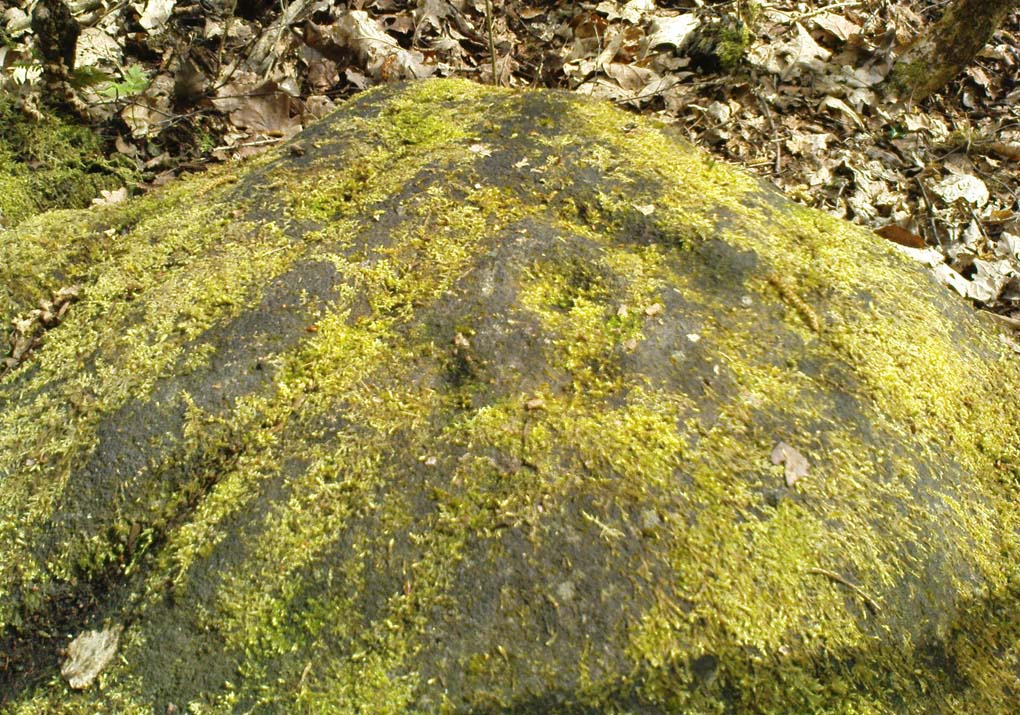
Line of cups
Main scatter of cups

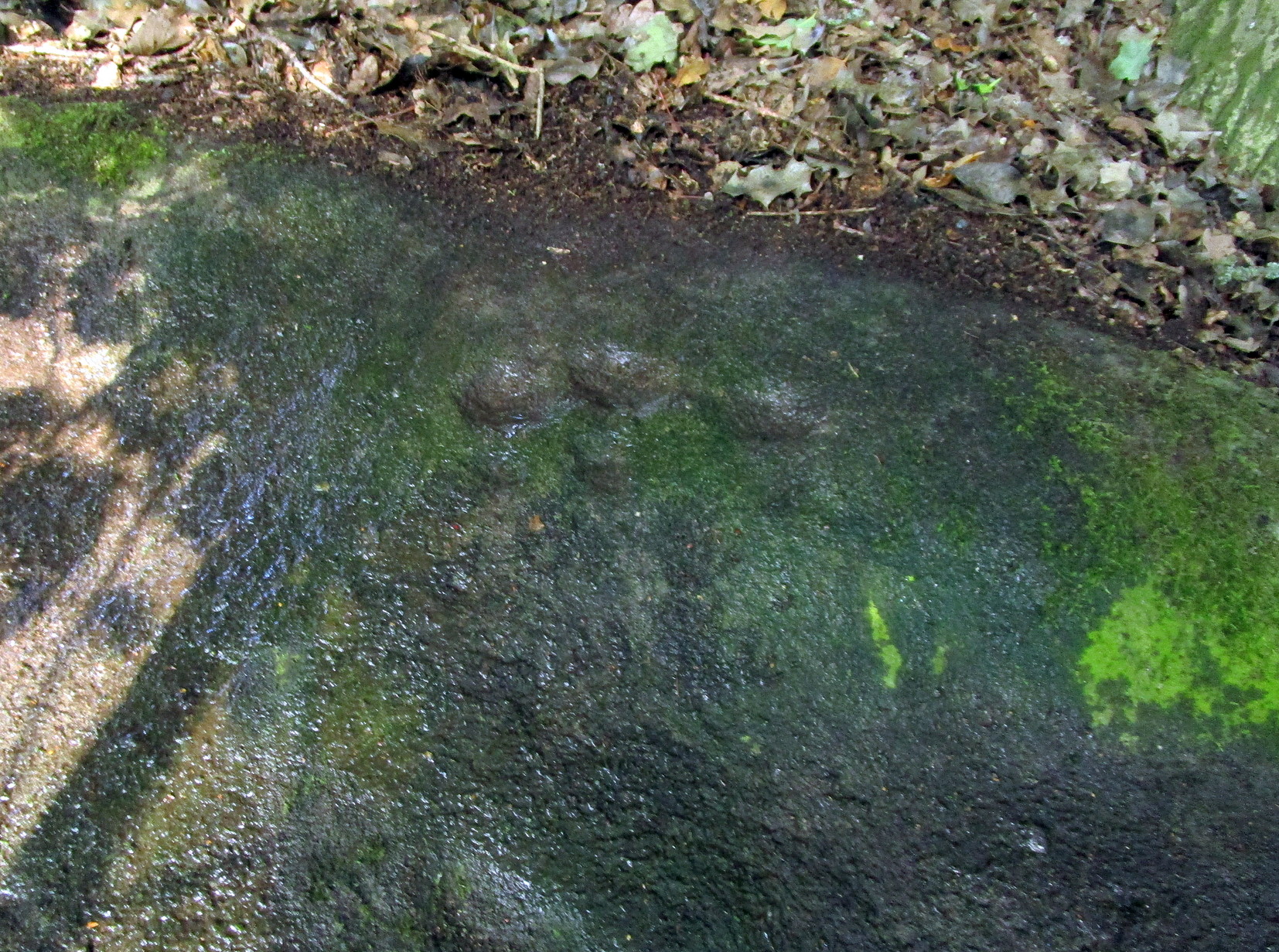
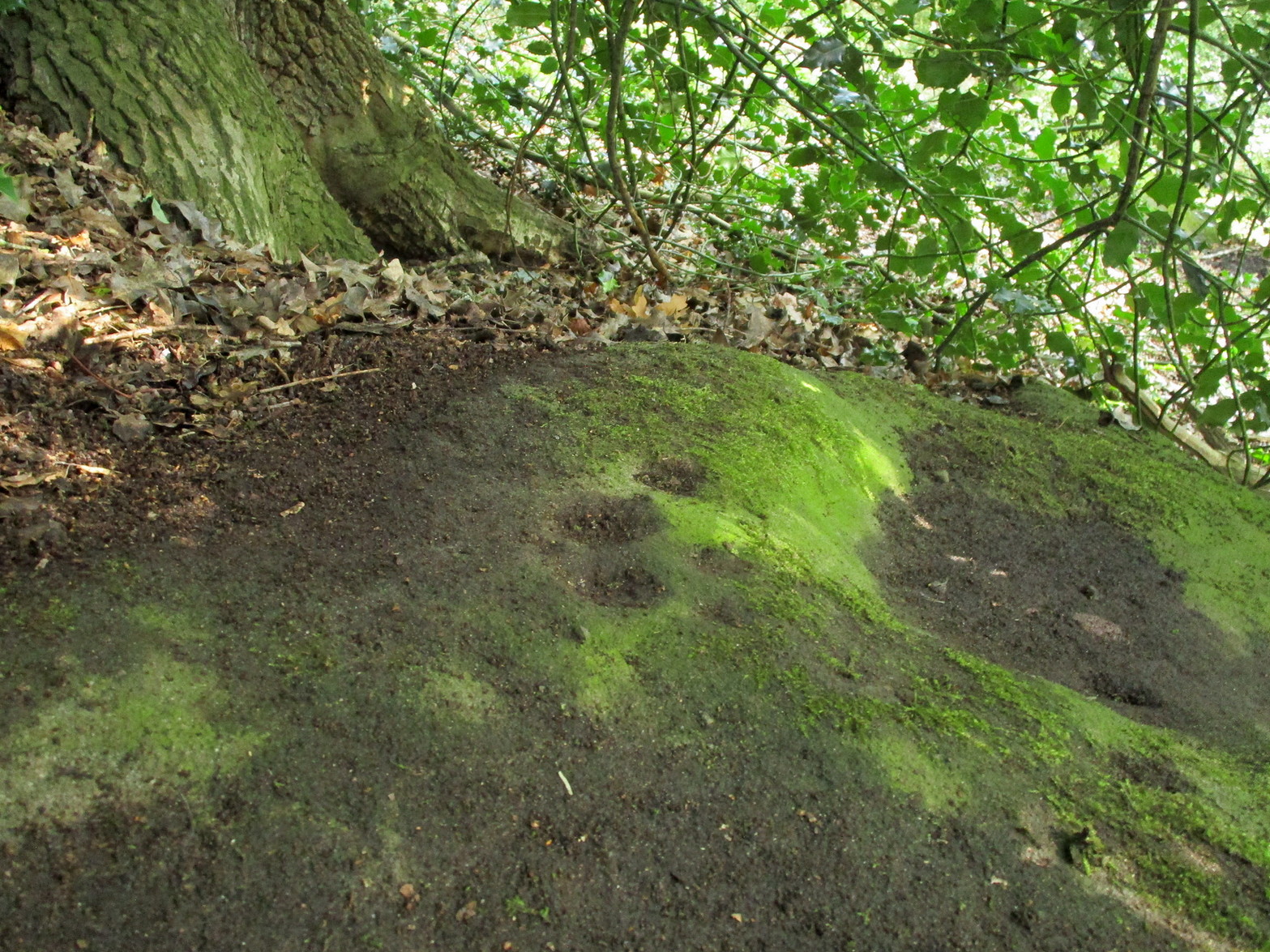
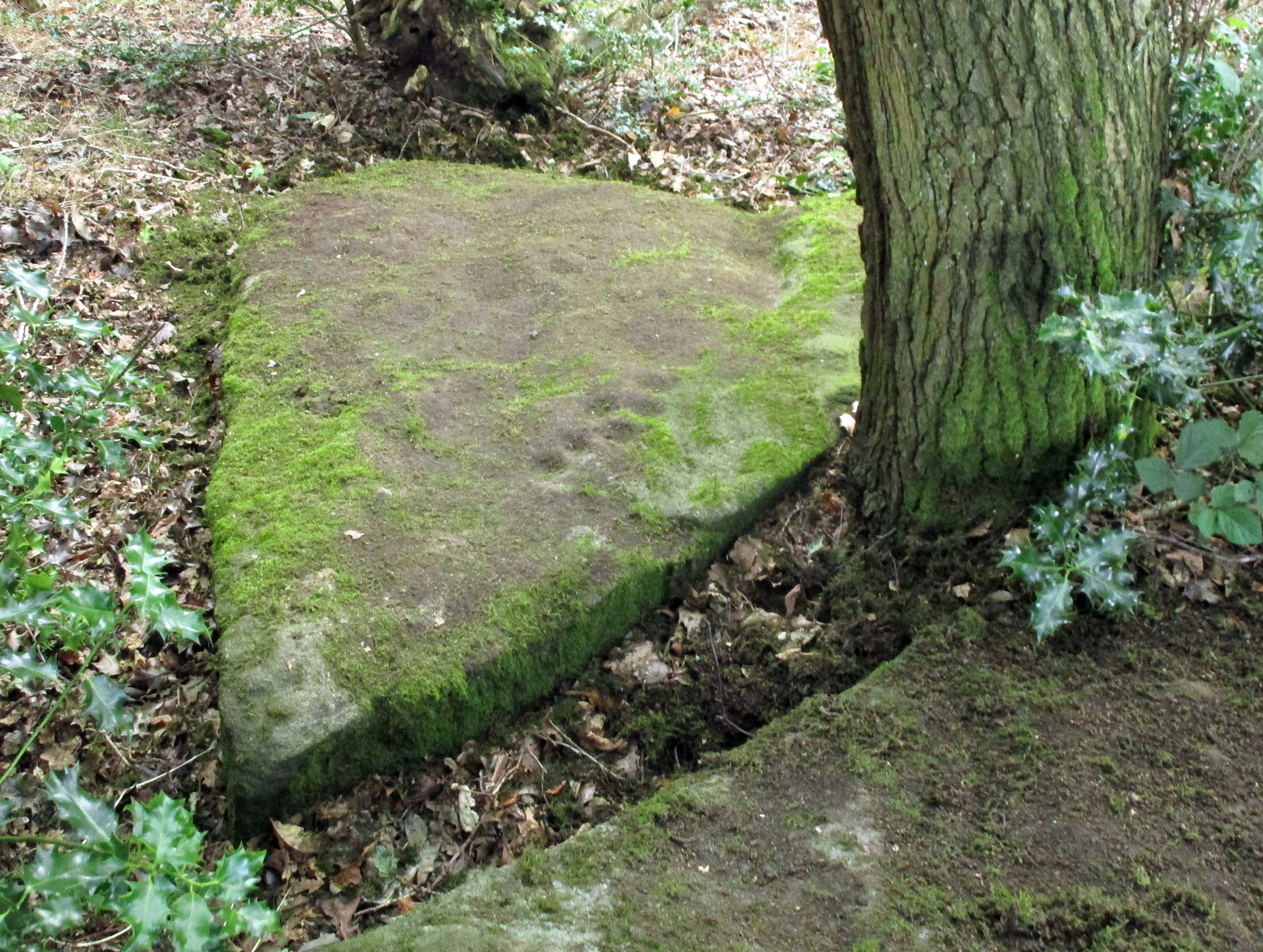
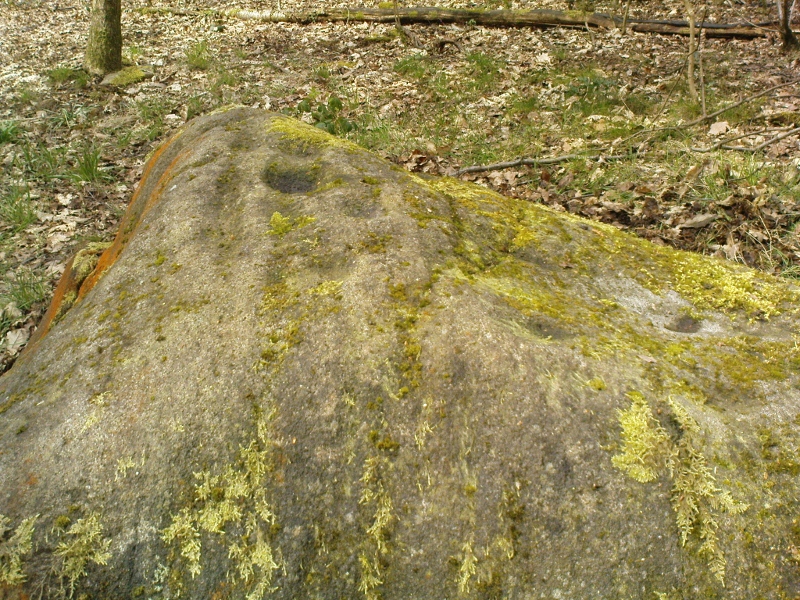
Sloping ever-so-slightly down into the ground, the surface of the stone had a cluster of quite worn, shallow, but distinct cup-markings between one and two inches across, four of which ran in a line from the top to the edge of the stone in a slight curve.  As I walked round it, looking from different angles, it became obvious that two or three other cups existed—mainly from the top to the western side of the rock.  One seemed to exist near the edge, whilst two other faint ones sat to the side of the line-of-four—almost creating a square formation.  From some angles it looked as if there may be faint lines running between some of the cups but (as usual) the sunlight didn’t really help highlight them and they could just be faded erosion lines.

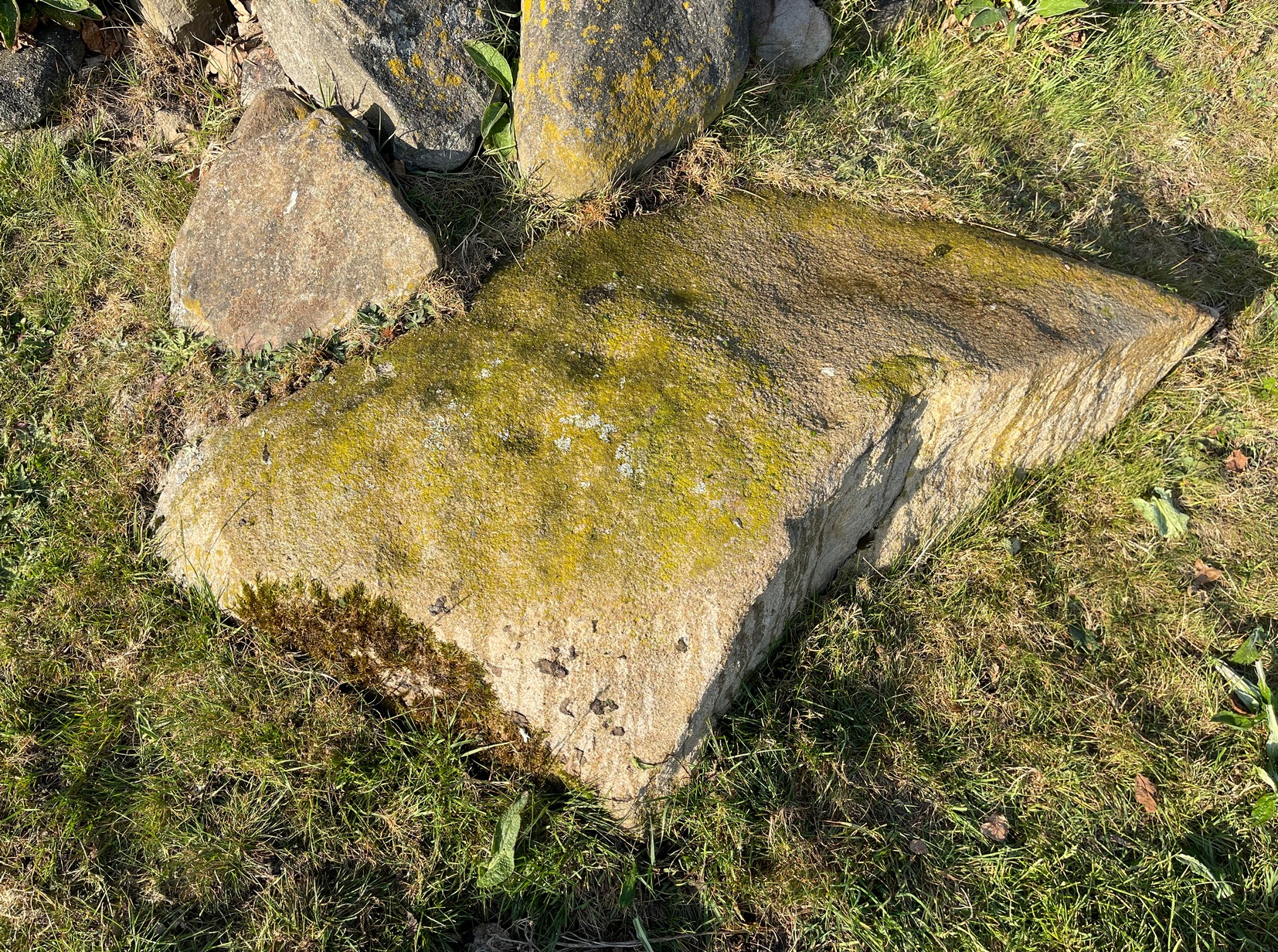
Looking down at the cups
Water & sunlight & cups

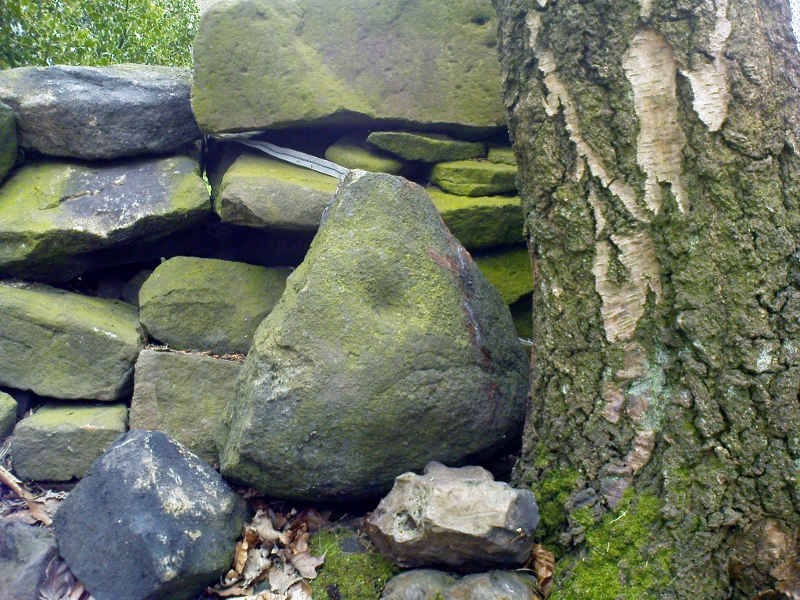
It was obvious that a section of the stone on its southern edge had been broken off in the not-too-distant past, raising the idea that the design may originally have been larger than its present form.  This thought returned when I walked another 60 yards west along the wall and came across a broken section of stone that had been placed into it, pretty recently, and on its vertical face noticed a single cup-mark in a good state of preservation, indicating that it had either been cut recently or instead been dug out of the ground not too long ago and shown intself to the world after a sleep of several millenia.  Look at it when you have a gander at the main carving here and make up your own mind….

© Paul BennettThe Northern Antiquarian

Hawksworth Spring (04), Hawksworth, West Yorkshire

Cup-Marked Stone:  OS Grid Reference – SE 15802 41206

Getting Here

Hawksworth Spring (04)

Take the same directions as if you’re going to visit the Hawksworth Spring (1) carving.  From here, the small footpath at its side keeps going uphill, curving to the right and following the line of walling.  After about 20 yards where the land begins to level out, keep your eyes peeled for a small elongated earthfast rock, less than three feet long, just to the left of the path and only three or four yards away from the wall.  If the leaves have covered the stone, get on your hands and knees and scrub around a bit.  You’ll find it!

Archaeology & History

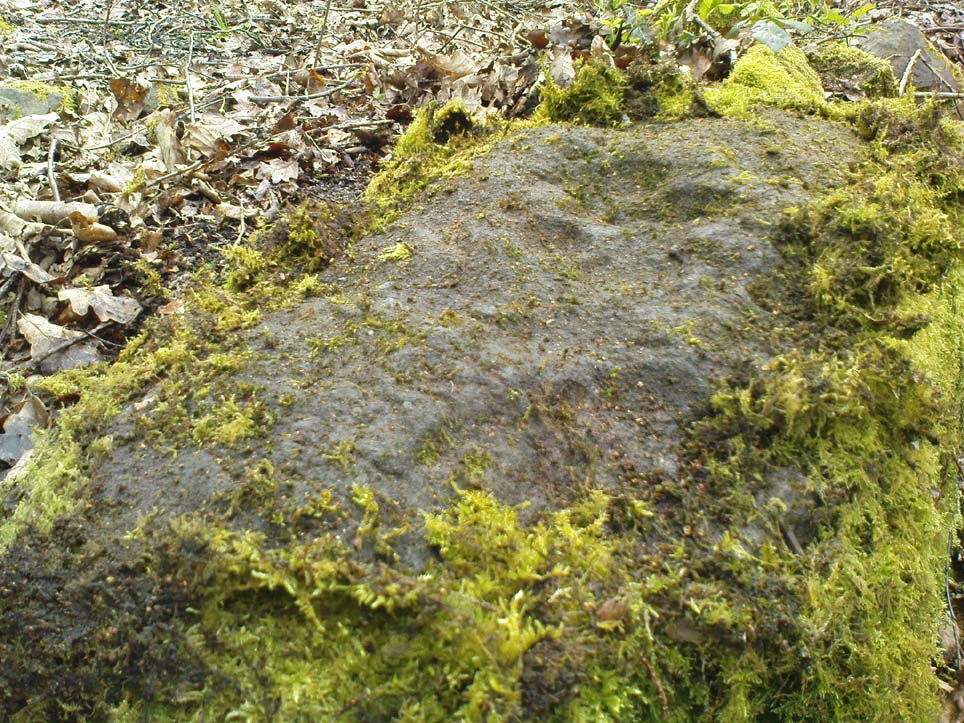
Primary cup-marking

This was a frustrating find as there are several elements on the stone, only one of which I could be 100% certain about – and that’s the singular cup-marking on the top-left of the stone.  Just next to this is what looks to be another one, unfinished, cut into a natural fissure in the rock—but the daylight was frustrating, allowing only glimpses of visual clarity on the stone.  At the other end of the stone, as the photo shows, are what stand out as two or three more cup-marks, but these seem geophysical in nature—although examples such as these scatter the works of Boughey & Vickerman (2003; 2018) as authentic, which shows the problem we all have as rock art students. Anyhow, at least one of these cups is the real deal.  I’ll let the computer-tech lads sort the rest of it out for us…

© Paul BennettThe Northern Antiquarian

Hawksworth Spring (03), Hawksworth, West Yorkshire

Cup-Marked Stone:  OS Grid Reference – SE 15807 41196

Getting Here

Hawksworth Spring (3) CR

Once you’ve located the carvings of Hawksworth Spring (1) and (2), walk up the slope towards the topmost section of the walling where the land begins to level out.  Hereby you’ll see the Hawksworth Spring (4) carving (if it’s not covered in leaves) several yards below the wall. Turn around and look diagonally to your left, into the trees, where you need to walk into and beneath the overhanging holly branches.  Here you’ll reach the large earthfast rock whose edge rests up against the trunk of a larger tree.  You can’t miss it!

Archaeology & History

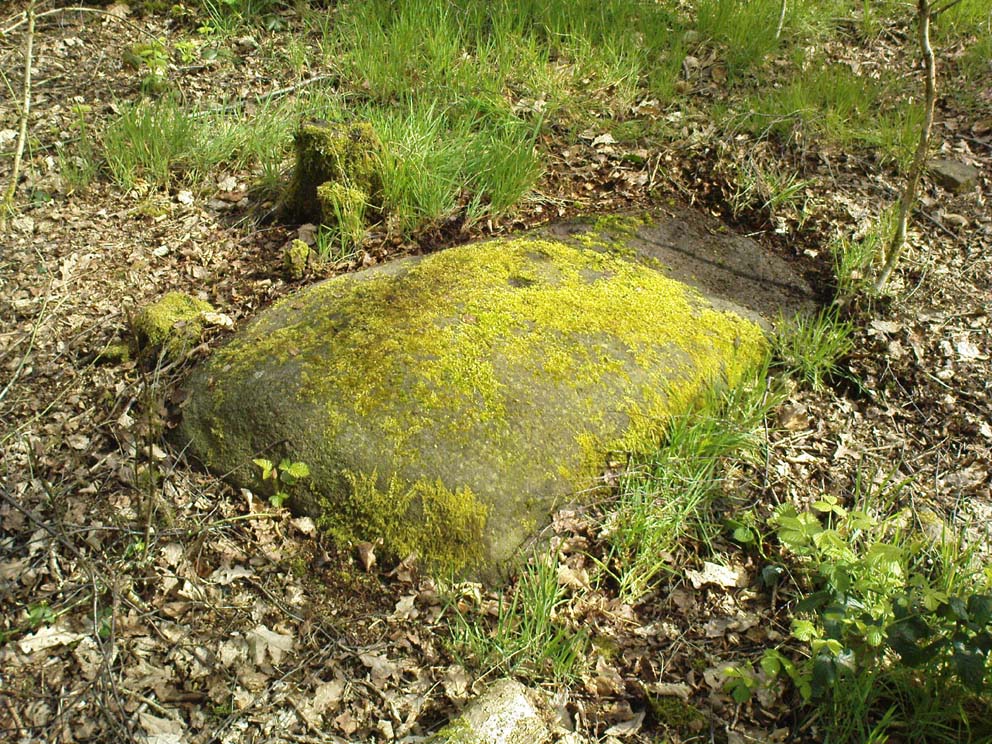
Notable curious “cups”

I’m not 100% convinced that this a prehistoric design, despite it being listed as such in Boughey & Vickerman’s (2003) survey—although, to be fair, they do suggest it as being “doubtful.”  The two most notable so-called “cups” have more of a recent hallmark to them and the other elements are troublesome to see with any certainty, but they may be geophysical in nature.  Their description of it told us this was a “fairly large fine-grained rock with some included pebbles.  Two pairs of cups, one pair connected by groove”.  Make of it what you will….

References:

  1. Boughey, Keith & Vickerman, E.A., Prehistoric Rock Art of the West Riding, WYAS: Wakefield 2003.

© Paul BennettThe Northern Antiquarian

Hawksworth Spring (02), Hawksworth, West Yorkshire

Cup-and-Ring Stone:  OS Grid Reference – SE 15774 41191

Getting Here

Here’s the one yer after!

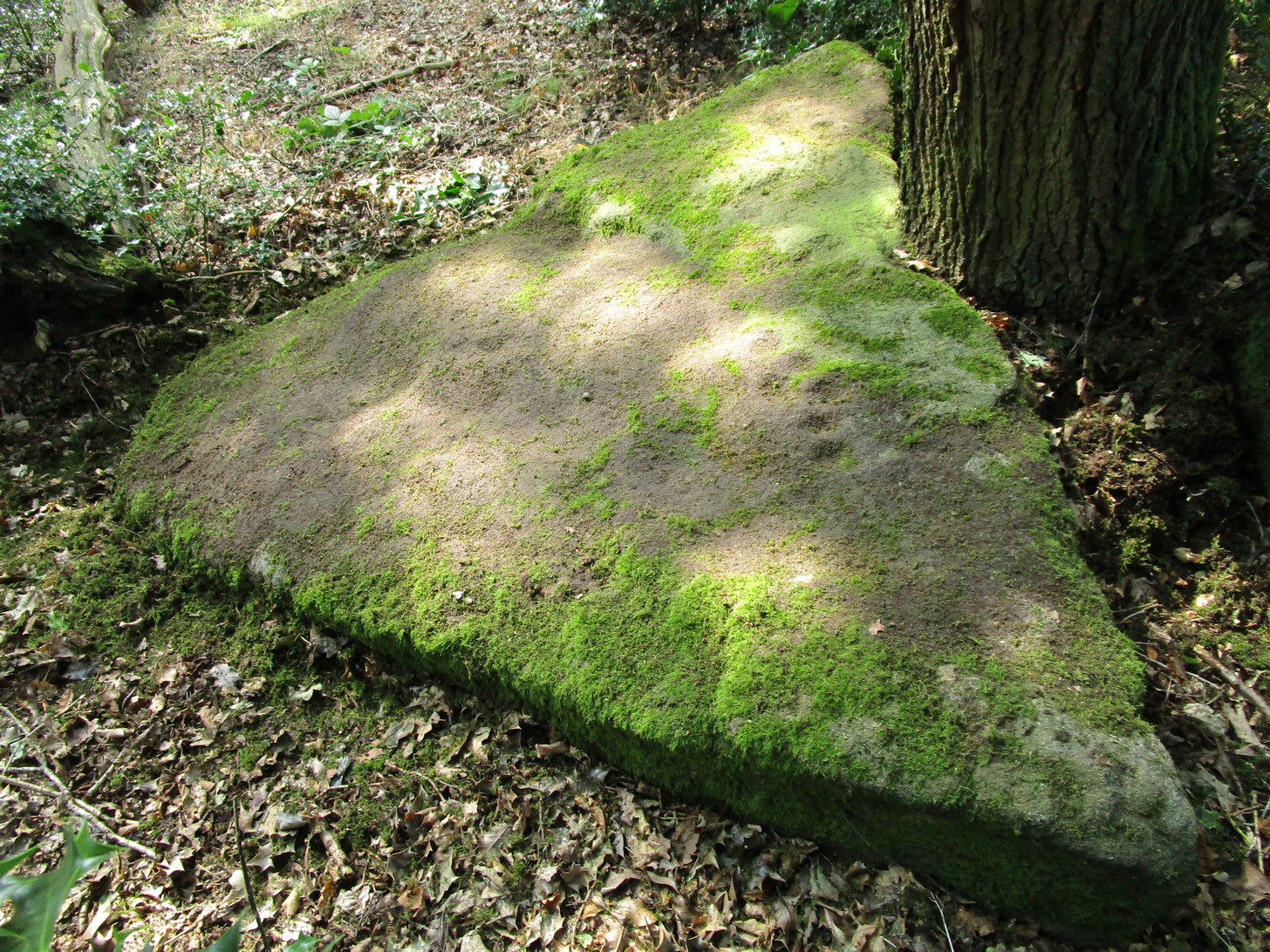
You can take the same directions to get here is you follow the route for the Hawksworth Spring (01) carving, or take this alternative route. Take the standard road from Guiseley along Hawksworth Road.  When you reach the first row of old houses in the village, a couple of hundred yards on you reach the village school and, shortly after the footpath is sign-posted.  Walk left (downhill) through the field for half-a-mile until you reach the woods.  100 yards into the into the trees, walk to your right and follow the line of walling straight for 400 yards, then veering right up the slope and it then slowly bends round, keeping to the wallside all along. It then starts heading back downhill.  As it does so, 10 yards from the wall into the woods you’ll see the broken triangular rock of the Hawksworth Spring (01) carving.  Walk another 10 yards where the large holly bushes are and you’ll see the large sloping stone in front of you.

Archaeology & History

This carving is similar in nature to its companion 10 yards away, inasmuch as each of them possess two small arcs of cup-marks almost in the same format, very close together, one above the other near the top of the stone.  It’s possible that the mythic nature/function of this particular element of arcs is the same on each stone—although fuck knows what it might be!

Clear line & faint line of arcs
Clear arc of cups

Below this double arc (only one of which is clearly visible in the photos) we see a scatter of other cup-marks—perhaps six, perhaps seven—one of which appears to have a very faint incomplete ring round it.  When Liz Sykes and I visited the place, the light of day and the shadows across the rock didn’t help to convince us one way or the other, so we await news from other visitors who get better light conditions to tell us whether our hopeful eyes were deceiving us or not.  There are a number of other marks on its surface, but these are much more recent and very obviously cut, or rather scratched, by metal artifacts with no bearing on the prehistoric design.

References:

  1. Boughey, K.J.S. and Vickerman, E.A., Prehistoric Rock of the West Riding (Supplement), Shipley 2018.

Acknowledgements:  Huge thanks to Liz Sykes for her renowned cleaning skills!

© Paul BennettThe Northern Antiquarian

Hawksworth Spring (01), Hawksworth, West Yorkshire

Cup-and-Ring Stone:  OS Grid Reference – SE 15767 41195

Getting Here

Looking down on the stone

Through Baildon town centre, take the road onto Baildon Moor, but instead of turning left up to Baildon Hill, keep straight on the Hawksworth road and 100 yards along you’ll see a car-park is on the right-hand side, just before you start going downhill.  From here, walk down the road a couple of hundred yards until you see the footpath (keep your eyes peeled!) turning right towards The Whitehouse, and from there take the footpath dead straight down to the woods below.  Cross the stream, turn right, then immediately left uphill by the wall-side.  Shortly before reaching the top you’ll see a large triangular sloping slab of rock with a tree at its top.  That’s it!   Alternatively you can come via Hawksworth village by following the directions to the Hawksworth Spring (02) carving, which is just 10 yards east of this one.  Easy!

Archaeology & History

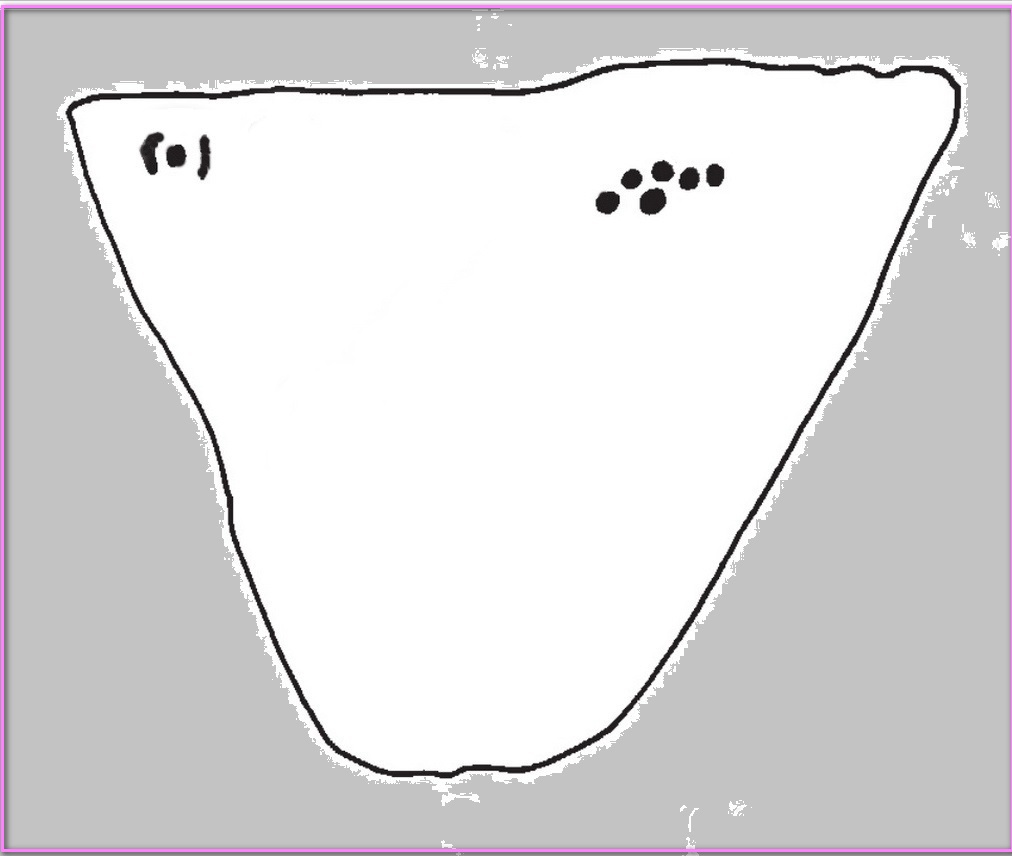
Sketch of carving (after Hedges 1986)
Note the faint cup, top-right

This minimalist design is best seen from above the adjacent rock which, in times gone by, was attached to this very same stone.   The main aspect of the carving are the two short rows of three cups, running almost alongside each other, in a likeness which my compatriot Liz Sykes said “was like some animal footprints.” It’s not a bad description to be honest (this same motif is found on a companion petroglyph just a few yards to the east: the Hawksworth Spring [2] stone).  If you follow the direction of the “animal tracks” to the western end of the stone, you’ll see another isolated cup with a faint incomplete ring around it.  You can just make it out on the photo to the right.  Another single cup-mark seems apparent two-thirds the way down the stone.

References:

  1. Hedges, John (ed.), The Carved Rocks on Rombalds Moor, WYMCC: Wakefield 1986.

Acknowledgements:  Huge thanks to Liz Sykes for her renowned cleaning skills!

© Paul BennettThe Northern Antiquarian

Buck Woods Carving (03), Thackley, Bradford, West Yorkshire

Cup-and-Ring Stone:  OS Grid Reference – SE 17456 39162

Getting Here

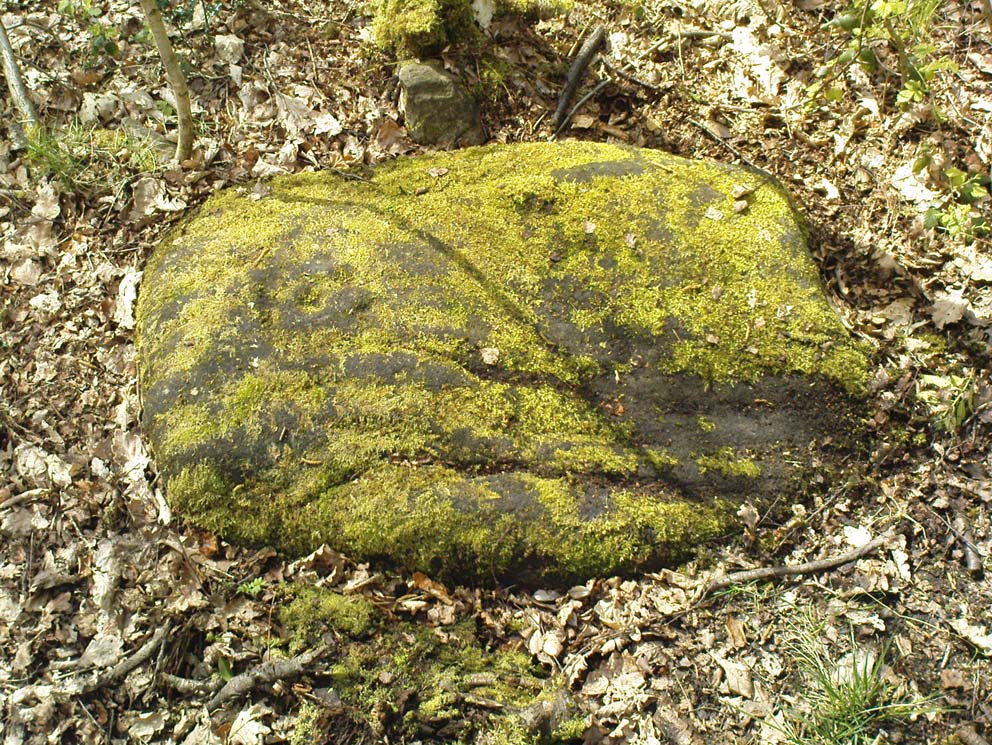
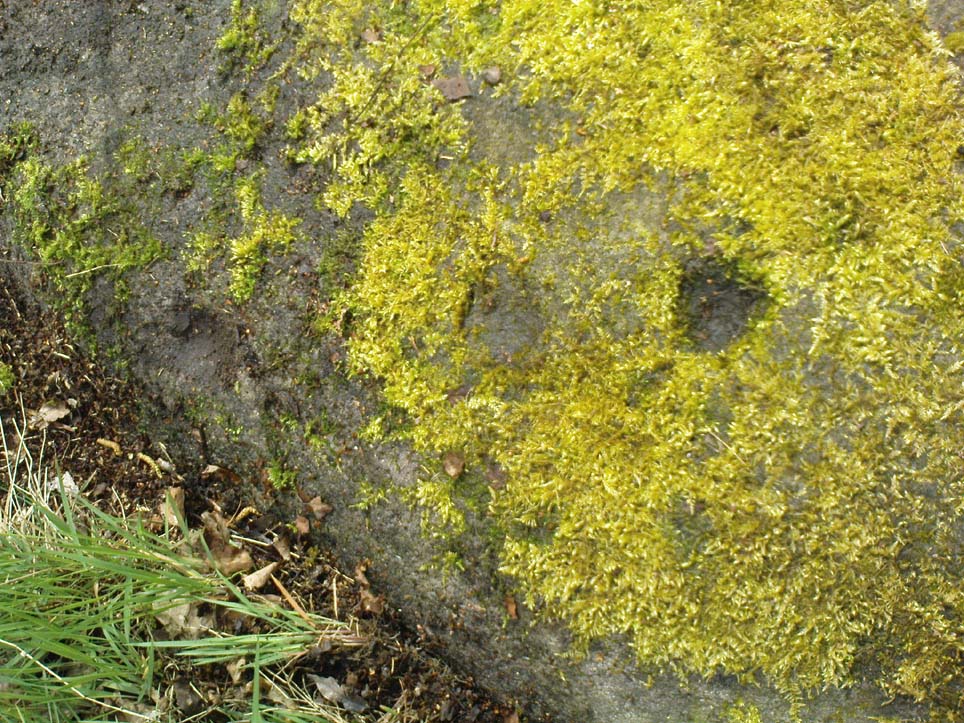
A mossy cup-and-ring

Follow the same directions as if you’re visiting the largest and most ornate of the Buck Woods carvings. From here, about 10 yards ahead of you, roughly north, you’ll see another stone, less than half-size of Buck Woods 1, moss-covered and not rising too much out of the Earth.  It’s not difficult to find once you’ve located the largest of the Buck Woods stones.

Archaeology & History

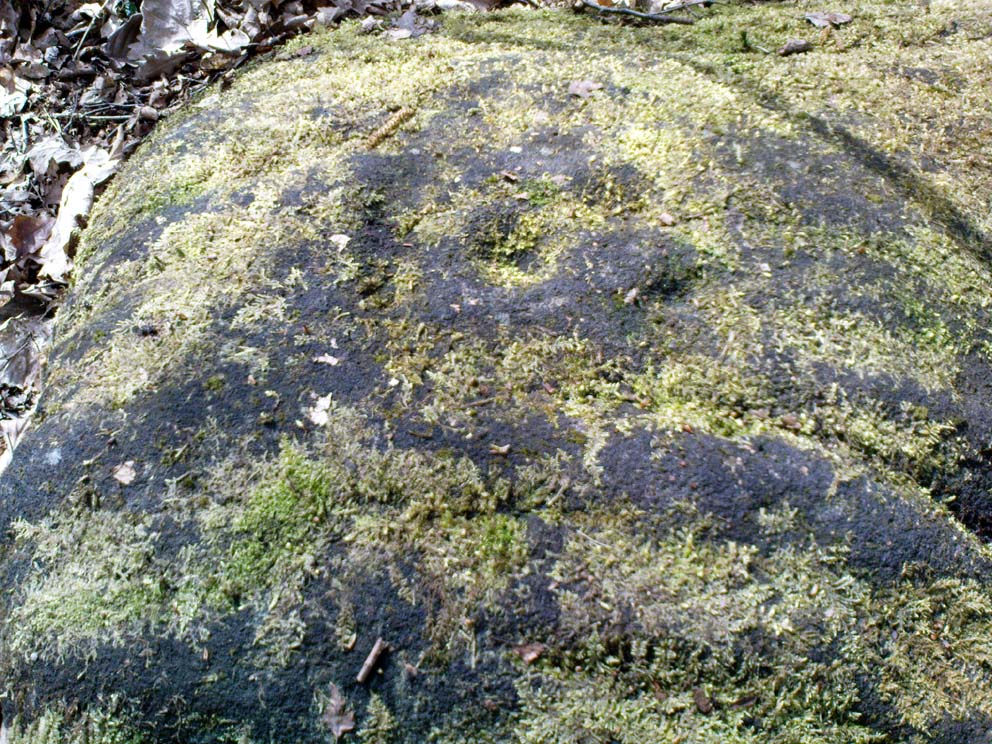
A cup-and-half-ring

Another of the small cluster of little-known prehistoric carved stones in this woodland on the edge of Bradford, not in the Boughey & Vickerman (2003) survey.  This however is possessed of a cup-and-half-ring, with other seemingly carved ingredients fusing onto natural aspects of the rock.  The design is found on the highest part of the stone; and whilst the main cup is easy to make out, the encircling half-ring is slightly troublesome.

…and from another angle

There are two distinct lines running down one side of the rock, both seemingly natural, but they may have been added to—it’s difficult to say with any certainty.  Certainly the one closest to the cup-and-half-ring has the carved line etched to meet the natural geological feature, as you can just make out in the photos here.  There also seems to be other carved features surrounding the central design, with other marks round the main cup, almost suggesting that a complete ring was being made, but never accomplished.  It’s an odd one.  If I’d have stripped the moss from the stone I could have seen the design in greater detail, but I’ve gotta bittova soft spot for mosses and lichens, so left it alone!

© Paul Bennett, The Northern Antiquarian


Buck Woods Carving (04), Thackley, Bradford, West Yorkshire

Cup-Marked Stone:  OS Grid Reference – SE 17418 39163

Getting Here

It’s the moss-covered stone, centre-right

Follow the same directions as if you’re visiting the largest and most ornate of the Buck Woods carvings. From here, walk 10 yards to the Buck Woods 3 carving, then about the same distance forward again until you reach the low lines of (what looks like) Iron Age walling running roughly east-west through the trees.  Walk 10-20 yards east along the walling until a gap or entrance appears – and on the other side where the walling starts again, check the 2nd or 3rd rock along, beneath the mosses.

Archaeology & History

More simple cup-marks

There are no previous references to this small cup-marked stone, whose cups are on the topmost surface of the stone in this ancient stretch of walling (into which some vandal has recently carved his name, ‘Hunt’). It’s another one for the purists amongst you though, as we only have 2 or 3 cupmarks here, as the photos show – with just one which I can say is a certainty.  Curiously the other two look, for all the world, as if they’re mollusc cups!—but considering you’re about 50 miles from the sea, this seems a little unlikely.  Worth having a look at when you’re checking the other four carvings close by.

© Paul Bennett, The Northern Antiquarian

Buck Woods Carving (02), Thackley, Bradford, West Yorkshire

Cup-Marked Stone:  OS Grid Reference – SE 17473 39152

Getting Here

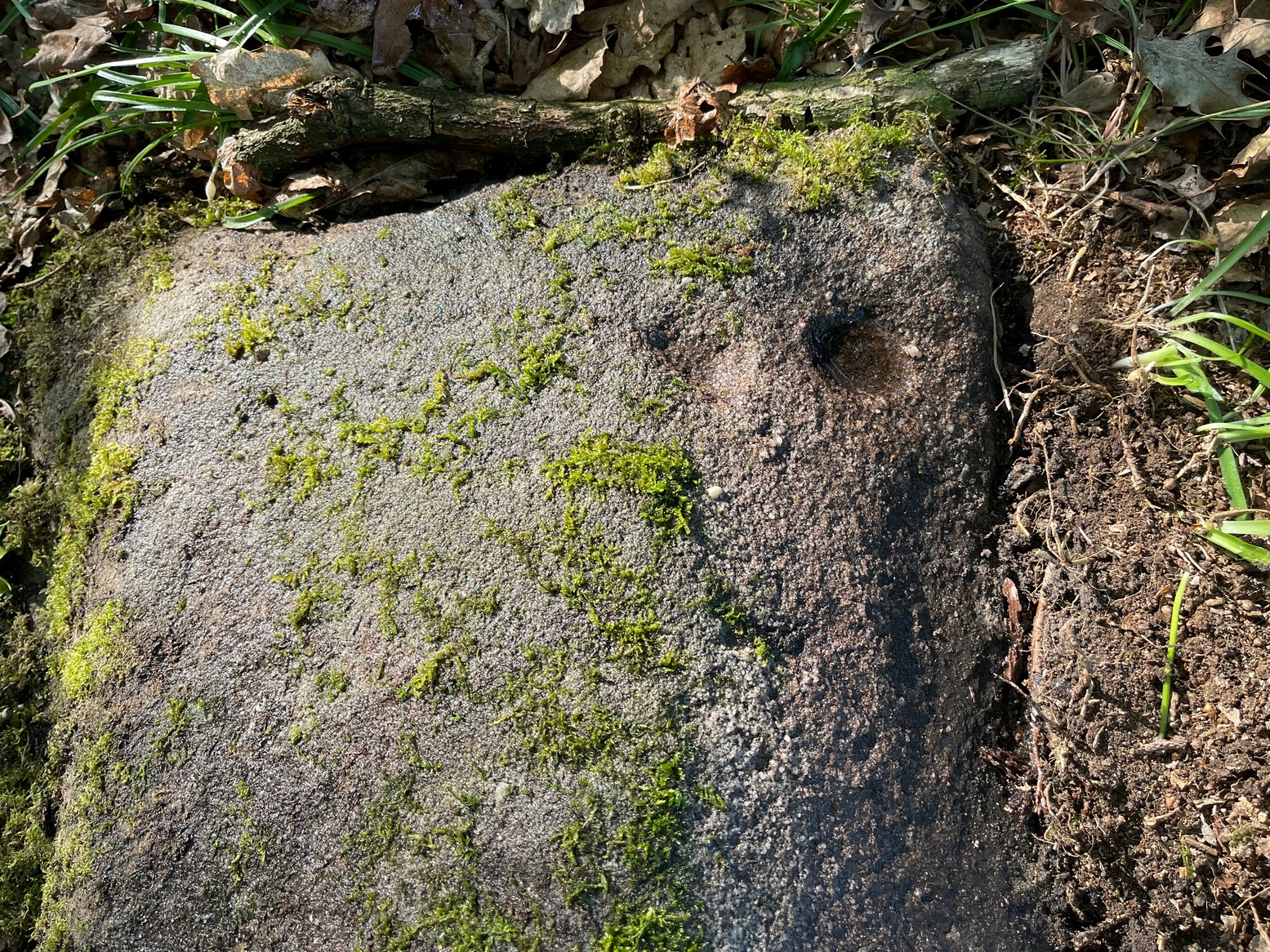
Buck Woods cup-marks

Follow the same directions as if you’re visiting the largest and most ornate of the Buck Woods carvings. Once there, notice the green field on the other side of the wall less than 50 yards away. Walk towards the wall, about 20 yards from the Buck Woods 1 carving, keeping your eyes peeled for a flat mossy stone.  You’ll find it!

Archaeology & History

Close-up of the cups

A nice simple, almost cute cup-marked stone—not included in the Boughey & Vickerman (2003) survey—with three simple cups running almost in a straight line from the middle of this long stone to its outward, eastern edge.  One of the good features of this and its associated carvings is the setting amidst which it’s found. We tend to associate these carvings with open moorland, where many now live, but when they were first carved they were surrounded by woodland and much more: important ingredients relevant to understanding the nature of these curious carvings…

© Paul Bennett, The Northern Antiquarian

Buck Woods Carving (05), Thackley, Bradford, West Yorkshire

Cup-Marked Stone:  OS Grid Reference – SE 17554 39290

Getting Here

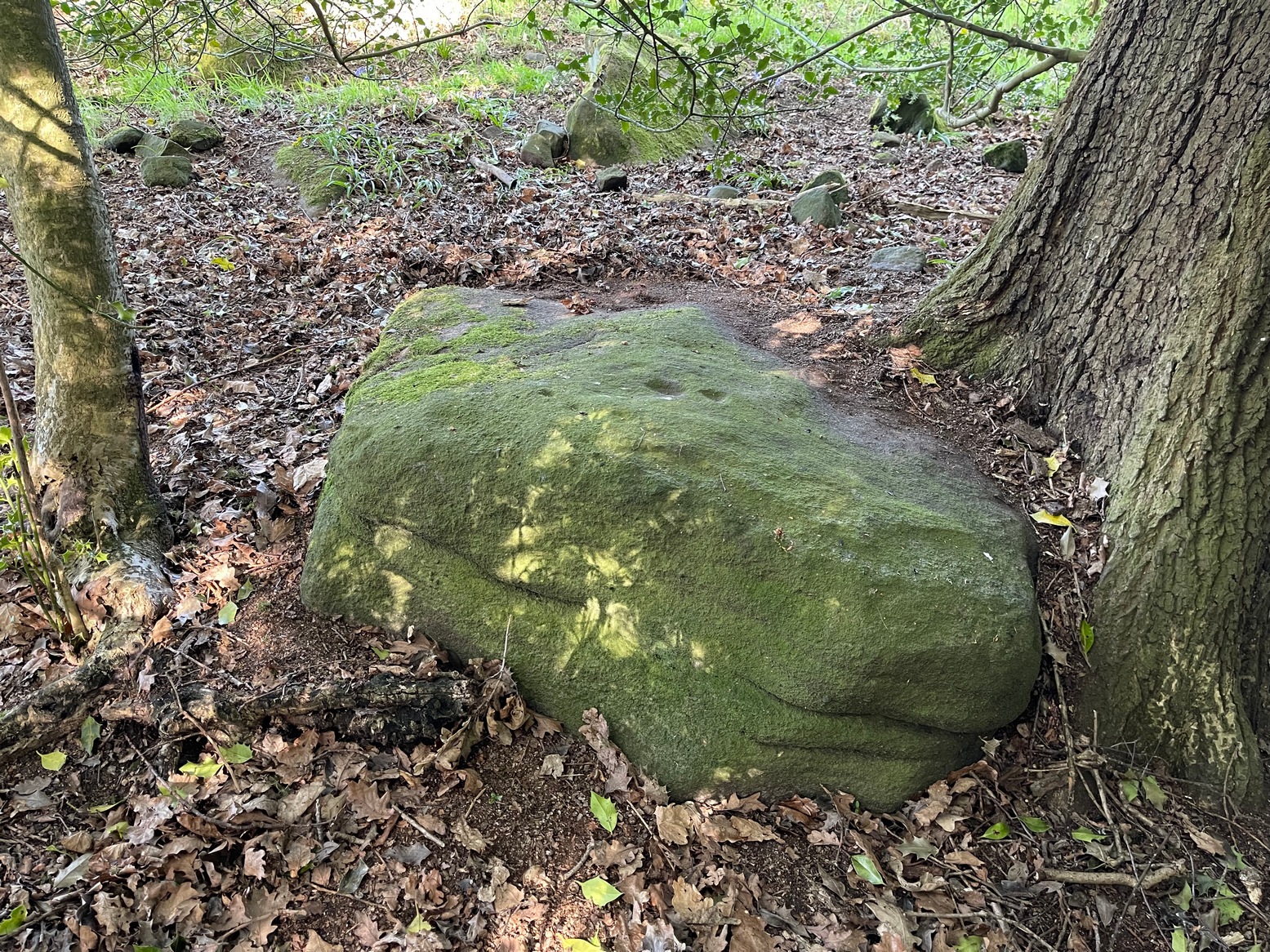
Single cup-marked stone against wall

From Thackley corner, take the Esholt road down Ainsbury Avenue.  Walk past the Thackley football ground and another 50 yards on, to your left, there’s a field.  Cross this and go through the gate into the trees.  Another field is across the footpath, but turn right and walk on the muddy path, keeping parallel with the other field, until the walling bends round to the left.  About 15 yards round where the wall bends left, watch out for the silver birch tree and the small cup-marked rock at its base, right up against the wall.

Archaeology & History

This is an archetypal single cup-marked stone known as a ‘portable’ — though in its original state, when the rock was obviously larger than it is today, I doubt anyone could have carried it further than a couple of yards!  The stone has been split from a larger rock, and we’re unsure the size of its original form—but presume it to have been perhaps double its present size.

The broken rock stands (now) upright against the wall and nice birch tree (Betula pendula), but wasn’t like that when we first found it, and the cup was barely visible as it faced down into the Earth.  As the images show, we have just a single cup-mark on its outer face.  It looks typical of those carvings found in the larger Bronze Age cairns scattering the moors to the north, but we have no evidence nor folklore indicating the existence of such a monument hereby.  The extensive amount of overgrown multiperiod walling all over this woodland may have used up such a cairn, but we will probably never find out, as the woods have been overused by industrialists, who are now, slowly, turning the woods here into a park.

© Paul Bennett, The Northern Antiquarian

Buck Woods Carving (01), Thackley, Bradford, West Yorkshire

Cup-Marked Stone:  OS Grid Reference – SE 17456 39155

Getting Here

One of the Buck Woods carvings
One of Buck Woods carvings

From Thackley corner, take the Esholt road down Ainsbury Avenue.  After a couple of hundred yards, note the metal gateways into the woods.  Go through here, following the main path, until you reach another split in the paths where one of those awful touristy signs tells you where you are.  Walk past this (not left or right) into the opening of large oaks and other trees on a flat plain.  A path swings round the right side of this, and less than 100 yards along, watch out for some rocks on your right, heading towards the wall and small field.  You’re damn close!

Archaeology & History

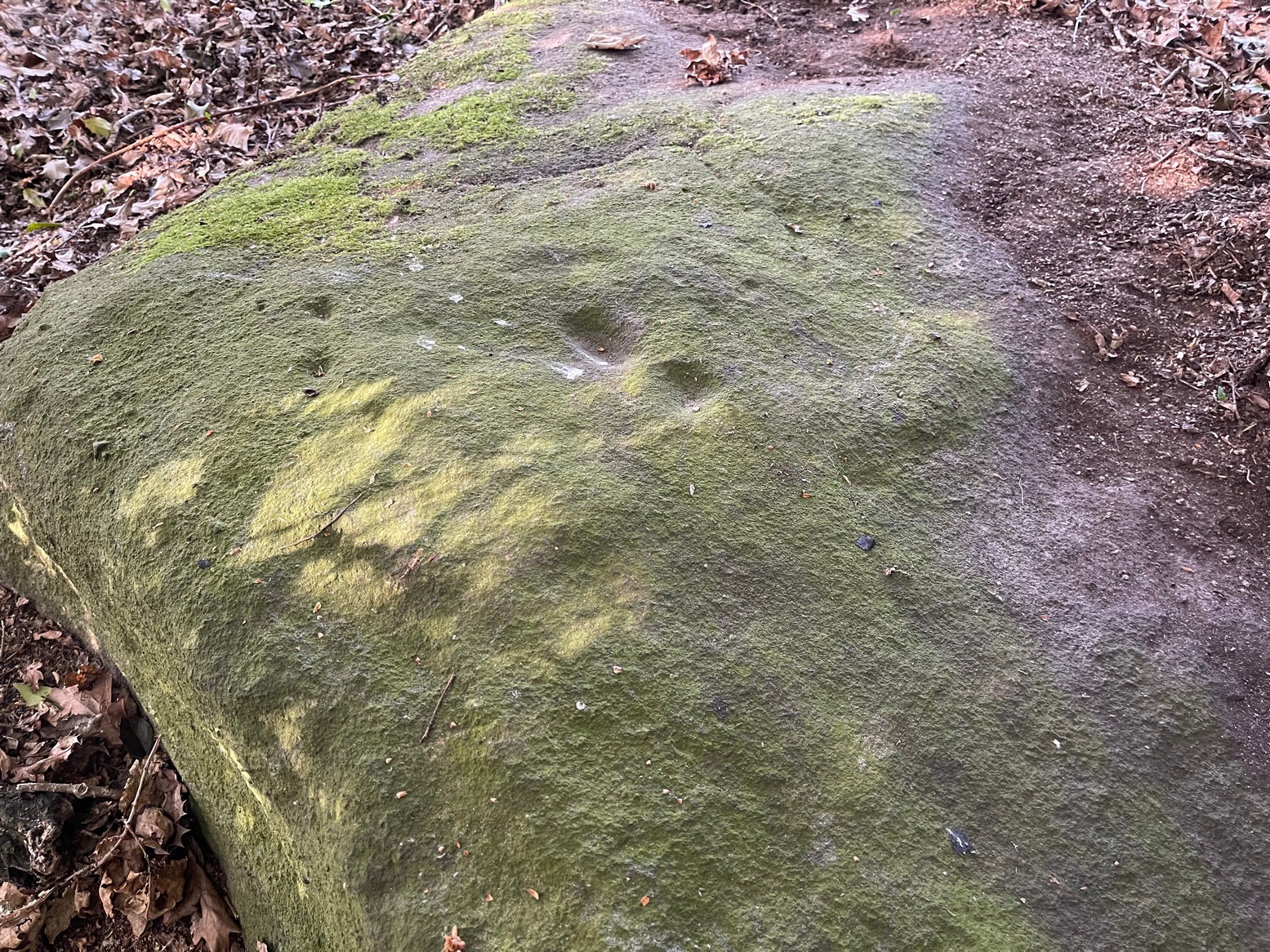
Close-up of cup-markings

This is one amongst a cluster of at least five cup-marked stones very close to each other in the woods here — and probably the best of the bunch.  Also found in conjunction with what seems to be an Iron Age walled enclosure 20 yards away, there are at least eight cup-marks on top of this rock,  They occur in two groups: one, on a sloping section of the boulder where three fading cups can be seen; and the other is on the topmost section of the stone, where five larger cups distinctly stand out, and occur in conjunction with what seems to be a long carved line running close to the edge of the rock before it drops sharply to the ground.

This and its associated carvings are found in close proximity to some sort of walled enclosure.  It’s difficult ascertaining the age and nature of the enclosure walling, as masses of it are found throughout this section of woodland and it appears to be multiperiod in age and nature: from Iron Age to Victorian by the look of things.  Neither this cup-marked stone, nor any of its close associates (the closest of which is the Buck Woods 3 carving, less than 10 yards away), were recorded in the Boughey & Vickerman survey of rock art in West Yorkshire.

© Paul Bennett, The Northern Antiquarian