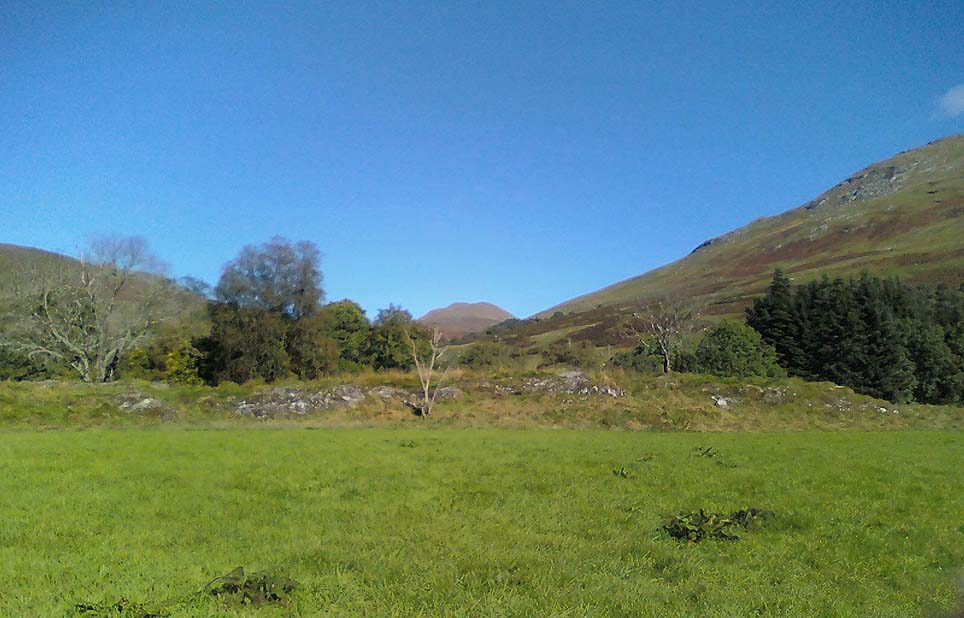
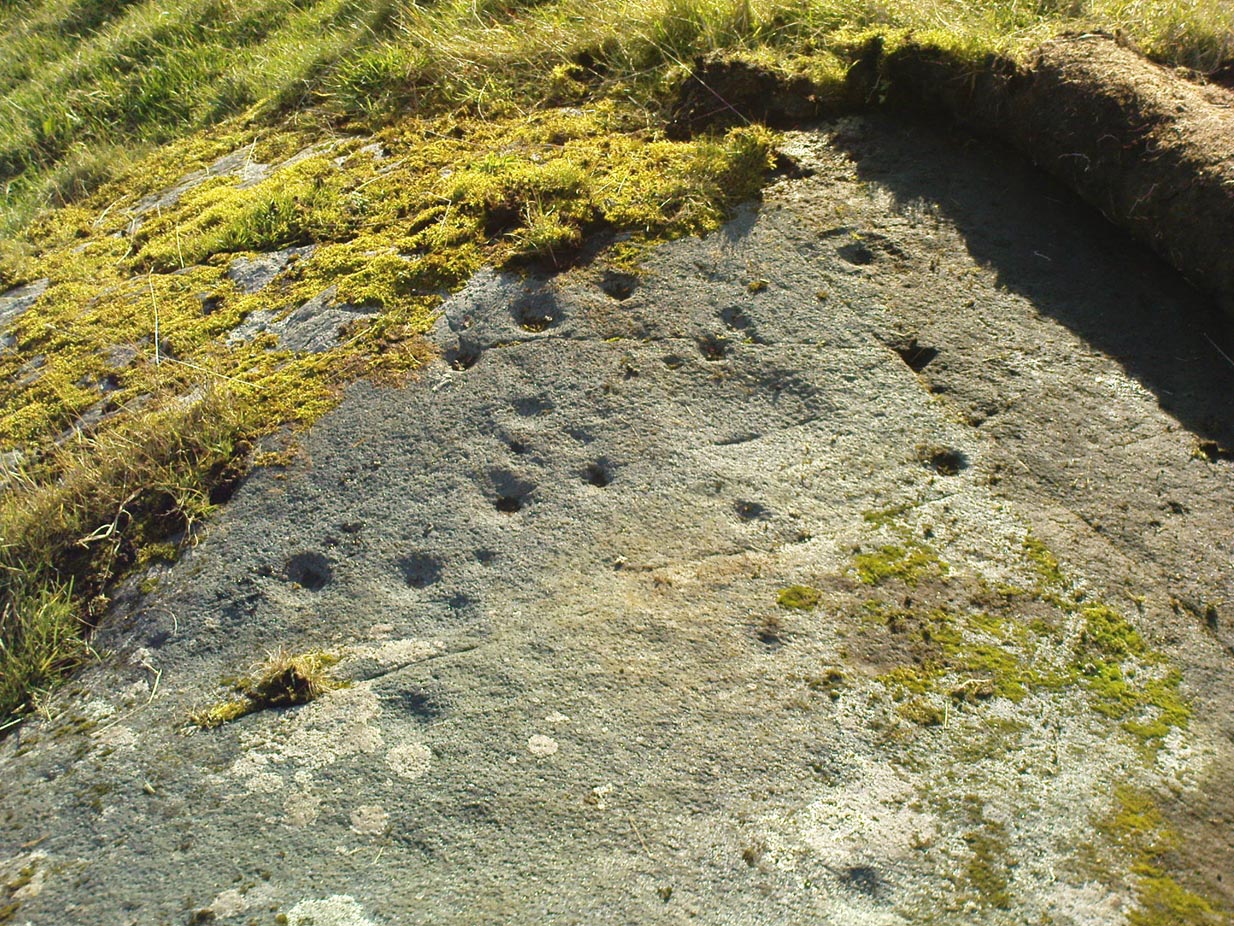
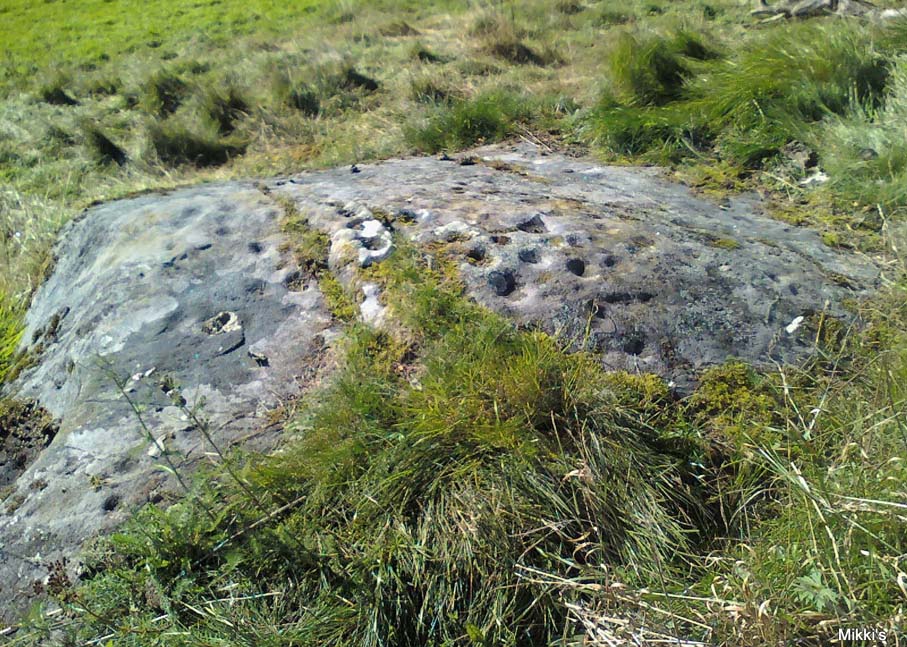
Duncroisk (2), Glen Lochay, Killin, Perthshire

Cup-and-Ring Stone:  OS Grid Reference – NN 53134 35850

Also Known as:

  1. Canmore ID 24169
  2. Duncroisk 3 (Canmore)

Getting Here

Cup-and-rings by the River Lochay

Troublesome to get to unless you’re reasonably fit.  Probably the easiest route is to get to the Duncroisk 3 cup-and-ring stone. Keep walking along the riverside, climb over the first tall wooden fence and onwards till you reach the rocky crag reaching into the river Lochay. By whichever means possible, get yourself up and round this crag, but keep by the riverside till you get to the easier walkable rocky outcrop protruding into the river on the other side of the drop.  Hereby, on one of the stones, look and you’ll find these faint cup-and-ring symbols.

Archaeology & History

Although this carving was first described in Edward Cormack’s (1952) essay on the prehistoric carvings of the district, they have subsequently proved difficult to locate by the Royal Commission lads and other archaeologists.  I’ve been here a few times looking for it and never managed to find it — until last week.  When Mr Cormack first told of the design, he said:

“On a smooth rock surface just above the mouth of the small burn running into the Lochay, immediately west of the cup-marked ridge, are two cup-and-ring markings a yard apart. The rings are curiously rough edged, and do not give the same impression of weathering as those on the ridge; possibly they have been silted over shortly after being cut, and exposed again relatively recently.”
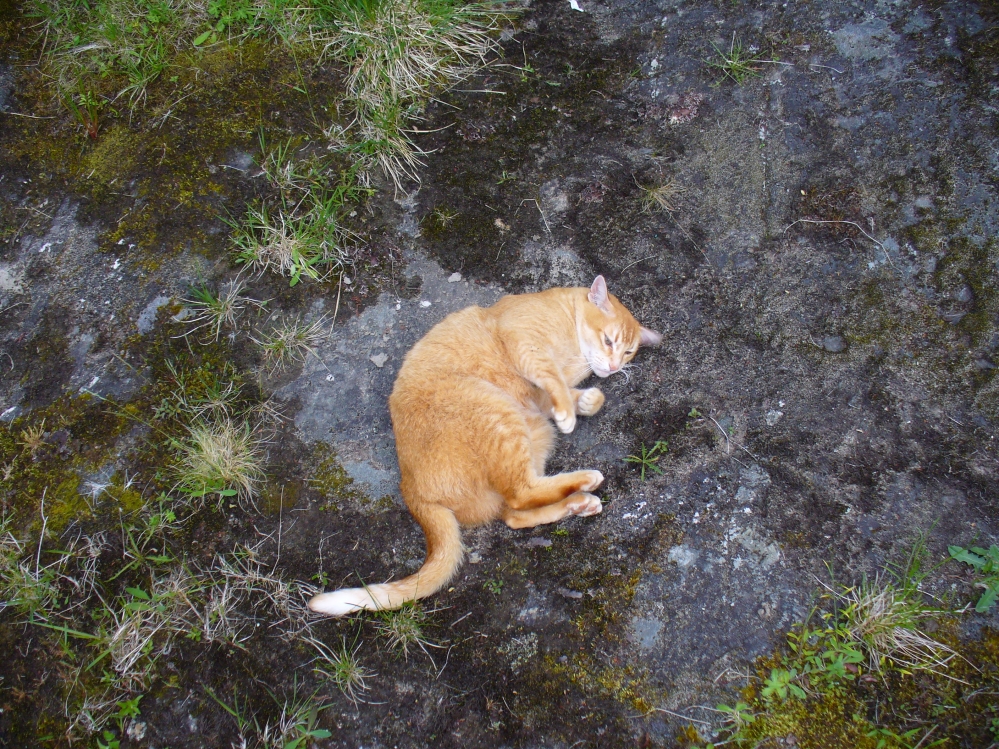
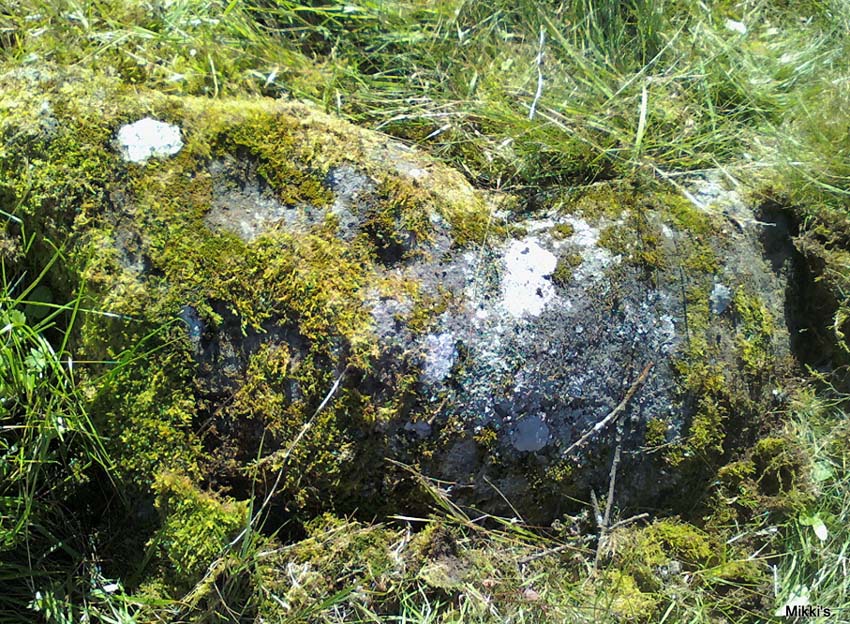
Flambeau the Cat uses the carving as his bed!

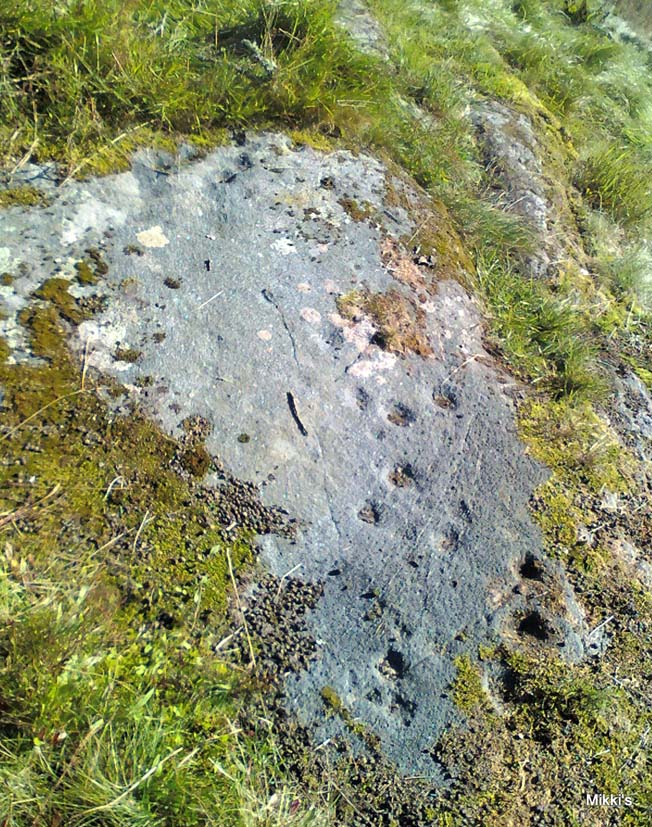
A few decades later, Ron Morris (1981) came across the carving, 10 yards “southeast of an elbow of River Lochay”, as he put it. Described as “hard to find”, he went on to give a basic outline of the design as he saw them, telling there to be “2 cups-and-one-ring, both probably complete, up to 16cm (6in) diameters, with radial grooves from cup to ring—up to 1cm deep.” Or more simply, two cup-and-rings, each with a line running from the centre to the surrounding ring.

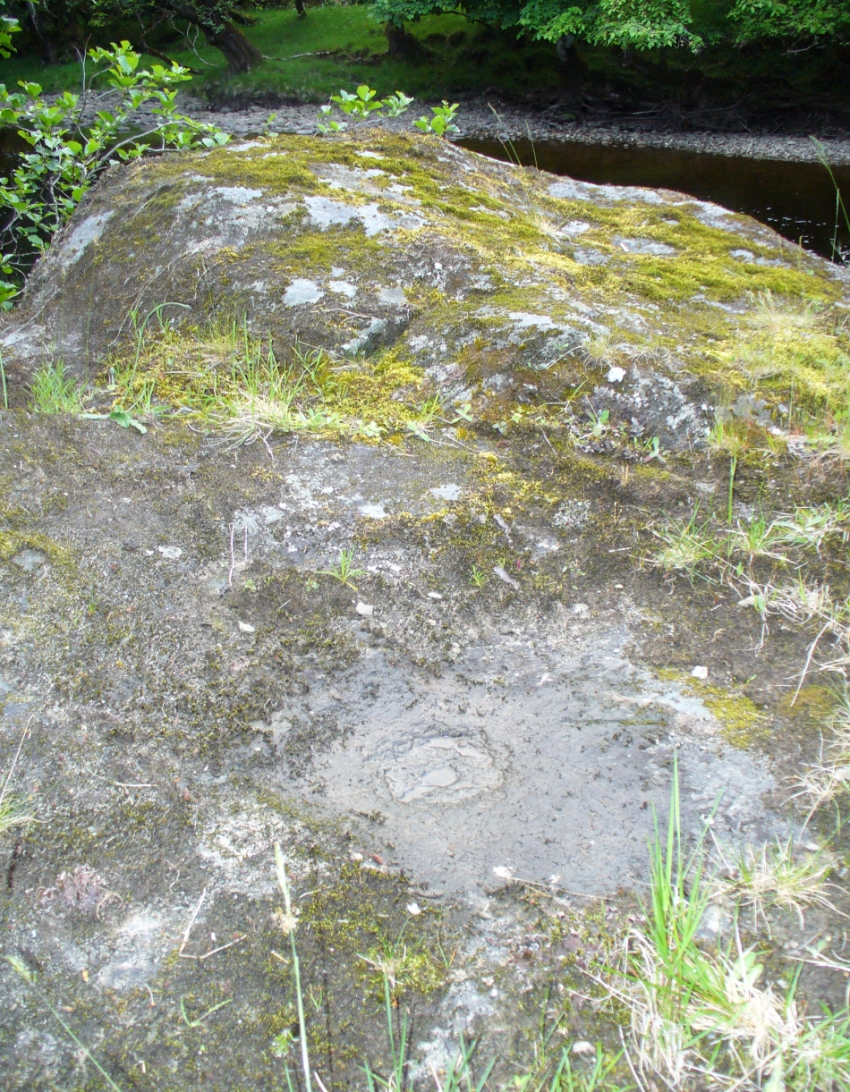
After trying to find this carving on several occasions, without success (somehow!), it was brought to my attention under the brilliant guidance of a local cat called Flambeau only last week (no lies!).  In a venture down to the riverside, the great cat (in tandem with Pip the dog, who also ventures out with me to find ancient sites in this region) got to the riverside on the rock in question and began rolling about in the dust on the stone, mewing and purring away merrily!  It was really brilliant to watch. Sincerely heart-warming (soz…but I can’t help it!).
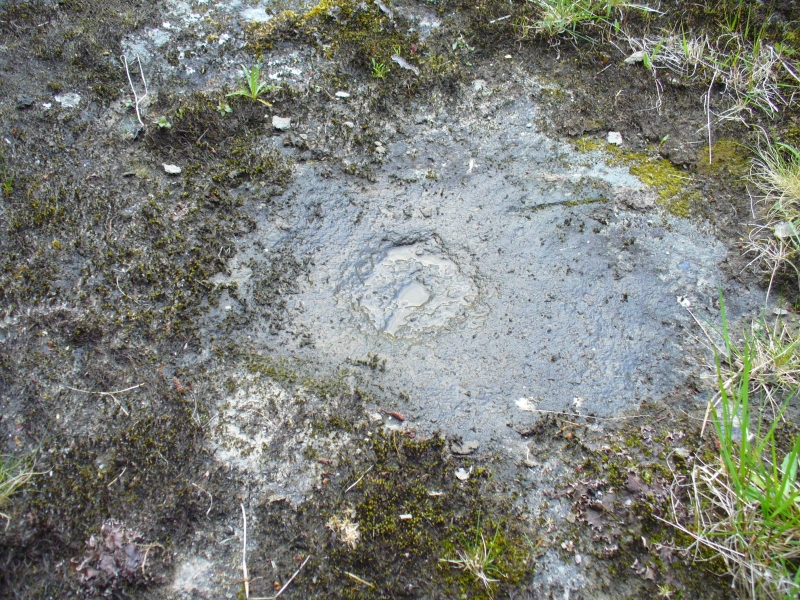
Primary cup-and-ring at Duncroisk-2
Primary cup-and-ring at Duncroisk (2)

I stepped over and complimented him as he looked superb (hence the photo, above) and he just kept purring. Then, curiously, he stood up and began scratching at the dried earth on the rock, mewing away whilst doing this.  Twas very odd indeed.  But there,  exactly where Flambeau has been scratching and rolling about, it seemed a faint cup-mark was apparent.  And such it was!  So I got on my knees and began cleaning away the dirt from the rock — and there, right where he’d been purring and playing, was the lost cup-and-ring carving!

Its location would suggest that the carving had some relationship with water: be that the spirit of the place, or a good site where fish can be had, or a place where someone had drowned, etc.  We’ll probably never know… But it’s a beautiful spot, with the impressive Stag Cottage carvings in the adjoining field, and the newly discovered Corrycharmaig East carvings on the other side of the river — plus many others in the area.

Folklore

The River Lochay where this carving is found is named after a dedication to the Black Goddess, according to Prof. W.J. Watson. (1926)  The stream by the side of the carving which runs into the River Lochay has been the place where faerie music has been heard by local people in times past.

References:

  1. Cormack, E.A., “Cross-Markings and Cup-Markings at Duncroisk, Glen Lochay,” in Proceedings of the Society of Antiquaries, Scotland, volume 84, 1952.
  2. Morris, Ronald W.B., The Prehistoric Rock Art of Southern Scotland, BAR: Oxford 1981.
  3. Royal Commission on the Ancient & Historical Monuments of Scotland, Archaeological Sites and Monuments of Stirling District, Central Region, Society of Antiquaries of Scotland 1979.
  4. Watson, W.J., The History of the Celtic Place-names of Scotland, Edinburgh 1926.

© Paul BennettThe Northern Antiquarian


Tomochrocher, Glen Lochay, Perthshire

Cup-Marked Stone:  OS Grid Reference – NN 457 359  —  NEW FIND

Getting Here

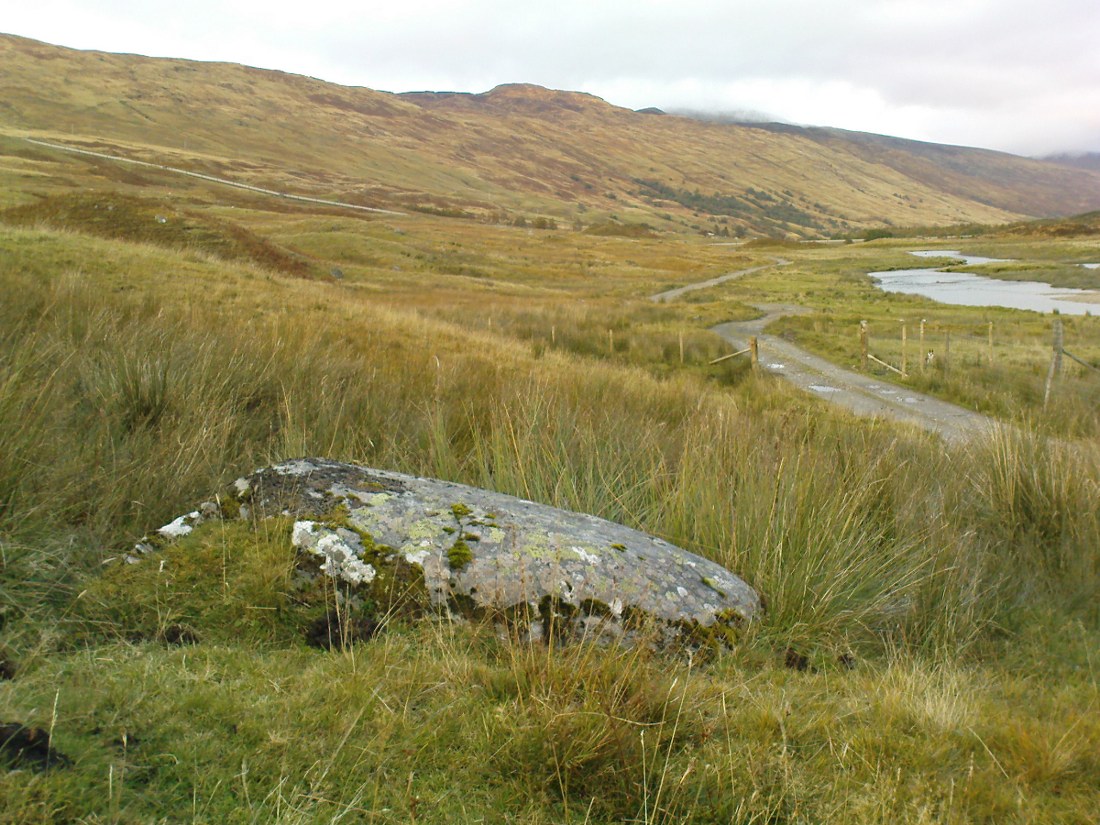
The stone in its setting

From Killin heading out along the northern Loch Tay road, turn left just past the Bridge of Lochay hotel and go right to the very end of Glen Lochay, just past Kenknock.  From here you’ve gotta keep walking along the glen’s dirt-track, and when you go through the third gate along (about a mile), another 100 yards on, keep your eyes peeled for a reasonably large boulder on the left of the track. This is your marker to go up on the right-hand side of the track, where the large stone is about 20 yards up the slope.

Archaeology & History

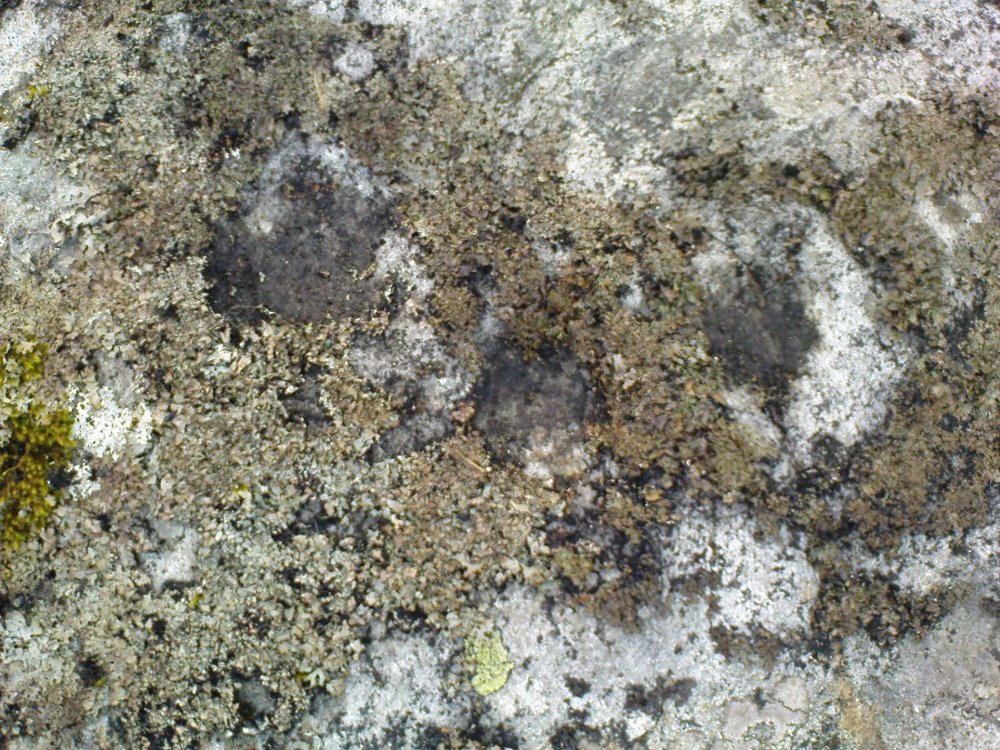
Three cup-marks & their lichen

Not far from a prehistoric hut circle relocated by archaeologist Dugald MacInnes I found this, a previously unrecorded cup-marked stone, when I was ambling about around the top of this beautiful valley last week.  It’s only a simple cup-marked stone with two very distinct cups and a probable third in the middle of the well-defined ones.  A covering of aged lichen was living on the carved rock and it seemed that there may have been other cups beneath the lichen — but I’ve got a real love of these old plants and wasn’t about to tear them from their homely stone.

There are some other little-known unrecorded human remains all along the slopes above here, which I’ll have a look at when next up this Valley of the Black Goddess…

© Paul Bennett, The Northern Antiquarian

Duncroisk Enclosure, Glen Lochay, Killin, Perthshire

Enclosure:  OS Grid Reference – NN 5325 3607

Getting Here

D. MacInnes’ ground plan

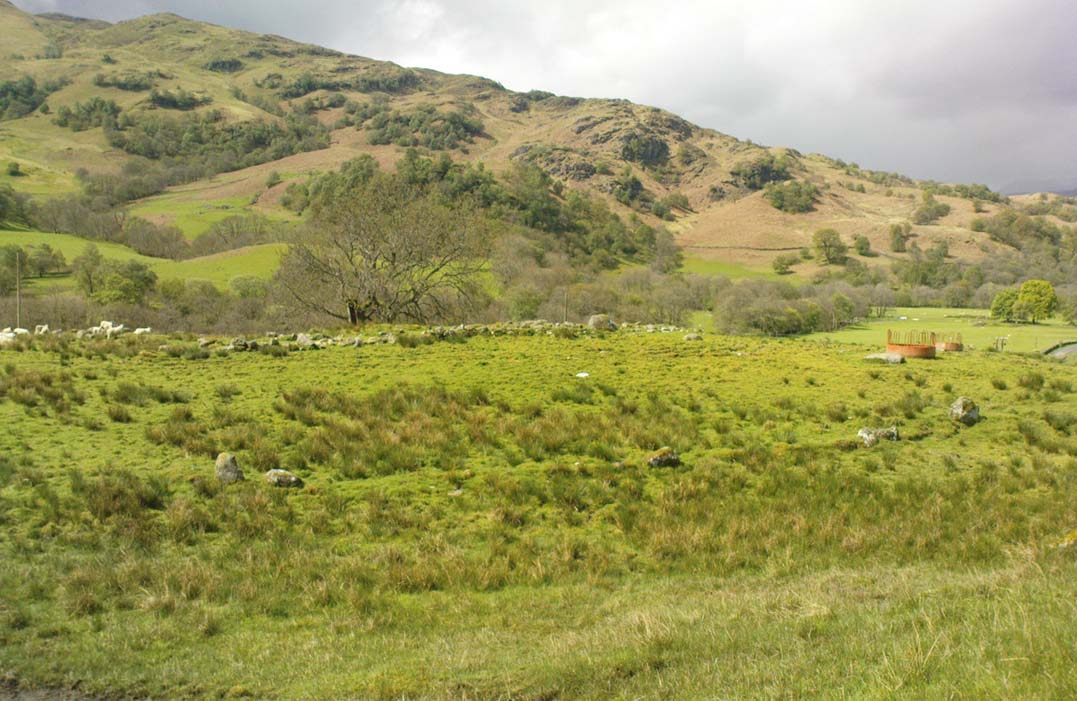
Take the single-track Glen Lochay road down past the Bridge of Lochay hotel at the edge of Killin, as if you’re gonna visit the superb cup-and-ring carvings opposite Stag Cottage (or Duncroisk 1).  Immediately past the garden of Stag Cottage is a small copse of trees and a couple of old wartime-looking buildings in the field above the roadside.  Go up past these buildings and onto the rise at the back.  You’re here.

Archaeology & History

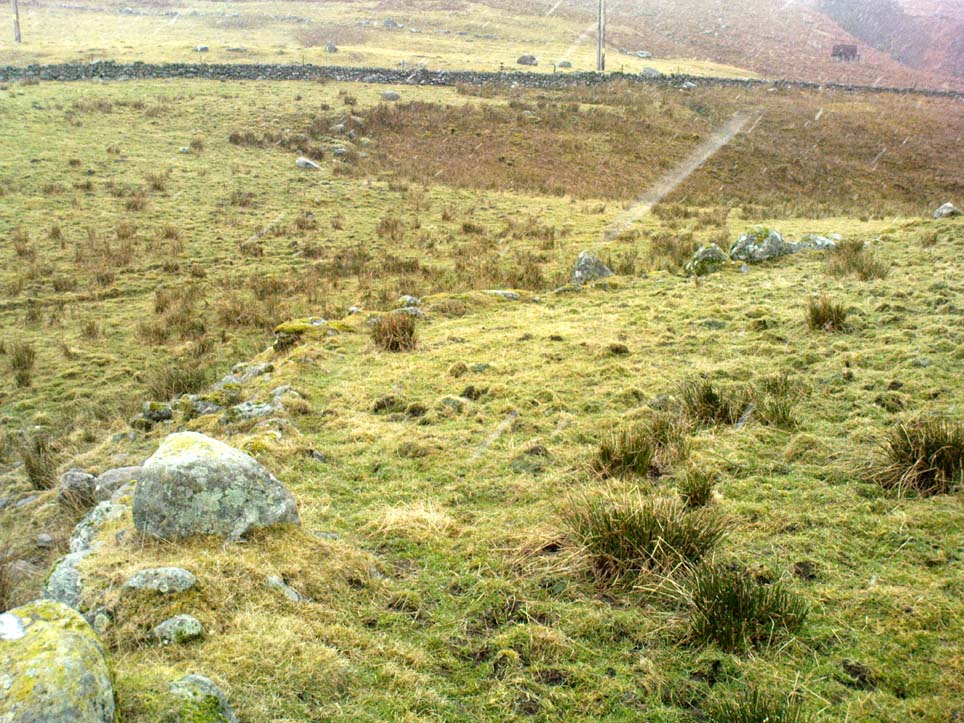
This is a fascinating site of multi-period historical usage, which Dugald MacInnes (2001) thinks may have its origins in the early Bronze Age or neolithic; but which I reckon was probably first used in the Iron Age.  Either way, we have here a large interesting well-preserved prehistoric stone enclosure, that has yet to be excavated.  I first came across it whilst gathering firewood from the adjacent copse and was quite puzzled by what seemed to be an extensive curved line of ancient walling running from its east to northeastern section, typical of prehistoric Iron Age walled structures common in northern England and beyond.  I must have paced back and forth along a 75 yard length of this section of walling a half-dozen times, wondering what the hell this place was.  And the more I looked at this section of the enclosure, the greater my conviction grew that this was constructed in prehistoric times.  And thereafter came the puzzle.

Looking down at the walled enclosure
NW section of walling

For along the southern walled section were a number of much more modern medieval and much later walled sections, including the remains of buildings that looked barely Victorian in age and nature.  The site was obviously being used presently by the local farmer for his cattle.  And so it became obvious that here was a large oval-shaped stone-walled enclosure or settlement that had been used over and over again through many centuries, with its origins seeming to be Iron Age in nature. Measuring approximately 195 yards (178m) in circumference, the structure has a maximum E-W diameter of 78 yards (71m) and N-S measurement of 44 yards (40m).

The mass of evidence for prehistoric activity is all round this hidden enclosure, with the fascinating clusters of cup-and-ring stones of Duncroisk and Corrycharmaig close by.  The small standing stones of Tirai 600 yards NW, and a similar prehistoric enclosure at Tullich ¾-mile NW show ample evidence of prehistoric man in this part of Glen Lochay.

Despite the size of the place, no literary reference of it occurs before MacInnes and his team came here.  His description is as follows:

“An oval enclosure, its boundaries formed principally from large water-worn boulders interspersed with drystone walling and in part by an earthen bank in the easternmost section, sits atop of a natural terrace about 155m OD.  The terrace slopes steeply to the west and south and cut into the western slope is a track, the course of which cannot be determined beyond the extent of the slope.  This track displays revetment in the form of stone coursing.

“The SW corner of the enclosure is angular rather than the rounded character of the other sections.  The W and SW sections are composed of coarsely constructed stonework in which large, 1m wide, often 1m high, water-worn boulders at two to three metre intervals, are interspersed with smaller boulders which form crude drystone coursing.

“The NE section is formed largely of large boulders, one of which is 1.5m in width and 1.2m high by 0.8m wide.  Sections of the northern part would appear to be robbed out, perhaps to construct the modern wall which lies about 25m to the north.  There are no remaining large boulders there, however, which could indicate their absence in the original construction of the enclosure.  The central section of the northern perimeter may be constructed of two outer skins of boulders, forming a wall about 0.9m wide, 0.4m high on its exterior, but reducing to 0.3m on its interior side.  Two sections could possibly be filled with a rubble core.

“The E section is formed by a low 0.3m high earthen grass-covered bank with occasional boulders.  This bank is about 0.2m high relative to the interior, but is about 0.5m to.0.8m high on its exterior side.  The NW side shows on the western side more evidence of double skin, rubble construction.  Close inspection of the stonework around the perimeter of the enclosure has revealed no evidence of shot-holes.  However a monolith situated in the NE has been split, but this would appear to be natural.  The interior of the enclosure is more or less level and grass-covered.  There is however, a slight drop in level in the western third of the interior.  This is defined by a linear slope which may be a lynchet.”

Northern section of enclosure
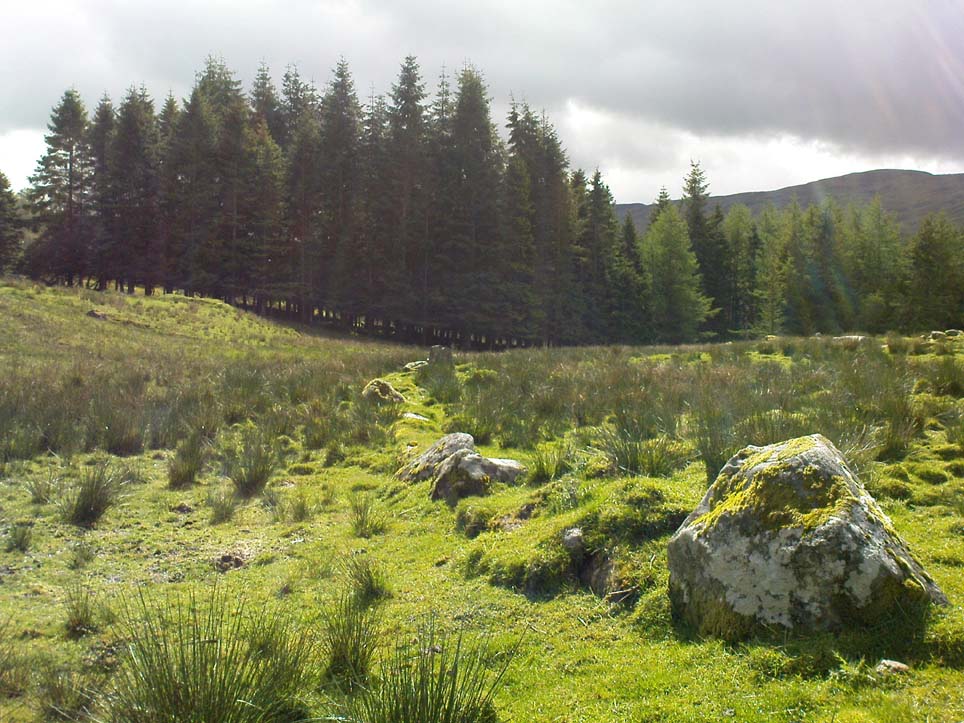
Upright stone in eastern wall

Northeast of the enclosure about 40 yards away is the normal drystone walling running along the sloping hillside.  But more intriguingly to archaeologists is the second line of much more ancient walling 76 yards (70m) further up the grassy slope, running at an angle across and uphill in a northwesterly direction.  This line of walling has a distinctly Iron Age flavour to it and is composed of some very large upright monoliths, almost Bronze Age in nature!  It continues into the next field for some 400 yards and onto Duncroisk Burn — the other side of which we find another line of ancient walling with an impressive cup-and-ring stone incorporated.

There’s tons more to be said of this region…

…to be continued…

References:

  1. MacInnes, Dugald, An Archaeological Field Survey of a Deserted Settlement at Duncroisk Farm, Glen Lochay, Association of Certified Field Archaeologists: Glasgow 2001.

© Paul Bennett, The Northern Antiquarian

Duncroisk (3), Glen Lochay, Killin, Perthshire

Cup-and-Ring Stone:  OS Grid Reference – NN 53447 35669

Also Known as:

  1. Canmore ID 24181
  2. Duncroisk 5 (Canmore)

Getting Here

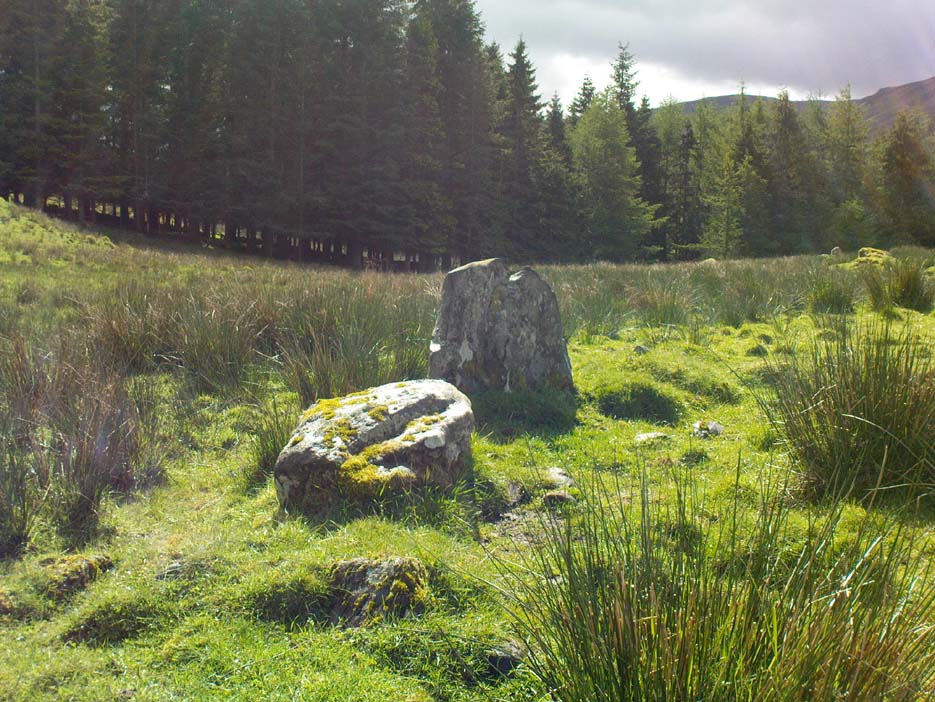
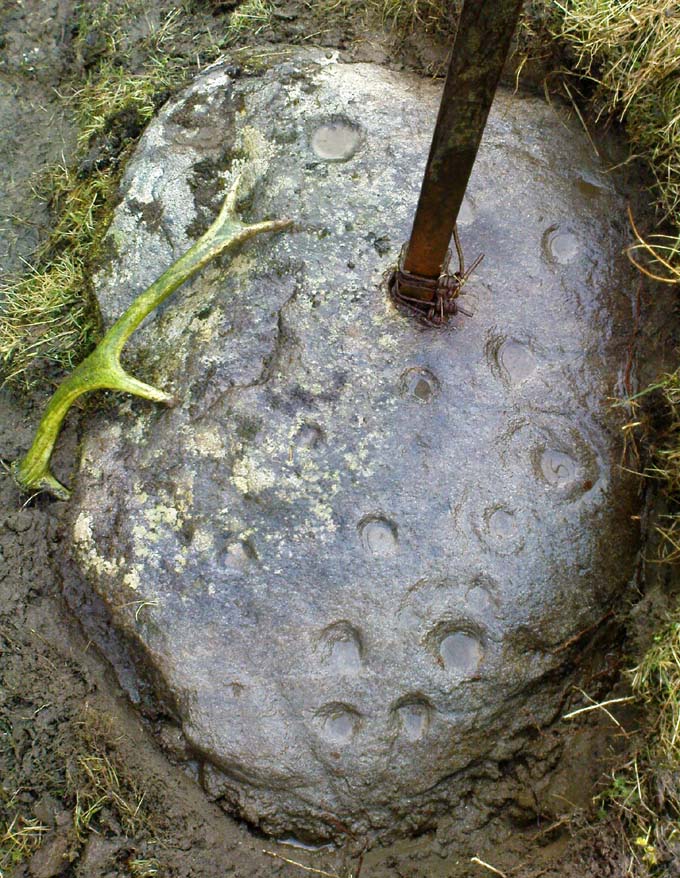
Duncroisk 3 Carving
Duncroisk 3 Carving

Two real ways to get here. Either (i) follow the directions to get to the Stag Cottage carvings of Duncroisk 1, then walk down to the fence by the riverside and walk along to the left for a coupla hundred yards till you reach a second metal fence-post sticking out of a rock on the other side of the deer-fencing; or (ii) from the roadside burn a coupla hundred yards along the road before you reach Stag Cottage, follow it down to the riverside, then head along the footpath behind the fencing, parallel with the river’s edge.  It aint far.  Within 100 yards you’ll reach the stone with the metal pole sticking out of it and the carvings are on this!

Archaeology & History

Confusingly redesignated as Duncroisk 5 carving by the usually efficient Canmore people, we’re sticking with this stone’s original name given by Ronald Morris (1981) in his British Archaeological Report of this and nearby carvings — and a quite fascinating carving this is as well!

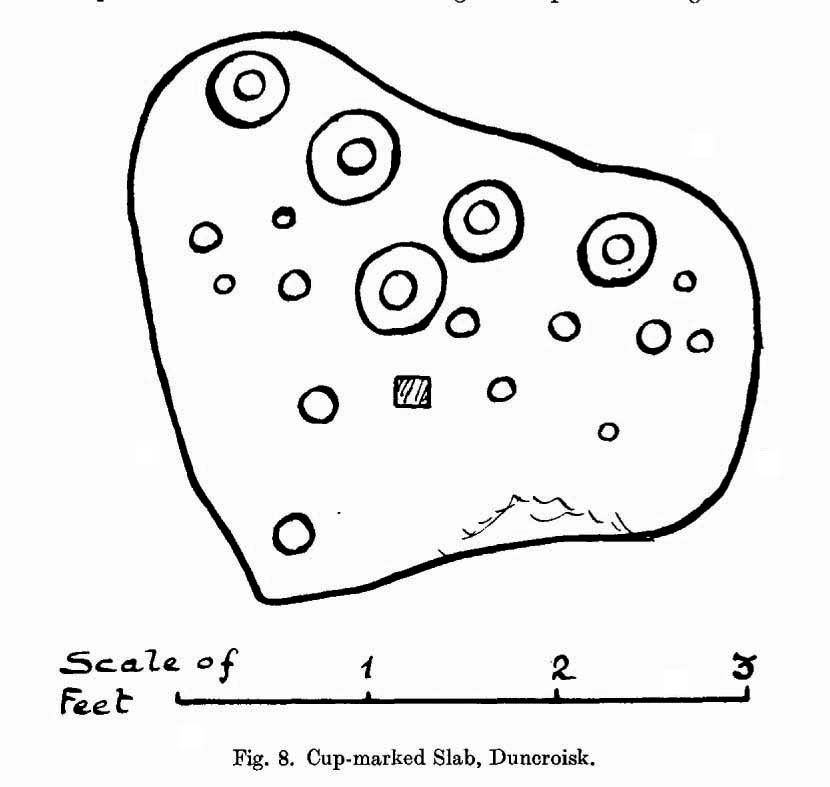
C.G. Cash’s drawing
Duncroisk 3 stone

As with many cup-and-rings, erosion and lighting has a powerful effect on seeing the design correctly.  On my visit here in recent months there were quite distinct additional elements in the carving which haven’t been noted by previous archaeologists.  But in saying that, there were also some elements that were reported by the earliest antiquarians that proved difficult to see in the grey light of day when I was here.  The earliest report of the carving by C.G. Cash (1912) told there to be five rings, whereas today only 3 or 4 are visible (though this will probably change when viewed in other lighting conditions).

When Mr Cash told of this stone in his essay on the antiquities of Killin it sounded as if it was lucky to have survived, as it had previously been dug out and left by the roadside, before then being reused by a local to fix a fence-post in!  Mr Cash told us that the local,

“had used it as the foundation stone of the stretching post at the south end of the easternmost fence on the farm, and there I found it, near the brink of the river, buried in sand and turf.  I cleared it and then in pouring rain crouched over it to make a hasty sketch.  It bears eighteen cups, of which five are surrounded by rings.  The largest cups are 2½ inches and the rings 6 inches in diameter.”

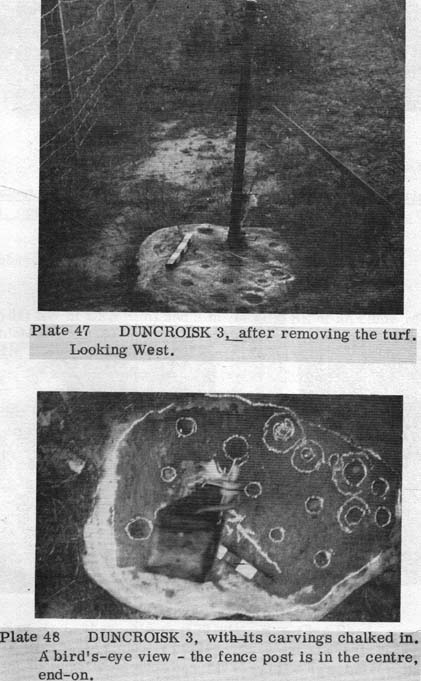
Ron Morris’ images

When I visited the place the weather was much the same as Mr Cash described: lovely teeming rain, typical of the mountains, with the surrounding trees breathing moisture onto the slopes as ever.

Years later when Ronald Morris (1981) came here he saw “4 cups-and-one-ring…probably complete rings, up to 12cm (5 in) in diameters and 10 cups up to 2cm deep.”

If you stand and face the stone, the cup-marking on its lower right side (see Morris’ old photo, above) has a pecked line running from it further to the right and down to the edge of the rock.  You can clearly make it out on the top photo.  This carved line also seemed to touch another carved line which can be seen running along the outer edge of the stone — although the poor light didn’t allow me to view this with absolute confidence.  I’ll have another look at it again when I’m up in the area in May and hopefully confirm or deny it with greater confidence (and if anyone else gets here in the meantime, have a look and see what y’ think).

References:

  1. Cash, C.G., “Archaeological Gleanings from Killin,” in Proceedings of the Society of Antiquaries of Scotland, volume 46, 1911-12.
  2. Morris, Ronald W.B., The Prehistoric Rock Art of Southern Scotland, BAR 86: Oxford 1981.

© Paul Bennett, The Northern Antiquarian


Stag Cottage, Glen Lochay, Perthshire

Cup-and-Ring Stones:  Grid Reference – NN 5320 3584

The carved rocky outcrop

Also Known as:

  1. Duncroisk 1 (Morris 1981)
  2. Duncroisk 4 (Canmore)
  3. Keeper’s Cottage

Getting Here

From the north side of Killin, take the minor road next to the Bridge of Lochay Hotel at Killin, past the hydroelectric station, through the wooded section until the fields open out again. The first gorgeous old house you come to is on the right-hand side of the road. Stop here! (I could really do with living here misself – tis a truly superb place!) You can ask the lady at the house where the carvings are and she’s very happy to point them out – they’re on the rocky crag near the bottom-end of the field on the other side of the road.

Archaeology & History

R.W.B. Morris sketch of the main carvings

What a brilliant setting and clump of carvings we have here! As you get to the rocky hillock in the field, you see that there are numerous rocks visible along the ridge, a number of which have carvings on them – some with just cups, but most possess a number of cup-and-rings.  It’s an excellent spot!  Depending on the time of year when you come here will determine whether or not you get a better look at the carvings or not.  I’d recommended April and May as the best time, as the vegetation is at its lowest then.  Visiting the site near the end of summer doesn’t give you as good a view — but even then, if you like your rock art, you’ll still love it!  The rocks here are mainly quartzite schist, with a number of the surfaces being almost pure quartz.  Intriguingly, none of the pure quartz sections appear to have been carved on.

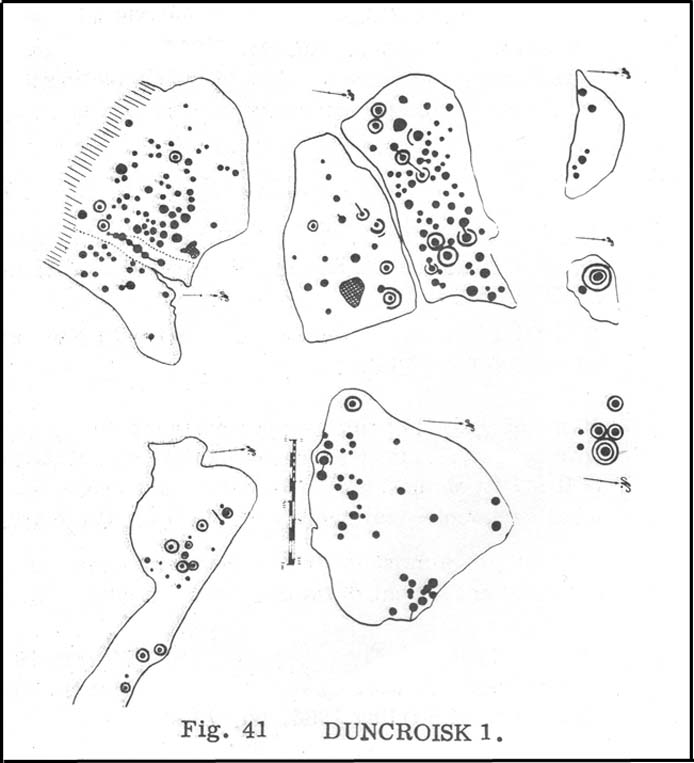
The carvings here were first mentioned in an article by D. Haggart (1895), who described them as “a very remarkable set of incised rock sculptures…discovered lately in this neighbourhood by Mr John McNaughton.”  And remarkable they are indeed!  In Ronald Morris’ (1981) survey of this site — which he labelled Duncroisk 1 — he counted eight separate rock surfaces that had been carved, marking them as carvings a-h, but there are at least eleven of them here; and in all honesty, if we could strip the surface of the hill of its vegetation, we’d probably find a few more hidden away!

Cup-marked stone

As you’ve walked across the field from the road, past the first unrecorded cup-marked stone near the start of the rocky rise, we reach Mr Morris’s ‘stone A’ near the easternmost end of the ridge, which is just a small slab of stone with “at least 6 cup-marks” on its surface.  It’s easily missed in poor light, so watch out.  However, if you reach ‘stone b’ (described below), just walk back ten steps and you’ll see it.

Carved Stone B

Ten yards west is ‘Stone B’, seemingly split into two sections, whereupon we find “a cup-and-two-rings and at least 12 cups-and-one-ring, up to 19cm in diameter – some rings gapped, others not, some with and some without a radial groove from the cup, and some with a “runner” or cup in a ring. There are also at least 58 cups” on this section of rock. ‘Stone C’ can also be missed, this time due to its size and the fact that the larger cup-marked surfaces are ahead of you.  But assuming you don’t miss it, this carving consists of “a well-preserved cup-and-two-complete-rings 25cm in diameter, and a cup.”

Carved Stone D

‘Stone D’ is just next to ‘stone C’, but with rather more ornate designs etched upon it.  This is one of the more archetypal petroglyph designs that are found in the photo-guides and textbooks.  Morris (1981) told that it consisted “of a cup-and-two-complete-rings and 2 cups-and-one-complete-ring up to 20cm in diameter, also a cup-and-one-complete-ring and 2 cups.”  The photo here shows it pretty clearly.

Carved Stone E
Curious 'bowl', top-centre
Curious ‘bowl’, top-centre

‘Stone E’ is the next one along, just a foot or two away and Mr Morris (1981) told that the carving consists of “2 cups-and-one-ring up to 13cm in diameters, 1 complete, the others gapped, joined by groove to a cup, and at least 33 cups (C.G. Cash counted 42 in 1911).”  Most of the carved elements on this rock are around the edges of the stone.  A very large faded circular depression, man-made, is also visible on this section of the petroglyph (above left), suggestive of lunar symbolism.

Carved Stone F

‘Stone F’ is less than 10 yards further west and has the greatest number of cup-markings of the entire group here, as Morris described: “3 cups-and-one-complete-ring up to 9cm in diameter, and at least 80 cups, a few of which are widely scattered over a big area sloping steeply further south, beyond the attached diagram.”  It’s perhaps the most notable of the carved rocks along the ridge here — not by virtue of its design, more its geological physique than anything else.

Carved stone G

‘Stone G’ is next along and has a curious look about it, suggestive of more modern times.  At first sight it doesn’t seem to have quite the magnitude that Morris’ description affords it, but on closer inspection by rolling some of the covering turf back away from the rock, you can see what he meant.  This stone has “10 cups-and-one-complete-ring, up to 10cm diameter…and also 15 cups.”  One of the cup-and-rings on this section was found by Morris to have been “the smallest so far recorded by the author in Scotland.”

Then we reach ‘stone H’ at the eastern end of the carved ridge, consisting of simply 3 cup-markings.  One of them has a faint arc pecked around it.  Further along the rock, a complete cup-and-ring is visible close to the edge.

This entire line of petroglyphs is a fine place in a fine setting, perfect for meditative practices!  Other carvings can be found close by: Duncroisk 3 is a coupla hundred yards east across the field just over the fence by the riverside; and Duncroisk 2 is on the other side of the fence down towards the River Lochay on the same side of the adjacent burn less than 100 yards away (though this is trickier to reach). Other prehistoric sites can be found not too far away…

Folklore

Local people tell of having seen curious lights flitting along the edges of the field, river Lochay and roadside close to the carved rocks hereby.

References:

  1. Cash, C.G., “Archaeological Gleanings from Killin,” in Proceedings of the Society of Antiquaries of Scotland, volume 46, 1911-12.
  2. Cormack, E.A., “Cross-Markings and Cup-Markings at Duncroisk, Glen Lochay,” in Proceedings of the Society of Antiquaries, Scotland, volume 84, 1952.
  3. Gillies, William A., In Famed Breadalbane, Munro Press: Perth 1938.
  4. Haggart, D., “Notice of the Discovery of Cup-and-Ring Sculpturings at Duncrosk, near the Falls of Lochay, in Glenlochay,” in Proceedings of the Society of Antiquaries of Scotland, volume 29, 1894-95.
  5. Morris, Ronald W.B., The Prehistoric Rock Art of Southern Scotland, BAR 86: Oxford 1981.

© Paul Bennett, The Northern Antiquarian