Dunino, Fife

Stone Circle (destroyed):  OS Grid Reference – NO 541 109

Also Known as:

  1. Balkethly
  2. Balkaithley
  3. Canmore ID 34487

Archaeology & History

We know very little about the site that once stood here — even Aubrey Burl (2000) found no history here.  It seems that antiquarian records were never made in this outlying district and even folklore records seem to have missed this region! (surely not?)  A. Lindsay Mitchell (1992) told that the circle here had been built into the church, but knew no more.

First described in the old Statistical Account of Scotland in 1794, even then it was in the past tense, as they said that “a Druidical temple is said to have stood in the vicinity of Balkethly. Not the smallest vestige can now be seen.”  Balkaithly Farm is a few hundred yards east of Dunino.  In the New Statistical Account of the region in 1845 it was reported that three stones close to the west wall of the minister’s garden at Dunino were said to be part of the ruined circle. The site had truly gone.  By 1925 when the Royal Commission (1933) lads visited the place to look for any remains, they told:

“The stone circle which formerly existed near the church at Dunino has now been entirely destroyed, but what are believed to be portions of some of the original stones are built into the dyke on the north side of the roadway at the south-west of the churchyard, about 100 yards east of its junction with the main thoroughfare to St. Andrews.”

A few hundred yards west of the circle, “a short cist containing a fine food-vessel urn was accidentally discovered during ploughing on the farm of Beley.” This was sent to Edinburgh’s National Museum.

Folklore

Locally, there are several places alleged to have been the actual spot where the circle once stood.  Several stones within nearby Dunino church have typical Mason marks carved on them which, local folklore says, identifies them as coming from the circle and then subsequently being built into the church.  Also in the churchyard is a small carved upright stone, which local people visit and leave offerings upon.

References:

  1. Batchelor, Richard A., Origin of St. Andrews: Moon, Magicians and Maidens in Fife, Shieling: St. Andrews 1997.
  2. Burl, Aubrey, The Stone Circles of Britain, Ireland and Brittany, Yale University Press 2000.
  3. Leighton, John M., History of the County of Fife from the Earliest Period to the Present Time – volume 3, Joseph Swan: Glasgow 1840.
  4. Mitchell, A. Lindsay, Hidden Scotland, Lochar: Moffat 1992.
  5. Royal Commission on the Ancient & Historical Monuments of Scotland, Fife, Kinross and Clackmannan, HMSO: Edinburgh 1933.
  6. Stuart, John, Sculptured Stones of Scotland – volume 2, Spalding Club: Edinburgh 1867.

© Paul Bennett, The Northern Antiquarian
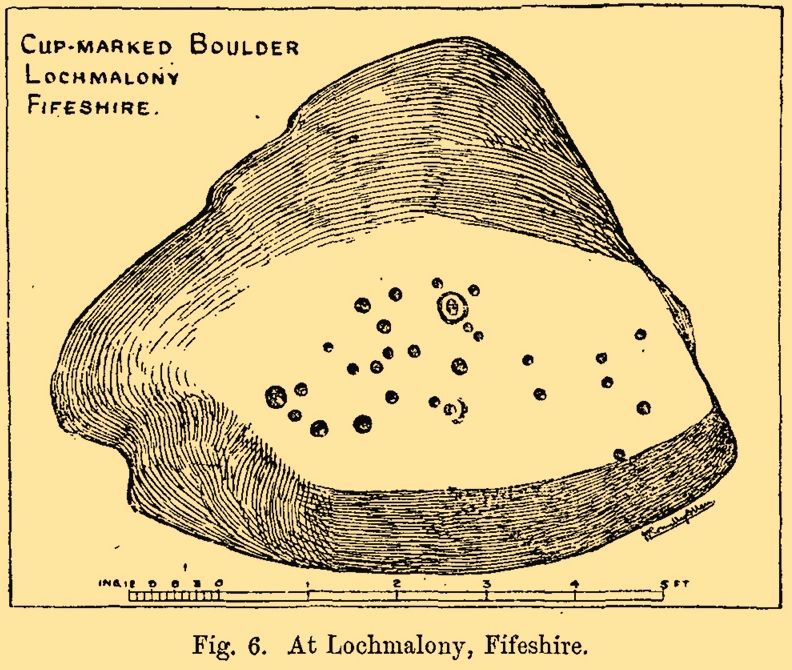

Lochmaloney, Kilmany, Fife

Cup-and-Ring Stone (destroyed):  OS Grid Reference – NO 379 204

Archaeology & History

J.R. Allen’s 1882 sketch

Here’s another old carving that has succumbed to the lack of animistic respect endemic in modern culture.  Ronald Morris (1981) reported that this carved rounded boulder was “dynamited by the farmer and (is) now no longer extant.”  First described in 1882 and later included in the Fife Inventory (1935), the large smooth rock used to lay within a nice copse of dense gorse, measuring 2½m x 1¾m across and about 1m high from ground level.

It was uncovered in 1872 and mentioned briefly for the first time in Arthur Mitchell’s (1874) fine essay on the antiquities of Cromar, where he told that “Dr. Batty Tuke tells me there is a cup stone on a moor forming part of Lochmalonie farm, in the parish of Logie, Fifeshire.”  His notes were followed up by the great Romilly Allen (1882), whose sketch is all that remains of this ancient site.  The carving was subsequently included in one of Ron Morris’s (1981) survey of Scottish petroglyphs, describing it simply as,

“2 cups-and-one-complete ring (one mostly weathered off), diameters 10cm (4in) and 27 cups (carving depth and angle of slope not now known.”

Its isolation from any other known petroglyphs is a little odd and there is every possibility is accompanied a prehistoric burial of some sort; although from the attitude of the farmer, all trace of that would have gone too.  On a more positive note, when Batty Tuke spoke with Romilly Allen about this carving, he told that he has “frequently noticed well-marked cups on dry stone dykes in the Glenduckie area.”  Petroglyph explorers amongst you might want to spend some time meandering in this neck o’ the woods….

References:

  1. Allen, J. Romilly, “Notes on some Undescribed Stones with Cup Markings in Scotland,” in Proceedings of the Society of Antiquaries Scotland, volume 16, 1882.
  2. Mitchell, Arthur, “Vacation Notes in Cromar, Burghead and Strathspey,” in Proceedings of the Society of Antiquaries Scotland, volume 10, 1874.
  3. Morris, Ronald W.B., “Fife: Loch Maloney – Cup Marks,” in Discovery & Excavation, Scotland, 1967.
  4. Morris, Ronald W.B., The Prehistoric Rock Art of Southern Scotland, BAR: Oxford 1981.
  5. Royal Commission on Ancient & Historical Monuments, Scotland, Eleventh Report with Inventory of Monuments and Constructions in the Counties of Fife, Kinross and Clackmannan, HMSO: Edinburgh 1935.

© Paul Bennett, The Northern Antiquarian


Witch’s Stone, Crossford, Dunfermline, Fife

Legendary Stone (destroyed):  OS Grid Reference – NT 058 865

Archaeology & History

Travelling along the old road between Crossford and towards Cairneyhill, on the right-hand (north) side, there was until recently a huge boulder, described by the folklorist J.E. Simpkins (1914),

“Its horizontal dimensions above ground are diagonally 18 feet by 21 feet; its vertical height above ground 5 feet…  I estimate its weight at nearly 200 tons.”

The stone was proclaimed by 19th century geologists to be a glacial deposit from the upper region of the Forth (the nearest mountain region possessed of this type of stone); although our old petroglyph writer, Sir James Simpson, postulated the Witch’s Stone to be “of meteoric origin.”

But like oh so many old sites with heathen tales attached, the stone was destroyed by a local farmer on 7 February, 1972.  The following interesting notes were made in a Crossford & Cairneyhill School log-book, describing its destruction:

“The local farmer blasted the “Witch’s Stone”, situated about 300m East of school at 2.30 this afternoon.  Children vacated both buildings and sheltered at West End of main building.  All windows were opened.  Police informed that further operations of this nature will be carried out at weekend.”

A week later on February 14, all “remains of “Witch’s Stone” removed by blasting at 3pm today.”

On the other side of the road from our Witch’s Stone was another boulder, this time known as the Cadger’s Stone, said by Beveridge (1888) to have got its name,

“from the circumstance of its having formed a landmark for the ‘cadgers’, or itinerant merchants, who were wont to rest themselves and their ponies whilst they deposited for a short while their burdens on the stone.”

The earliest OS-map of the region in 1856 shows neither of these stones, but does highlight a Capel Stane, or Stone of the Horse, very close by.

Folklore

The stone was obviously of some traditional importance to local people in pre-christian times.  David Beveridge (1888) described the position and creation myth of the Witch’s Stone as follows:

“On our right a singular-looking stone of blue limestone appears in a field, and is known as the Witch’s Stone, the popular legend being that a notable witch in this neighbourhood found it on the seashore, and that after she carried it some distance in her apron, the string of the latter broke, and the stone has since continued to lie in the place where it fell. “

A few years after this, the folklorist J.E. Simpkins (1914) wrote:

“The legend connected with this boulder is, that a witch wishing to bestow a valuable gift on the Pitfirrane family, resolved to present to them a cheese-press. With that view, she lifted this boulder and carried it some distance in her apron, but owing to its excessive weight the apron-strings broke and the stone fell to the ground, where it has remained ever since.”

If anyone knows anything more about this old stone, or has any old photos of the fella, please let us know!

References:

  1. Beveridge, David, Between the Ochils and Forth, William Blackwood: Edinburgh 1888.
  2. Simpkins, John Ewart, Examples of Printed Folk-lore Concerning Fife, with some Notes on Clackmannan and Kinross-shires, Sidgwick & Jackson: London 1914.

© Paul Bennett, The Northern Antiquarian


Devil’s Blue Stane, Crail, Fife

Legendary Rock:  OS Grid Reference – NO 614 079

Also Known as:

  1. Devil’s Blue Stone

Folklore

This curious rounded boulder sitting outside the parish church was described by Alexander Polson in his survey of witch-lore.  He told us that “when the old church was being built, the devil, as a mason out of work, came here and was employed.”  But it wasn’t long before a local christian discovered his disguise and, uttering some magickal biblical words, the devil became furious.

“Immediately he heard this there was a clap of thunder and the fiend flew away to the Isle of May,” about five miles away to the south. “Here in his anger he seized a huge rock and hurled it at the church. It fell quite near, did no harm, and a part of it lay at the church’s door, with the mark of the devil’s thumb on it.”

On the north end of the Isle of May are the Altar Stanes (NT 652 997), thought to have been where the devil stood (close to the holy well of St. Andrew [NT 652 994]) and threw this stone at Crail several miles north.  In pre-christian mythic terms, north is the direction or airt of greatest symbolic darkness.  A variation on the creation myth for this stone tells that when it was thrown from the island, one half of it split off and it fell by the coast in Balcombie, Fife.

References:

  1. Polson, Alexander, Scottish Witchcraft Lore, W. Alexander: Inverness 1932.

© Paul Bennett, The Northern Antiquarian