Slaughter’s Well, Lechlade-on Thames, Gloucestershire

Healing Well (destroyed):  OS Grid Reference – SU 215 995

Archaeology & History

Not listed in the field-name surveys of the town, the name Slaughter Well was obviously a folk-name given to it by local people.  The place was mentioned in an unpublished manuscript that Adin Williams’ (1888) managed to lay his hands on, where it was mentioned in relation to the missing pyramidal Market Cross.  Its waters were “said to be medicinal.”  The name of the well was said to derive from a battle here between Oliver Cromwell’s men and the Royalists.  At this place,

“an officer was shot, and this incident gave the name ‘Slaughter’ to the well.”

References:

  1. Williams, Adin, Lechlade: Being the History of the Town, Manor and Estates, The Priory and the Church, E.W. Savory: Cirencester 1888.

© Paul BennettThe Northern Antiquarian

High Cross, Elkstone, Gloucestershire

Cross (destroyed):  OS Grid Reference – SO 9674 1321

Archaeology & History

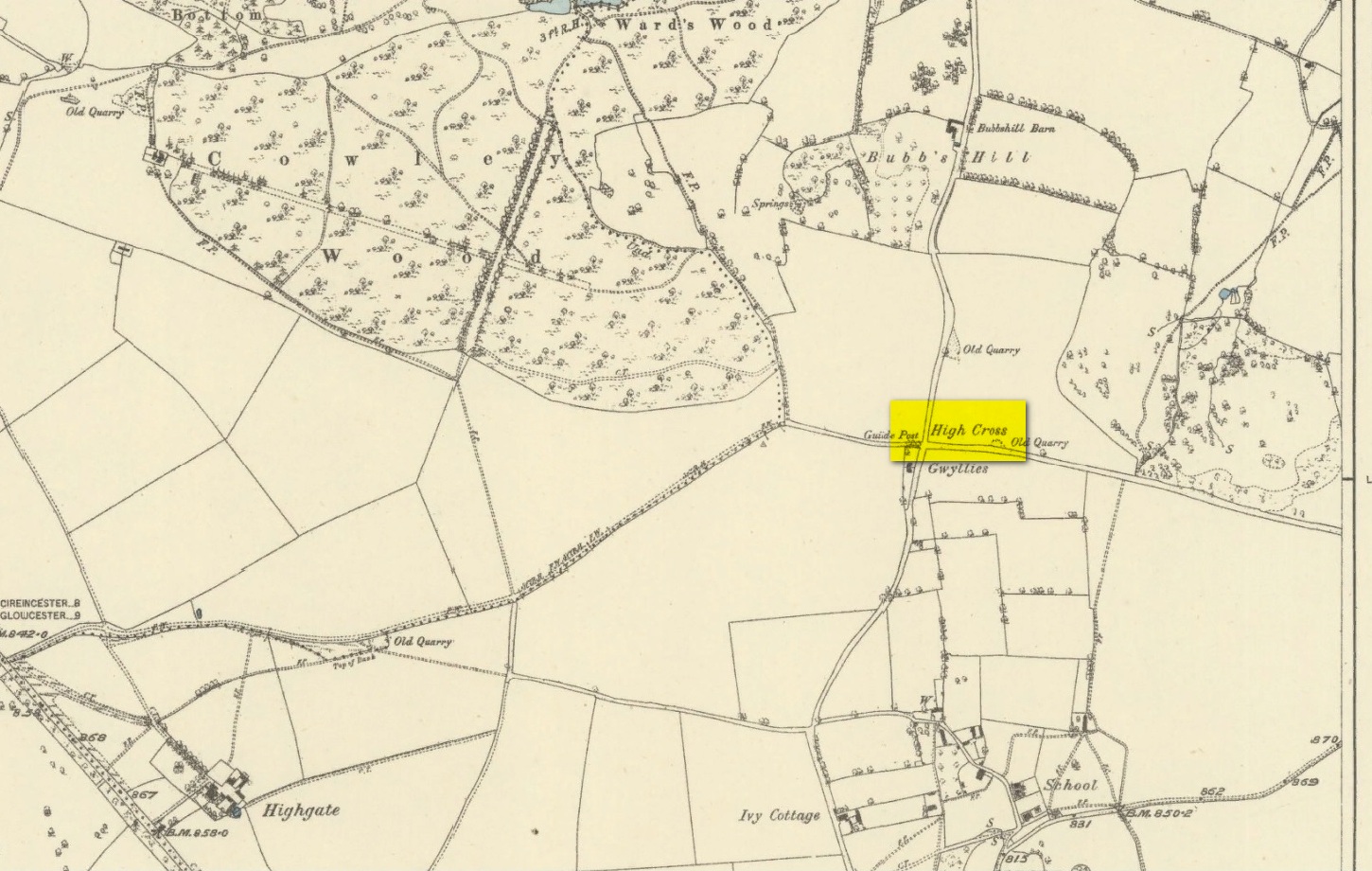
High Cross on 1883 map

First shown on a 1775 map of the region, this long-lost site is preserved in several place-names near the old crossroads a half-mile north of Elkstone village.  It is mentioned, albeit briefly in Charles Pooley (1868) county survey, where he told that, “in former times a very handsome and lofty High Cross stood in this parish.”  However, there’s the possibility that the name ‘High’ cross may here derive simply from a cross located at a high point in the landscape.

An old ‘Guide Post’ marked on the early Ordnance Survey map at the same spot has been suggested by Danny Sullivan—and not without good reason—to be a prehistoric standing stone.  He may be right.

References:

  1. Pooley, Charles, Notes on the Old Crosses of Gloucestershire, Longmans Green: London 1868.
  2. Sullivan, D.P., Old Stones of the Cotswolds and the Forest of Dean, Reardon: Cheltenham 1999.

© Paul BennettThe Northern Antiquarian

Churchyard Cross, St Briavel’s, Gloucestershire

Cross (destroyed):  OS Grid Reference – SO 559 047

Archaeology & History

At the church of St. Mary at the northern end of the village, Charles Pooley’s (1868) county survey told that,

“There was formerly a Cross in the churchyard near the south porch, but it was removed in the year 1830, when the new tower was built.”

It would seem there is no longer any trace of the monument.

References:

  1. Pooley, Charles, Notes on the Old Crosses of Gloucestershire, Longmans Green: London 1868.

© Paul BennettThe Northern Antiquarian

Market Cross, Lechlade, Gloucestershire

Cross (destroyed):  OS Grid Reference – SU 214 995

Archaeology & History

In days of olde, Charles Pooley (1868) told us that “an old cross formerly stood in the Market-place” in the centre of the town where the old crossroads meet—as was customary for crosses and maypoles—just outside the church of St. Lawrence.  Pyramidal in form, it was mentioned in an old manuscript cited by Adin Williams (1888), which told us,

“Leland saith that in his days there was a Piramid of Stone at ye west end of ye Church, whose foundations are to be seen near Slaughter’s Well, which is said to be medicinal water.”

And although we don’t know when the cross was erected, we know when it was destroyed.  Williams again tells us:

“About 1770, Sir Jacob Wheate pulled down this cross.  He is said to have taken the stones to the house he was building.”

References:

  1. Pooley, Charles, Notes on the Old Crosses of Gloucestershire, Longmans Green: London 1868.
  2. Williams, Adin, Lechlade: Being the History of the Town, Manor and Estates, The Priory and the Church, E.W. Savory: Cirencester 1888.

© Paul BennettThe Northern Antiquarian

Village Cross, Deerhurst, Gloucestershire

Cross (destroyed):  OS Grid Reference – SO 870 299

Archaeology & History

In Charles Pooley’s (1868) definitive account of Gloucestershire county crosses, he informs us that,

“there was formerly a Cross erected in this village, but it has long since disappeared.”

He gives no further information about its history, but we must surmise that it was either associated with the ancient priory on the north side of the village, or in the traditional place at the centre of the the village. The grid-reference cited places the lost cross in the grounds of the priory.

References:

  1. Pooley, Charles, Notes on the Old Crosses of Gloucestershire, Longmans Green: London 1868.

© Paul BennettThe Northern Antiquarian

Churchyard Cross, Lower Dowdeswell, Gloucestershire

Cross (destroyed):  OS Grid Reference – SP 001 199

Archaeology & History

In Charles Pooley’s (1868) definitive history on the county crosses, this monument is mentioned in passing without any known history, apart form it been destroyed sometime in the early 19th century:

“A cross formerly stood in the churchyard, but it has been removed within living memory.”

References:

  1. Pooley, Charles, Notes on the Old Crosses of Gloucestershire, Longmans Green: London 1868.

© Paul BennettThe Northern Antiquarian

Village Cross, Powerstock, Dorset

Cross (destroyed):  OS Grid Reference – SY 5167 9622

Archaeology & History

This old cross was almost lost to history, but thanks to personal notes written by one John Banger Russell in 1780, we’ve been left with a description of the monument, which Alfred Pope (1906) published in his survey:

“In the middle of this parish are the remains of a large cross, which has been much injured by time.  The shaft, which seems to have been of considerable height, has been taken down, tho’ the base or pediment still continues in its proper place.  The ascent was by four steps but the whole is very ruinous.”

Nearly a hundred years later in the hugely updated magnum opus of John Hutchins (1863), the site had long gone:

“A mutilated cross which stood in the centre of the village at the beginning of the present century, has since been destroyed.”

References:

  1. Hutchins, John, The History and Antiquities of the County of Dorset – volume 2, Bowyer & Nichols: London (3rd edition) 1863.
  2. Pope, Alfred, The Old Stone Crosses of Dorset, Chiswick Press: London 1906.

© Paul BennettThe Northern Antiquarian

The Cross, Gussage All Saints, Dorset

Cross (destroyed):  OS Grid Reference – ST 999 108

Archaeology & History

In days of olde an old stone cross used to stand “at the crossroads just outside the churchyard,” wrote Alfred Pope (1906); but even in his day he told that “the cross has long since disappeared.”  He continued:

“The Rev A.S.B. Freer, vicar, informs the writer that the site is still known as ‘The Cross’, and is never called by any other name by the villagers.”

The church in the village is dedicated to All Saints, whose festival date was known in older times to be the pre-christian New Year’s Eve, or Halloween, when the spirits of the dead move across the landscape.

References:

  1. Pope, Alfred, The Old Stone Crosses of Dorset, Chiswick Press: London 1906.

© Paul BennettThe Northern Antiquarian

Chalybeate Well, Blockley, Gloucestershire

Healing Well (destroyed):  OS Grid Reference – SP 166 350

Archaeology & History

This is one of several iron-bearing wells (chalybeates) that used exist in and around the village.  Mentioned briefly in Alfred Soden’s (1875) history of the parish, he told that,

“years ago, there were several chalybeate springs here, very strongly impregnated.  One of these was at the lower end of Westmacott’s Lane: of this spring there is now no visible trace, it having been built over.”

Although Mr Soden said nothing about the healing properties of this well, due to the mineral composition of chalybeates they always tend to be good fortifiers or pick-me-ups, being good for the blood.  And in this case, as the waters were “very strongly impregnated” they would have possessed some considerable local renown.

References:

  1. Soden, Alfred J., The History of Blockley, J.W. Parbury: Coventry 1875.

© Paul BennettThe Northern Antiquarian

Blind Well, Blockley, Gloucestershire

Healing Well (destroyed):  OS Grid Reference – SP 163 347

Archaeology & History

It would seem that there’s no longer any trace of a healing well of some renown that once existed on the south side of Blockley village.  It is mentioned briefly in Alfred Soden’s (1875) history of the parish, where he wrote:

“At the back of what is called “Bath Orchard,” now belonging to Mr. John Herbert, there was a well called “Blind Well;” the medicinal properties of the water being considered to be remedial in cases of weak eyesight.  The writer has been informed that persons would come from a considerable distance to fetch water from this well for the purpose of bathing the eyes.”

References:

  1. Soden, Alfred J., The History of Blockley, J.W. Parbury: Coventry 1875.

© Paul BennettThe Northern Antiquarian