Allt Coire Phadairlidh (1), Fearnan, Perthshire

Cup-Marked Stone:  OS Grid Reference – NN 69279 42814

Getting Here
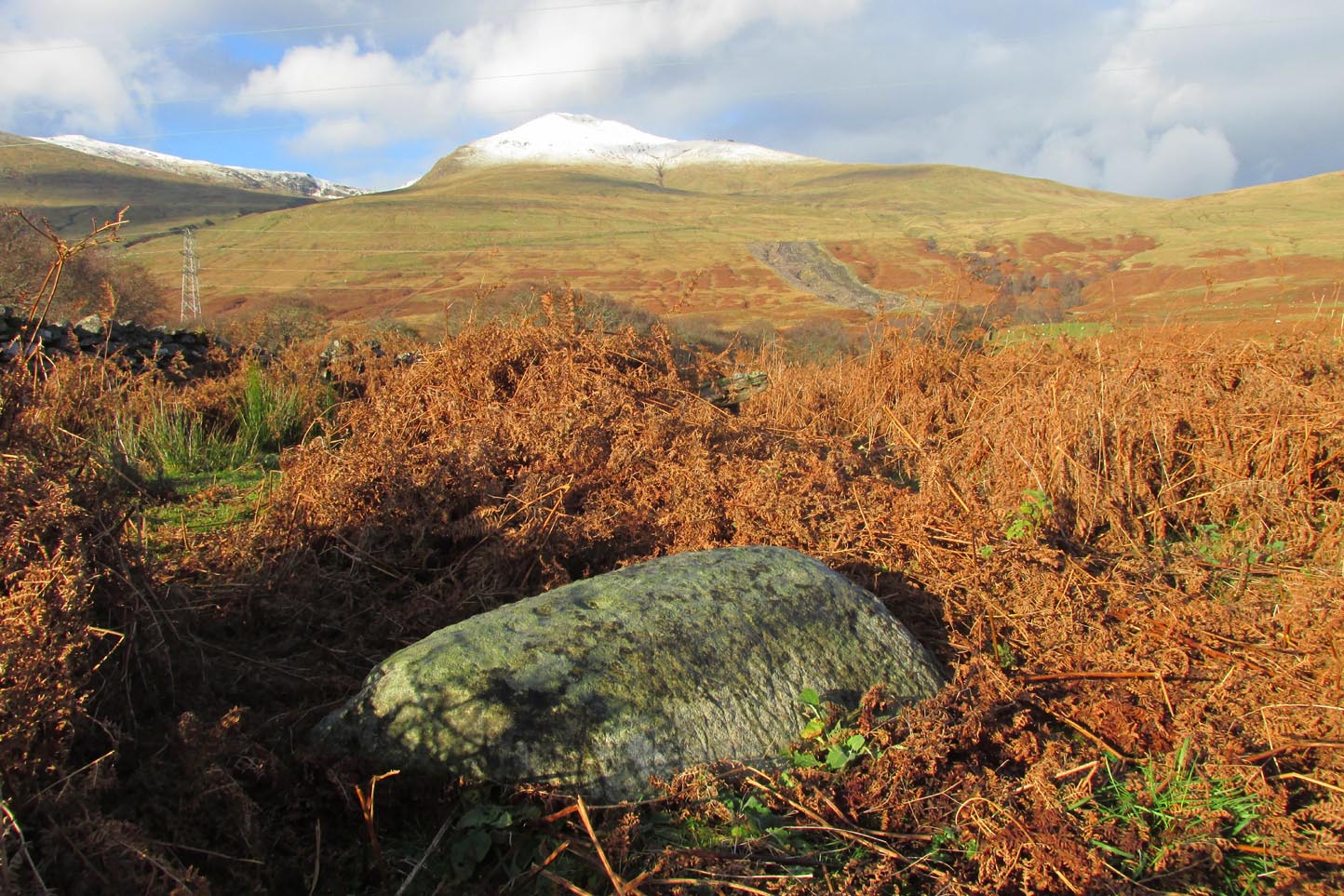
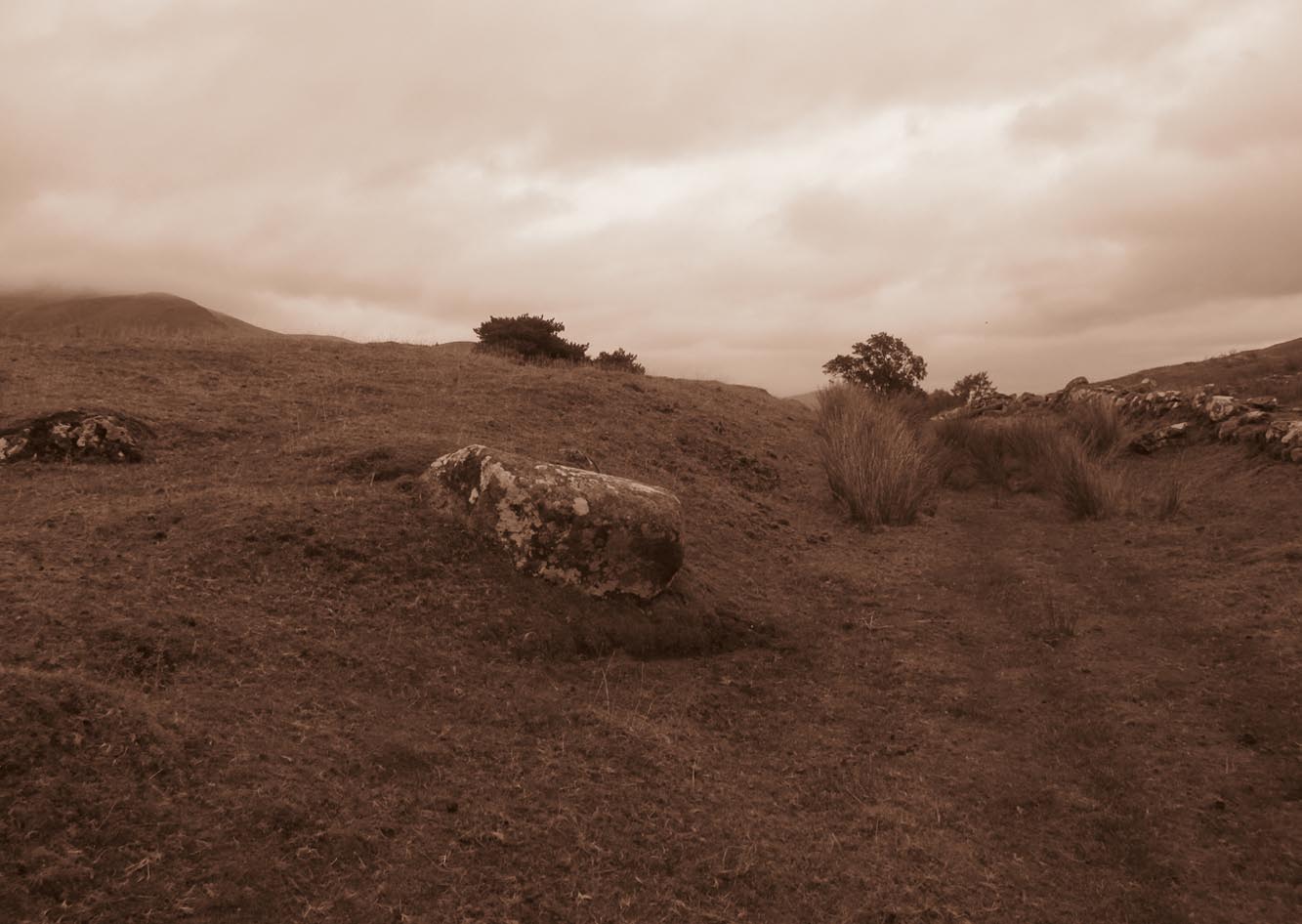
Allt Coire Phadairlidh stone

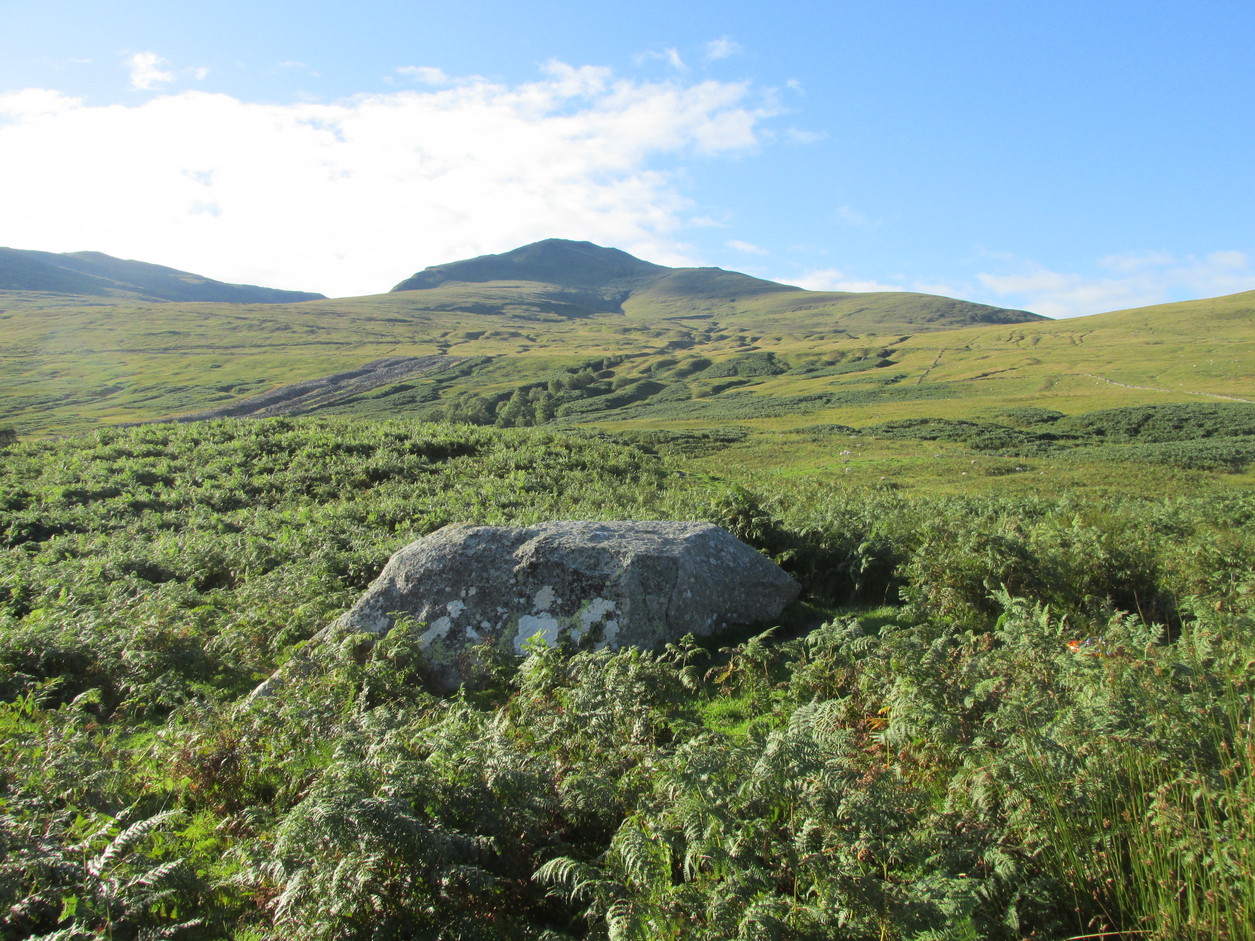
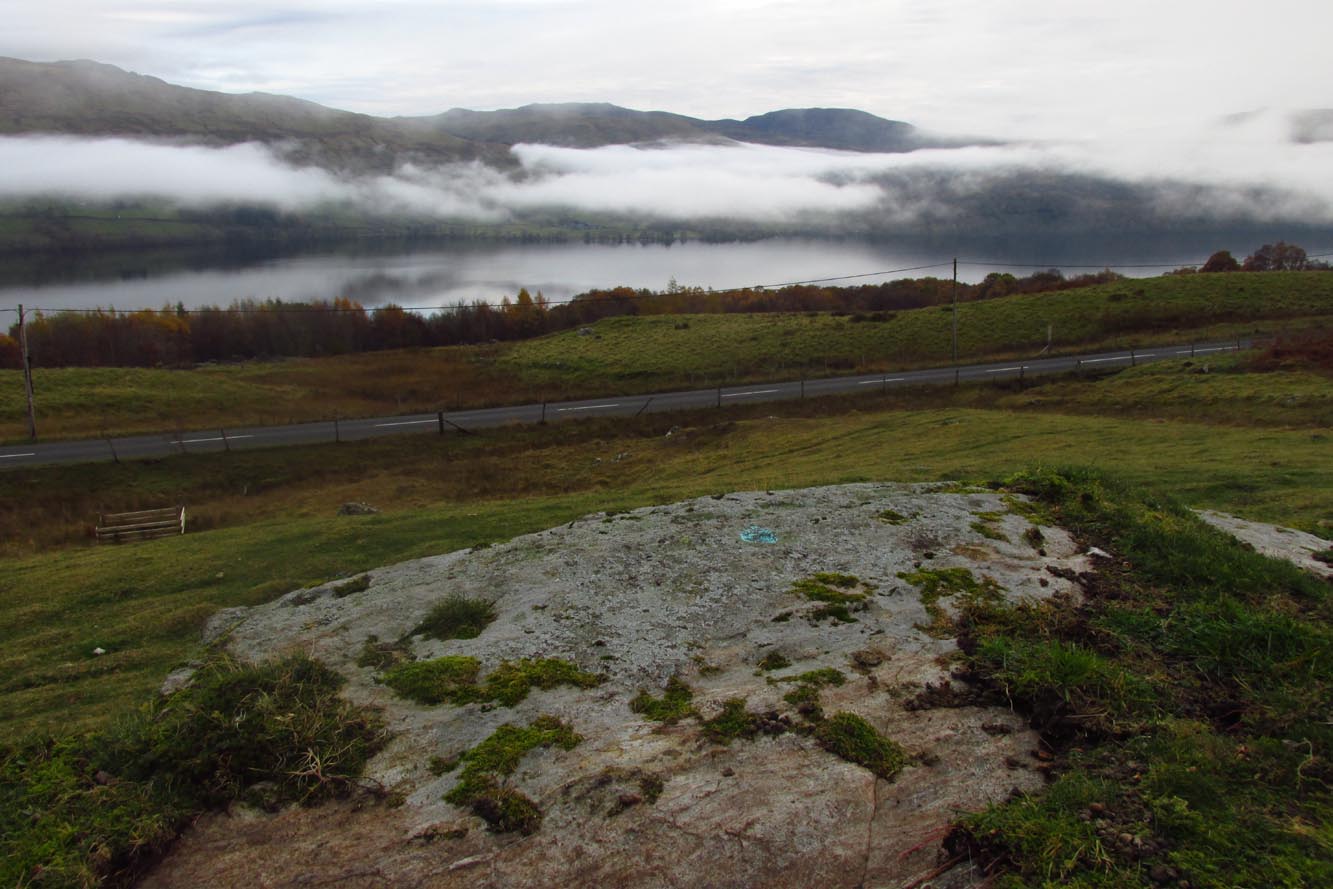
Along the A827 Loch Tay road, halfway between Fearnan and Lawers just beyond the forestry, a track goes up into the fields across from Feadan house (big shed above you in field).  Careful, or you’ll miss it.  Go up here and head all the way up the steep winding track for 700 yards (as the crow flies) until, where the land starts levelling out, you hit the long straight line of old walling.  Go over it and walk to your right (northeast) for a few hundred yards until it bears sharp left (NW), keep walking along it for another 45 yards and, where the fence turns down to the water, just keeping walking up the slope to the scatter of rocks. Look around!

Archaeology & History
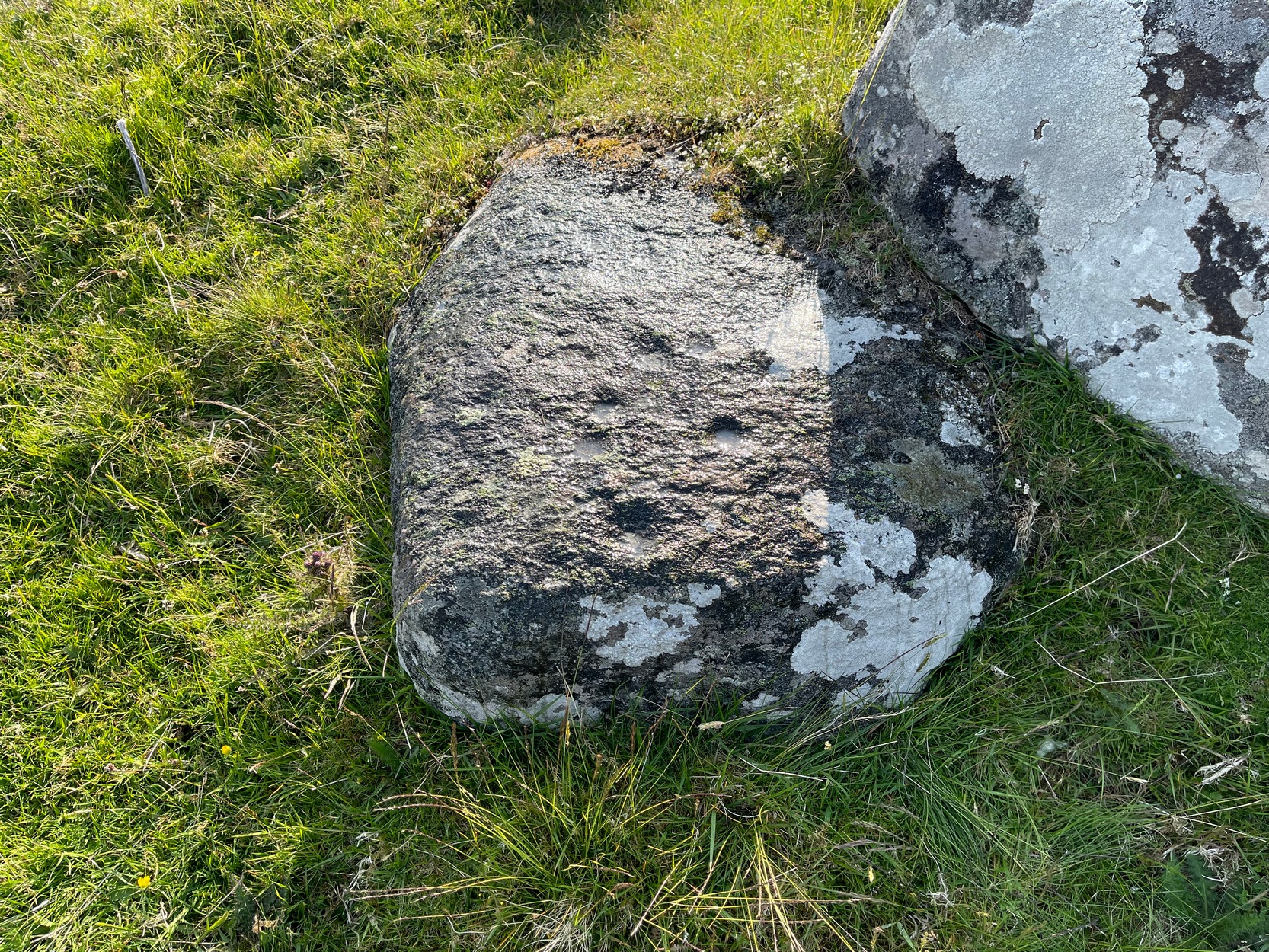
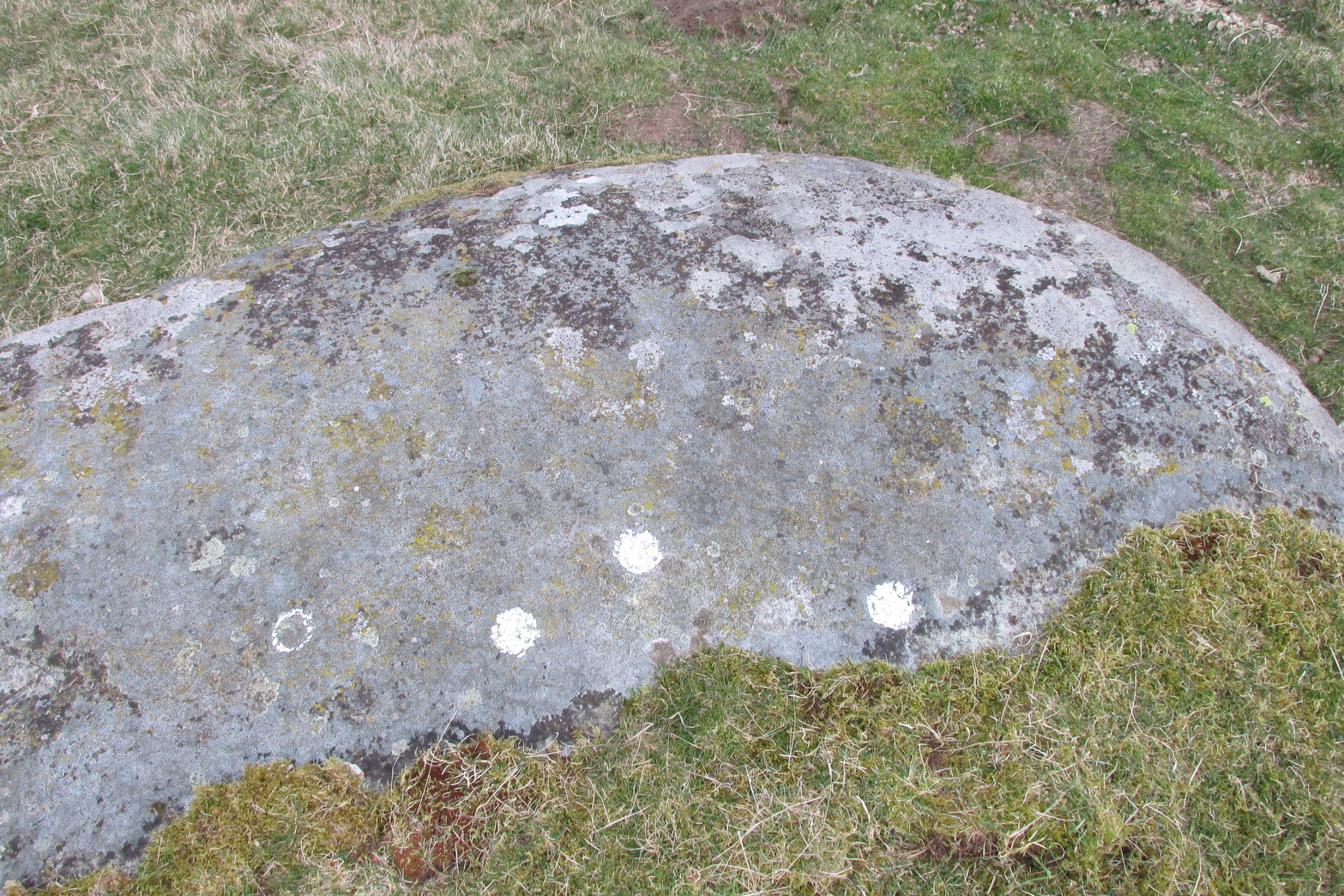
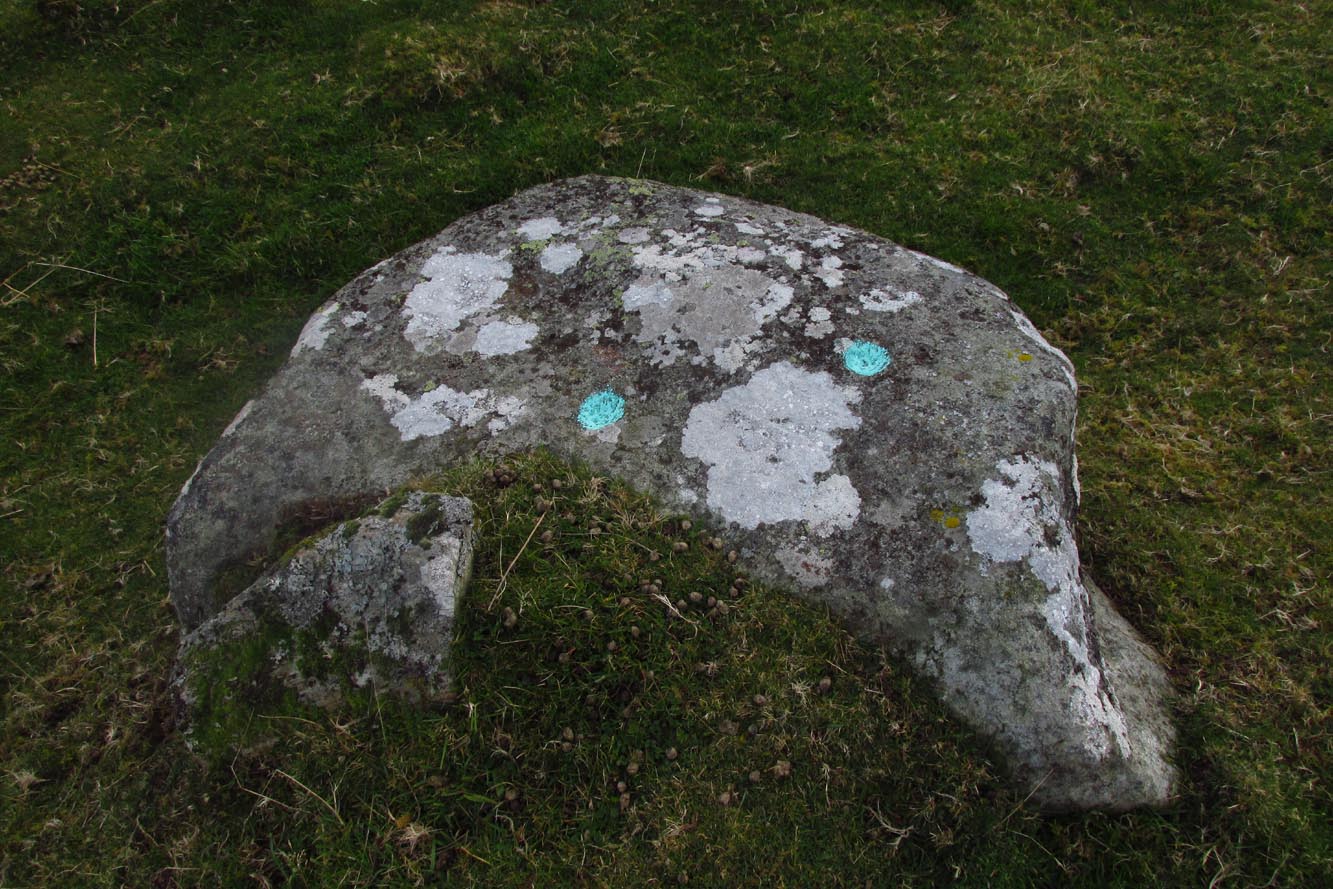
Looking down at the cups

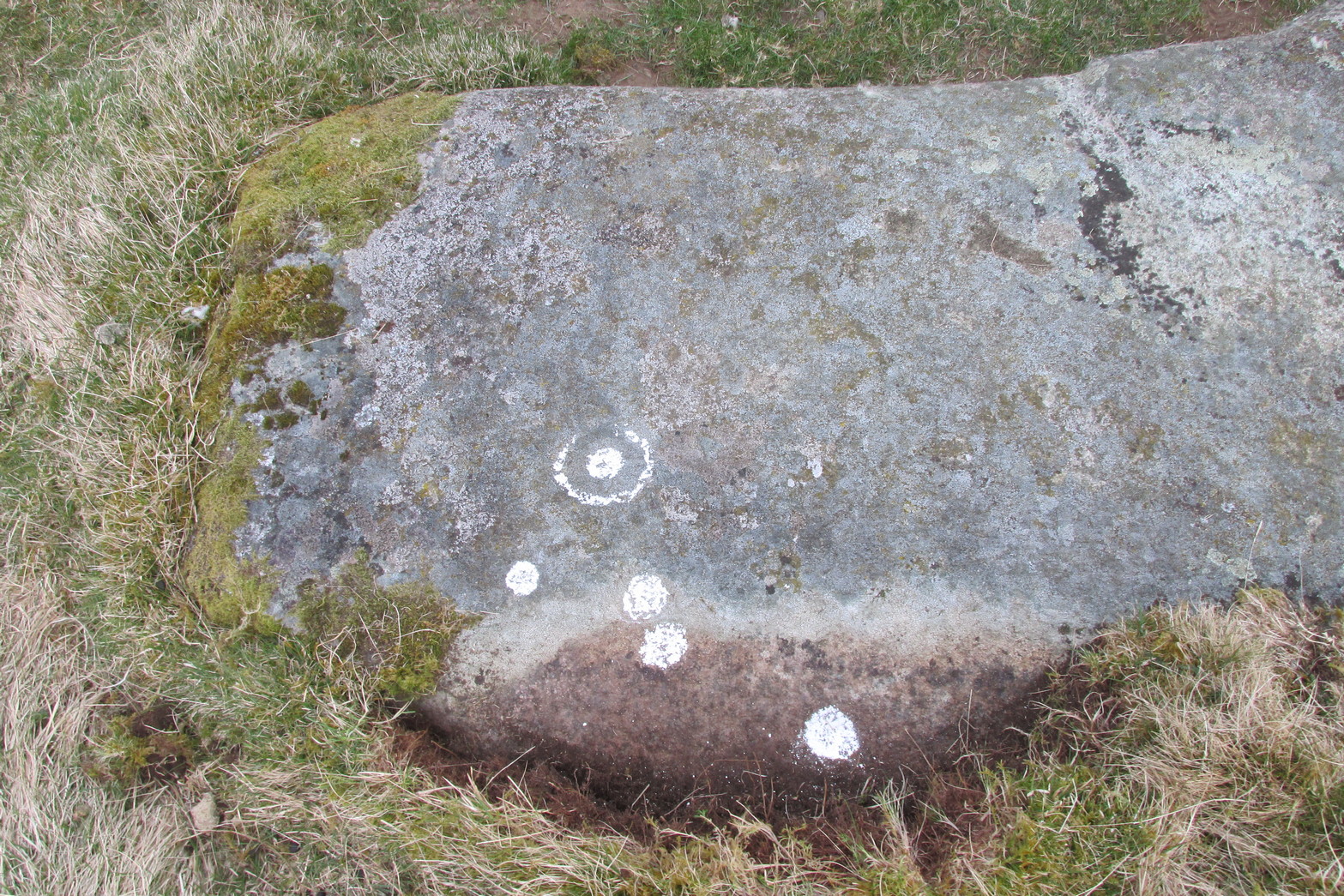
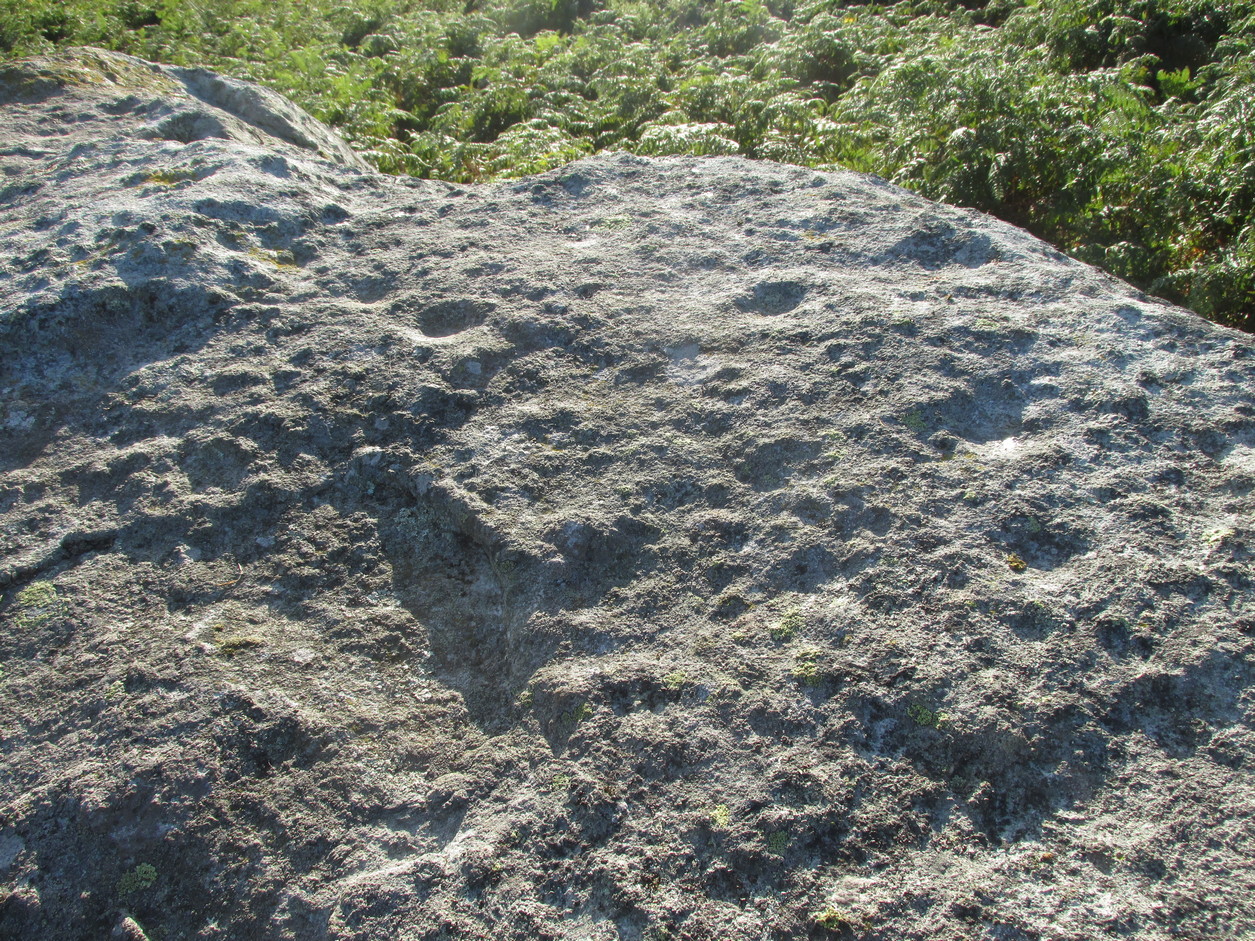
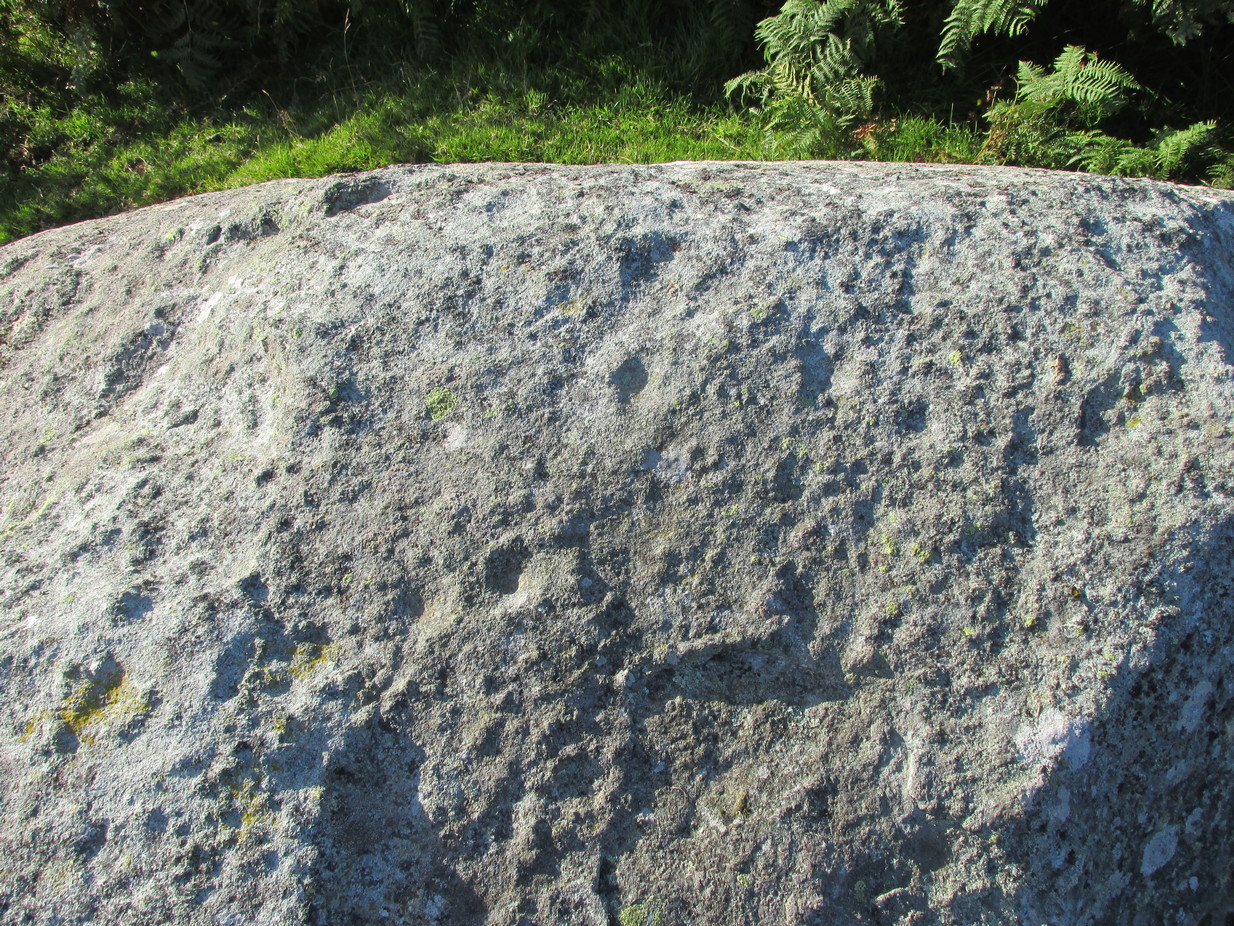
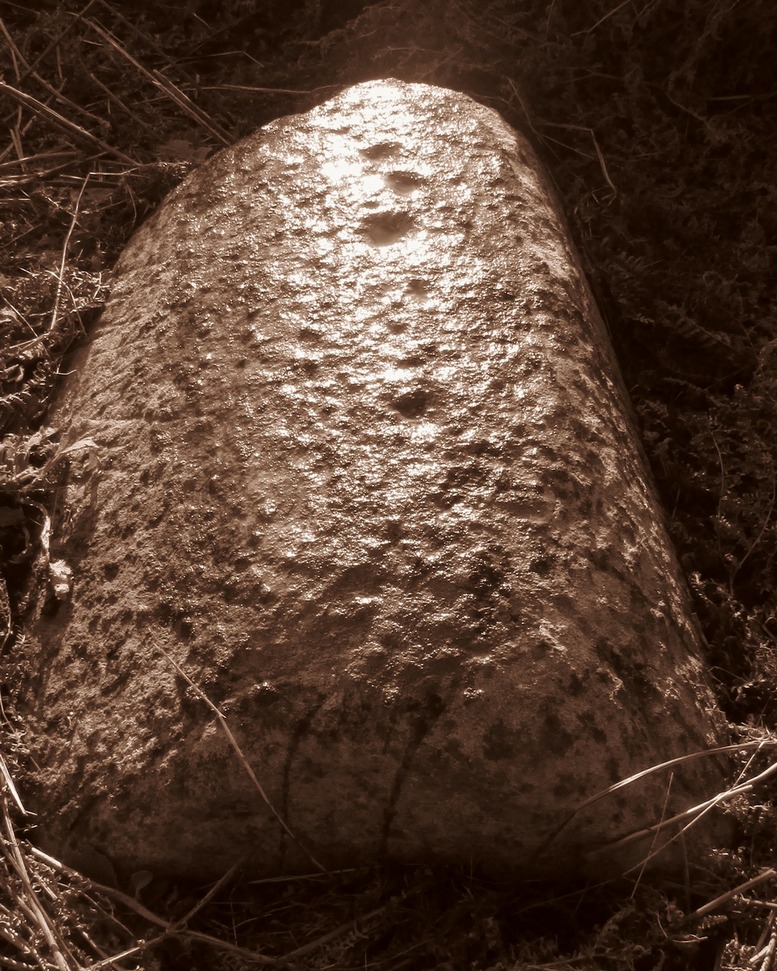
When you consider there are multiple-ringed carvings close by on the same geological ridge as this carving, there’s little wonder this fella hardly gets any attention: the design here is nothing special compared to its close neighbours.  That aside: on this small flat surface we have six or seven simple cup-marks; most of them quite small, with the largest of the lot having what looks like a small carved arc around one side of it—although I couldn’t make my mind up one way or the other to be honest.  A few more visits might prove more conclusive.

Folklore

The stream at the side of this carving and others nearby—the Allt Coire Phadairlidh, or Padderlie’s Burn—was the haunt of an urisk, who gave his name to the waters.  He lived a little further up on the knoll.  Several other carvings are just below here.  Urisks were plentiful in this area.  They are variously described as demonic creatures, referred to by Alexander Carmichael as “a monster, half human half goat, with abnormally long hair, long teeth and long claws.” (teeth aside, that sounds like me! 🙂 ) They mainly live by lonely waterfalls and a small beautiful fall is very close by.  They are associated in some places with cup-marked stones, where offerings of milk were made to placate them.  In truth, these nature spirits seem to be folk remnants of solitary shaman figures cast into the edges of hills.  A local lady who lived in this area said she’d met an urisk near here and he was anything but the fearful creatures they are made out to be…

References:

  1. Currie, George, “Kenmore: Allt Coire Phadairlaidh (AP1): Cup-Marked Rock,” in Discovery & Excavtion Scotland, vol. 9 (new series), 2008.

© Paul BennettThe Northern Antiquarian
Balnasuim (3), Kenmore, Perthshire

Cup-Marked Stone:  OS Grid Reference – NN 66075 39622

Getting Here

Take the directions to the Balnasuim (1) carving, then up and across to Balnasuim (2).  From here, walk diagonally uphill to your right (NE) for about 150 yards and head to the the very top-corner of this field.  You’ll see the large embedded rock emerging out of the ground, just ten yards away from a small stream.  You’re there!

Archaeology & History

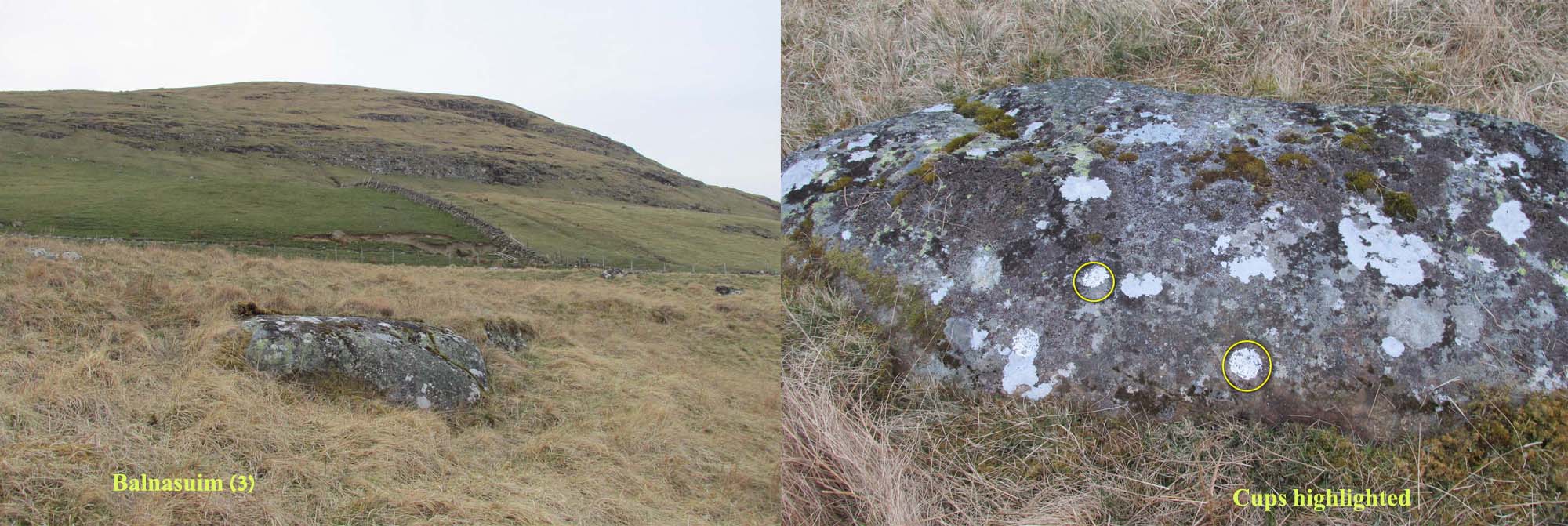
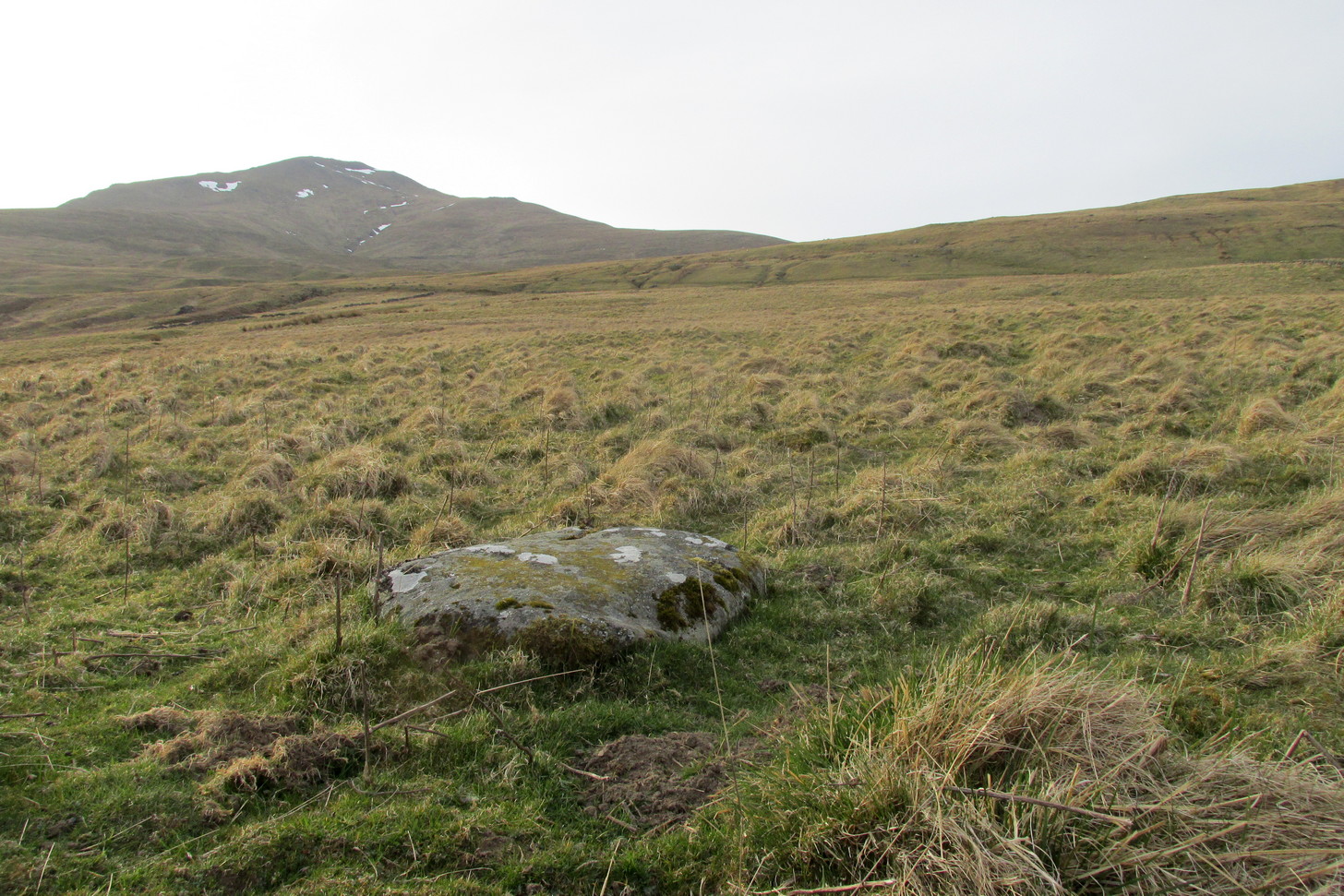
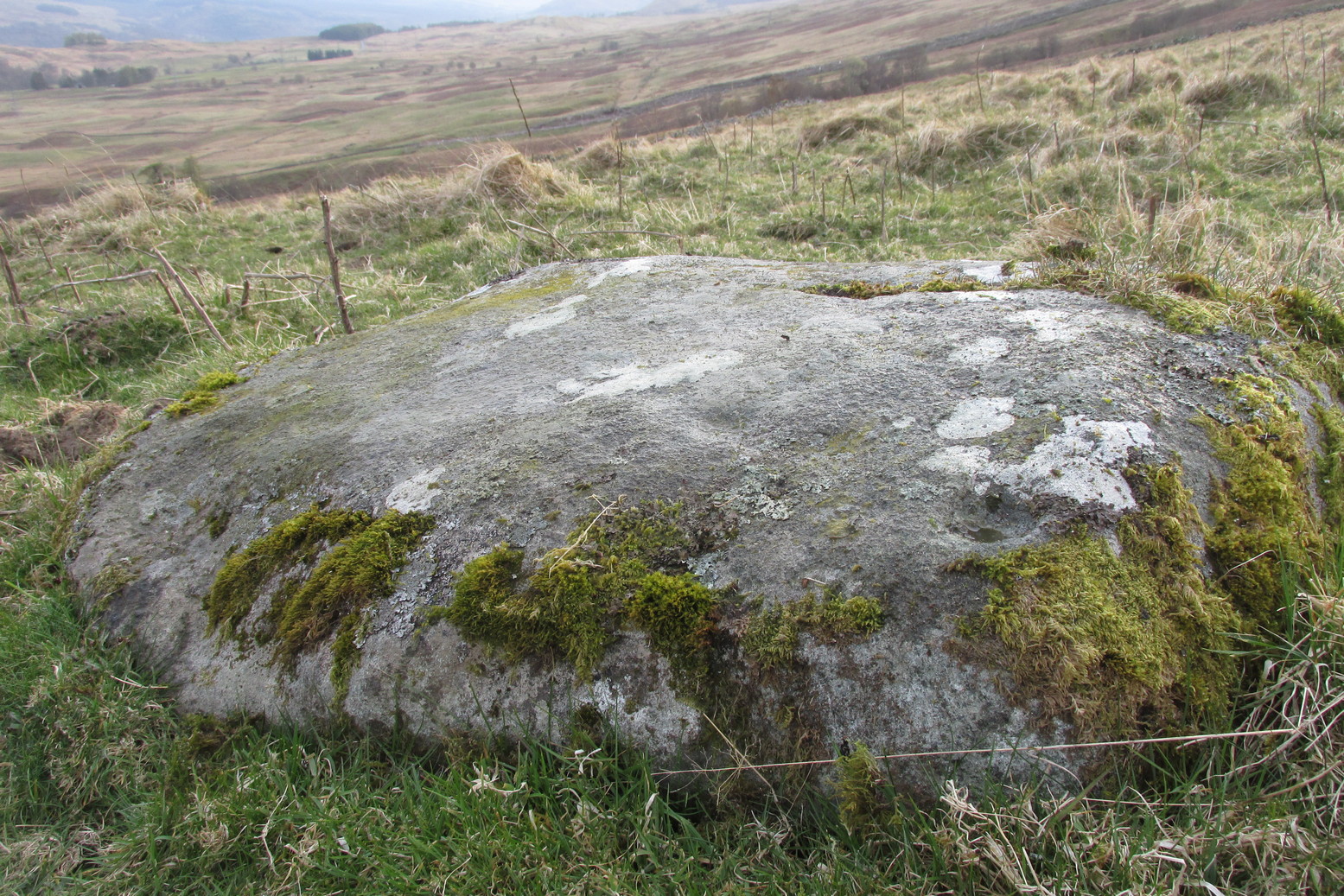
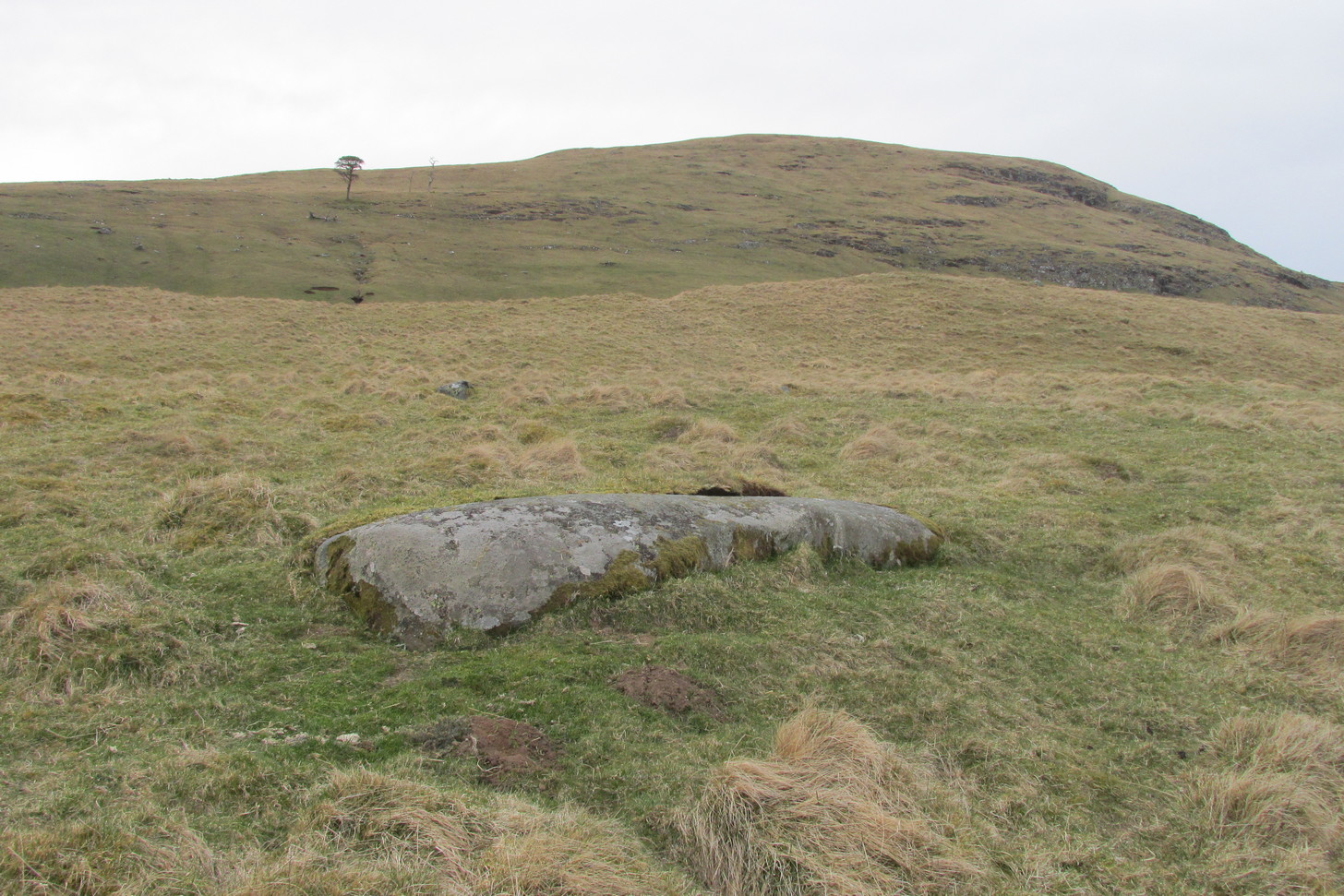
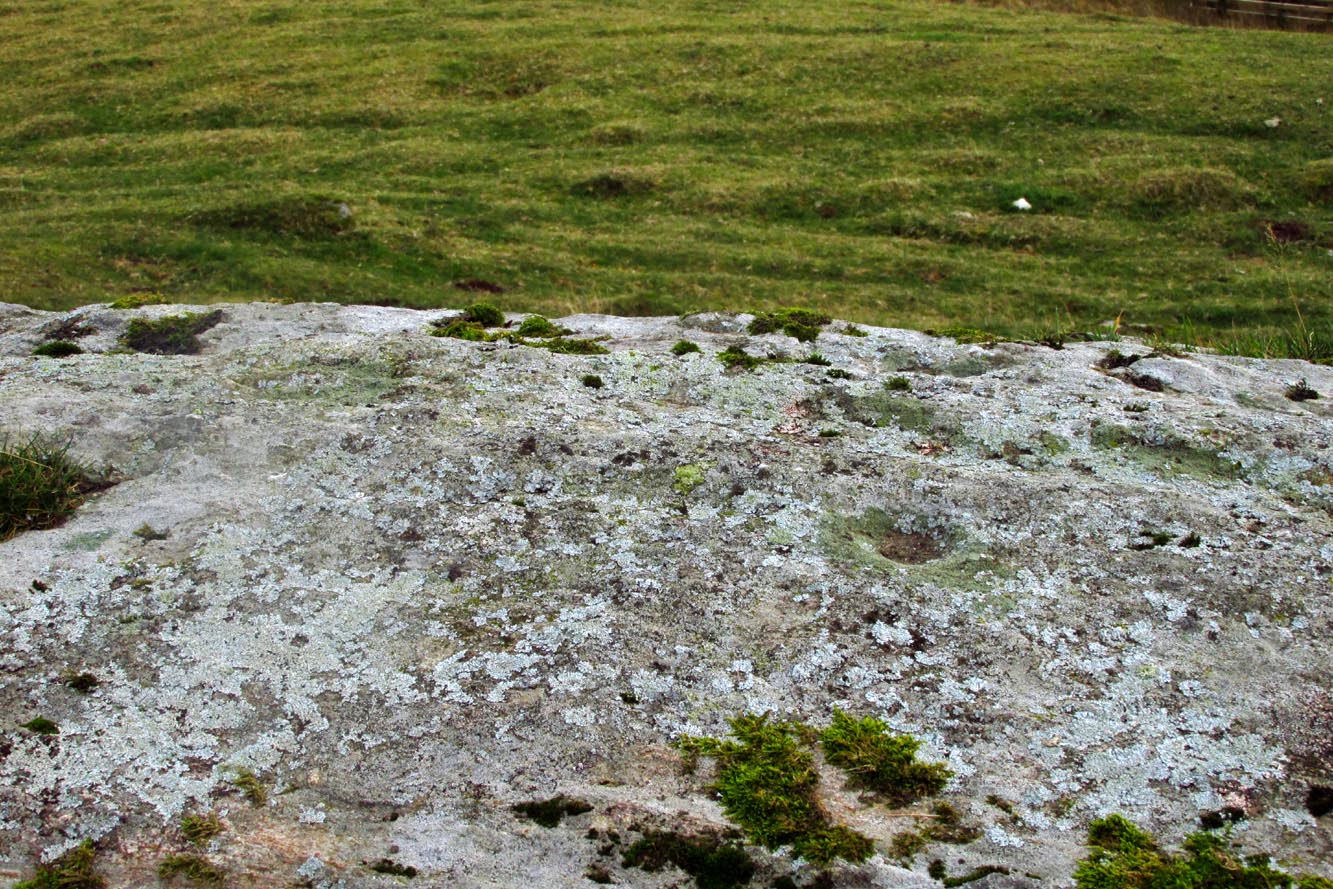
As Officer Barbrady likes to put it, “move along people, there’s nothing to see here!“—and that’s really the case with this, another of Balnasuim’s petroglyphs.  This lichen-encrusted rock has just two simple cup-marks, barely visible when the daylight’s poor – and it’s almost as disappointing when the day is good!  In all honesty, in wilfully visiting this site and its geographical compatriots, I can sincerely understand how people can tell us petroglyph-nuts that we “really have nothing better to do” with our time!

© Paul BennettThe Northern Antiquarian
Balnasuim (1), Kenmore, Perthshire

Cup-Marked Stone:  OS Grid Reference – NN 65813 39268 

Getting Here

Balnasuim (1), beneath Ben Lawers

From Killin, take the A827 road to Kenmore. 6 miles along, on your right, is the track down to the Big Shed at Tombreck.  Keep on the A827 for exactly ⅓-mile (0.53km), and opposite the driveway to Craggantoul is a small parking spot.  A few yards on the road, over the burn, go thru the gate on your left.  From here, follow the straight line of walling uphill and 20 yards before reaching Cragganester (9) carving, follow the line of fencing right (ENE) until you hit the wall more than 350 yards away.  From here, follow the walling uphlil 350 yards where it turns a right-angle west.  About 50 yards east of the right-angled wall, look around…

Archaeology & History

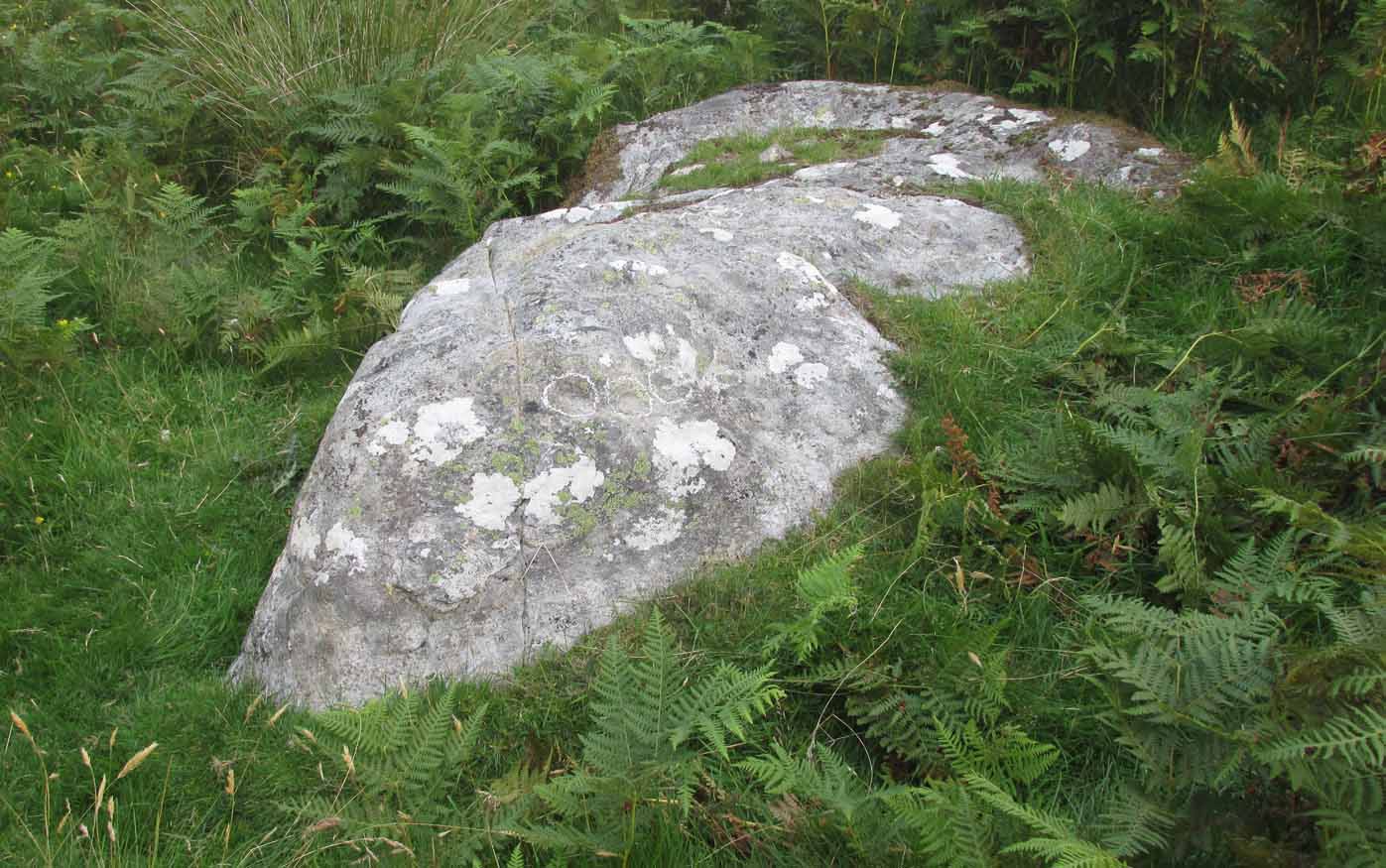
3 faint cups in an arc

As with the other carvings up here at Balnasuim, there is little to look at unless you’re one of the ardent petroglyphic crazies!  On this small rounded stone, cushioned beneath the skylines of Ben Lawers and Meall Odhar, are at least three cupmarks in a rough arc running from the northern part of the stone, with the most pronounced of them being close to the northern edge of the rock.  The others are very shallow and can be difficult to make out in poor sunlight.  A possible fourth cupmark with a short protruding line may exist close to the SE part of the stone.  The Balnasuim (2) carving is 305 yards (279m) to the NE.

© Paul BennettThe Northern Antiquarian

Balnasuim (2), Kenmore, Perthshire

Cup-and-Ring Stone:  OS Grid Reference – NN 65965 39521

Getting Here

Balnasuim (2), looking N

From Killin, take the A827 road to Kenmore. 6 miles along, on your right, is the track down to the Big Shed at Tombreck.  Keep on the A827 for exactly ⅓-mile (0.53km), and opposite the driveway to Craggantoul is a small parking spot.  A few yards on the road, over the burn, go thru the gate on your left.  From here, follow the straight line of walling up past Cragganester (9) carving, following the burn uphill parallel to the copse of trees until, after about 800 yards, you reach the wall.  From here, walk towards the rounded hill of Meall Odhar and, after about 450 yards, you’ll notice it meets a line of walling that runs downhill.  Keep walking along, past this, but after 150 yards, go into the field on your right and walk downhill for about 100 yards.  Look around!

Archaeology & History

Despite the climb, plus its description as a ‘cup-and-ring’ stone, this petroglyph is somewhat of a disappointment.  An elongated stone, half-covered in earth faces south towards Loch Tay and the mountains across, with a series of very eroded cup-marks.

Cup-marks on SW side
Cup-and-ring on NE side

They are separated into two small groups.  At the southwest side of the rock we can see three or four faded cup-marks.  The middle of the rock seems devoid of anything, but on its more northeastern side we find four more cups in close attendance to a standard cup-and-ring motif.  That’s about it!  The Balnasuim (1) carving can be found 305 yards (279m) to the southwest.


© Paul BennettThe Northern Antiquarian

Clach an Tuirc, Fearnan, Perthshire

Cup-Marked Stone:  OS Grid Reference – NN 72183 44970

Also known as:

  1. Boar Stone

Getting Here

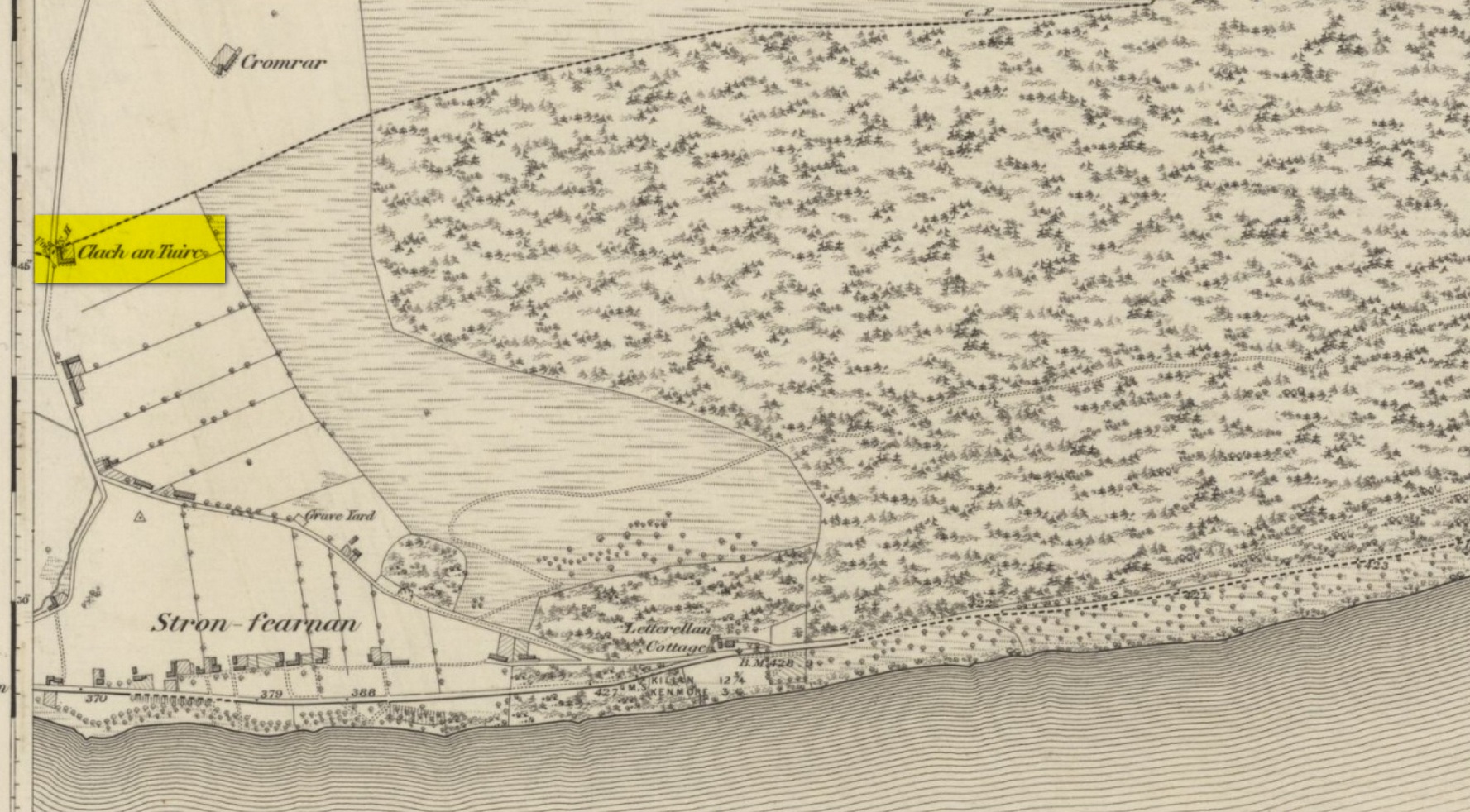
Clach an Tuirc on 1862 map

Pretty easy to find unless the vegetation takes over!  From Fearnan take the road to Fortingall.  Just as you’re going out of Fearnan, in the walling by the very last house on the right-hand side of the road is this large earthfast boulder. Y’ can’t miss it!

Archaeology & History

I first visited the Clach an Tuirc – or the Boar’s Stone – in 1981 when I stayed at Fearnan for a few weeks and, after clambering on top, looked down on the several simple cupmarks.  Forty years later, I returned with a camera!

First highlighted on the 1862 OS-map, Fred Coles (1910) made a brief note of the petroglyph in one of his megalithic surveys, but only noticed a single cup, saying:

“Near Cromraor, close to the cottage at Clash na Tuirc, stands the large boulder bearing that name, the Boar Stone. Its highest point is about six feet above the road, and bears one very distinct cup-mark.”

But there are several cup-markings on top of the stone, just as William Gillies (1938) described.

Folklore

Not far from here tradition tells of a legendary figure who is known today only as the Lady of Lawers (whom tradition asserts to have been a member of the Stewart family, from Appin, Argyll – they of the daemonic Red Book of Appin).  She made various prophecies, one of which said “that when Clach an Tuirc, the Boar’s Stone at Fearnan, would topple over, a strange heir would come to Balloch.” Though as the stone still aint toppled, we’re still waiting… (let’s just hope this doesn’t augur more of those selfish tories into our mountains who bring with them their mantras of “gerrof mah land”)

References:

  1. Coles, Fred, “Report on Stone Circles Surveyed in Perthshire (Aberfeldy District),” in Proceedings Society Antiquaries, Scotland, volume 44, 1910.
  2. Gillies, William A., In Famed Breadalbane, Munro Press: Perth 1938.
  3. MacMillan, Hugh, ‘Notice of Two Boulders having Rain-Filled Cavities on the Shores of Loch Tay, Formerly Associated with the Cure of Disease,’ in PSAS 18, 1884. ???
  4. Yellowlees, Walter, Cupmarked Stones in Strathtay, Scotland Magazine: Edinburgh 2004.

Links:

  1. Canmore notes on Clach an Tuirc

Acknowledgements:  Huge thanks for use of the 1st edition OS-map in this site profile, Reproduced with the kind permission of the National Library of Scotland.

© Paul BennettThe Northern Antiquarian 

Cragganester (11), Kenmore, Perthshire

Cup-Marked Stone:  OS Grid Reference – NN 65858 38750

Getting Here

Cragganster 11 in situ

From Killin, take the A827 road to Kenmore. 6 miles along, on your right, is the track down to the Big Shed at Tombreck.  Keep on the A827 for exactly ⅓-mile (0.53km), and opposite the driveway to Craggantoul is a small parking spot.  A few yards on the road, over the burn, go thru the gate on your left.  Follow the straight line of walling up for 400 yards it meets where another line of walling running right (E), into the boggy pasture-lands. Walk along here for roughly another 400 yards then go up the slope as if walking up Ben Lawers (N).  You’ll come to 2 large boulders next to each other where the slope levels out.  It’s the one on your left!

Archaeology & History

This carving is really for the purists amongst you.  It’s like most of the carvings along this contour line in that the design is simplistic.  Consisting of at least nine cups all on top of the stone, they can be difficult to see amidst the rough garnet and lichen-encrusted rock.

Cupmarks on its west face
Looking down on the cups

On one of our visits here, when the light cut across the surface at a lower angle, it seemed as if one of the cups had a faint ring around it; but it looked as if the outline of it had been started, but then for some reason the ring was never actually carved.  This outline is very faint.  We’ve found examples of this at two of the Duncroisk carvings, several miles to the west, where the faintest trace of a ring was outlined, but never carved.  Of the cup-marks: five of them are carved on the east-side of the rock and are pretty easy to see (with the ring around one of them), whilst the other four—slightly more difficult to make out—are on its west side.  A couple of hundred yards north you can see the Cragganester 10 carving.

© Paul BennettThe Northern Antiquarian

Cragganester (3), Kenmore, Perthshire

Cup-Marked Stone – NN 65632 38144

Getting Here

The rock in the landscape

From Killin, take the A827 road to Kenmore. 6 miles along, on your right, is the track down to the Big Shed at Tombreck.  Keep on the A827 for exactly ⅓-mile (0.53km), and opposite the driveway to Craggantoul is a small parking spot.  A few yards on the road, over the burn, go thru the gate on your left and walk up the path for less than 100 yards. The stone is just a coupla yards on your right (if you reach the derelict tractor, you’ve gone about 10 yards past the stone).

Archaeology & History

Cupmarks along the top

This is another one of the many simple cup-marked petroglyphs scattering the Cragganester and Tombreck regions beneath the slope of Ben Lawers.  It’s an elongated, smoothly-shaped ‘female’ stone, aligned north-south, possessing four distinct cups along its crown: three in a small line at the south-end of the stone and a single one close to the north end.  However between these is what may be another, shallow fifth cupmark—but this is uncertain.

One notable feature here is that the rock is encrusted with small garnets.  This geological ingredient isn’t uncommon in this area, and we’ve found that quite a proportion of the petroglyphs hereby possess this feature.  It was probably of some importance to the people who carved them.

Acknowledgements:  Thanks to Paul Hornby for use of his photograph.

© Paul BennettThe Northern Antiquarian


Cragganester (19), Kenmore, Perthshire

Cup-Marked Stone:  OS Grid Reference – NN 66627 38647

Getting Here

Cragganester 19 stone

Although you could just as well follow the directions to reach the Cragganester 22 carving (exactly 100 yards away), it’s probably easier to get there from where the track leads down to Balnasuim, but there’s nowhere to park any vehicle here—unless you’re on a bike!  Across the road from the Balnasuim track is a gate.  Go thru this and then follow the fence immediately on your left, running parallel with the road for roughly 250 yards (218m), until you reach a denuded wall that runs onto the hillside above you.  Follow this up for roughly 200 yards (96m) until you reach a grass-lined track.  Walk to your left and keep your eyes peeled for a reasonably large rounded boulder next to the track 40 yards on.  That’s it!

Archaeology & History

2 cupmarks highlighted

This is one of the many simplistic petroglyphs in the Cragganester complex, probably only of interest to the fanatics amongst you!  There are two distinct cup-marks on this nice rounded ‘female’ stone, one near the top and one near the middle, amidst the olde lichen growth.  Loch Tay stretches along the glen below here, but only a portion of it is visible nowadays.  In times gone by, tree growth probably prevented any vision of the waters below…

© Paul BennettThe Northern Antiquarian


Cragganester (22), Kenmore, Perthshire

Cup-Marked Stone:  OS Grid Reference – NN 66585 38564

Getting Here

Looking across Loch Tay

It’s a bittova pain-in-the-arse to reach this and its associated carvings, as there’s little place to park along here.  The easiest is to park 600 yards east of Tombreck at the spot just by the small bridge at Craggantoul.  Keep your eyes truly peeled!  From here, walk along the road for ⅔-mile where you’ll hit a gate taking you onto the boggy hillside.  Go diagonally up here for 150 yards where you’ll hit an overgrown track and small disused quarry.  Some 50 yards along you’ll see a small rock outcrop on your left (as if you’re going back to the road).  That’s the spot!

Archaeology & History

Close-up of cupmark

Not previously recorded, this simple petroglyph on a small rock outcrop—barely 50 yards above the A827 Killin-Kenmore road—comprises of one clear cup-mark prominently etched near the middle of the upper surface; and another possible cup on the left (eastern) section of the rock.  Cragganester carvings 19 and 20 are respectively about 100 yards NE and NW of here but, like other carvings nearby, is only gonna be of interest to the fanatic nutters out there!

© Paul BennettThe Northern Antiquarian

Cragganester (5), Kenmore, Perthshire

Cup-Marked Stone:  OS Grid Reference – NN 65379 38389

Getting Here

3 cups on the side & 2-3 on top

From Killin, take the A827 road to Kenmore. 6 miles along, on your right, is the track down to the Big Shed at Tombreck.  Keep on the A827 for exactly ⅓-mile (0.53km), and opposite the driveway to Craggantoul is a small parking spot.  Go through the gate here and walk up the little hill right in front of you until you can see an electricity pylon 200 yards away.  Head for, go up the slope behind and along until you drop into a tiny little valley where a long line of very distinct old walling runs east-west.  Walk back and forth along it till you see a reasonably large earthfast stone on its own.

Archaeology & History

Close to a long line of what I think is pre-medieval walling—possibly Iron Age—is what can only be described as a truly crap-looking petroglyph which, to be honest, I’d walk past and give not a jot of notice if it wasn’t for the fact that it’s been recorded.  When we visited here, three very worn large cup-marks were visible on its sloping west face, with what looked like two more on top of the stone—but these seemed questionable in terms of them being man-made.  Apparently there’s another one on it, but in the searing heat and overhead midday sun when we visited, this couldn’t be seen.

© Paul BennettThe Northern Antiquarian