Holy Well, Eccleshill, Bradford, West Yorkshire

Holy Well:  OS Grid Reference – SE 1878 3622

Getting Here

Take the A658 road north out of Bradford, past Undercliffe, and downhill towards Greengates.  When you meet with the large junction where Ravenscliffe Avenue turns to your right – stop!  Immediately on the left-hand side of the road is where the old well used to appear.

Archaeology & History

Old map showing Eccleshill's Holy Well
Old map showing Eccleshill’s Holy Well

In times past this was one of the most renowned holy wells in the region (we have at least 200 in West Yorkshire). First recorded as a holy well in 1585, specialist writer Edna Whelan remembers the waters here running into a stone trough at the side of Harrogate Road when she was young.

In 1932, local historian W.E. Preston described, “the remains of what was once a fine grove of trees leading up the hillside from the road to its source,” implying ritual commemoration and a procession to the site.  Today, this grove is still evidenced by the straight footpath across the main road, leading to the infamous Ravenscliffe estate.

In 1704 a court case was brought against some locals – Mr & Mrs Richard and Sarah White (and their daughter, Mary) – “for diverting the water from its ancient channel.”

In 1867 it was described in the Object Name Book:

“A considerable and well-known spring, it has the appearance of having been a bathing place. A bank has been thrown up on the east side, and a broken wall remains on the other sides. There is no tradition about it. It is likely to have been of some note…in the days of Romanism. Large trees are ranged on either side of the approach to it, forming a grove.”

Up till 1978, Andrea Smith (n.d.) reported the well to still be “protected by local tradition,” but this is no longer possible. Yorkshire Water don’t particularly give a damn about its preservation (water is money folks!) and today it’s covered by a man-hole in the garden.

References:

  1. Preston, William E., ‘Notes on the Early History of the Manor of Eccleshill,’ in Bradford Antiquary, 5, 1912.
  2. Preston, William E., ‘Some Local Holy Wells,’ in Bradford Antiquary, June 1932.
  3. Smith, Andrea, ‘Holy Wells Around Leeds, Bradford & Pontefract,’ in Wakefield Historical Journal 9, 1982.
  4. Whelan, Edna & Taylor, Ian, Yorkshire Holy Wells and Sacred Springs, Northern Lights: Pocklington 1989.

© Paul Bennett, The Northern Antiquarian

Armshaw Lowe, Oxenhope, West Yorkshire

Tumulus?:  OS Grid Reference – SE 04422 35130

Getting Here

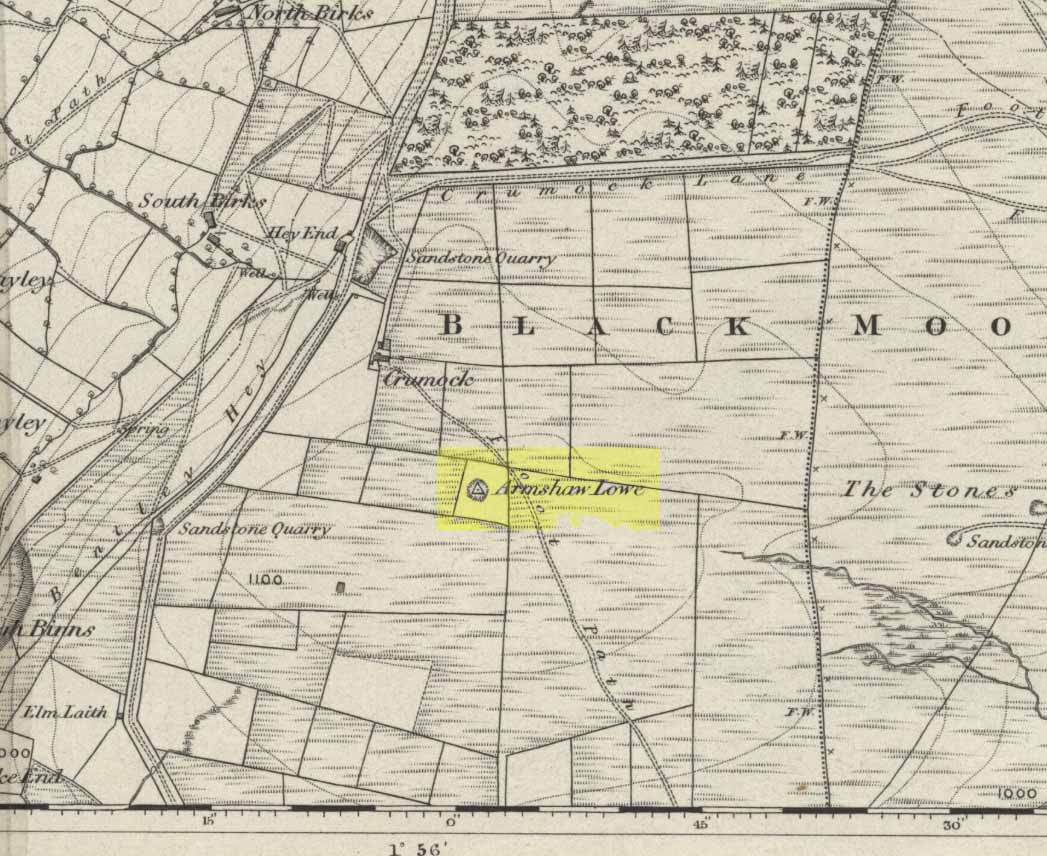
Armshaw Lowe on 1852 map

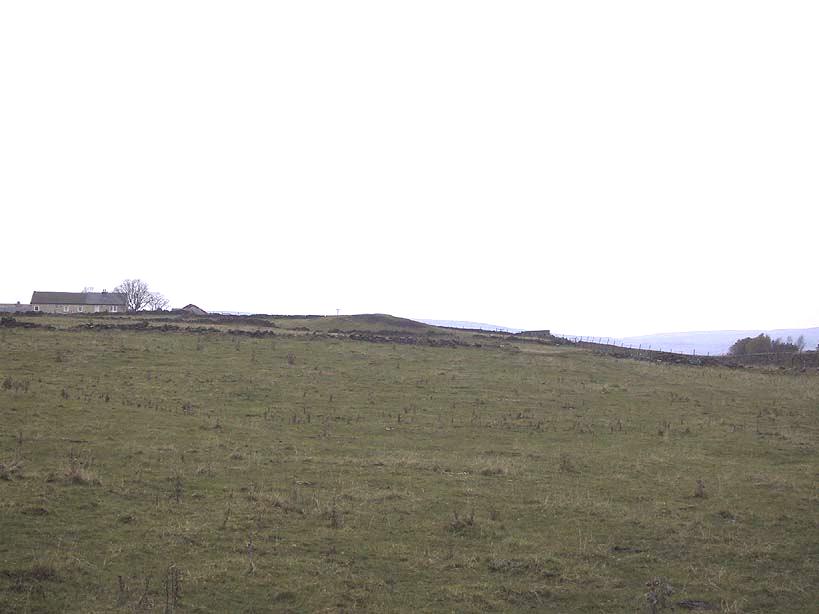
Go along the B6141 from Denholme to Oxenhope, turning right just by the bend which drops into Oxenhope, and head along the small road to Upwood Park camping site. Just before here is the Grange Park Animal sanctuary.  Ask there to walk onto the field behind, where you’ll see a rise in the land, as you can see on the rather poor photo I took from the east-side.

Archaeology & History

Although ascribed on early OS-maps as a tumulus (and still shown as an antiquity on the modern ones), this site appears to be simply the end-point along a geological ridge, starting a few hundred yards east of here, consisting of an upsurge of rocks covered in earth and nothing more. A survey of the place done by Bellamy in 1970 (Yorkshire Archaeological Journal, 42:6, 1970) seems to indicate the same. To those who want to test the theory, start by exploring it from Cullingworth Moor and walk along the ridge itself. It seems pretty clear.

Armshaw Lowe - looking west
Armshaw Lowe – the small mound in centre of photo

The “antiquarian” element to the site seems to originate in its positioning in the landscape. Armshaw Lowe is on the topmost point of the hills hereabouts, with 360-degree views all round, commanding excellent sights all round. But it’s perhaps the word ‘lowe’ that might be the important bit here, as in old english it can mean an old moot or meeting spot — which it may well have been for local tribes.  It is may be this element that gives Armshaw Lowe its lingering antiquarian status.

Check it out for yourselves and see what y’ think. I went up here to see an old burial mound, but found only a decent geological feature atop of local hills. But me ‘n’ the archaeologists might be wrong…

References:

  1. Gomme, G.L., Primitive Folk-Moots; or Open-Air Assemblies in Britain, Sampson Low: London 1880.

© Paul Bennett, The Northern Antiquarian

Druid’s Well, Bingley, West Yorkshire

Sacred Well:  OS Grid Reference – SE 09394 39894

Getting Here

If you’re a bittova unhealthy dood, give this site a miss, as it takes a bitta getting to!  Otherwise, get to the rocks at the very bottom of the Druid’s Altar and walk to the right (east) until you hit the walling a few hundred yards along.  Near the bottom of the slope, where the land levels out, there are several lovely moss-strewn boulders in their music of graceful hues.  One of them, you’ll see, has water emerging from it base.  You’re here!

Archaeology & History

The Druid's Well, Bingley
The Druid’s Well

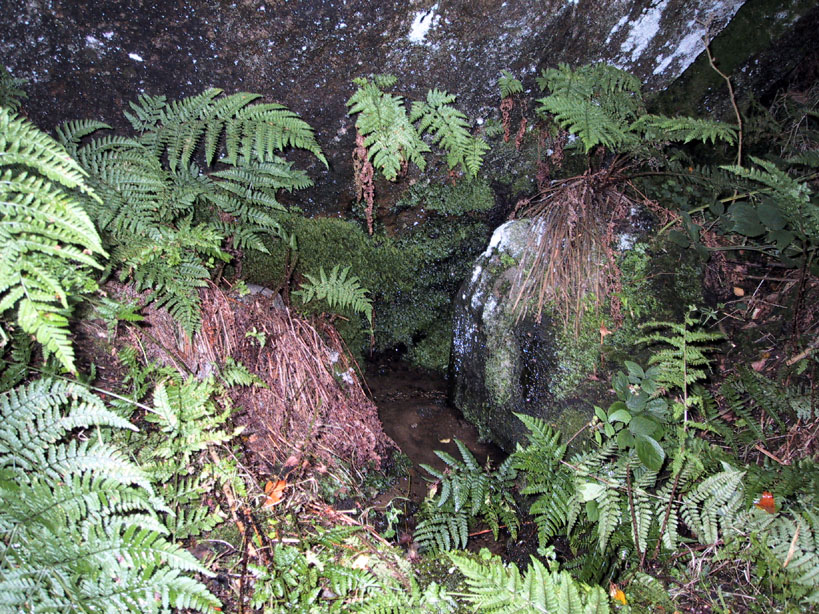
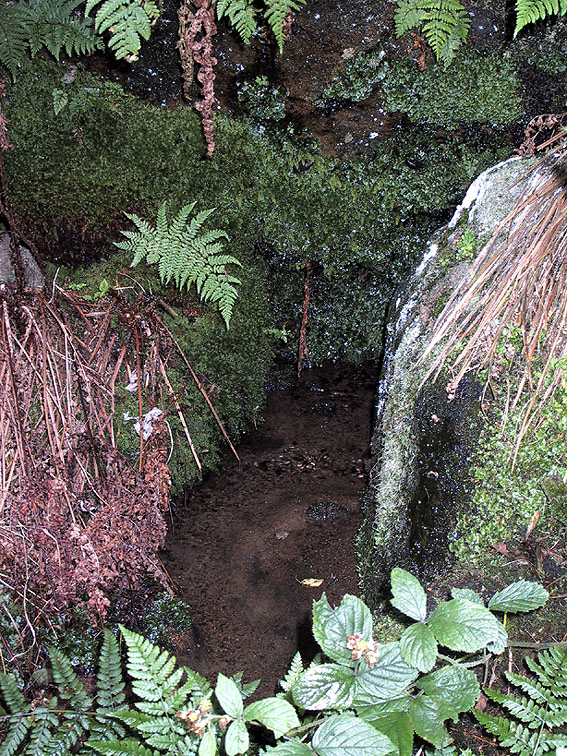
I first visited this old site with the holy wells writer Edna Whelan sometime in the early 1980s, when we went in search of the sacred spring of water known as the ‘Altar Well,’ shown on early maps to be just a short distance beneath the small cliffs called the Druid’s Altar.  We didn’t find it!  Another visit with Graeme Chappell and Edna (again) sometime later also proved fruitless – but something else was found which we didn’t know about on our first sojourn: the Druid’s Well, or more accurately the Druid’s Spring. (no stone trough y’ see)  Not far from the spot that the Altar Well could once be seen, this beautiful spring of sweet water emerges beneath the rich lichen-encrusted boulder, painted with dappled mosses and an overhang of vivid ferns.  Tis a fine oracular site, if ever there was one!

The waters run slowly from beneath the great old rock, upon which grows a fine specimen of a birch tree – a truly old thing!  And if there was ever any truth about this regions association with the druids, one of their most important sacraments grows profusely here when the season is right: no, not mistletoe (though it can be found sparingly upon the old oaks), but a wealth of the sacred Amanita muscaria, to whose spirit visionary journeys were bestowed.

Close-up of the waters beneath the boulder

The name of the woodlands in which our Druid’s Spring emerges — the Hollin Wood — might also have had some associative relationship with this well, or the Altar above (modern maps call it the Hollin Plantation, as much of the old woods have been felled and copsed by modern man).  Place-name texts ascribe this to be the ‘woodland of holly trees’, but during our wander through the woods a few weeks ago (when we got the photos of the Druid’s Well) holly trees were not common.  It may be that the Hollin Wood originally derived from ‘holy wood’, as this old well and the Druid’s Altar above would have surely made the site sacred to the druids.  Just a thought.  We will probably never know (if someone finds out for sure, one way or t’other, lemme know and I’ll amend where necessary!).

References:

  1. Greenbank, Sydney, The Druid’s Altar, Bingley, R.G. Preston: Bingley 1929.
  2. Speight, Harry, Chronicles and Stories of Old Bingley, Elliott Stock: London 1898.
  3. Whelan, Edna & Taylor, Ian, Yorkshire’s Holy Wells and Sacred Springs, Northern Lights: Dunnington 1989.

© Paul Bennett, The Northern Antiquarian