Dun Dubh, Ford, Argyll

Dun:  OS Grid Reference – NM 8640 0479

Getting Here

From Ford village, take the track that goes uphill (west) running near the edge of the forest-line. Keep going until you hit the top of the forest and the large rocky hill above you (on your right) is where you need to be heading.  The rise to your left is Dun Chonallaich.  Walk around the bottom of the hill until you get to the other side (you should be 100 yards or more above the tree-line) where you’ll notice a ‘pass’ running west, with a rocky knoll above you on your right.  That’s it!

Archaeology & History

Thought to date from the Iron Age, the remains here cover an area 15 yards by about 25 yards.  Remains of walling around the edge of the summit nearly a yard wide in places define quite clearly where the ‘fort’ was centred.  The entrance to the site was found on the northwestern side.  In more recent times however, animal pens have intruded on the remains here and the archaeological remnants are much denuded.

Folklore

Samhain fires were lit on the larger ridge above this ruined fort until recent years, as some old local folk will tell you. These Halloween fires (done to celebrate the old New Year) were stopped a short time after the new ‘owner’ of the Auchinellan Estate (on whose land Dun Dubh is found) took exception to them and, for all intent and purpose, deemed them a fire hazard! The lady in question who inherited the Estate was in fact a devout christian who took exception to the local “pagan” goings-on, contrary to the beliefs of the previous Estate owner, who not only allowed such old events, but played a part in them.  Local folk hereabouts, not surprisingly, aint too keen on their part-time dictatorial christian neighbour.

The fires up here were also related to the linear cemetery at Kilmartin. Here the giant tombs all line up & point to Dun Chonallaich, behind which hides the more flattened top of Dun Dubh. When the Halloween fires were lit on top of this, the glow from behind the great pyramid of Chonallaich all the way down to Valley of the Kings, was spectacular! One wonders just how long the local people had been doing this…

References:

  1. Royal Commission on the Ancient & Historical Monuments, Scotland, Argyll – volume 6, HMSO: Edinburgh 1988.

© Paul Bennett, The Northern Antiquarian

Ford, Kilmartin, Argyll

Tumulus:  OS Grid Reference – NM 86899 03572

Getting Here

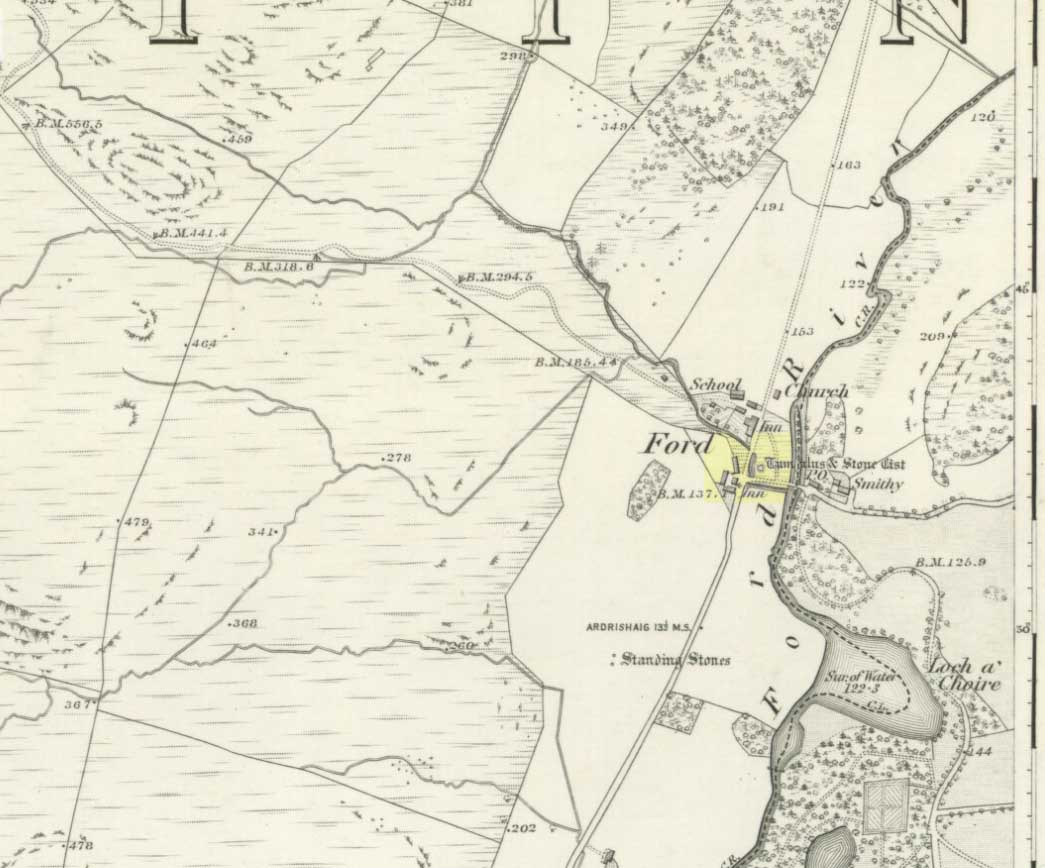
Ford Tumulus on 1875 map

Although I describe this site in association with the township of Kilmartin, it is in fact several miles north of there – but I reckoned that if I say it’s near Kilmartin, then those of you who don’t really know this region, will have some idea of its locale.  So – from Lochgilphead, go up north thru Kilmartin, another coupla miles on, till you reach the small road to your right (signposted ‘Ford’).  Just keep driving for a couple more miles until you hit the village.  If you park by the only shop, you’re just past the old tomb.  Diagonally across on the opposite side of the road from the Ford Hotel, right by the road-junction, just before the little shop, you’ll see a notable rounded mound overgrown in shrubs. Embedded in this are the remains of an old tomb.

Archaeology & History

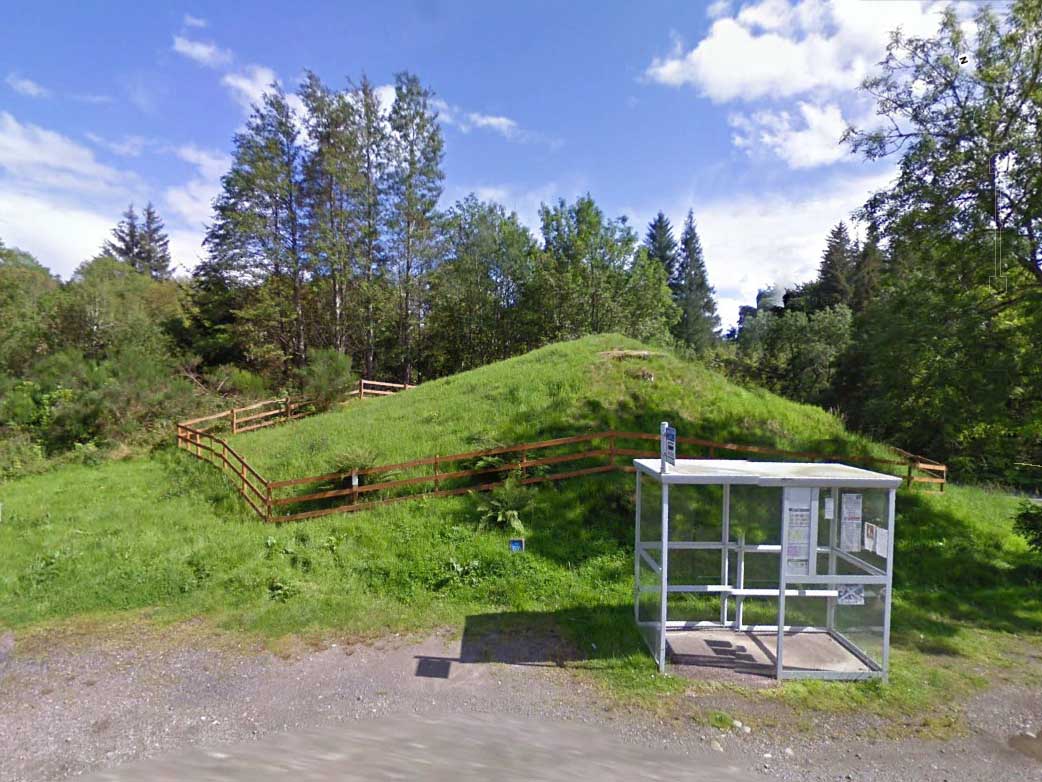
Ford tumulus (photo, couresty J. Reid)

This typical-looking fairy-mound just by the road junction in the village is where me and my daughter used to scramble around, sometimes playing and sometimes seeing if we could find anything of note in this ancient hillock, but all trace of any prehistoric stonework seems to be well-buried.  When excavators explored the site in bygone times, a small stone cist was found, which aligned (yet again) north-south and measured internally, roughly, 3ft x 2ft.  Only small!

A food vessel in Edinburgh’s central museum, “found in a cist in the neighbourhood of the lower end of Loch Awe” is thought to have come from this tomb.

References:

  1. Royal Commission on the Ancient & Historical Monuments of Scotland, Argyll – volume 6: Mid-Argyll and Cowal, HMSO 1988.

© Paul Bennett, The Northern Antiquarian

Dun Chonallaich, Ford, Argyll

Hillfort:  OS Grid Reference – NM 8544 0366

Getting Here

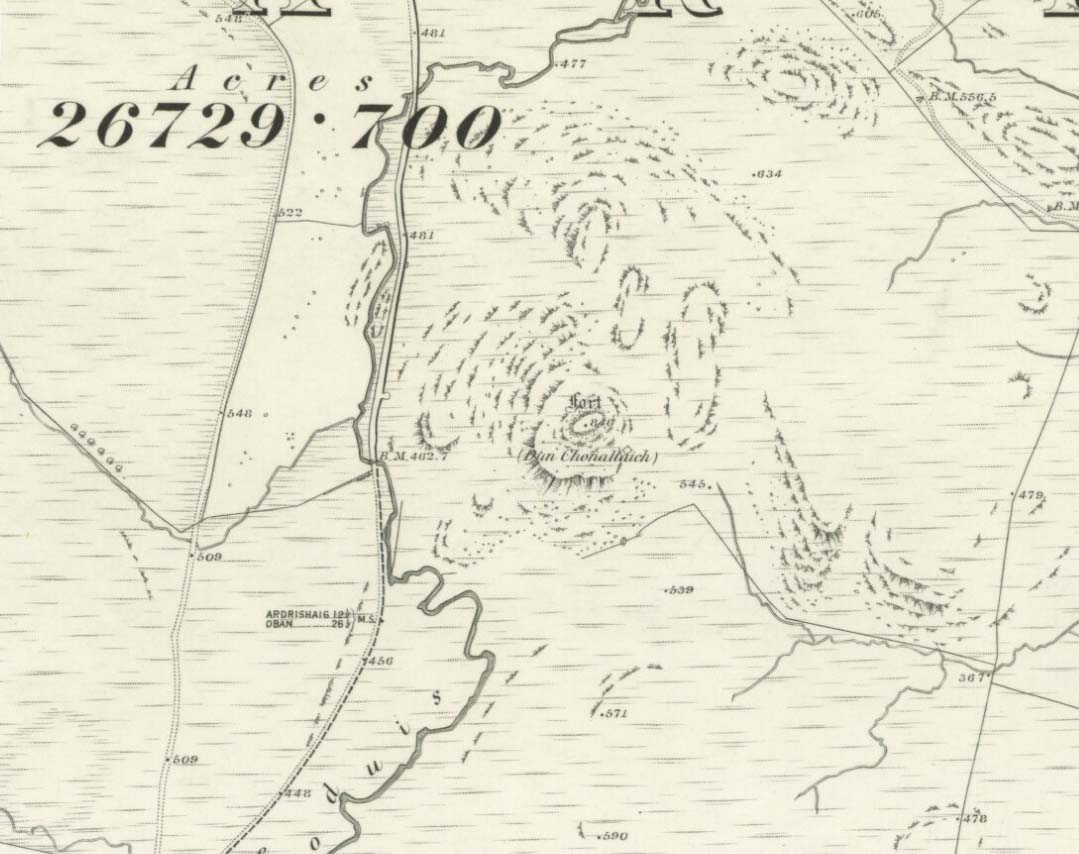
Dun Chonallaich on 1875 map

There’s two real ways to get up here: one from the Oban-Kilmartin roadside; the other from Ford village. I’d go for the latter as it avoids the traffic. Walk up the track to Salachary from the village centre, heading west. It’s a gradual uphill climb and after about half-a-mile (past six or seven cup-marked rocks) the great hill rises to your left.  Dun Dubh is to your right.  Climb over the fence and head for the hilltop.

Archaeology & History

It’s my opinion that this fort, above all others in the region apart from Dunadd, was of paramount importance to our prehistoric ancestors.  The reason being that it’s the great pyramidal hill to which the line of tombs in the Kilmartin Valley align, three miles to the south.  This prehistoric alignment was quite intentional (if you’ve got your doubts, gerrup there & have a look for y’self — you’ll soon change yer mind).

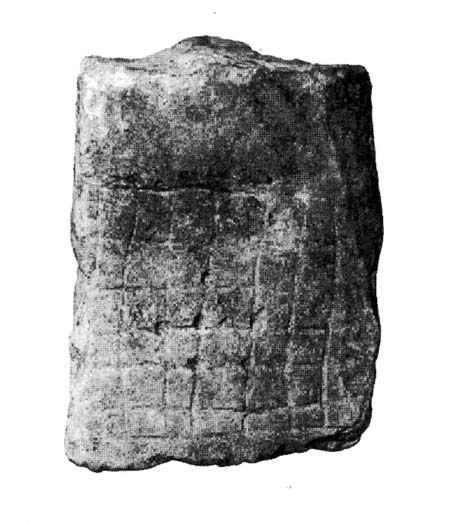
Curious carved stone found here

The main part of the structure is an irregularly-shaped construction with walling on all sides, measuring about 40 yards by 20 yards.  Much of it is pretty well defined – though has been vandalized by various doods in the past: one bunch being a film-crew who used the site in the early 1980s!  Inside the main walled fortress are several ruins.  The Royal Commission (1988) report told:

“Much of the interior is occupied by a rock spine which is surmounted by a modern cairn, but the NW half is relatively level and it contains, in addition to the modern round-house…and and an S-shaped structure associated with film-making, a number of ruined stone foundations.  On the north side there is a rectilinear building, and between the modern round-house and this rectilinear building, there is a further structure…an arc of walling, but its precise shape cannot now be determined without excavation.”

Dun Chonallaich means “the fort of King Connal’s people,” and although much denuded, is well worth the clamber for a short archaeological day out. A curious “gaming-board” was found here (see photo). A portable cup-marked stone in the fort’s southern wall is a modern artifact.

It’s a lovely view from up here too.  This is one of many places I’ve sat during a raging thunderstorm.  One helluva buzz, believe me!

References:

  1. Gillies, H. Cameron,The Place-Names of Argyll, David Nutt: London 1906.
  2. Royal Commission for Ancient & Historic Monuments, Scotland, Argyll – volume 6, HMSO 1988.

© Paul Bennett, The Northern Antiquarian
Creag a’ Chapuill, Ford, Kilmartin, Argyll

Hillfort:  OS grid reference – NM 8555 0244

Getting Here

Dead easy!  From Kilmartin go north towards Oban and turn right a mile onwards, to Ford and Loch Awe.  Keep on the tiny road for about 2 miles and if you hit the small Loch Ederline, you’ve gone too far.  To your left is a small hill-cum-small-mountain, scattered with trees and a great rocky face.   That’s it!  Whichever way you wanna approach its height is entirely up to you!

Archaeology & History

I clambered up and down this steep ‘crag of the horse’ many-a-times when I lived below here at the old farmhouse at Auchinellan.  Tis a grand old hill with good views all round.  The hillfort however has little left worth seeing, much of the stone being nicked by locals for drystone walls and barns. The best preserved section seems to be at the northeast side of the old hill. Archaeologists think that the mass of rubble nearby was also part of the fort walls in bygone days. Not being much of a hillfort fanatic, I can’t really comment!

On a decidedly mycological note, the magickal fungus of legendary repute, ergot (Claviceps purpurea), grows like the plague at the bottom of the hill (opposite the Creagantairbh standing stone). I wonder if our ancestors used it for owt in particular…?

References:

  1. Royal Commission on the Ancient & Historic Monuments of Scotland, Argyll – volume 6, HMSO: Edinburgh 1988.

© Paul Bennett, The Northern Antiquarian