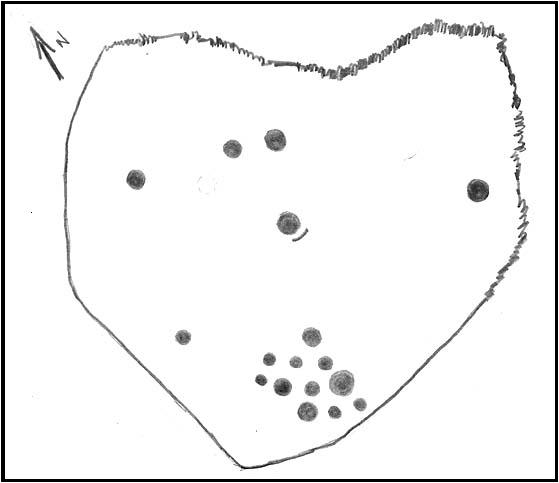
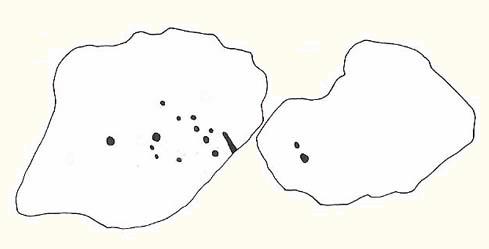
Rough Holden CR-7, Silsden, West Yorkshire

Cup-and-Ring Stone:  OS Grid Reference – SE 06918 45020

Getting Here
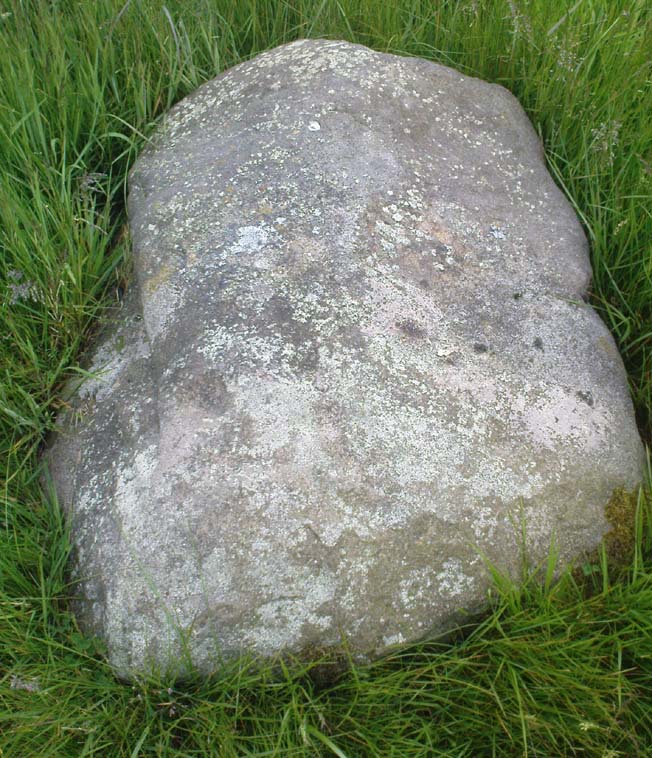
Rough Holden Cup-and-Ring Stone

Another carving that might take a bitta finding.  Follow the same directions for reaching the Holden Buttock Stone, going past it towards the fence 100 yards away.  Go through the gate and walk along the path for a couple of hundred yards.  As you walk down, you’ll eventually see the cluster of rocks amidst which lives the Dump Stone carving.  This, the Rough Holden cup-and-ring, is off the path (right) before you get to them in the grasses.  Look around.

Archaeology & History

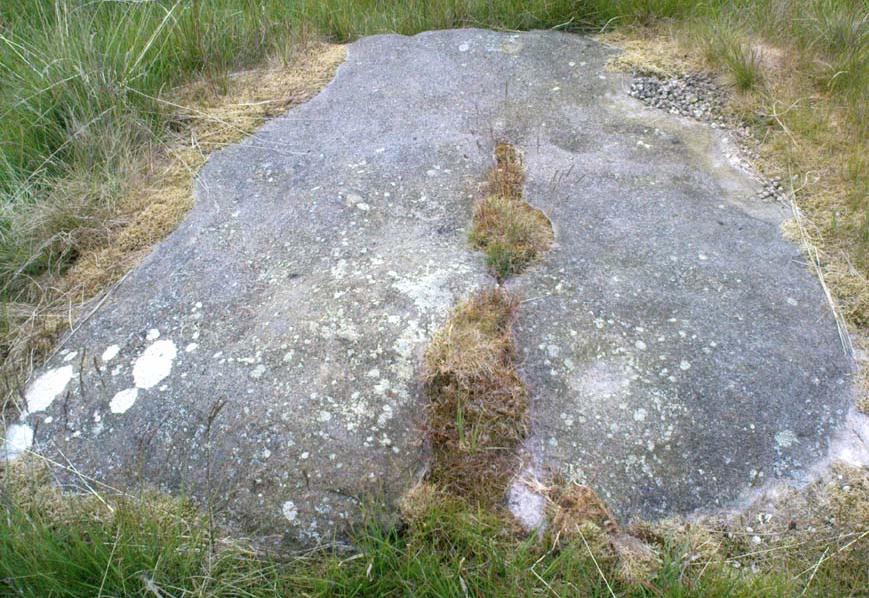
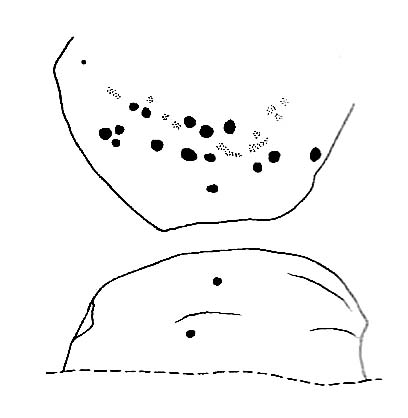
Rediscovered in June 2009 by Michala Potts and I, this little stone at first only appeared to possess a few cup-markings, but the more we looked at it, the more obvious it became that one of the cups had a nice ring surrounding it.  Unfortunately this didn’t come out at all well in any of the photos we took, so we need to another visit here whe the sunlight’s right to get a decent image.  Aswell as that, the drawing we did of the basic design appears to be missing what looks another blatant cup-marking near the centre of the rock, which did not seem at all obvious to the naked eye when we found it. (such are the delights of assessing cup&rings!)

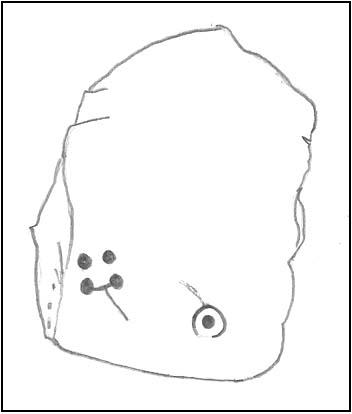
Rough Holden cup-marks
First sketch of the stone
Basic sketch of the stone

The main cluster of cups occurs on the northern-edge of the stone, where a couple of them seem linked by linear features.  There are also what may be a cup or three on the vertical edge of the rock, below these cups – but this needs looking at again the better lighting.   The cup-and-ring is very faint, but once noticed it become increasingly obvious that it’s there, and most of the ring can be traced with ease by running one’s finger along the groove.  Mikki reckons the ring runs all the way round the cup (she’s probably right), where as I could only work it out running 75% of the way round.  The line which runs off above the ring seems to link up with what looks like another obvious cup-marking on the photo.  We’ll have to check it out properly next time we’re up there!

© Paul Bennett, The Northern Antiquarian

Holden Buttock Stone, Silsden, West Yorkshire

Cup-Marked Stone:  OS Grid Reference – SE 06886 44723

Also Known as:

  1. Rough Holden CR-5

Getting Here

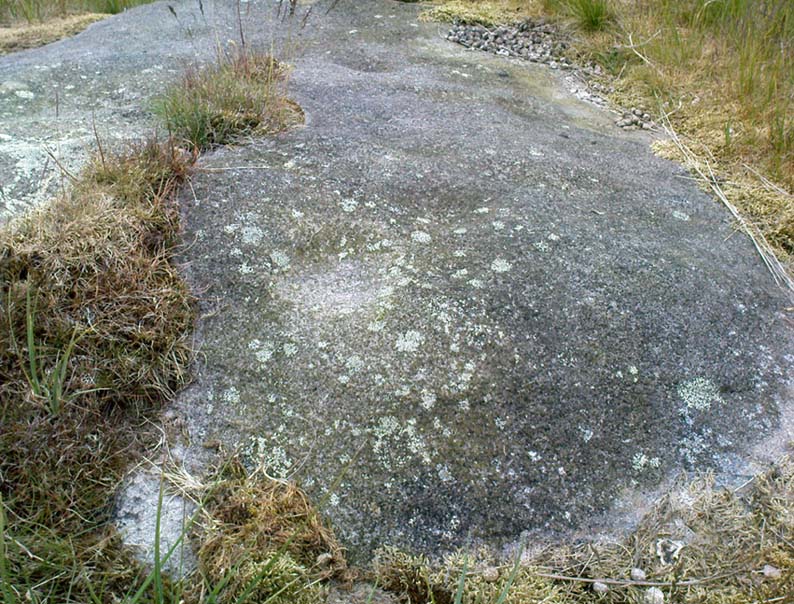
Holden Buttock Stone and its faint cups

A bit troublesome this one – and the 8-figure grid-ref might be slightly astray (though only by a little).  Get to the TV-mast below Rivock Edge and notice the small path going along the top of the adjacent field, over the fence, heading north-ish into the meadows — not the path into the forest.  Walk on the meadow path, over the wall and notice a rise in the ground ahead of you.  Go past this mound for about 75 yards and keep your eyes peeled!

Archaeology & History

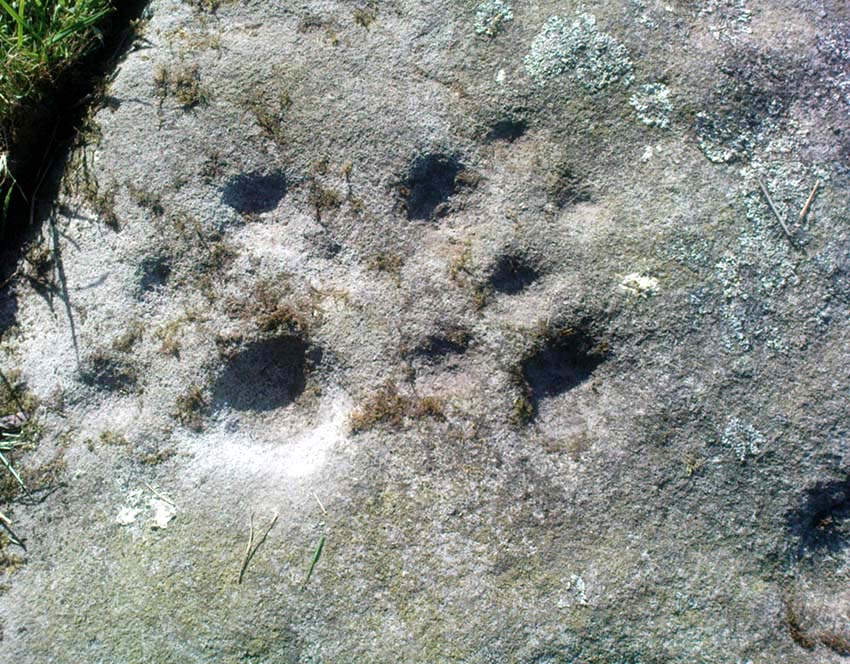
Close-up of cup-markings

Named by virtue of the shape of the stone, the Keighley volunteer Michala Potts of Bracken Bank found this carving on an exploratory amble yesterday (Friday, June 12, 2009).  Previously unrecorded, this carving consists merely of cup-markings — four distinct ones on the northeasterly edge of the rock, with two other ‘possibles’ thereon.  The cups have been pretty well-eroded by the elements and there are few distinguishing features which will make this of any real interest, unless you’re a real rock-art freak!

© Paul Bennett, The Northern Antiquarian

Rivock Nose (2), Keighley, West Yorkshire

Cup-Marked Stone:  OS Grid Reference – SE 07360 44629

Also Known as:

  1. Carving no.11 (Hedges)
  2. Carving no.46 (Boughey & Vickerman)

Getting Here

Follow the same directions for reaching the Wondjina Stone.  Once here, walk to the edge of the cliffs less than 10 yards away and the second largest of the rocks is the one you’re after. (the Rivock Nose [1] and [3] carvings are the rocks either side of this one)

Archaeology & History

Possible cup-markings at Rivock Edge

I’ve gotta admit, I was slightly surprised to find this carving logged in both Hedges (1986) and Boughey & Vickerman’s (2003) surveys.  Although we find the distinct appearence of cup-markings near the edge of the cliff at the northwestern end of Rivock Edge, these seem a little too close to being natural to be comfortably acknowledged in archaeo-texts without notes the contrary.  I took a photo of them when we were up visiting the other day, but didn’t expect them to be in the books.  Not only do they include this probably natural example, they also add another two rocks found along the cliff edges (Hedges 12 & 13; B&V 45 & 47).  In the event that these carvings are deemed authentic, then those along the edge of the great Kirk cliffs above Steeton must also be added to the same pot.

In the photo here you can work out perhaps nine cup-marks near the edge of the cliff, which is what the textbooks say.  Make your own mind up when your next looking at the Wondjina Stone and others nearby.

References:

  1. Boughey, Keith & Vickerman, E.A., Prehistoric Rock Art of the West Riding, WYAS 2003.
  2. Feather, Stuart, ‘Mid-Wharfedale Cup-and-Ring Markings: Nos. 7 & 8, Rivock Edge,’ in Cartwright Hall Archaeology Group Bulletin, 6:8, 1961.
  3. Hedges, John (ed.), The Carved Rocks on Rombald’s Moor, WYMCC: Wakefield 1986.

© Paul Bennett, The Northern Antiquarian 


Niplet Stone, Rivock, Keighley, West Yorkshire

Cup-Marked Stone:  OS Grid Reference – SE 07481 44452

Also Known as:

  1. Carving no.23 (Hedges)
  2. Carving no.59 (Boughey & Vickerman)

Getting Here

Niplet Stone (after Hedges)

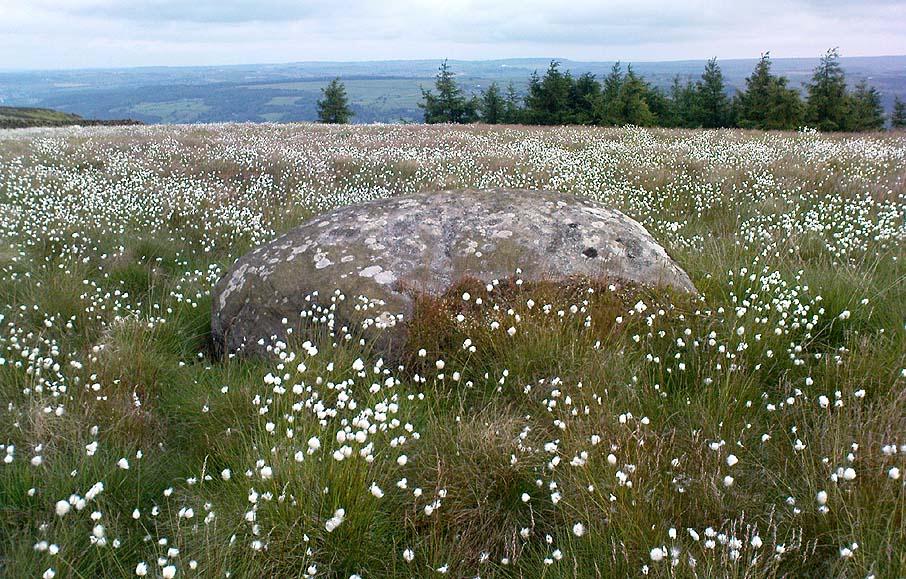
Follow the same directions to reach the nearby Wondjina Stone, but as you reach the trig-point at the top of Rivock Edge, note the smooth rounded boulder 50 yards ESE.  That’s it!

Archaeology & History

Named after the sea of cotton grasses, or niplets (Eriophorum angustifolium), amidst which it lives for several weeks of the year, the cups-marks that make up this design can be terribly difficult to work out even in the best of lighting.  We have here a lichen-encrusted stone with perhaps as many as 25 cup-marks scattering, mainly, the top and westerly sloping face.  Although some of the cups are quite noticeable, the vegetative growth and simple erosion has made an accurate visual impression of the original carving very difficult — as the images plainly tell!  If I ever manage to capture the stone resting in a good mood, I’ll replace the photos I’ve got here!

Niplet Stone, looking SE
Beautiful fusion of faded cups, lichen & great age...
Beautiful fusion of faded cups, lichen & great age…

Although I remember coming here and seeing this and the nearby carvings when I was a teenager, then a few years later on with Edna Whelan and Graeme Chappell, it seems that the first literary note of this carving after my own initial exploration was in the Ilkley Archaeology Group’s survey (Hedges 1986), where they make note of a flint that was found beside the stone.  Boughey and Vickerman (2003) later include the same stone in their work, but with no additional information.

References:

  1. Bennett, Paul, “The Prehistoric Rock Art and Megalithic Remains of Rivock & District (parts 1 & 2),” in Earth, 3-4, 1986.
  2. Boughey, Keith & Vickerman, E.A., Prehistoric Rock Art of the West Riding, WYAS 2003.
  3. Hedges, John (ed.), The Carved Rocks on Rombald’s Moor, WYMCC: Wakefield 1986.

© Paul Bennett, The Northern Antiquarian

Wondjina Stone, Rivock, Keighley, West Yorkshire

Cup-and-Ring Stone:  OS Grid Reference – SE 07366 44628

Also Known as:

  1. Carving no.10 (Hedges)
  2. Carving no.49 (Boughey & Vickerman)

Getting Here

Wondjina Stone, Rivock

A wonderful site, though a bittova walk for city-minded folk.  Head up the road from Riddlesden, Keighley, towards the southern edge of Rombalds Moor and keep going till you reach the road which surrounds the moor (called Silsden Road).  At the T-junction in front of you is a path which takes you onto the fields and moor.  Go over the stile and walk straight up the steepish field that follows the straight line of the forest, all the way to the top.  Climb over the wall on your left when you reach the top of the tree-line, walk past the triangulation pillar for 100 yards or so till you hit the end of the walling before it drops back into the trees.  The carving’s under your nose!

Archaeology & History

Wondjina Stone01
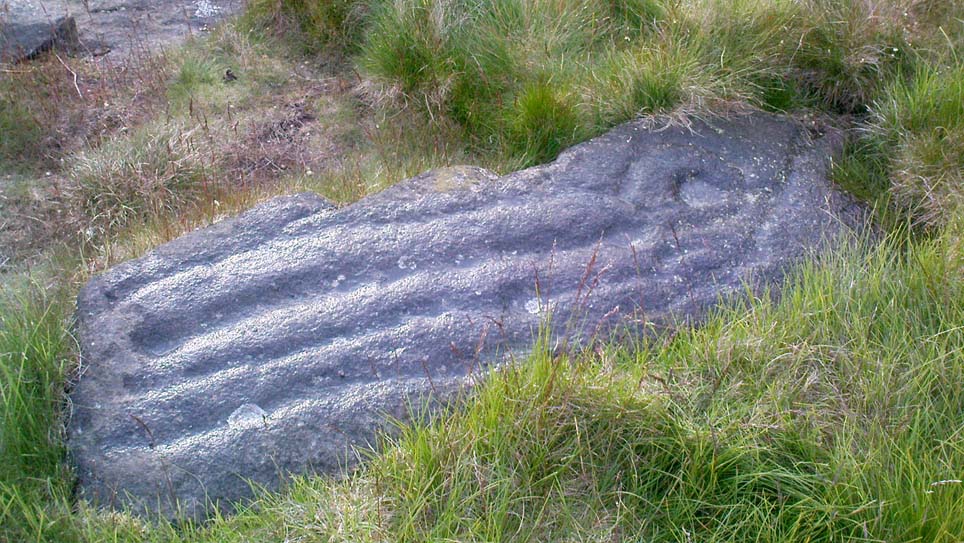
Rivock Edge’s ‘Wondjina’ carving

The name of this carving is based on a first impression I got of it when I came here as a young lad, still in my teens.  The ‘Wondjina’ is a name given to primal aboriginal spirits whose images are etched and painted on rock surfaces in various parts of Australia (usually rock overhangs or in caves).  Don’t ask me why, but that was the impression I first got of this stone — and it’s something that stays with me.  Some archaeo’s won’t like the association such mythic ancestral beings may have upon people’s notions of cup-and-ring art, but they tend to be the ones who have little educational background regarding the animistic nature of rocks in traditional and peasant societies: ingredients that are integral to these ancient carvings, as research worldwide clearly shows.

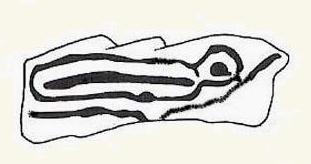
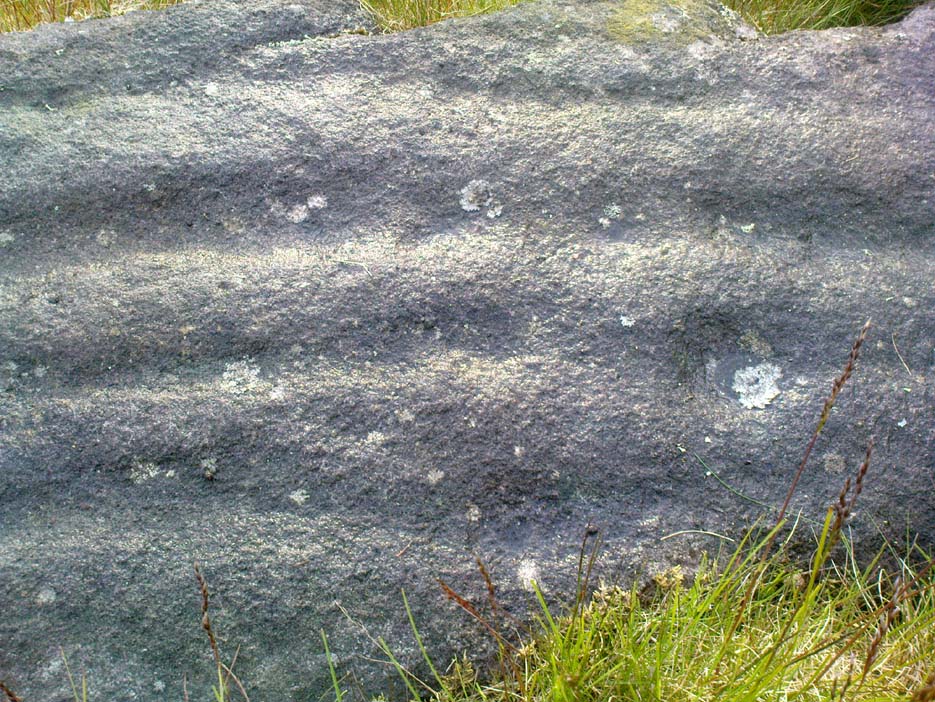
The carving was first described by our old Yorkshire historian Arthur Raistrick (1936) in an early essay on Yorkshire rock carvings; and then again in a later article by Stuart Feather. (1961)  The primary design is of a large single cup-and-ring at one end of the rock, with a series of seemingly unbroken lines reaching up (or perhaps moving away) from the cup-and-ring.  A long central line runs through the middle of the Wondjina ‘being’, which initially seems to have been a series of cups linked by this line; though these cups (at least four of them) have eroded over time and are difficult to see without good sunlight.  What seem to be several other very eroded cup-marks are also found on two of the other long lines.  These can be made out in the photograph here.

Close-up of lines & cup-marks

Another carving is on the stone right next to this one (2ft away) and there are several other cup-marked stones to be found along the same ridge (carving numbers 058, 059, 060, etc).  And for those of you into landscape archaeology, take the position of this carving into consideration.  The view from here is  quite superb and on clear days a number of prominent hills and important mythological landscape features stand out.  To those of you who think such things unimportant or of little relevance in the mythography of our ancestors — you’ve a lot to learn!  Otherwise, a visit to this carving and its associates is well worth a trek!

References:

  1. Bennett, Paul, ‘The Prehistoric Rock Art and Megalithic Remains of Rivock & District (2 parts),’ in Earth, 3-4, 1986.
  2. Boughey, Keith & Vickerman, E.A., Prehistoric Rock Art of the West Riding, WYAS 2003.
  3. Feather, Stuart, ‘Mid-Wharfedale Cup-and-Ring Markings: Nos. 7 & 8, Rivock Edge,’ in Cartwright Hall Archaeology Group Bulletin, 6:8, 1961.
  4. Hedges, John (ed.), The Carved Rocks on Rombald’s Moor, WYMCC: Wakefield 1986.
  5. Raistrick, Arthur, “‘Cup-and-Ring’ Marked Rocks of West Yorkshire,’ in Yorkshire Archaeology Journal, 32, 1936.

© Paul Bennett, The Northern Antiquarian

Baldwin Stone, Silsden, West Yorkshire

Cup-Marked Stone:  OS Grid Reference – SE 06453 44658

Getting Here

Baldwin Stone - with its happy discoverer!
Baldwin Stone with its finder

From East Riddlesden, go up the road (over the swing-bridge) that takes you onto the moor-edge (ask a local if you have trouble).  Go all the way up till you hit the road which encircles the moor (it’s called the Silsden Road where you hit it).  Turn left for several hundred yards till you see the microwave tower just on the hillock to your right on Pinfold Hill (not the larger TV towers just below the forest).  Walk up there, then follow the edge of the walling till you hit the old Pinus sylvestris trees of Robin Hood’s Wood where 2 walls meet.  Go over the gate and walk to your right for about 200 yards, following the line of the walling.  You’re there!

Archaeology & History

Cluster of cups on southern edge
Cluster of cups on W edge

A newly-discovered cup-marked stone, located for the first time on Tuesday, June 9, 2009, by Michala Potts, who was out on an amble with some long-haired halfwit whizzing about getting excited about stupid cup-markings on stones, dragging her back and forth and leaving her in the middle of a bog!  On one occasion when this ‘ere fruitbat wandered off (again!), leaving her alone in the middle of the hills, she decided to check out some rocks a bit further up the slope where she’d been left alone.  And there, along the edge of some walling, right on the edge of the much-denuded Robin Hood’s Wood, a short distance west of Rivock, a curious stone popped out and caught her attention!

Was this a cup-marking she saw before her!?  It certainly was!  But she didn’t call out to this halfwit who’d left her to her own devices.  She let him just wander off to his sad heart’s content, whilst she got into the nitty-gritty of checking the stone out, uncovering the essentials of the carving while he bimbled off like a freak!  And what a nice carving it was she found…

Baldwin Stone - looking south
Baldwin Stone – looking west
First sketch of the stone

Although no accurate measurements were made of the stone (it was bigger than 10-inch!), at least 17 cup-markings were counted here: one singular and very well-preserved cup, alone on its southern edge, right by the walling.  But the main feature of the design is a cluster of cup-marks (at least 11) on the western side of the rock — one part of this cluster having the appearance of the figure 5 on a dice!  Several other well-defined cups occur on the central and more northern end of the rock.

Eventually, her sad stone-wandering fella returned, forlorn, having found no new carvings of his own (poor soul!).  And so she took his poor little hand, and took him to see the little prehistoric treasure she’s uncovered — and her sad little man got all smiley and … well, you know what they’re like!

Additionally however, for the archaeo’s amongst you: if you come wandering up here to check this carving out, you’ll notice the remains of many large upright stones in a lot of the old stone walls round here.  Many of these are the remains of Iron Age walling.

© Paul Bennett, The Northern Antiquarian 

High Carr Rocks, Keighley, West Yorkshire

Cup-and-Ring Stones:  OS Grid Reference – SE 0578 4395

Getting Here

High Carr Cup-Markings (1 & 2)

Loadsa ways to get to this little outcrop, which the Boughey & Vickerman survey (2003) says comprises of five different carvings (CRs 33-37).  I’m not so sure misself.  When Stuart Feather first found these in the 1950s, he only thought three stones were carved, which I think is the more accurate.

Most folk would probably prefer to walk down the slope from Holden Gate down the footpath past Jaytail Farm, then dropping down to the very bottom of the fields (south) where you’ll see a small knoll with a cluster of rocks just in front of the tree-line.  But I wandered up thru the ‘Private’ (ahem!) woodland, wet-thru in the pouring rain, and clambered over the wall right to the very spot (the old dowser’s ‘seek-and-find-rock-art’ nose worked again!).

Archaeology & History

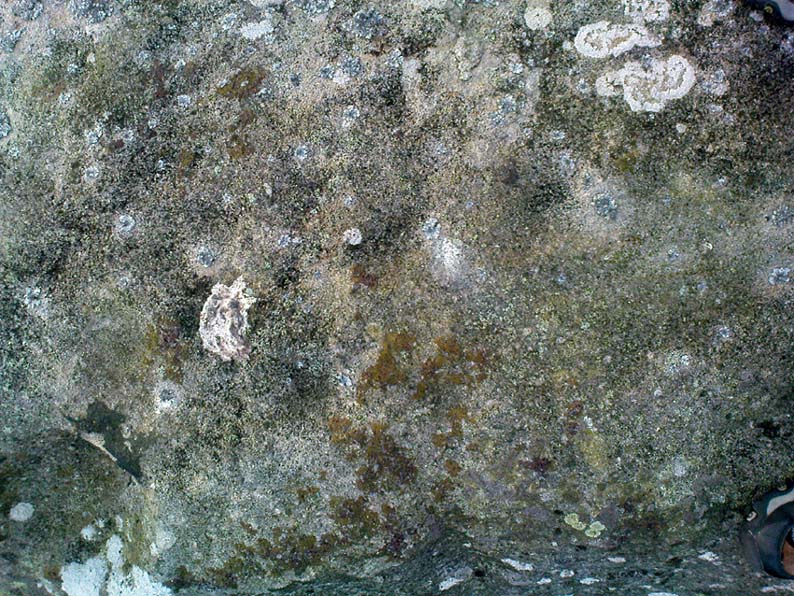
High Carr Cup-Marked Stone
High Carr Cup-Marked Stone – from Hedge’s Carved Rocks on Rombald’s Moor

Listed in John Hedge’s (1986) survey as carvings 1-5, I’d say there’s one “definite” carving here, but the others – comprising simply of cups – are a little dubious.  The main carving has at least six definite cup-markings, found on the rock at the highest point of the knoll at the bottom of the field.  The drawing in Hedge’s survey shows as many as 12 cups on this stone, but I’m not totally convinced.  Another stone right next to the main one has, perhaps, a cup-marking or two on it – but again, these may be natural.

Of the other alleged carvings, it was difficult to work out as they were literally covered in tons of cow-shit. It seems this rock-outcrop is the local bovine toilet!  A lovely secluded place though, with plenty of wildlife to see.  Next stop from here: the great Holden waterfalls!

References:

  1. Boughey, K. & Vickerman, E.A., Prehistoric Rock Art of the West Riding, WYMCC: Wakefield 2003.
  2. Feather, S., ‘Three Bronze Age Rock Carvings near Keighley,’ in CHAGB 4:3, 1959.
  3. Hedges, John D., The Carved Rocks on Rombald’s Moor, WYMCC: Wakefield 1986.

© Paul Bennett, The Northern Antiquarian