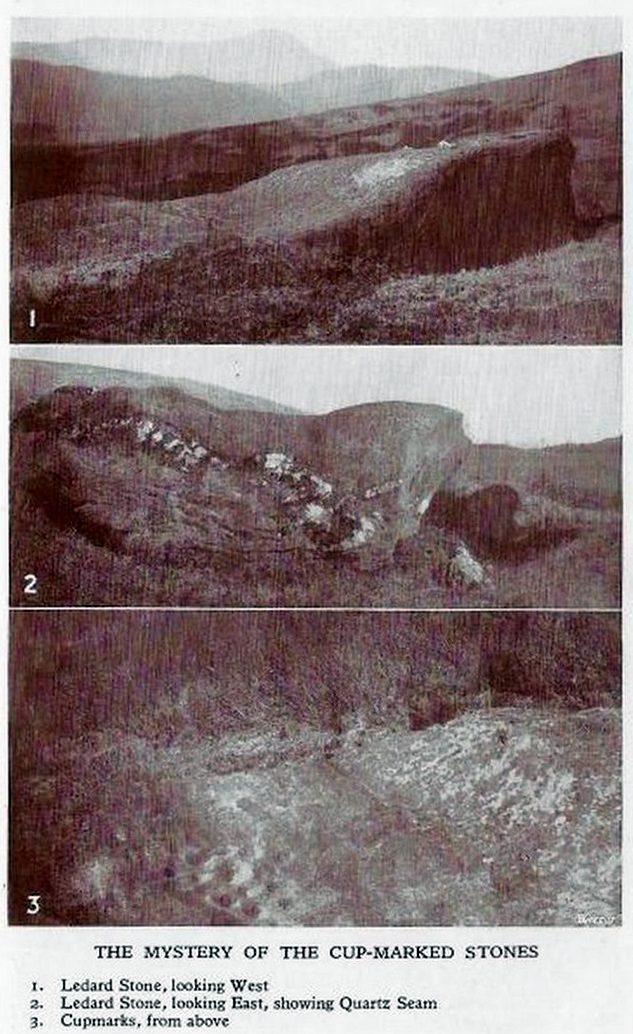
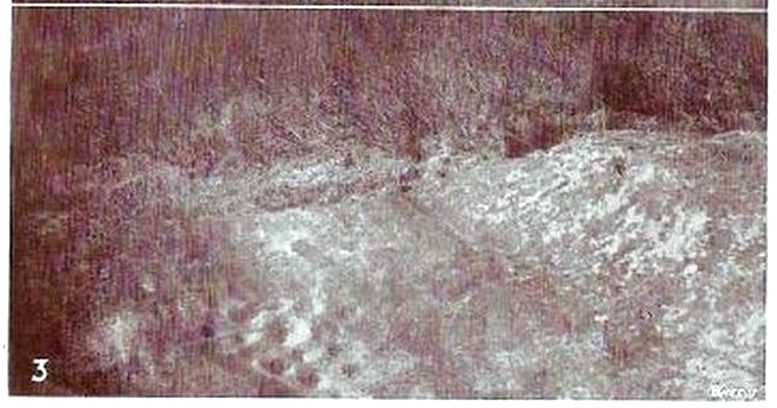
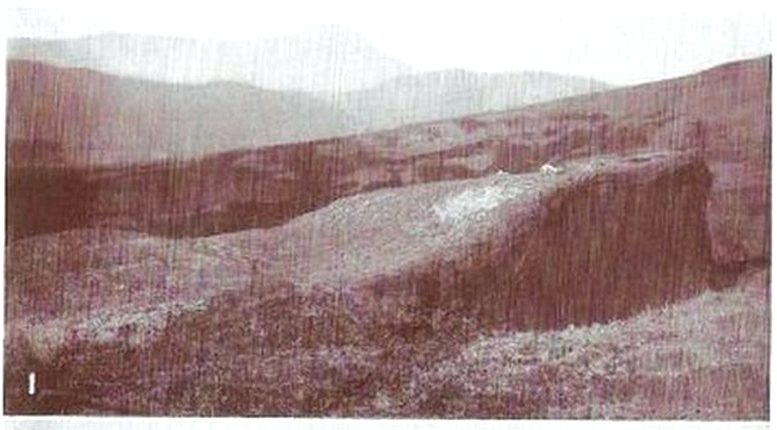
In Miss Maitland’s (1935) article on the Ledard Stone carving, she also made a brief mention of “another cup-marked stone (that) lies on the edge of the burn, beyond the one described, above Loch Ard.” She gave no further information about this second stone. It remains lost and sounds to be only a short distance further uphill and on the west-side of the burn. If any local explorers are able to find this carving please let us know and, if possible, add some info and photos of it on our Facebook page. (the grid-reference for this site profile is an approximation)
References:
Maitland, Mrs, “Cup Marked Stones”, in The Scottish Country Woman, 1935.
This carving hasn’t seen the light of day, seemingly, since it was first reported by a local lady, a Miss Maitland in the 1930s—and who, it transpires, uncovered a number of petroglyphs in this neck of the woods. She found it on one of her many forays in the mountains hereby and took some old photos of it—although they’ve not reproduced too well for the sake of the site profile. (apologies)
Since Miss Maitland’s days, the hillside has been covered in forestry plantation, making it extremely difficult to locate the carving. However, due to the reasonably large size of the stone, it should still be there (smaller cup-and-ring stones have been damaged and destroyed by forestry over the years); and as we can see in the middle photo, a long thick vein of quartz runs roughly along the middle of the stone—an ingredient which may have been significant for the people who carved the stone. In her article in the Scottish Country Woman magazine, Miss Maitland told:
cup-marks, bottom leftLedard Stone
“On the hill directly behind Ledard, on the north side of Loch Ard, a little to the west of the burn and a little to the east of the first grouse-butt, exactly 700 feet above sea level, lies a large boulder. Ice has smoothed and fashioned it and on the worn surface may be seen twenty-one, or so, small round hollows, varying in size and depth. The pattern made is roughly diamond-shaped, pointing directly east and west. I saw them for the first time as the sun was setting on New Year’s Eve, 1932. It was a solemn moment, for as far as I know no one else had looked upon them with such joy, and even awe, for perhaps a thousand years!”
She may have been right. And by the sound of her words, she’d certainly caught the petroglyph bug!
Anyhow, the carving doesn’t appear to have been seen since then. A “cup-marked boulder” was noted in the Royal Commission’s (1979) listings, but with no further details. We assume it must be the same carving, although they never visited it. It’s also possible that they were referring to another lost cup-marked stone a short distance further up the hill from here. If any local explorers are able to re-locate the carving, please let us know, and maybe add some info and photos of it on our Facebook page.
References:
Maitland, Mrs, “Cup Marked Stones”, in The Scottish Country Woman, 1935.
Royal Commission Ancient & Historical Monuments of Scotland, Archaeological Sites and Monuments of Stirling District, Central Region, Society of Antiquaries of Scotland 1979.
Cup-and-Ring Stones (lost): OS Grid Reference – NS 444 747
Archaeology & History
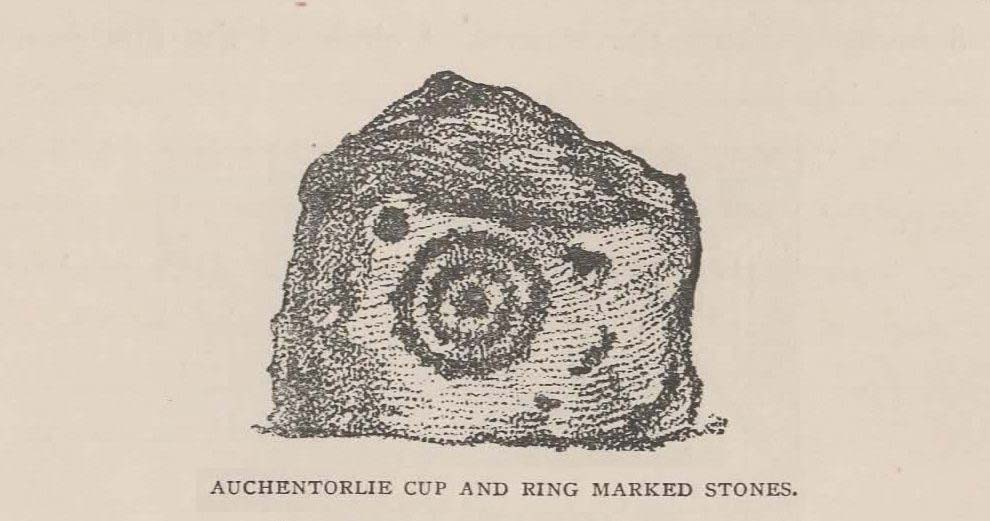
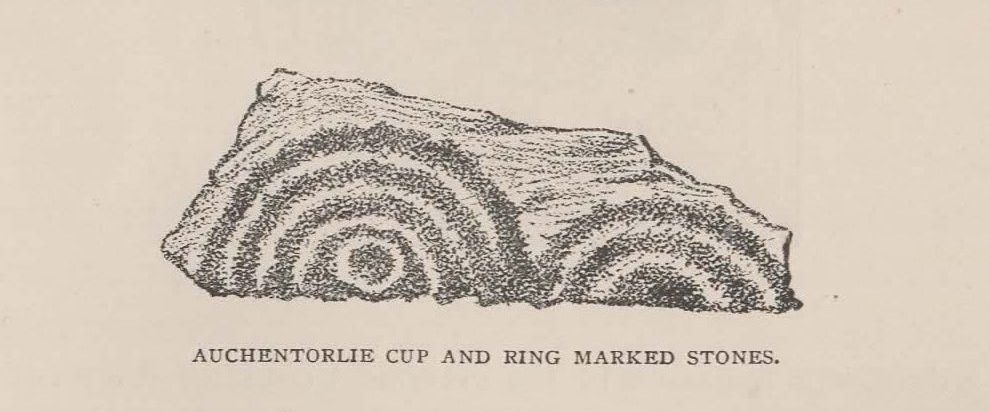
A couple of interesting multiple-ringed carvings were found high up on the slopes above Bowling, not far from the Bow Linn waterfalls, near the end of the 19th century. John Bruce (1893) told that, shortly after the discovery of the Cochno carvings,
“in the year 1889, two cup and ring marked stones were discovered in a dyke near the old farmhouse of Auchentorlie while the reservoir for the district water supply was being excavated close by.”
But since then, they seem to have disappeared. Searches for them by the old petroglyph writer Ron Morris in the 1960s and the Royal Commission lads in the 1970s both drew a blank. If we’re lucky, they might be hiding in a box somewhere, in the storage rooms of Glasgow’s Kelvingrove Museum. As you can from the sketches done by W.A. Donnelly, they’re quite impressive. The drawings give the impression that they were small portable carvings, which may suggest they were once part of a prehistoric cist or cairn, although no such site has been found in this locale. If this isn’t the case, their small size is an oddity.
References:
Bruce, John, The History of the Parish of West or Old Kilpatrick, John Smith: Glasgow 1893.
Cup-Marked Stone (lost): OS Grid Reference – NS 419 747
Archaeology & History
Very little is known of this site. It was discovered in the 1890s by a Mr W.A. Donnelly who was responsible for some of the early drawings of the famous Cochno Stone carving (found a few miles east of here), but it seems that he made no such sketch of this particular carving—although it doesn’t sound too impressive when we compare it to some of the others in this area. It was thankfully mentioned, albeit briefly by John Bruce (1893), who told that it was “a boulder with a large basin and a duct heading therefrom…at the foot of Dumbuck Hill.” The carving may well have been destroyed by quarrying.
References:
Bruce, John, The History of the Parish of West or Old Kilpatrick, John Smith: Glasgow 1893.
Cup-Marked Stone (lost): OS Grid Reference – NS 449 740
Also Known as:
Dunerbuck
Greenland (5)
Archaeology & History
Bruce’s 1893 sketch
This small and visually trivial cup-marked stone is one of a number in this neck o’ the woods that have either been destroyed or simply lost. This stone has the “lost” label stamped on it! It was first described in John Bruce’s (1893) classic local history work where he told it to be “a boulder of sandstone with three cup-marks…(that) lies on the slope of the Hill of Dun, about 100 yards north of Dunerbuck farmhouse.” It doesn’t appear to have been seen since, as none of the classic petroglyph writers described seeing it and a search for it in Glasgow’s Kelvingrove Museum in the 1960s drew a blank. The carving has subsequently been added to archaeological inventories with the standard, “this cup-marked boulder cannot now be located.” It may yet be found, overgrown by grasses and mosses, just that hundred yards or so above the buildings behind Dunarbuck. That entire area needs scanning to be honest…
References:
Bruce, John, The History of the Parish of West or Old Kilpatrick, John Smith: Glasgow 1893.
Bruce, John, “Notice of Remarkable Groups of Archaic Sculpturings in Dumbartonshire and Stirlingshire,” in Proceedings of the Society of Antiquaries of Scotland, volume 30, 1896.
Royal Commission Ancient Historic Monuments, Scotland, The Archaeological Sites and Monuments of Dumbarton District…, HMSO: Edinburgh 1978.
Cup-Marked Stone (lost): OS Grid Reference – NN 4808 0140
Archaeology & History
On the south-side of Loch Ard, just a few yards from the entrance to Rob Roy’s Cave (one of several), right by the water’s edge are the natural upstanding pillars known locally as Gog and Magog. In Peter Joynson’s (1996) work on Aberfoyle, this site is listed as one in a number of unrecorded cup-and-ring stones in the area. Discovered by a local lady—”the late Mrs Maitland”—here we have,
“two huge stones about 30ft high known as Gog and Magog situated at the mouth of Blan Ross Bay. They have numerous cup marks, but sadly have disappeared from view as they have been covered by forestry planting.”
This is an increasingly annoying problem that many rock art students are having to contend with! When we visited the site, the tops of these huge stones were, indeed, covered in depths of mosses and pine needles and the carving is hidden from sight. When the trees are felled, let’s hope someone can find it!
Folklore
These natural rocks were said to have been two giants that were turned to stone, the story of which seems to have been forgotten…
References:
Joynson, Peter, Local Past, privately printed: Aberfoyle 1996.
Of the “two stones bearing possible cup markings” mentioned in the Royal Commission (1978) survey of the area, this is one them – and it’s a dead cert, not a mere “possible.” It was rediscovered by Tom Welsh (1976) when he explored the large low-walled enclosure on this plateau. The carving is on a small rounded stone near the southern perimeter of the enclosure. Welsh described it as, “a boulder 48 x 35 x20cm, bearing six cups 45mm diameter, arranged five round a sixth, the pattern being 15cm across.”
A second cup-marked stone was also located “2.5m in from the last perimeter” bearing a single well-defined cup-mark more than an inch across. This seems to have been lost.
References:
Royal Commission Ancient Historical Monuments, Scotland, The Archaeological Sites and Monuments of Dumbarton District…, HMSO: Edinburgh 1978
Welsh, T.C., “Lang Craigs, Milton, Enclosure, Cup marks, Foundation, Mound, Platform”, in Discovery & Excavation Scotland, 1976.