Cup-and-Ring Stone: OS Grid Reference – NS 85520 88214
Getting Here
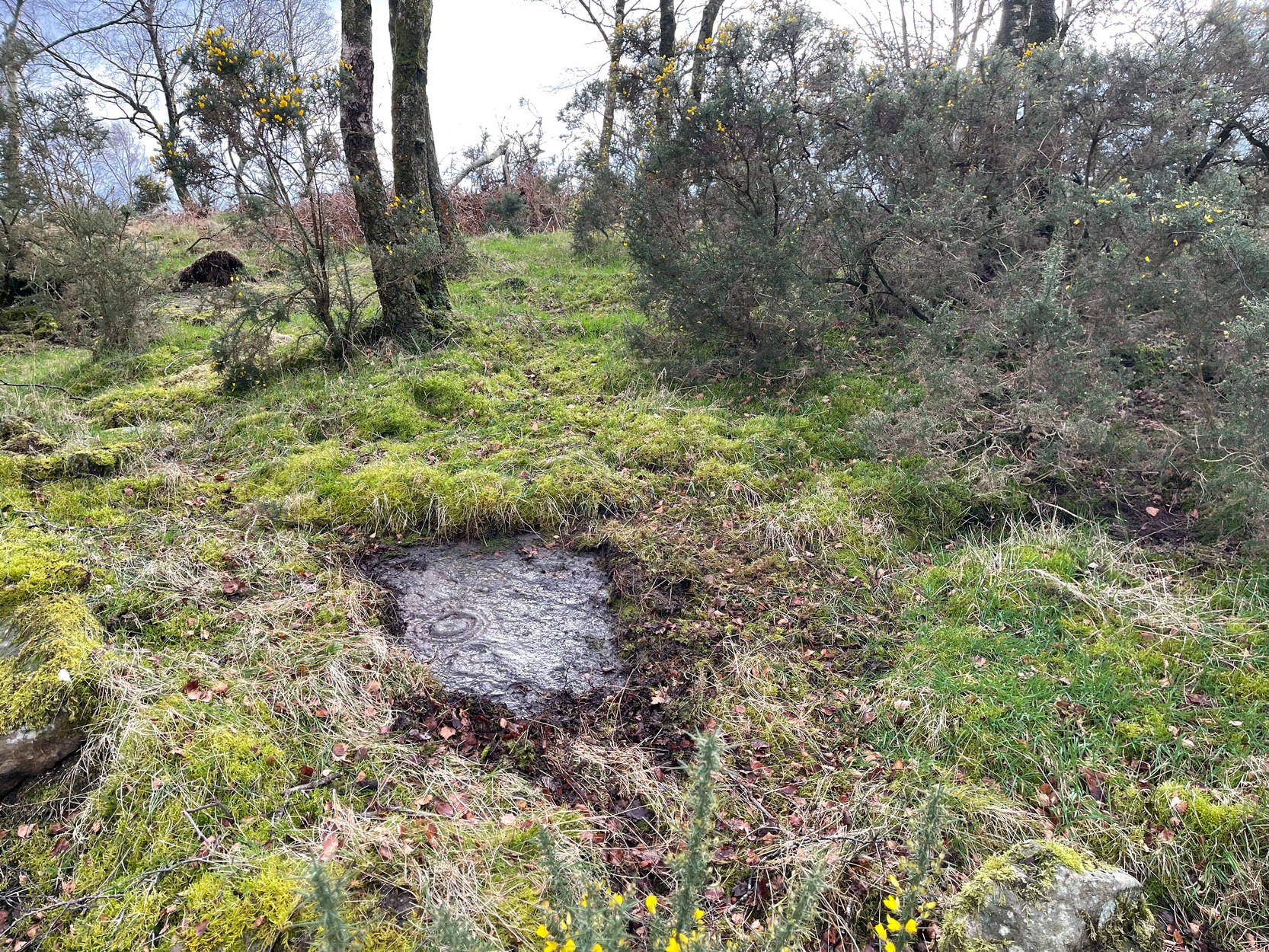
If you’re coming via Castleton Farm, at the back of the farm go through the gate on the right, by the corner of the field and walk along the line of the wall for 200 yards northwest until you approach the small copse of trees ahead of you. Just before the trees, instead, walk up the slope, SW, to the other small copse, and about 15 yards along the line of trees, go into them. Keep your eyes peeled on the upwards sloping ground where a gap in the greenery shows you the stone in question!
Archaeology & History
This is an odd one. Amidst the array of truly ancient and well-eroded multiple cup-and-ring stones in the incredible Castleton complex, this small design on the northeast slope away from the main cluster, has a distinctly different appearance about it when we compare it to the others along the ridge. It’s not been done by the same person or people who carved the more ornate designs close by. Indeed, it seems that it wasn’t even done at the same period but has a history that is much more recent.
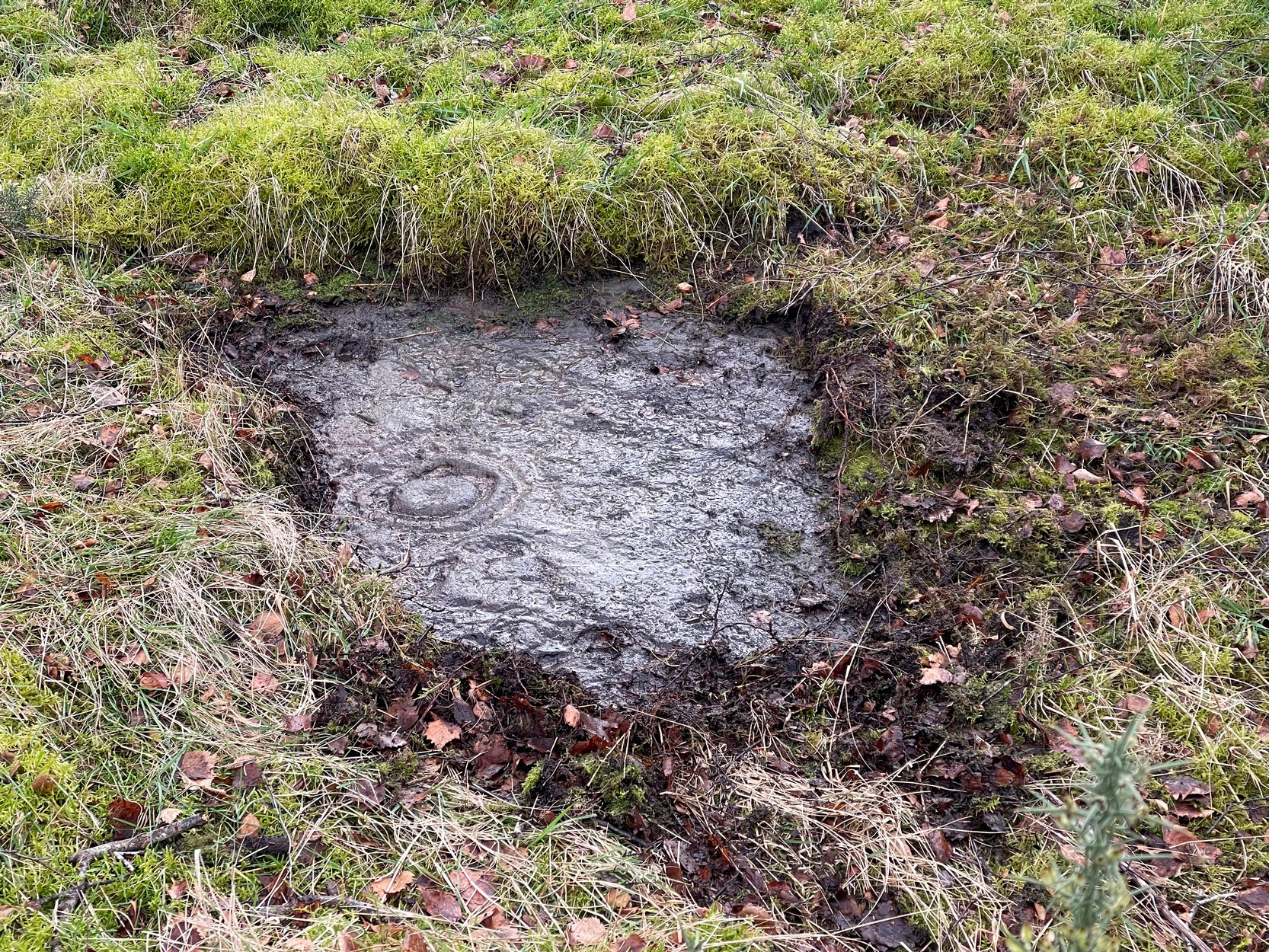
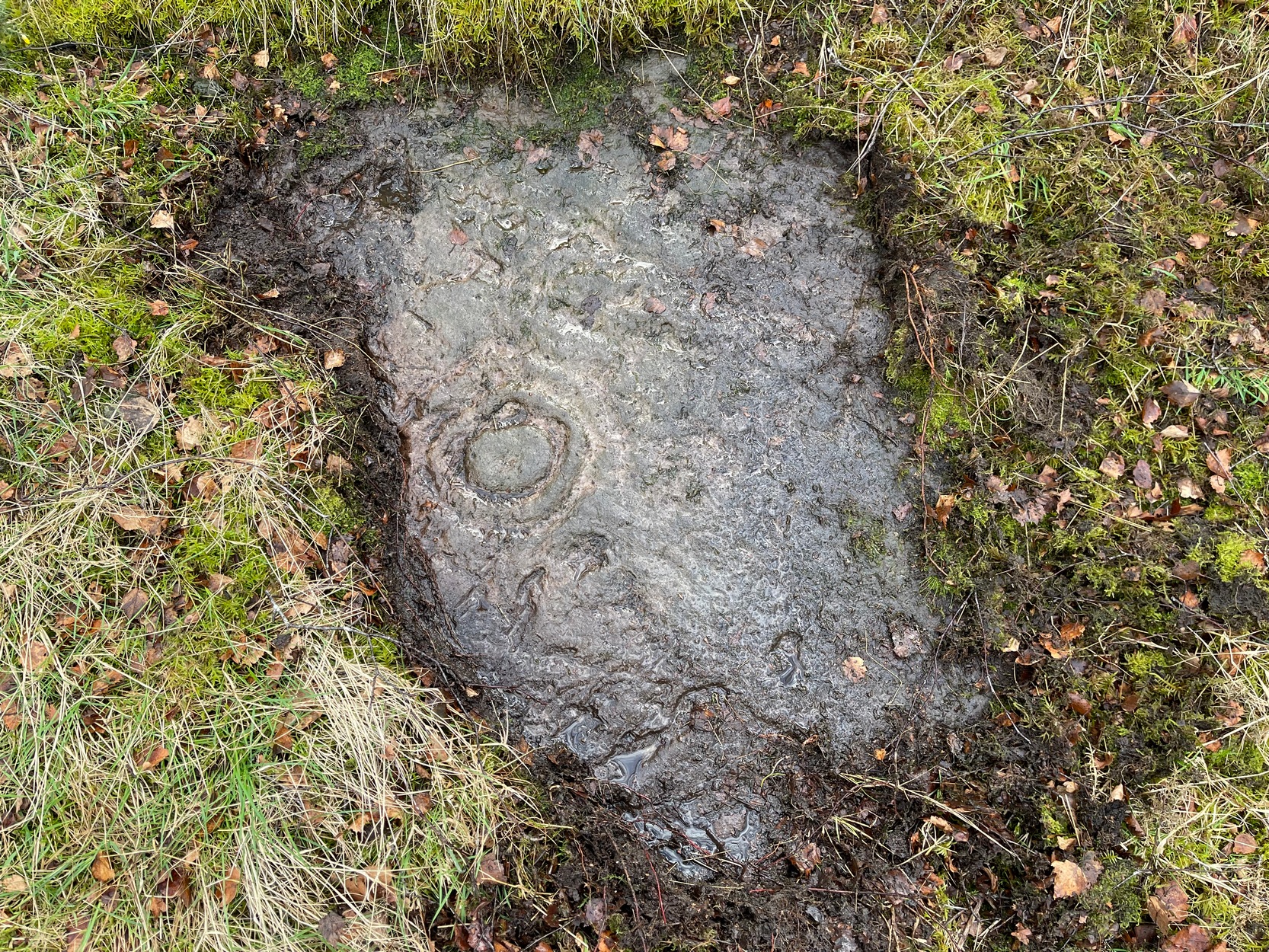 The carving, as you can see in the photos, has a somewhat scruffy look about it when compared to the more usual designs. If it’s prehistoric, it has the hallmarks of being done by someone with rock art dyslexia! My own view is that it’s a pretty recent carving. It’s possible, perhaps, that it may have been executed by a medieval christian priest who lived a short distance to the east and whose cross markings are evident on at least one of the other cup-and-rings hereby. But the carving might be even more recent: perhaps 19th Century in origin. It just doesn’t have that air of authenticity about it, as any seasoned petroglyph officionado would tell you. And we have to bear in mind that this was the site of a quarry in the 18th and 19th century, so the carving might have been done at that time by one of the workers to mimic the very ancient and faded designs close by. Anyhow…
The design consists of two distinct and deeply carved rings around a central raised point, in which it looks as if someone started to create a cup-mark, but never finished the job! The same can be said of an third outer-ring, whose faint outline is clearly visible in decent light, but which was started but never finished. Make of it what you will. When we first found this carving in 2019, someone had been up and already peeled back the turf (“there were a group o’ folk,” the farmer told me), thankfully showing the carving in its crude glory. The Canmore website informs us that the stone was first unfurled by George Currie in 2006, who said that it was little more than “a ring surrounded by a central boss”—but there’s clearly more to it than that and I wonder if this is actually the same carving that Mr Currie found.
Note: The name of this and the other carvings in the Castleton complex need completely re-designating into an accurate order, as they’ve been defined and redefined by various authors and groups over the years, leaving them in a disorganized haphazard mess.
© Paul Bennett, The Northern Antiquarian
