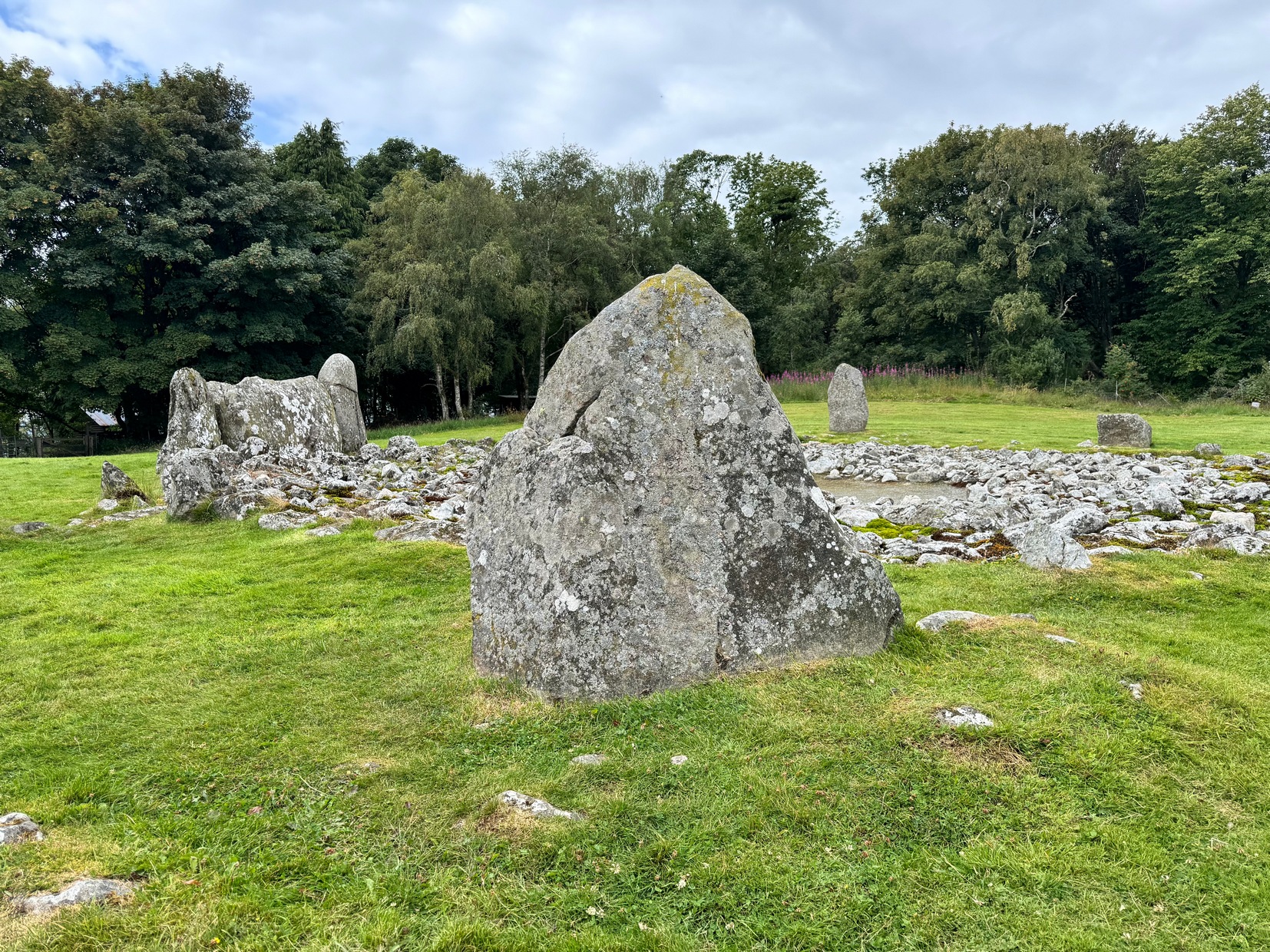
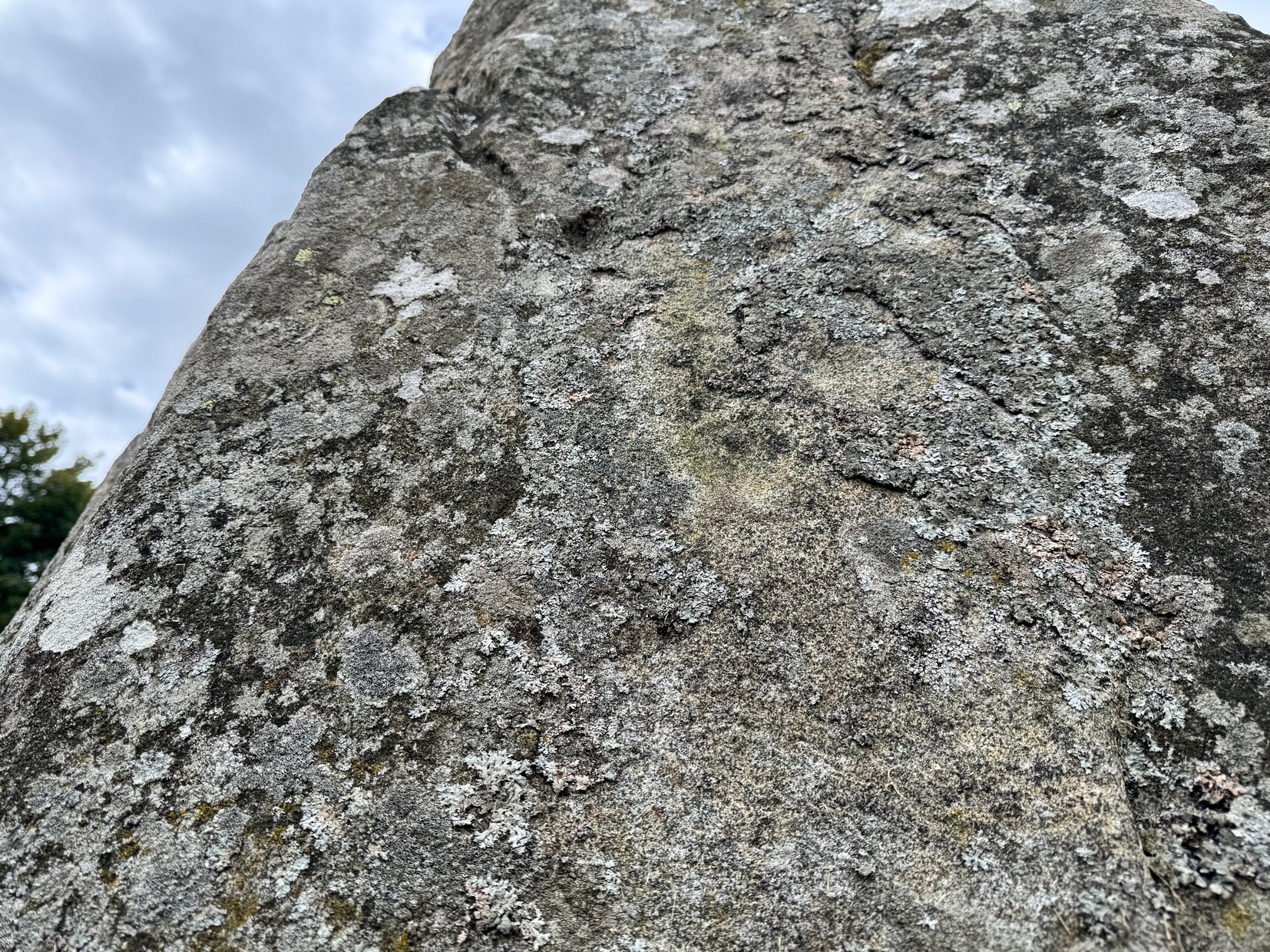
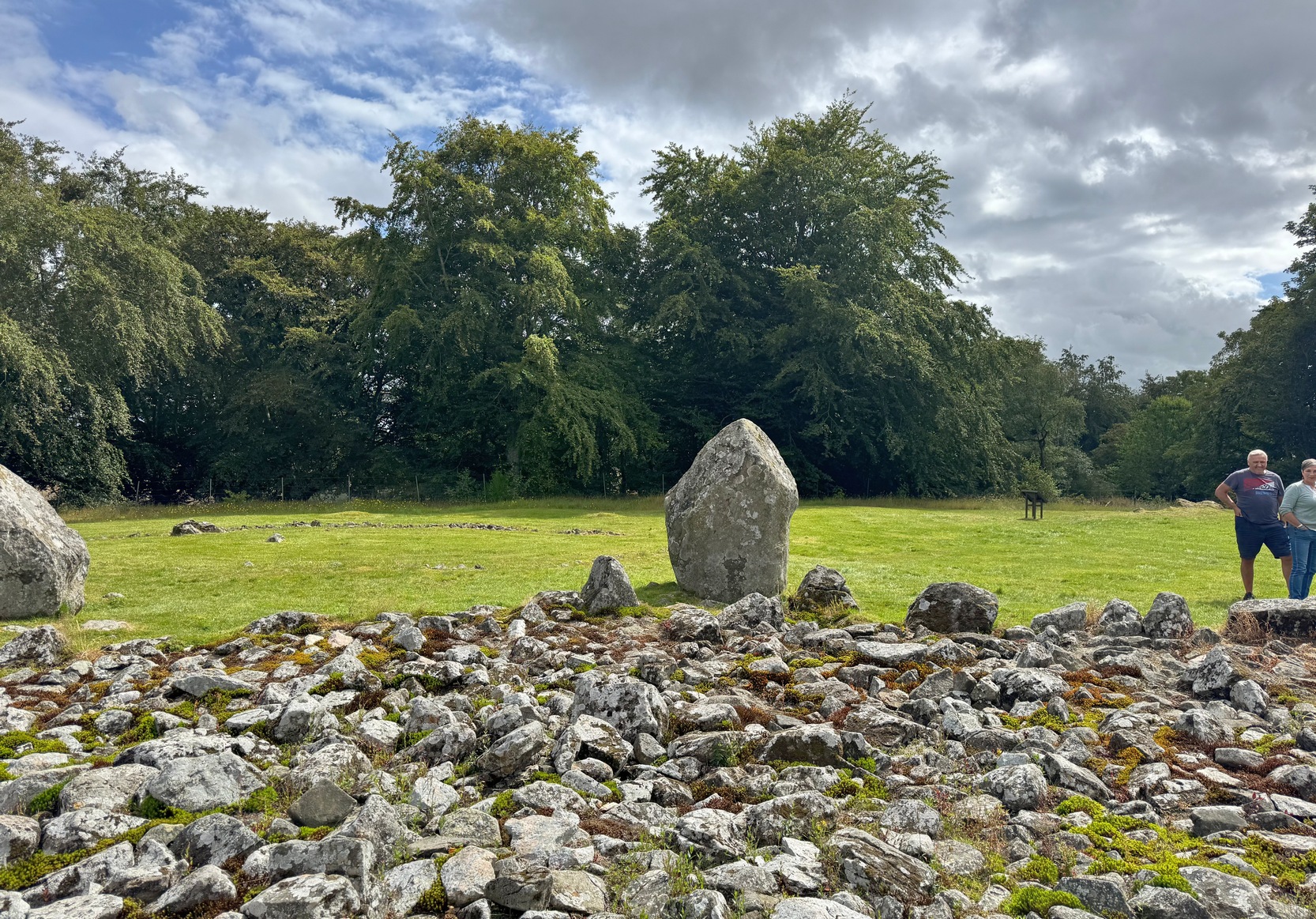
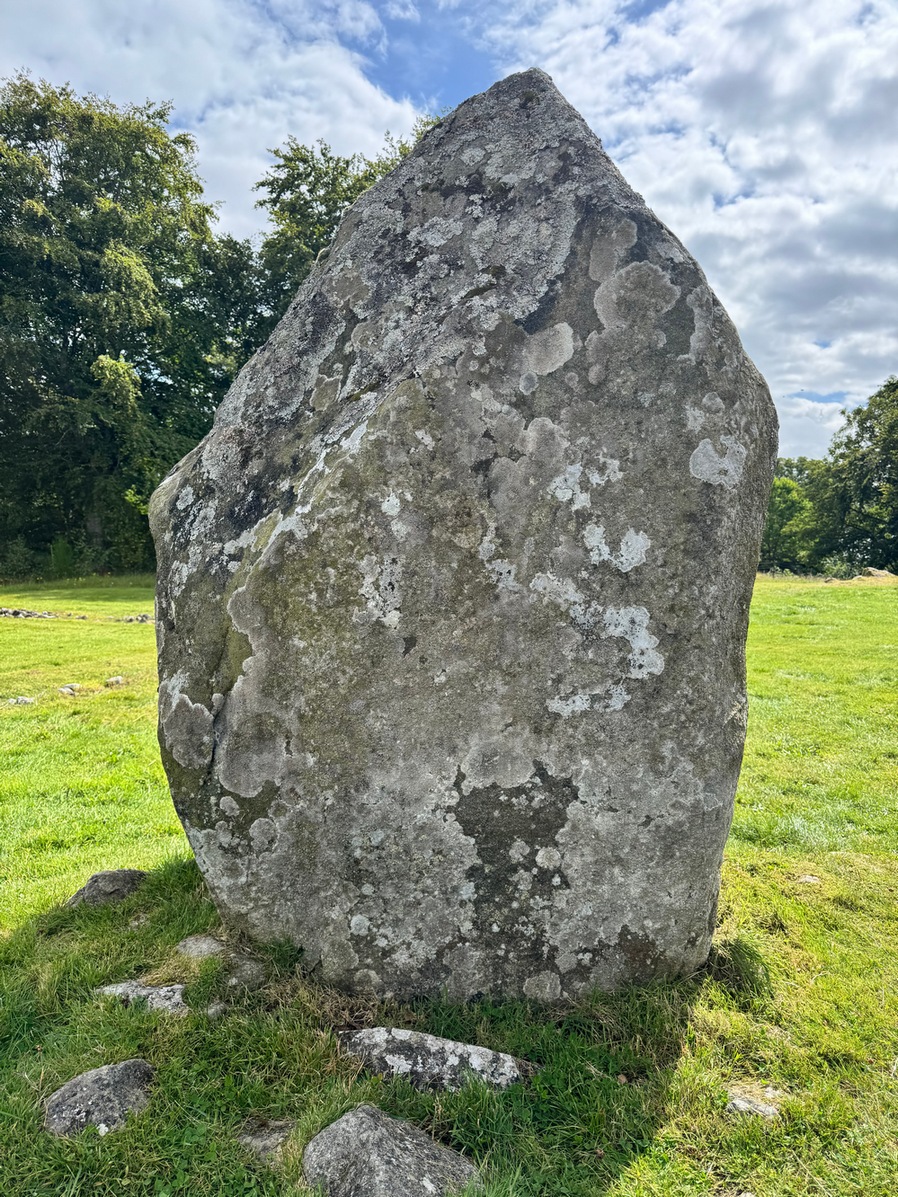
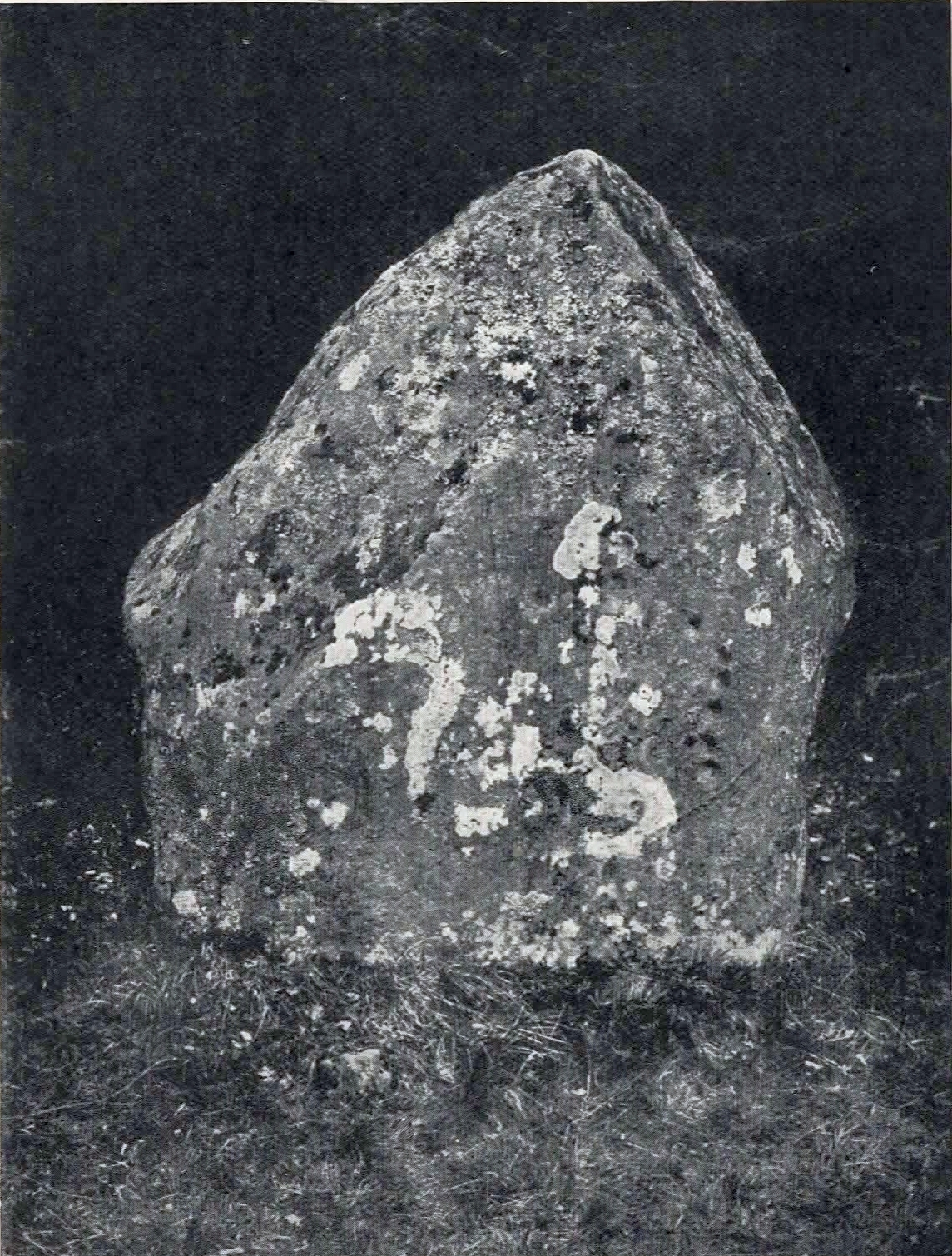
In Adam Welfare’s (2011) second volume to his grand megalithic inventory, he described there being, next to the cup-marked Loanhead of Daviot (1) stone, another, that “has two on its outer face”— i.e., the east-facing vertical surface of the standing stone. It looked as if there were three cup-marks when we visited here recently, but I may be wrong. The main one, visible in the attached photo, is about two-inches across and a half-inch deep; another is above this and the other one is below it (you can just about see them in the attached photo). The design is in no way impressive.
Cup-mark to centre
Aubrey Burl (1979) suggested that the cup-marks on the neighbouring Loanhead of Daviot (1) stone were symbolic of the Moon, whose movement across the sky was recorded in the architecture of the circle itself. When he wrote such words, this secondary cup-marked stone hadn’t been noticed and, as it faces the opposite directly looking eastwards, it makes you wonder what he might have thought this design represented. (Welfare [2011] also reported that on the standing stone flanking the east-side of the recumbent stone, there is “a single cupmark a little above the ground surface on its inner face”.)
References:
Burl, Aubrey, Rings of Stone, Frances Lincoln: London 1979.
Welfare, Adam, Great Crowns of Stone – 2 volumes, RCHAMS: Edinburgh 2011.
Acknowledgements: Massive appreciation to Michelle and Steve Allan of Montrose for taking us to this site. Huge thanks to you both.
As you walk through the gate towards the stone circle, veer to the long fallen recumbent stone and, past the large upright that flanks the recumbent on the right-hand side, walk to the next standing stone along from here. That’s the one you need to be looking at!
Archaeology & History
This is one of at least two petroglyphs within the Loanhead of Daviot circle. Difficult to see unless the light is good (oh how often that’s the case!), on our visit here—under the fine guidance of Michelle and Steve Allan—the cups were hard to see clearly, and they proved troublesome getting good photos of them (we’d forgot our standard water-enhancing bottles this day too!). But we could just about make them out, as our fingers fondled their depressions.
It seems that the carvings were first noticed (please correct me if I’m wrong) by the Aberdeenshire antiquarian James Ritchie (1918) who, in a lengthy essay on rock art and megalithic rings, described seeing “twelve plain cups” on the standing stone in question. They are situated on the north-facing side of the stone, or, as Ritchie wrote,
The carved stoneRitchie’s early photo
“on the inner face of the stone, which points towards the centre of the circle…. Near the western edge of the stone five cups are placed, one above another, in an almost perpendicular line. Each of the three lower members of this group is 2 inches in diameter and ½ inch in depth, while the two upper members are ½ inch less in diameter and only ¼ inch deep. A little to the left, near the upper end of the group, there is a single cup, 1 inch in diameter and ¼ inch in depth. Near the centre of the stone there is another group of cups very similar in appearance to that already described. It also consists of five cups in an almost perpendicular line, with a sixth, a little to the left, nearly in the middle of the stone. All the cups in this second group are about 1 inch in diameter and very shallow.”
The second group of cup-marks that Ritchie described were the most difficult to see on our visit here, due to the bright daylight. Under the Moon, or early sunrise when the stone is wet, they should stand out nice n’ easy. Thankfully, most of them are visible in Mr Ritchie’s old photo of the stone (above), taken in 1917.
An interesting idea was posited by Mr Browne (1921) in his classic on the Aberdeenshire sites, where he thought that the cup-marks here are marks that denoted “the registers of the magician in charge” of rituals at the Loanhead circle. More recently, the great megalithic archaeologist Aubrey Burl (1979) suggested that the cup-marks on this stone were representative of the cyclical movement of the Moon, as observed from this stone circle.
The second cup-marked stone at this stone circle is on the next stone along, going anticlockwise (east): on ‘Stone 5’ (as designated in the Royal Commission survey).
References:
Beckensall, Stan, British Prehistoric Rock Art, Tempus: Stroud 1999.
Beckensall, Stan, Circles in Stone: A British Prehistoric Mystery, Tempus: Stroud 2006.
Browne, G.F., On Some Antiquities in the Neighbourhood of Dunecht House, Aberdeenshire, Cambridge University Press 1921.
Burl, Aubrey, Rings of Stone, Frances Lincoln: London 1979.