Bell Stane, Queensferry, Midlothian

Legendary Stone (destroyed):  OS Grid Reference – NT 1292 7840
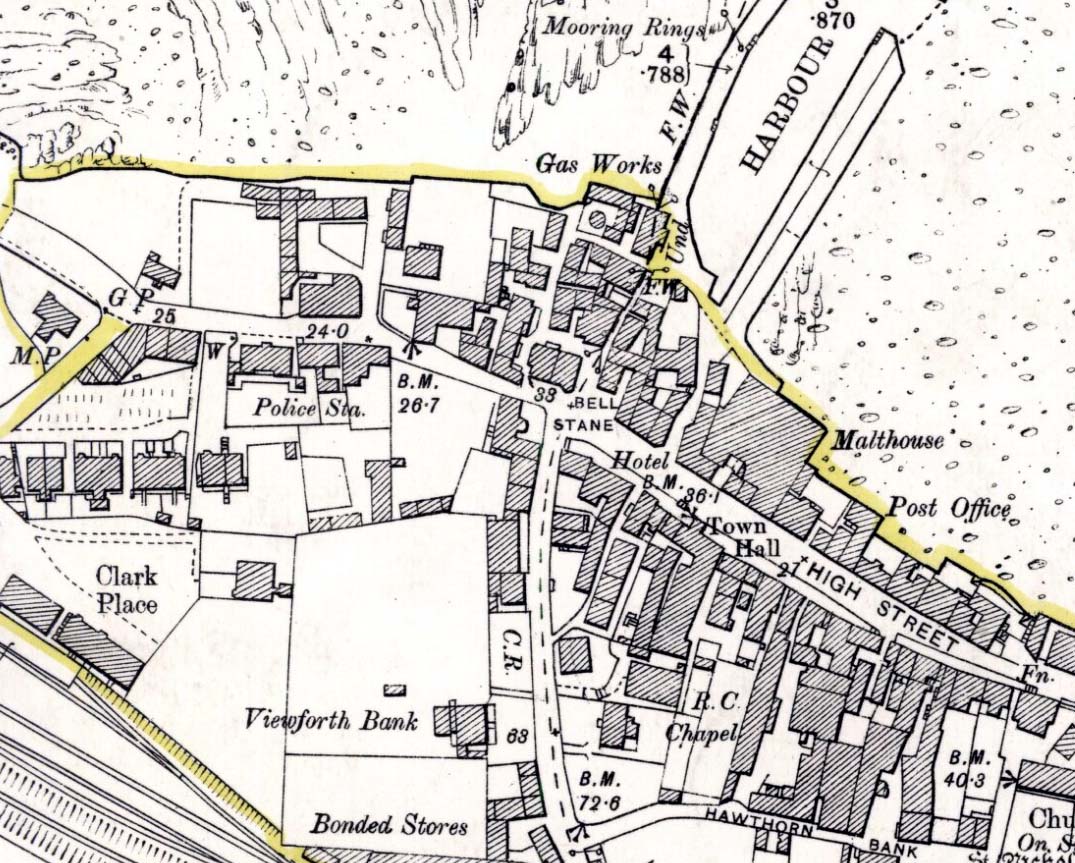
Bell Stane on 1896 map

Bell Stane on 1896 map

Archaeology & History

An intriguing site that needs adding to the Northern Antiquarian due to the foraging research of the Edinburgh historian Stuart Harris (1996).  Although the Bell Stane has been ascribed by the Canmore researchers to be just,

“a stone near the Mercat Cross on which the hand bell was set (rung to herald the opening of the weekly market or annual fair),”

Mr Harris dug deeper and found other references which led him to think that the site was “a conspicuous boulder or standing stone.”  I have to agree with him.  In his outstanding work on the historical place-names of Edinburgh and district, Harris wrote:

“The Bellstane…is noted on Ordnance Survey 1854 as the name of an object just outwith the burgh boundary and in the southwest corner of the little square that now bears the name.  Whilst it has been surmised that it was a stone named for a handbell rung beside it on market days, in point of fact a burgh council meeting of 1642 (quoted in Morison’s Queensferry, p.131) records that a piece of ground hitherto waste and unused, within the burgh but near the bellstane, was to be set aside for markets and fairs in times coming; and the clear inference is that the name belonged to the stone before any markets were held near it.  In absence of a reliable description of the stone or of early forms of its name, the origin of the name can only be guessed at.  Similar names (of sites) in Kirknewton and Whitburn are no better documented, but the early forms of Belstane in Lanarkshire (BellitstaneBellistaneBelstane and Bellstane prior to 1329 and Beldstanein 1452) suggest that its first part may be Anglian ballede or early Scots bellit (from a Celtic root, ball, white), making the name ‘the stone with a white or pale patch or stripe on it’ — such as one with a band of quartz running through it.  A conspicuous boulder or standing stone of this sort on this spur of higher ground above the shore would have been a useful meith or landing mark for boats making for the narrow landing place at the Binks.”

If anyone uncovers additional evidence about this Bell Stane that can affirm it as a standing stone (or otherwise), we will amend its status.

References:

  1. Harris, Stuart, The Place-Names of Edinburgh: Their Origins and History, Gordon Wright: Edinburgh 1996.
  2. Morison, Alexander, Historical Notes on the Ancient and Royal Burgh of Queensferry, West Lothian Courier: Bathgate 1927.
  3. Orrock, Thomas, Fortha’s Lyrics and other Poems, privately printed: Edinburgh 1880.

© Paul Bennett,  The Northern Antiquarian 2016

St. John's Well, Isle of May, Fife

Holy Well:  OS Grid Reference – NT 65858 99107

Also Known as:

  1. Pump Well

Archaeology & History

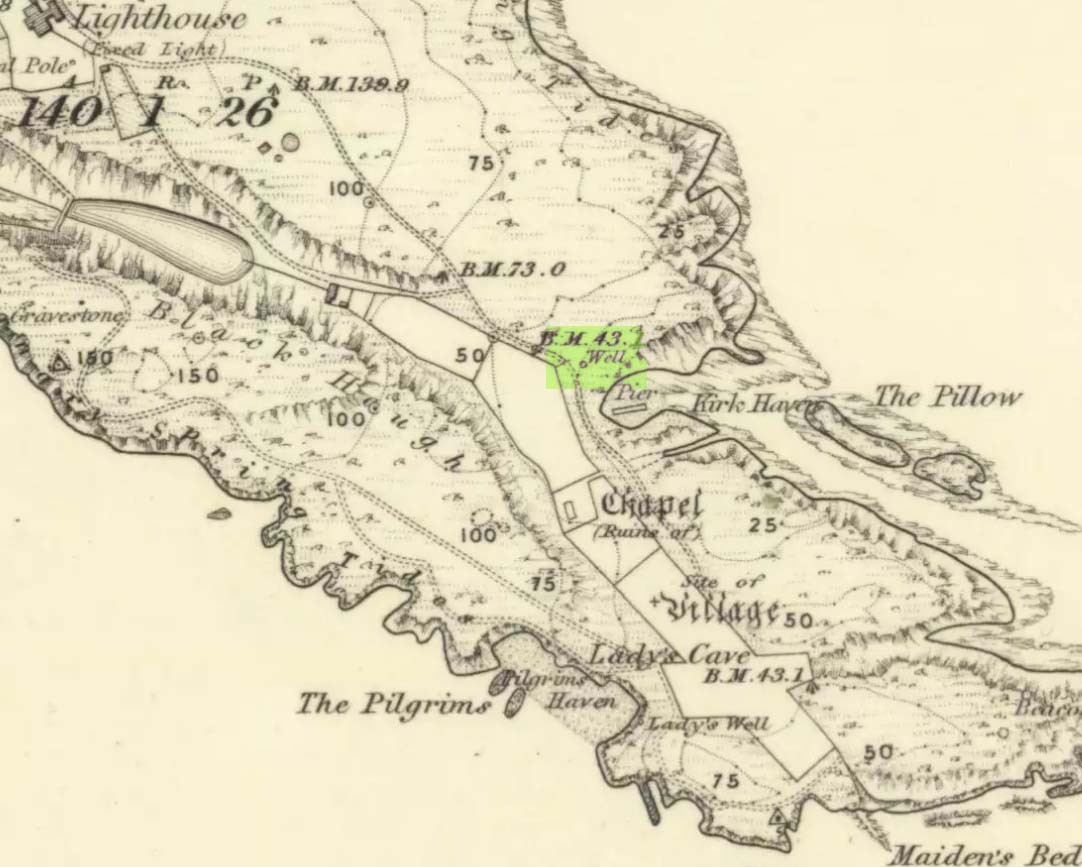
St John’s ‘Well’ on 1855 map

This seems to be the only ‘St John’ dedication on the Isle of May: a small island littered with more saint’s names, seemingly, than Iona and Lindisfarne combined!  Illustrated on the 1855 OS-map, without name—and on the present-day large-scale OS-maps too, 20 yards or so from its 1855 position—the standard archaeo-historical records say nothing of the place.  Thankfully antiquarian and folklore accounts have preserved evidence of its title.  When the Victorian traveller Thomas Muir (1868; 1883) visited the Isle of May, he told how the islanders struggled to maintain a good water supply during a drought there in the 1860s.  St. John’s Well was, he told,

“A pump standing by the path above Kirk Haven. The water good, but a little brackish. During all the drought of this summer we pumped water out of this well to supply our cattle.”

After Æ. J.G. Mackay’s (1896) visit to the island he told that here, along with the other holy wells on May,

“their brackish waters have lost the magic virtue they were credited with in early christian, possibly in pagan times.”

In more recent times it was described in W.J. Eggeling’s (1985) natural history survey.  St. John’s Well was,

“the well within the high, cylindrical, whitewashed wall-surround lying across Haven Road from the Coal House. Also known as the Pump Well.  It is a guiding mark for boats entering Kirk Haven.”

Folklore

St. John’s Day (June 24) was the christian name given to the traditional Midsummer Day, or days, around which good heathen festivals occurred; but we can find no ritual accounts of activity specific to this Well. Help!

References:

  1. Dickson, John, Emeralds Chased in Gold; or, The Isles of the Forth, Oliphant: Edinburgh 1899.
  2. Eggeling, W.J., The Isle of May, Lorien 1985.
  3. Mackay, Æ. J.G., A History of Fife and Kinross, William Blackwood: Edinburgh 1896.
  4. Muir, Thomas S., The Isle of May – A Sketch, Edinburgh 1868.
  5. Muir, Thomas S., Ecclesiological Notes on some of the Islands of Scotland, David Douglas: Edinburgh 1883.
  6. Simpkins, John Ewart, Examples of Printed Folk-lore Concerning Fife, with some Notes on Clackmannan and Kinross-shires, Sidgwick & Jackson: London 1914.

© Paul Bennett, The Northern Antiquarian 

St. Andrew's Well, Isle of May, Fife

Holy Well:  OS Grid Reference – NT 65375 99592

Archaeology & History

St Andrews ‘Well’ on 1855 map

In John Dickson’s (1899) fine work on the history and antiquities of the Forth islands, he describes a number of all-but-forgotten holy and medicinal wells that could be visited in the 19th century—this one included!  It was highlighted, without name, on the 1855 OS-map of the island, a short distance west of the curiously named Holyman’s Road.  Aerial views of it today seem to indicate that the well was surrounded by walling, which may have been an old well-house—although the archaeological record here is silent. Mr Dickson told us:

“St. Andrew’s Well, beside the Altar Stones, contains the best water on the May and is entirely used for domestic purposes.  This spring frequently dries up during the summer months and, in these circumstances, the islanders obtain a supply from Crail.”

Although it is still shown on modern large-scale OS-maps (as ‘St Andrew’s Well’), its present condition is unknown.  If this has become boggy and overgrown, it is a sure case for renovation, despite its desolate geography; and especially considering that St Andrew is the patron saint of Scotland, whose festival date is November 30 (thought originally to have been Samhain, or Halloween—the old heathen New Year’s Day).  If any visitor or islander could send us photos of the site, that would be awesome!

References:

  1. Dickson, John, Emeralds Chased in Gold; or, The Isles of the Forth, Oliphant: Edinburgh 1899.
  2. Eggeling, W.J., The Isle of May, Lorien 1985.
  3. Mackay, Æ. J.G., A History of Fife and Kinross, William Blackwood: Edinburgh 1896.
  4. Muir, Thomas S., The Isle of May – A Sketch, Edinburgh 1868.
  5. Muir, Thomas S., Ecclesiological Notes on some of the Islands of Scotland, David Douglas: Edinburgh 1883.
  6. Simpkins, John Ewart, Examples of Printed Folk-lore Concerning Fife, with some Notes on Clackmannan and Kinross-shires, Sidgwick & Jackson: London 1914.
  7. Taylor, Simon & Markus, Gilbert, The Place-Names of Fife – volume 3, Shaun Tyas: Donington 2009.

© Paul Bennett, The Northern Antiquarian 

Mineral Well, Portobello, Edinburgh, Midlothian

Healing Well (destroyed):  OS Grid Reference – NT 314 735

Archaeology & History

This was one of two medicinal springs that could once be found in old Portobello village. Like its companion Chalybeate Well nearly a mile northwest, in the early 19th century those entrepreneurial types tried fashioning these waters into being a Spa Well.  It didn’t really work and the fad passed after just a couple of decades—and soon after the local people had completely lost their water supply here.  The best historical account of it is in William Baird’s (1898) magnum opus on Portobello.  He told how the well,

“was, at the beginning of the century, situated in a garden near to the main road, where there was a well with drinking cups for the accommodation of visitors, a small sum being charged from those using it.  The supply here having in some way become interrupted the spring was neglected for a time. It found vent, however, lower down and nearer to the Promenade at the foot of Joppa Lane. About fifty years ago there was a pretty large open basin, in the centre of which the water bubbled up about half a foot. It was of a red brick colour. Unfortunately on the starting of a pump on the Niddrie Bum to drain the water from the Niddrie coal pits, the supply of water was again interrupted, and this excellent mineral spring, which was strongly impregnated with oxide of iron and sulphate of lime and magnesia, ceased to flow with its former fulness.”

In 1869, the Industrialists dug into the Earth to construct their promenade and, after countless centuries, the waters of this old medicinal well finally died and fell back into the deep Earth…

References:

  1. Baird, William, Annals of Duddingston and Portobello, Andrew Elliot: Edinburgh 1898.
  2. Bennett, Paul, Ancient and Holy Wells of Edinburgh, TNA: Alva 2017.

© Paul Bennett, The Northern Antiquarian


Sheep Well, Isle of May, Fife

Healing Well (lost):  OS Grid Reference – NT 654 993

Archaeology & History

Wells that are dedicated to sheep are none-too-common—and this one on the remote Isle of May between Edinburgh and Fife only received its commemoration, tradition tells, not too many centuries back.  It is described singularly in John Dickson’s (1899) fine work, where he informs us that,

“The Sheep Well lies to the west of the lighthouse.  Said to have got its name from a sheep having been drowned in it.  Its water is useless for household purposes, and it occasionally becomes dry during the hot season.”

Its present condition and precise location is unknown. If an islander chances upon this site and knows its present condition, please get some photos and let us know how it’s fairing.

References:

  1. Dickson, John, Emeralds Chased in Gold; or, The Isles of the Forth, Oliphant: Edinburgh 1899.

© Paul Bennett, The Northern Antiquarian