Cup-and-Ring Stone: OS Grid Reference – NN 56138 01827
Also Known as:
- Netherglenny 32
Getting Here
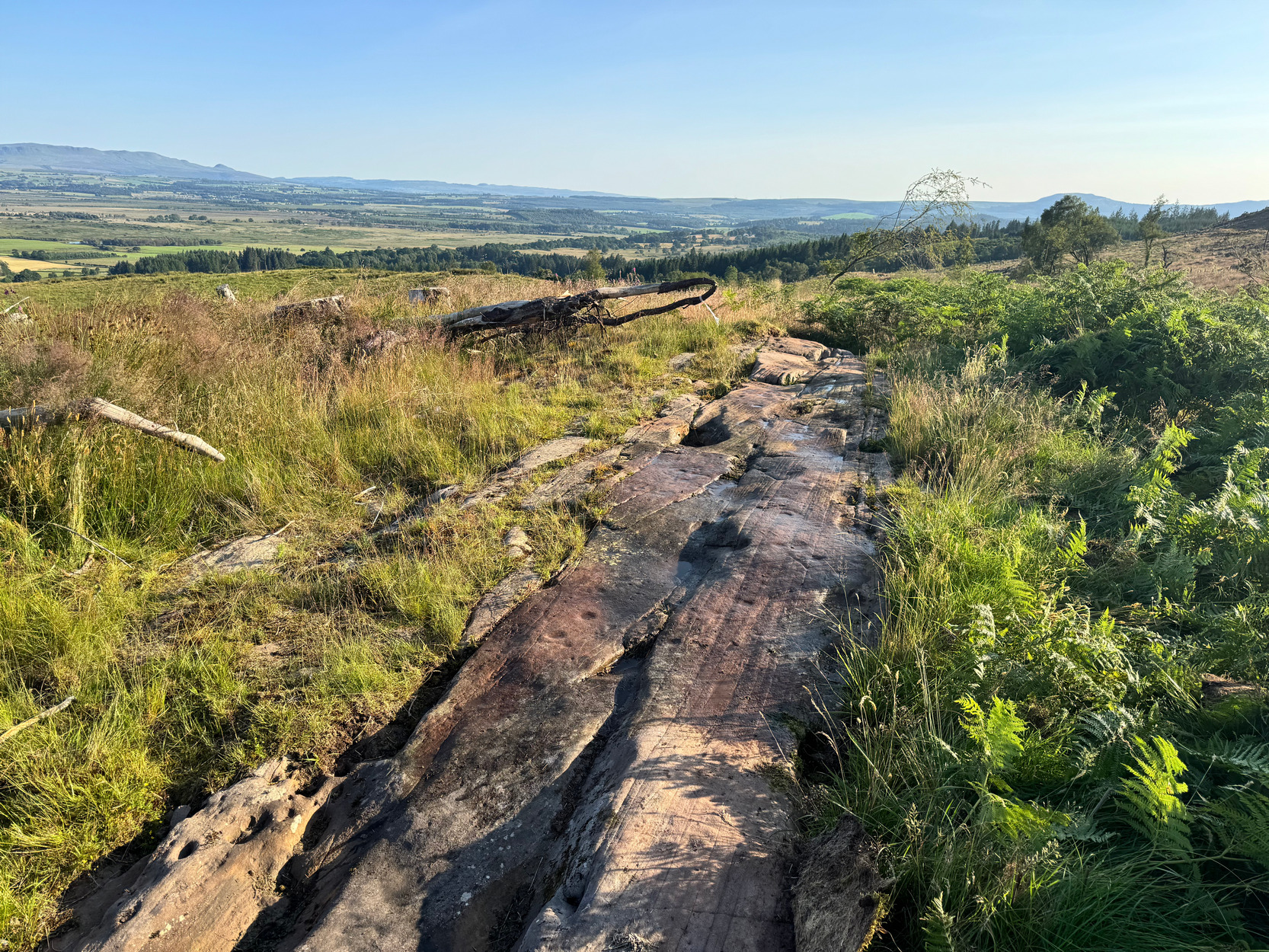
Along the A81 road between the Port of Menteith and Aberfoyle, ¾-mile (1.2km) west of the Port of Menteith you’ll see a small single-track road on the right—by a group of cottages—that takes you uphill. Go uphill for just over a half-mile and park-up on the rough grass on your left, ensuring there’s enough room for a tractor to get past (if some halfwit Englishman comes out and says “you can’t park there!”, remind him that this is Scotland!*). Just where you’ve parked-up there’s a dirt-track on your left; walk up it, go through the gate, and nearly 300 yards after this there’s a gate into the fields on your left. Go through here, and follow the straight line of fencing for 700 yards, passing one of the Netherglenny cairns, till you hit a wall. Go through the gate and, 60-70 yards south-west on a raised ridge of land is a long line of bedrock stone. You’ve arrived!
Archaeology & History
In the early 1990s, rock art explorer Kaledon Naddair gave a talk at Kilmartin on the prehistoric rock art of Scotland. Amongst other carvings, he reported on a number of new finds that he and others had made at the Ballochraggan complex near Aberfoyle and, as I recall, it included this fascinating and almost unique design (Naddair and his team did hundreds of detailed drawings of many carvings, most of which are very hard to find nowadays). Some years later, in 2009, rock art student George Currie came across the same stone shortly before forestry plantation grew to obscure it entirely. It was described for the first time in Brouwer & van Veen’s (2009) fine survey of the Ballochraggan petroglyphs. My first visit here was in 2021 in the company of Prof Paul Hornby, when the forest was still standing and we had to cut our way through the trees to see a section of stone. A few years on, now that the forest has been cut down, all of the carving has come to light again—and it’s a bittova beauty!
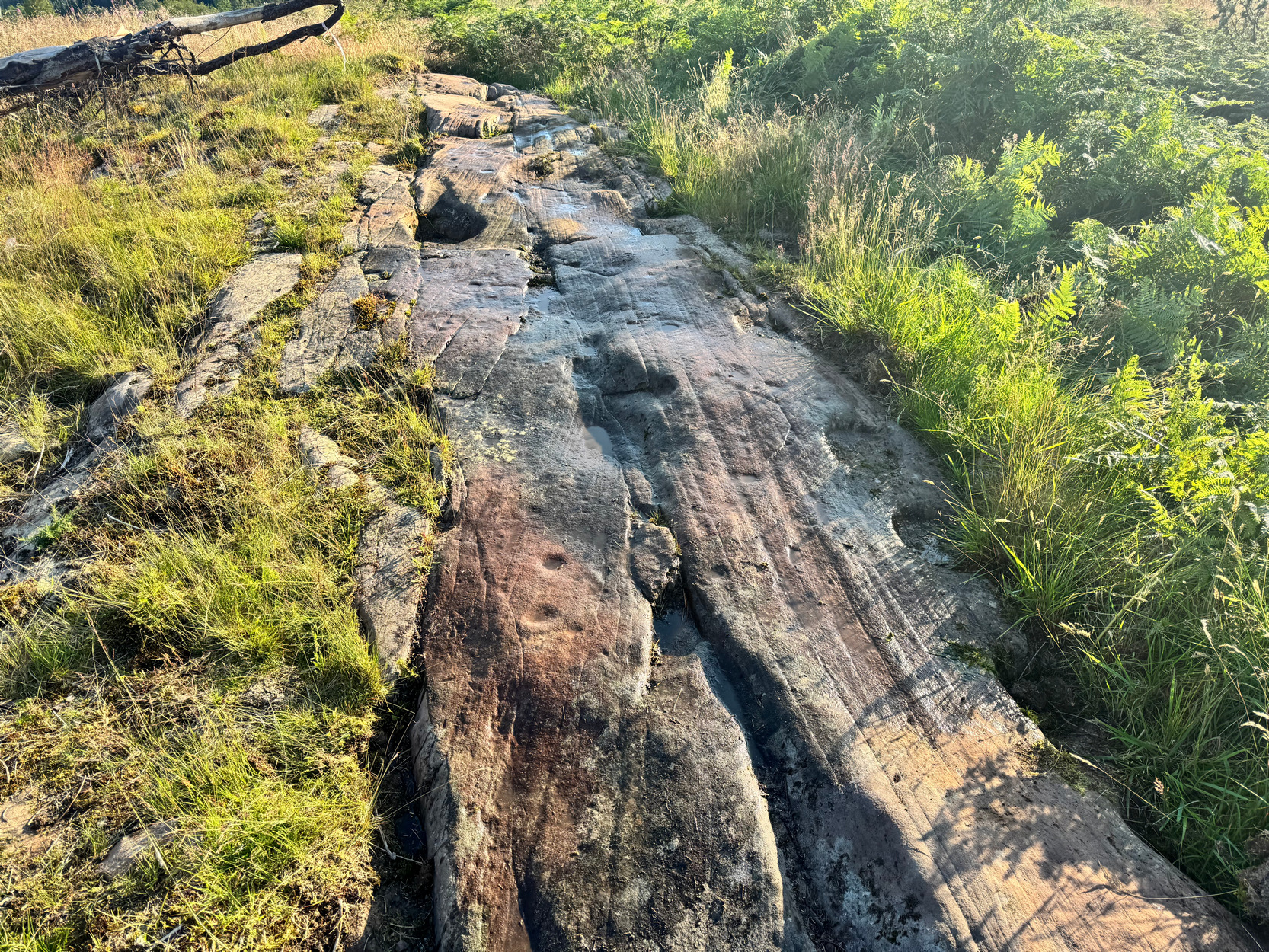
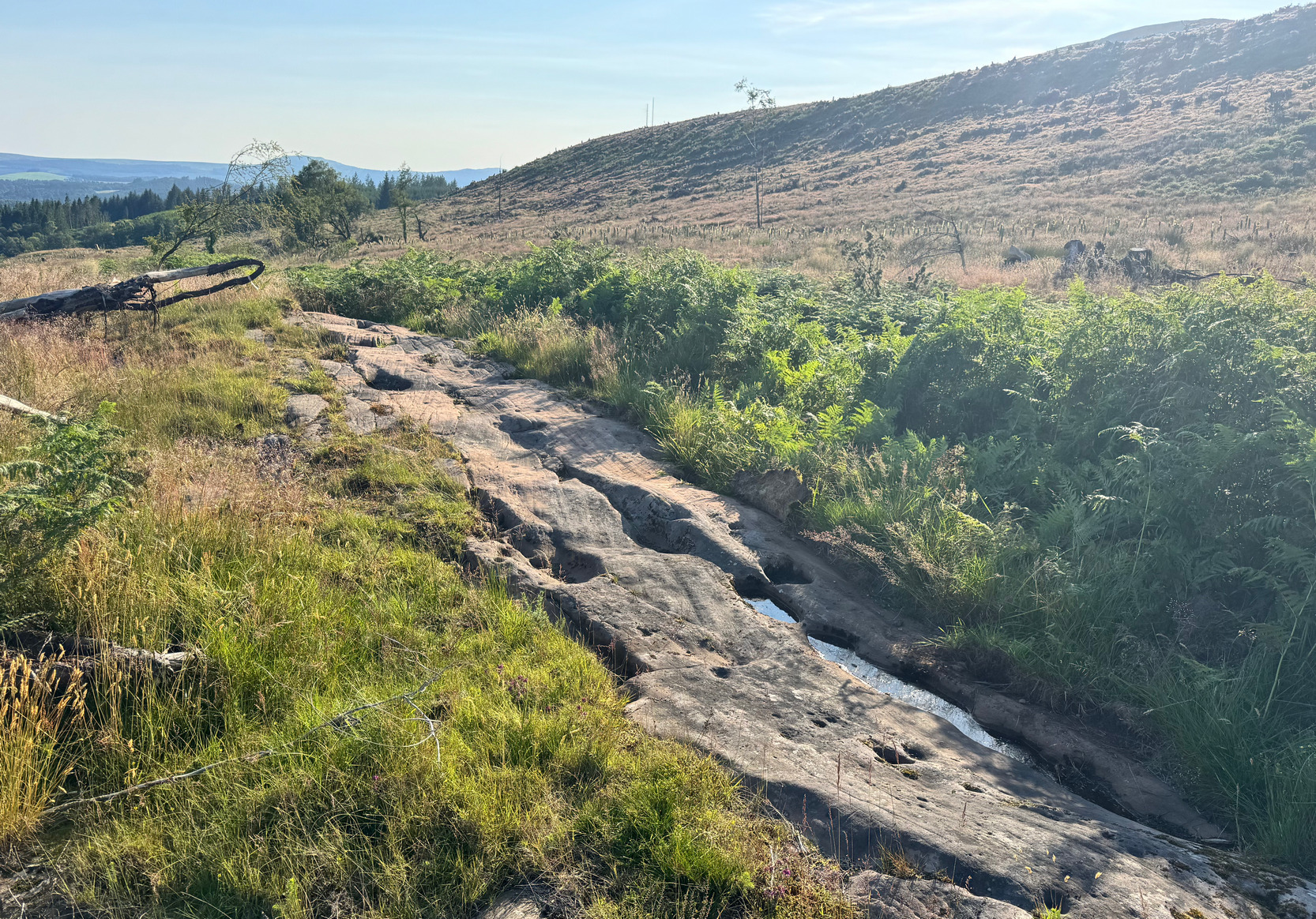
Described erroneously by the Scottish Rock Art Project as being at Netherglenny, this impressive design is just north of Ballochraggan house and is a faded but impressive carving, possessing a rare ‘motif’ or symbol not usually found on Scottish petroglyphs. The line of rock on which the carving’s found runs in a northeast-to-southwest line, perhaps relating to the rising and setting of the solstice sun. Perhaps… Most of the carving is a scatter of cup-and-rings covering more than half the length of the rock surface, mainly on its more western section. But also, notably, there’s a series of geological bowls and troughs along the rock, primarily from the middle of the stone to the easternmost end where, perhaps significantly, there are few carved elements apart from a couple of cup-marks close to two of the deep bowls. The bowls and troughs are mainly along the central and northern edge of the stone. On my visit here recently, near the end of a lengthy heatwave, these natural ‘bowls’ were still filled with a lot of water! I was grateful—and used the water to highlight some parts of the carving.
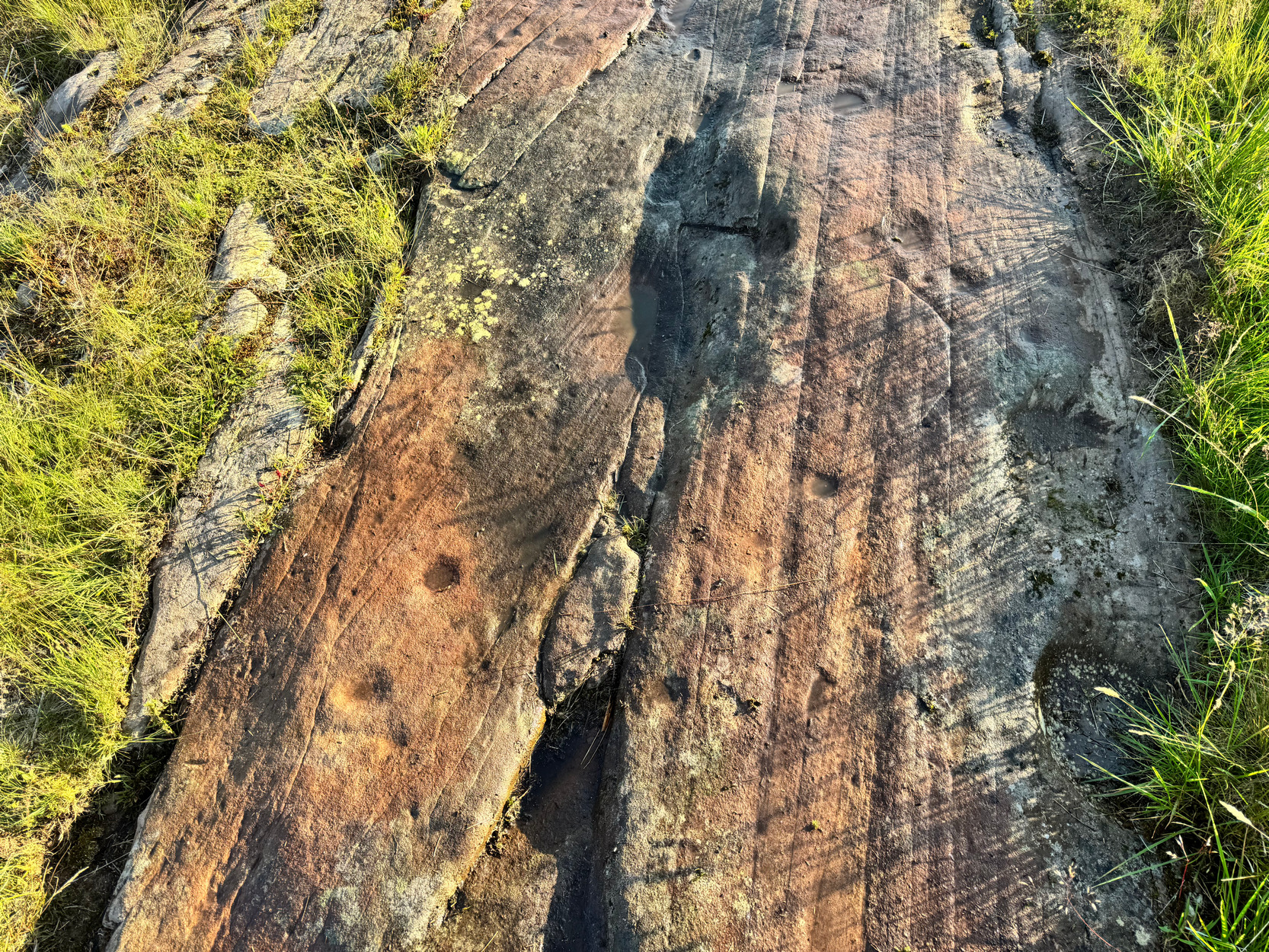
…And so…
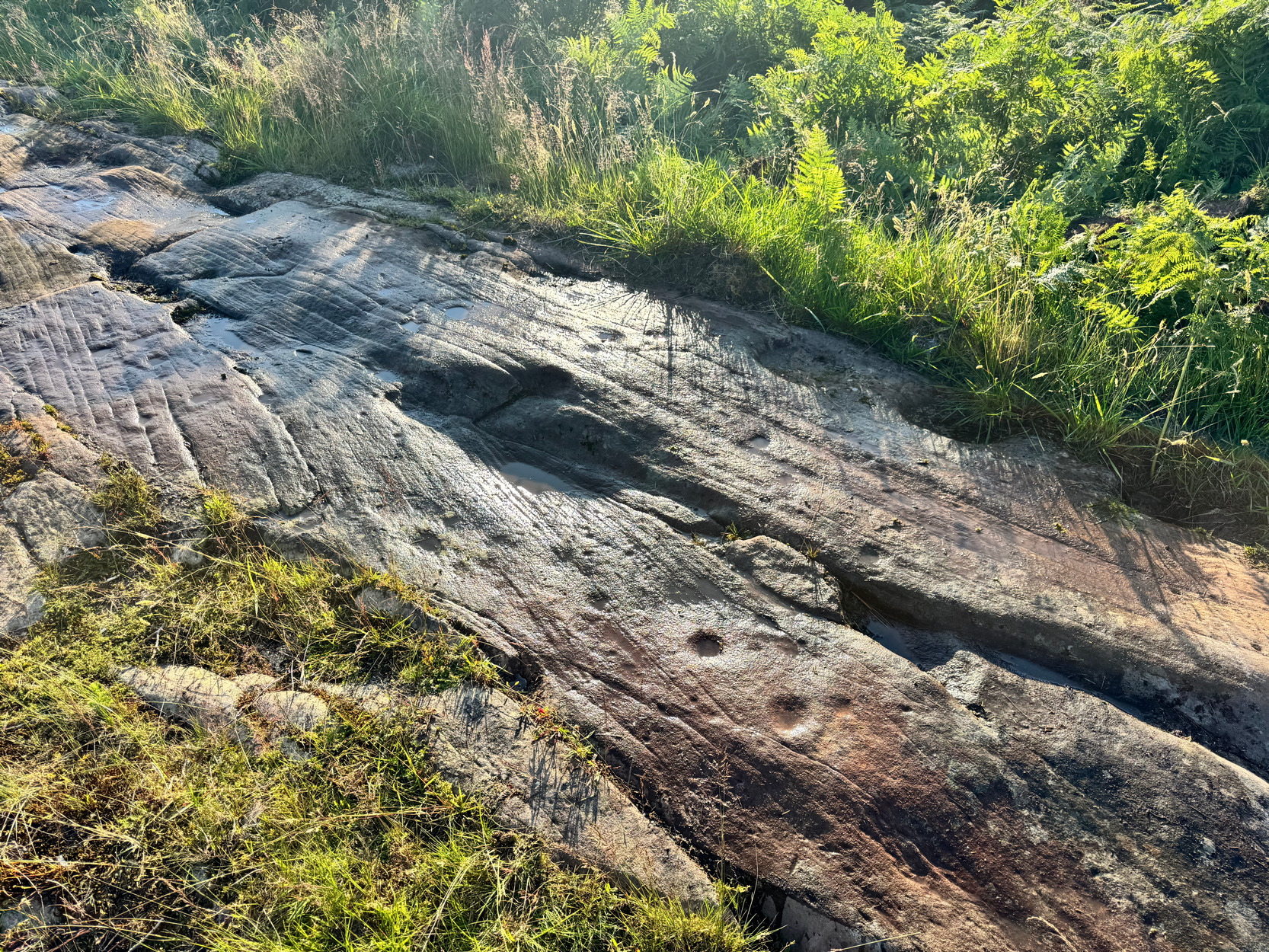
We approach the stone from its north-eastern end. Walking to the troughs and bowls of water, collecting some of it as we pass, it’s important to recognize that this water would have had some mythic relationship with the carving we are about to see. The water in these bowls may have been used to mix organic paints, or possessed some healing virtues relative to the spirit of the rock; it would certainly have had some relevance to the design, so it’s important to mention them even though they’re Nature’s handiwork. But as we get near the end of these watery cleavages, more of the cup-marks begin to appear.
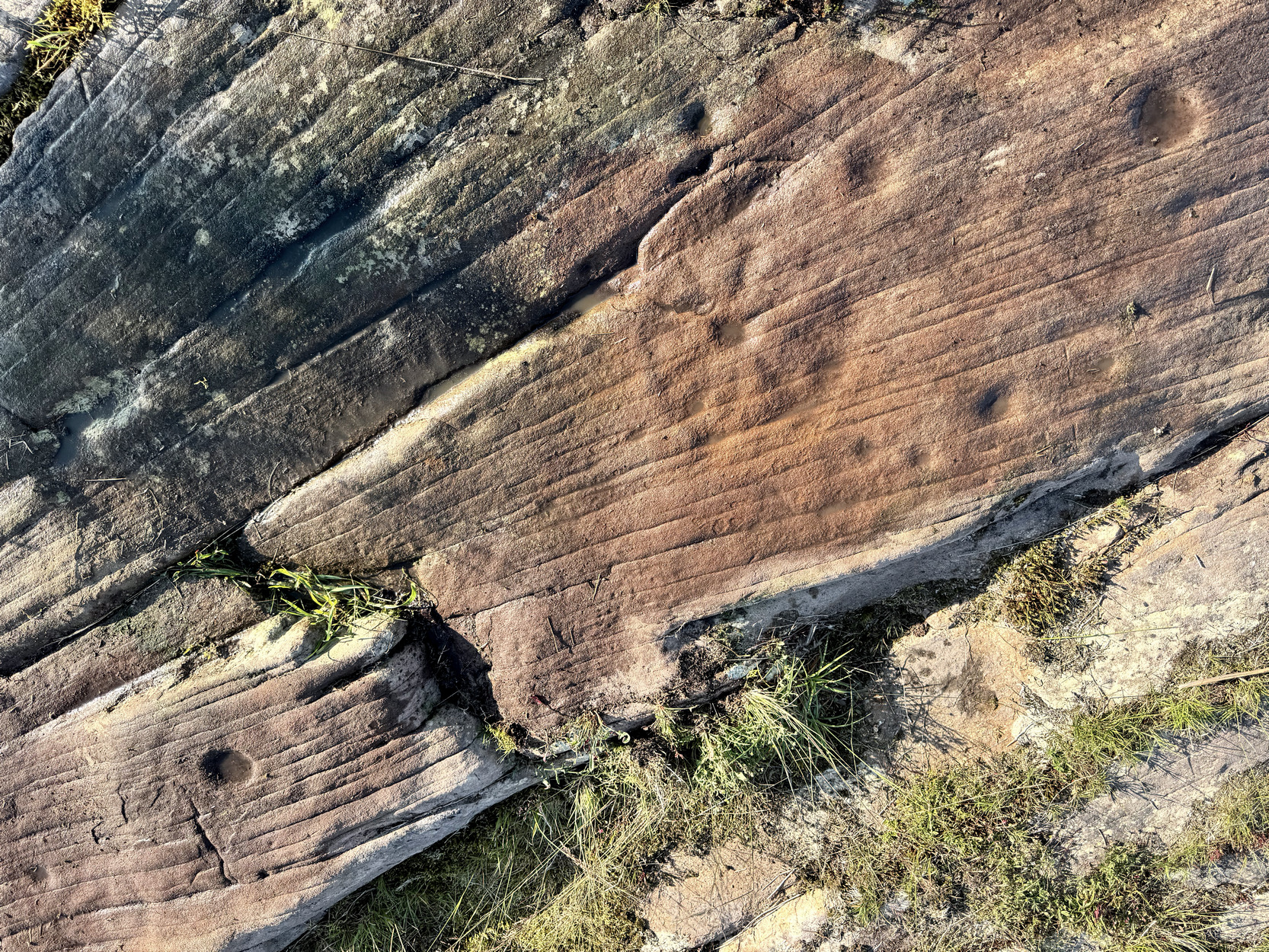
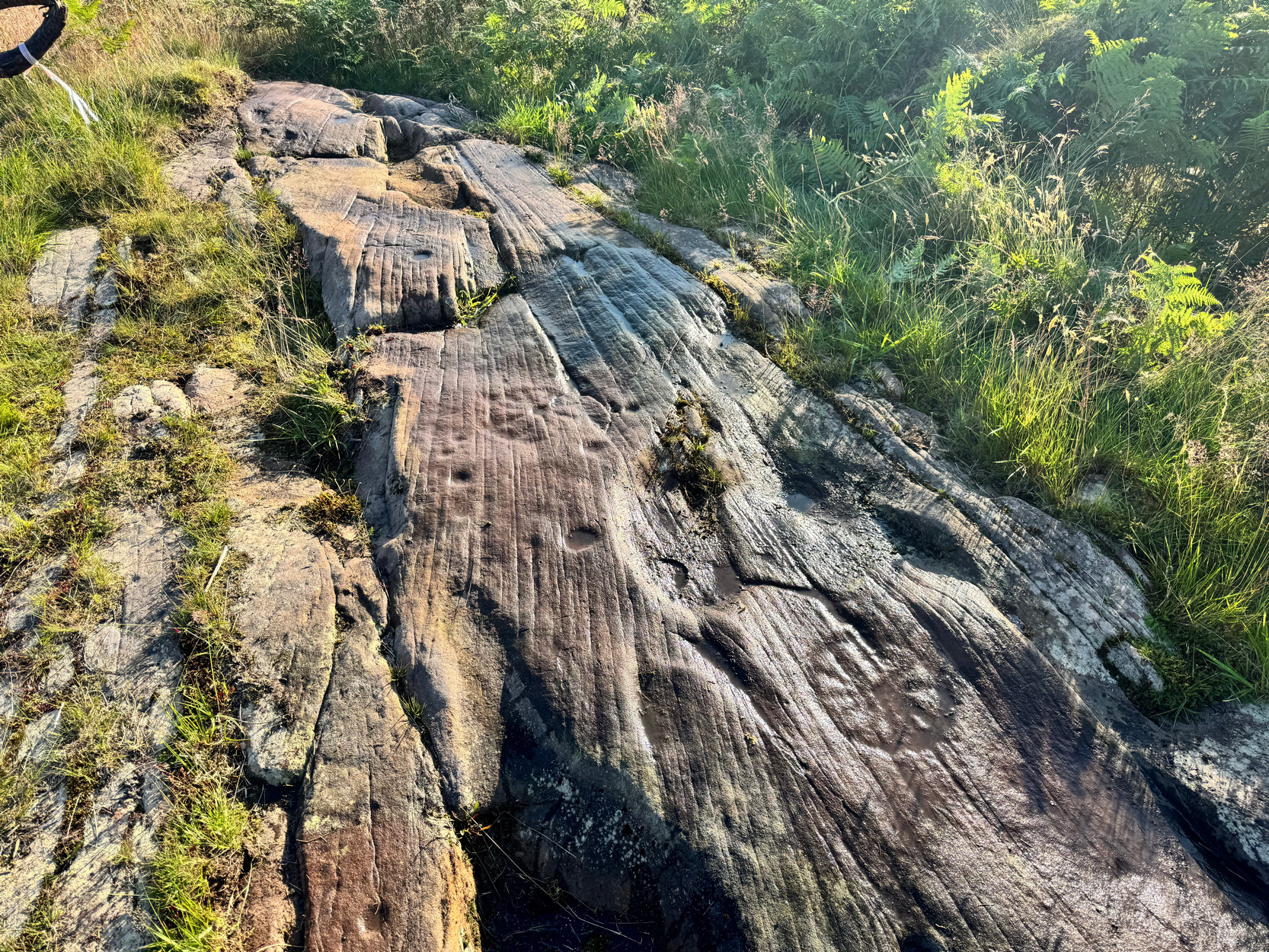
The first suggestion of a cup-and-ring appears where a single cup has the beginnings of a ring, or an arc, on its eastern side; and there’s a single cup attached to the end of this arc. Just past this is another cup-mark which, when looked at from certain angles, seemed to have had a very faint ring round it—but I’m really not sure. A couple of other single cups are just past these two, roughly in line with them. They’re clearly visible in the photos. Continuing southwestwards we come across a small cluster of cup-and-rings—two of them touching each other gently, all but kissing each other! From these conjoined cup-and-rings, a step to the north brings us to another single cup-and-ring.
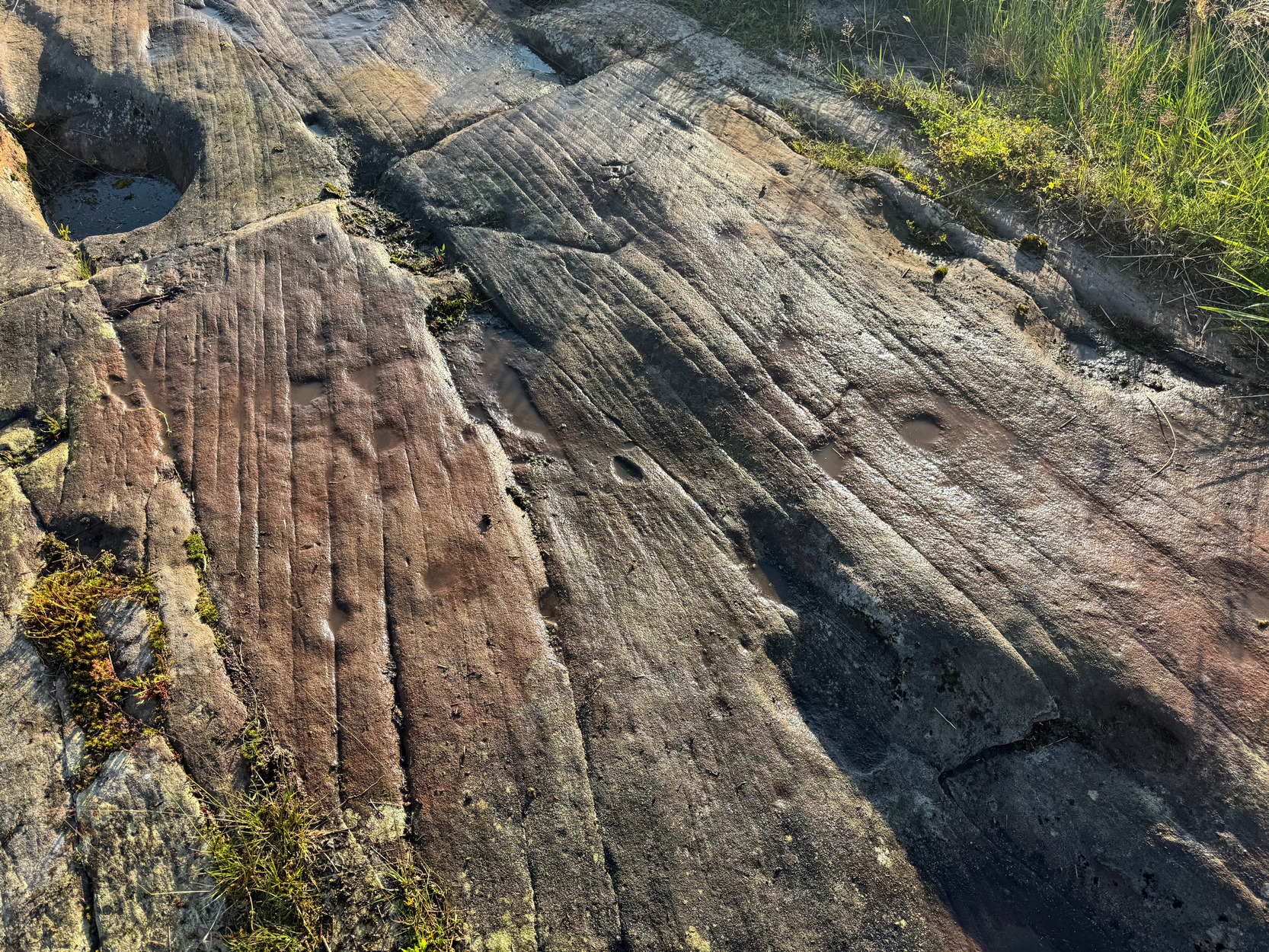
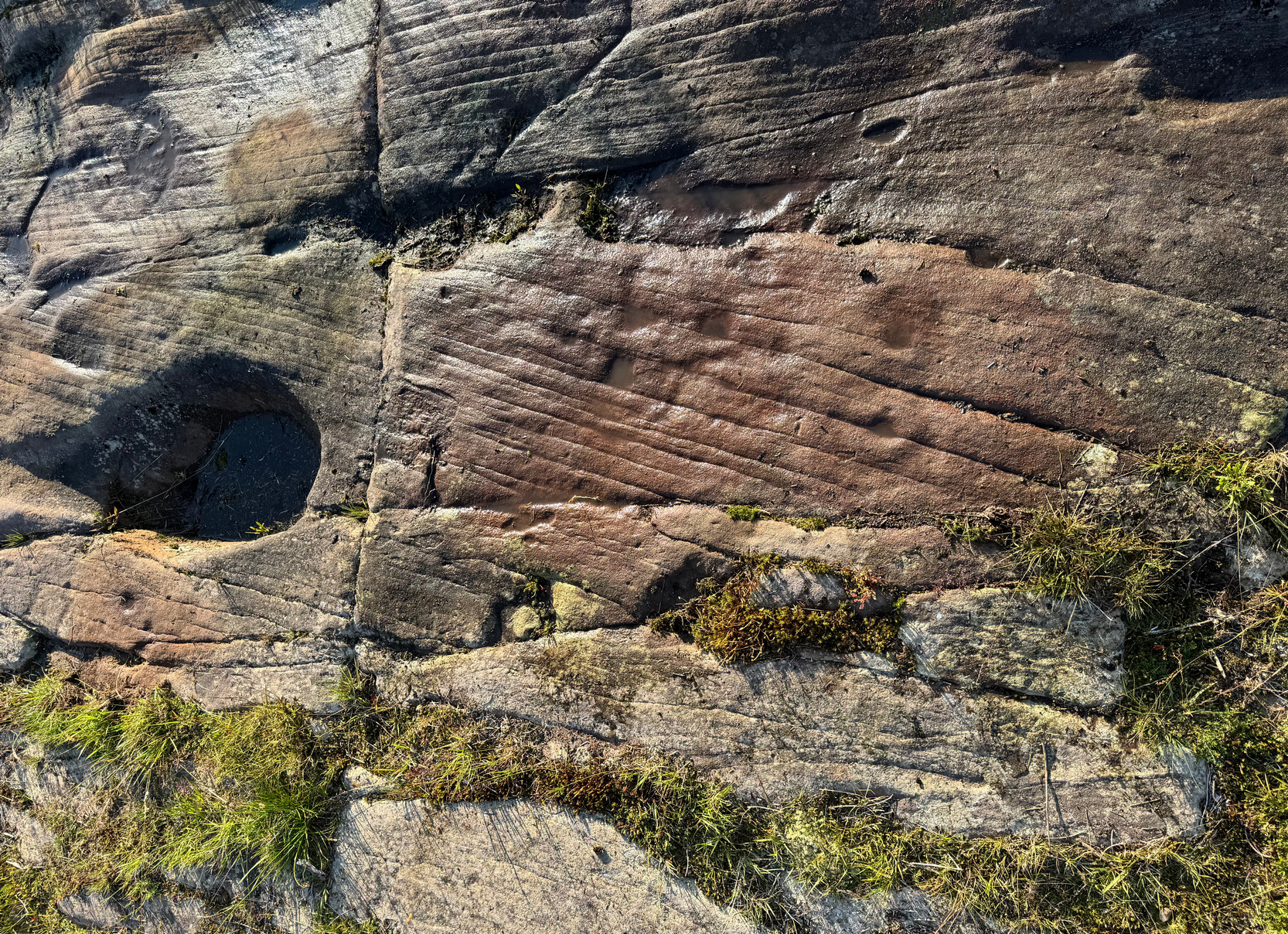
More intriguingly is what’s found a foot or so further west from the cup-and-rings that kiss! We come across a very faint double cup-and-ring that never seem to have been completed—instead, intruded upon by two or three cup-marks on its northern edge and, more curiously still, what looks to be straight lines intruding the outer ring at various angles, almost in the form of the letter ‘W’—or ‘M’ depending where you’re stood. It can be seen quite clearly in the photos here, both left and right. I couldn’t make my mind up about this particular ‘W’ ingredient, inasmuch as: which parts of it are natural, and which parts are man-made. As I walked round and round this element, crouching down, standing up and gazing at it from as many angles as I could, it never seemed to show itself fully one way or the other. There’s undoubtedly some man-made element about it, but its ambiguity should perhaps be left to the computer-tech rock art kids and give them something to do when they next get some grant money to line their pockets. 😉
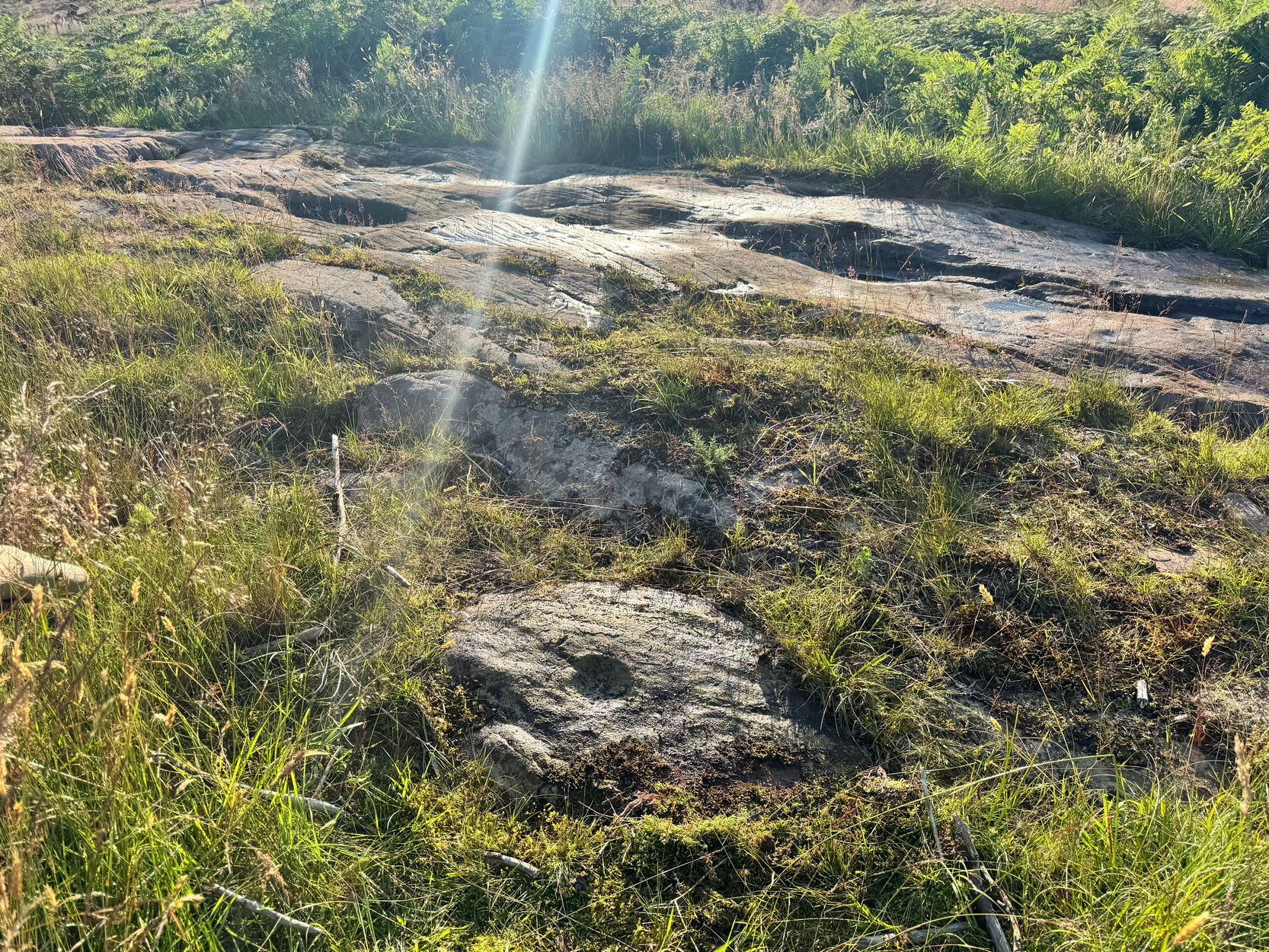
Detached from this portion of the petroglyph, a yard south of the main line of rock, is a small, earthfast oval-shaped stone. On it is a large deep cup-marking, bigger than all the other cup-marks on the main stretch of carvings. But back onto the main length of the carving and continuing west, we next step over a notable (but not large) natural scar running roughly north-south across the stone. Stepping onto the other side of this scar, the petroglyphic symbolism gets more expansive and complex.
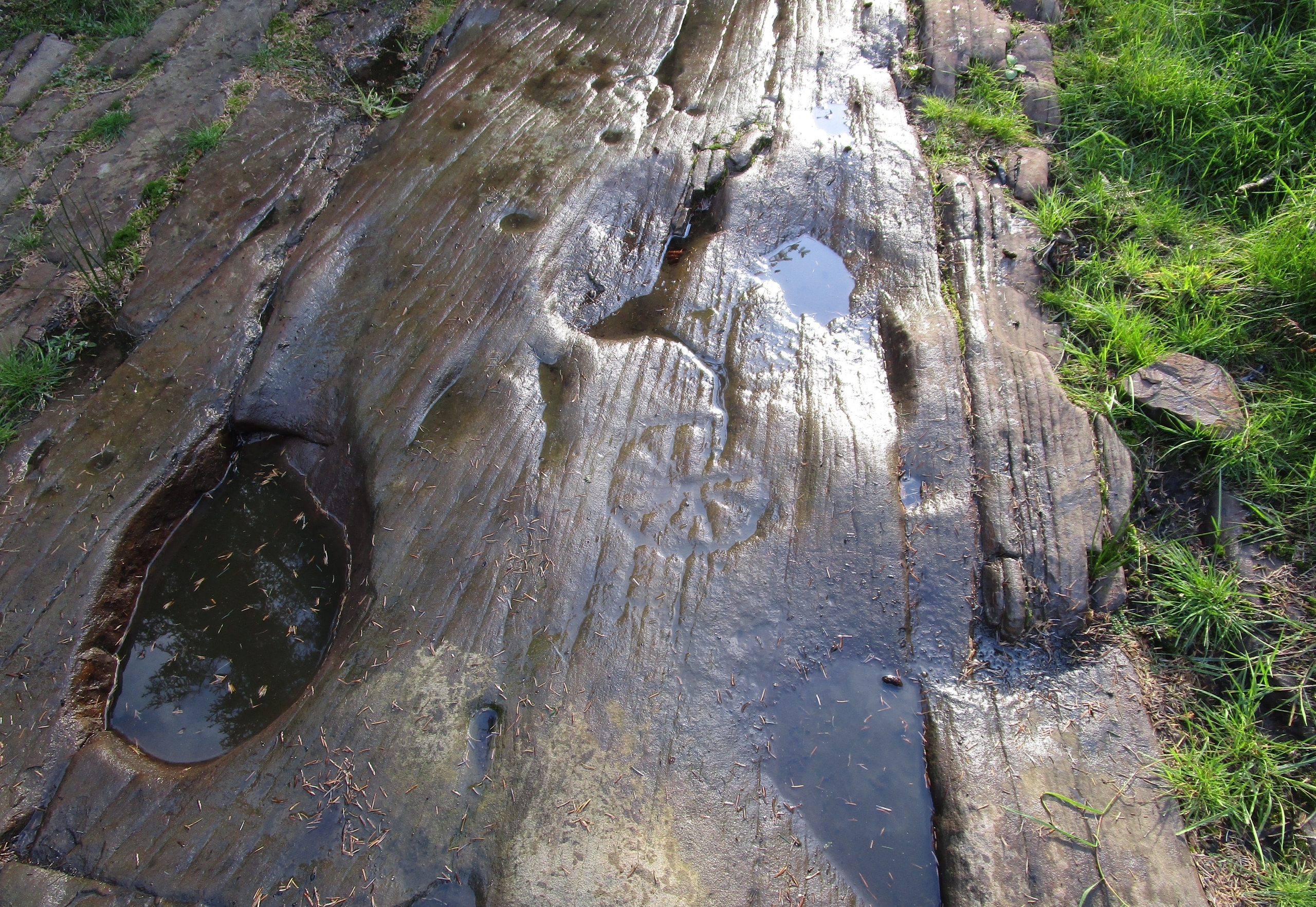
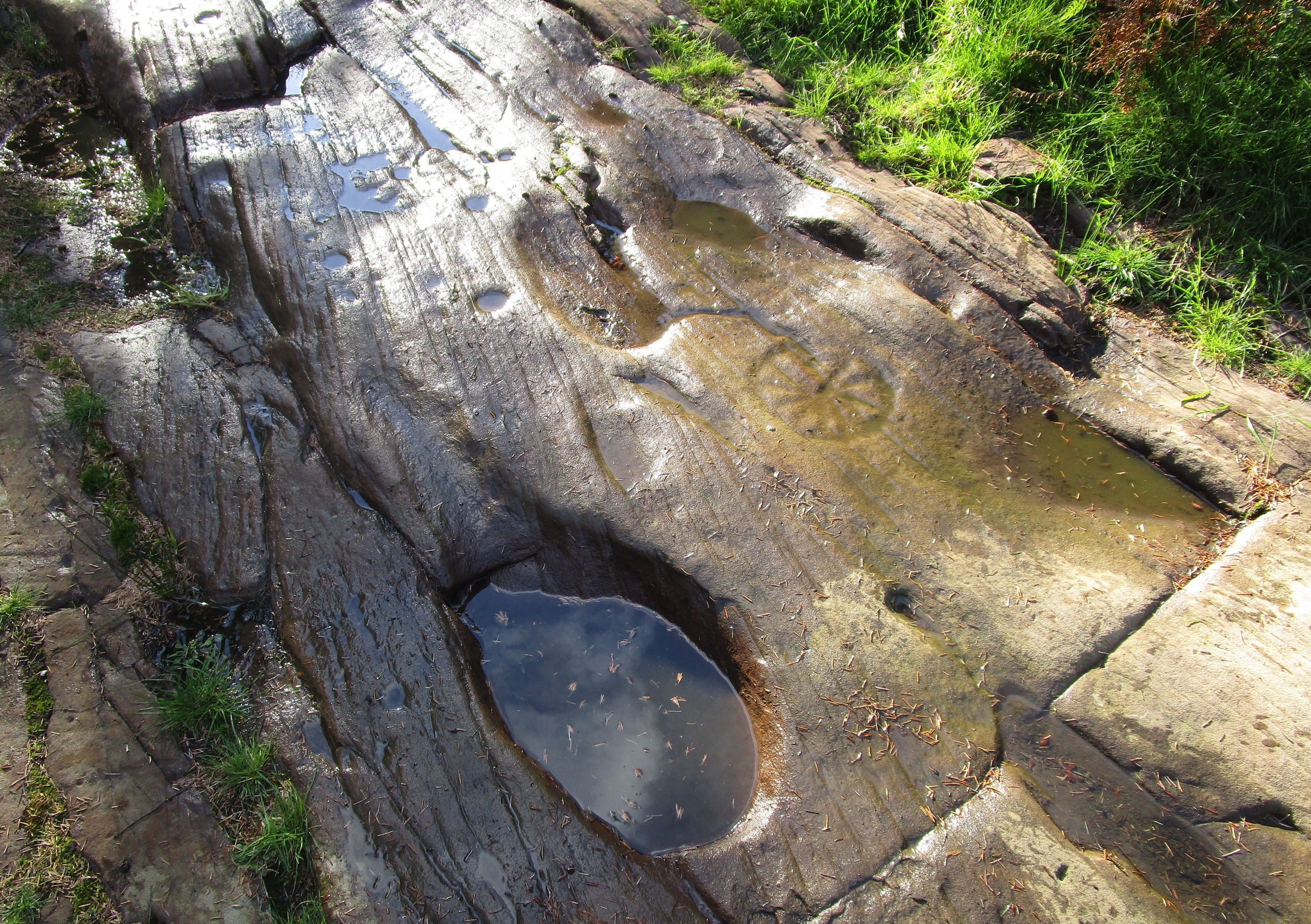
On the other side of the crack is another one of Nature’s carvings: a large, deep tear-shaped bowl. About twelve inches above this (north), albeit very faint and almost impossible to see in some lights, is a wide carved circle, at the centre of which is a small cup-mark and, emerging from this central cup and reaching to the outer edges of the ring are a series of at least nine straight carved lines, somewhat like spokes on a wheel (but in no precise geometrical order), giving the impression of what some folk like to call a ‘solar’ symbol. It may indeed have symbolized the sun—but we simply don’t know.
Next down the rock is a small scatter of single cup-marks and then we reach another spoked-wheel or solar symbol, about the same size as the first one and again made up of at least nine ‘spokes’ radiating from a central cup-mark. A couple of single cup-marks are outside or above the ring. Between the two solar wheels is another natural elongated hollow, albeit shallow compared to the others on this length of rock.
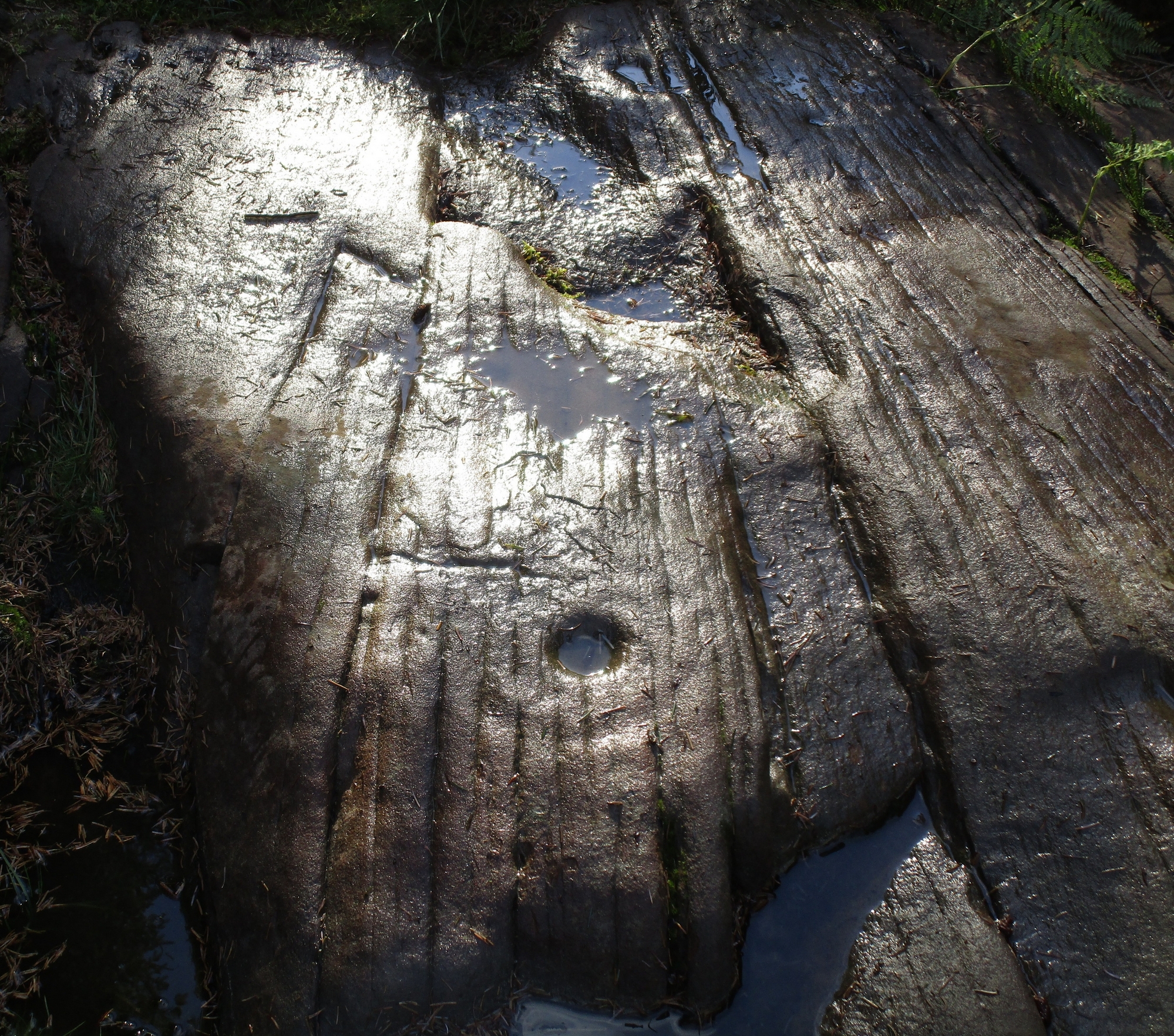
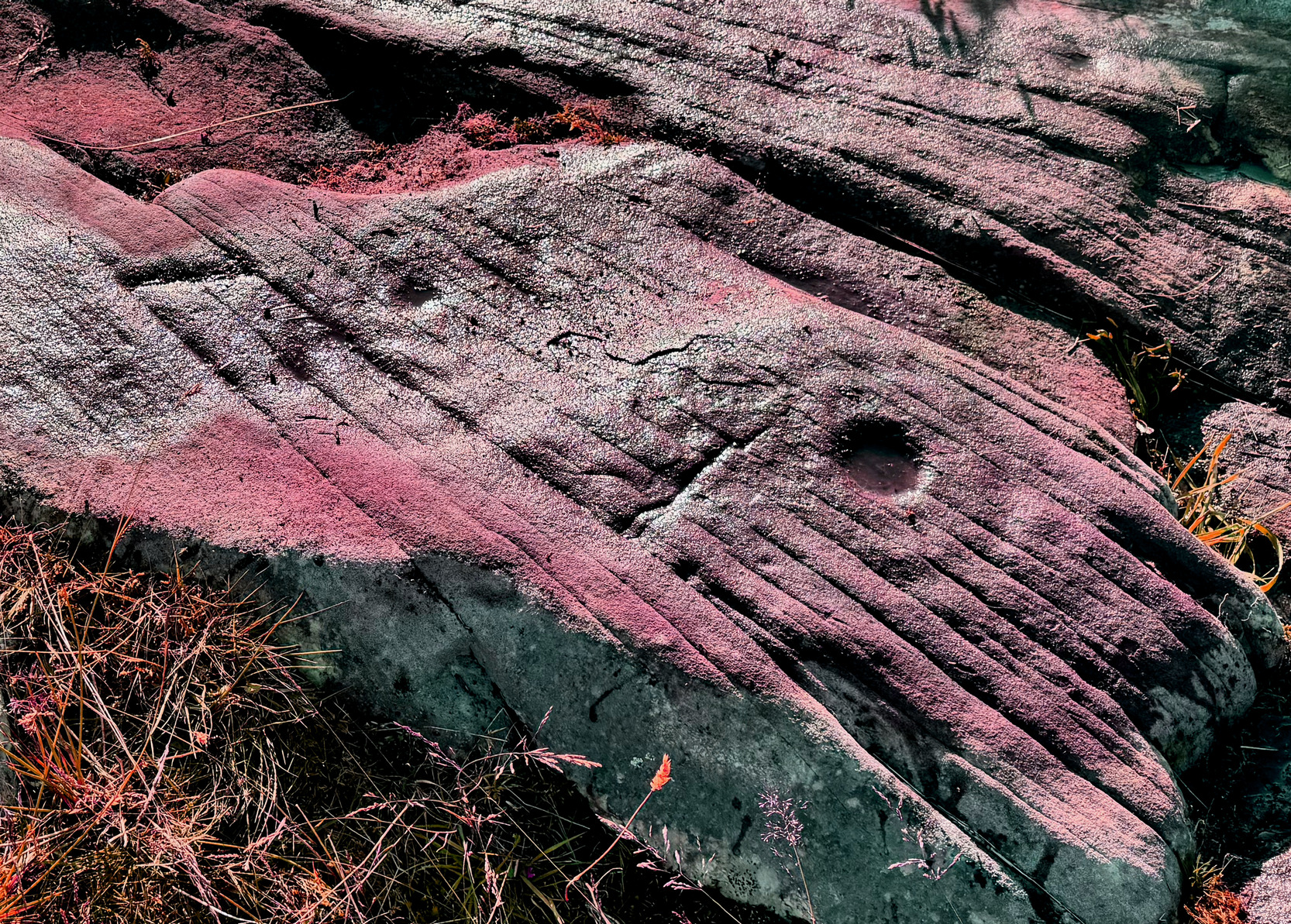
From here, a few steps further west brings us to two very faint multiple-rings. These intrigue me just as much as the spoked-wheels! Initial views of them seem to show them as double-rings around a central cup, but as I watered them and got views of them from different angles, it was obvious that there was more to them (as usual!), with one of the cups seemingly surrounded by four rings—although the outer ring is seemingly incomplete. I’m not 100% sure about it though and it would be good to get more views around sunrise and sunset when the light paints the stone with richer textures, bringing the spirit of the rock into greater life. The other multiple-ringed motif—three rings in all—is faint, but clearer in giving up its secrets: the outer ring of this looking somewhat deformed as it droops down in a more ovoid form.
As we walk now to the very end of this long stretch of rock, no more carved imagery greets the eye. If there was ever anymore to be seen, the elements and Time itself have faded them from view (the nearby Mask Stone exemplifying the difficulty we have in seeing eroded carvings). If, however we walk off the western end of this rock, down into the uneven mass of roots, branches and decaying trees and keep going westwards, a short distance away is another outcrop, albeit much smaller. It has a single cup-mark on its surface. And, quite obviously, other carvings will still be found beneath the mass of dead trees and vegetation across this piece of land. It was obviously a very important place indeed…
The entire carving is a pictorial narrative whose story has been lost. Its complexity fits into the scheme of other carvings in this locale, possessing a rich tapestry of complex symbols along one stony face. It reminded me somewhat of the equally impressive Blarnaboard (3) carving which, curiously enough, this Solar Stone points directly at four miles away to the southwest, and which also possesses a series of multiple complex symbols cut along a long thin stretch of bedrock stone.
Anyhow, to those of you who just need the simplistic shorthand of the archaeologists: this carving comprises of at least fifteen single cup-marks, five cup-and-rings, a cup-and-double-ring, two cup-and-triple-rings (one of which may actually be cup-and-four rings), and two spoked-wheels or solar symbols. It’s good—even by Ballochraggan standards!
References:
- Brouwer, Jan & van Veen, Gus, Rock Art in the Menteith Hills, BRAC 2009.
- Parish, Nick, “Perthshire: Nether Glenny Field Visit,” in Discovery & Excavation Scotland, 2023.
* Numerous people have reported encountering this dickhead, and a number of local folk as far as Aberfoyle also report him as a miserable angry little man. Please don’t be intimidated by his antics (he’s obviously an unhappy old control freak) as he has no legal basis in Scottish law for you to do what he commands. Just walk on by and leave him to stamp his little feet and rant.
Acknowledgements: Huge thanks for use of the Ordnance Survey map in this site profile, reproduced with the kind permission of the National Library of Scotland.

© Paul Bennett, The Northern Antiquarian
