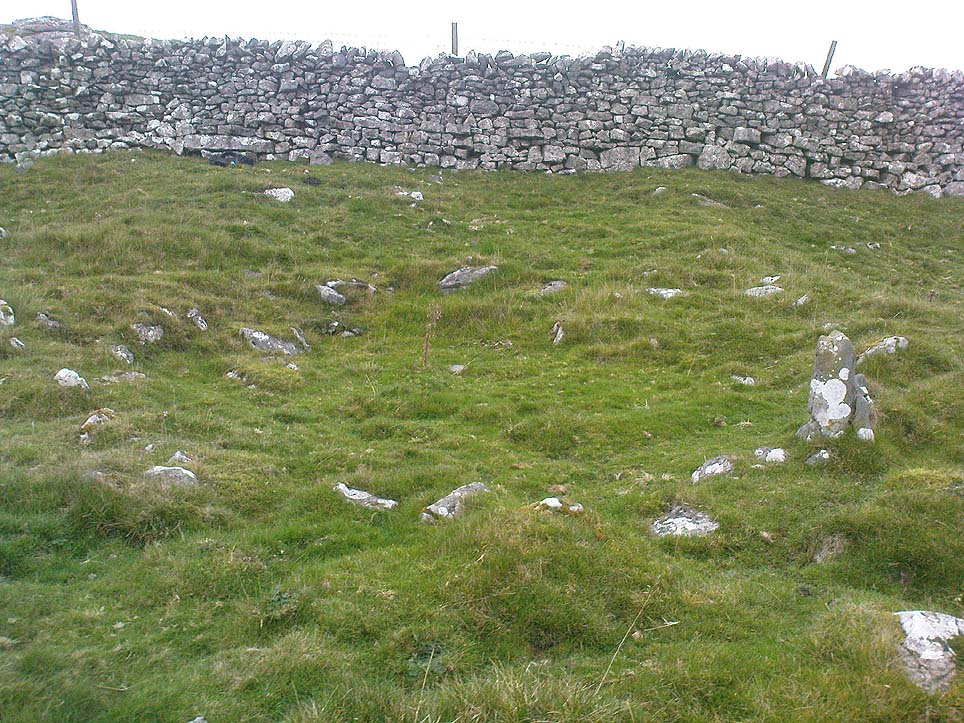
Lantern Holes, Bordley, North Yorkshire

Settlement:  OS Grid Reference – SD 9528 6574
Getting Here

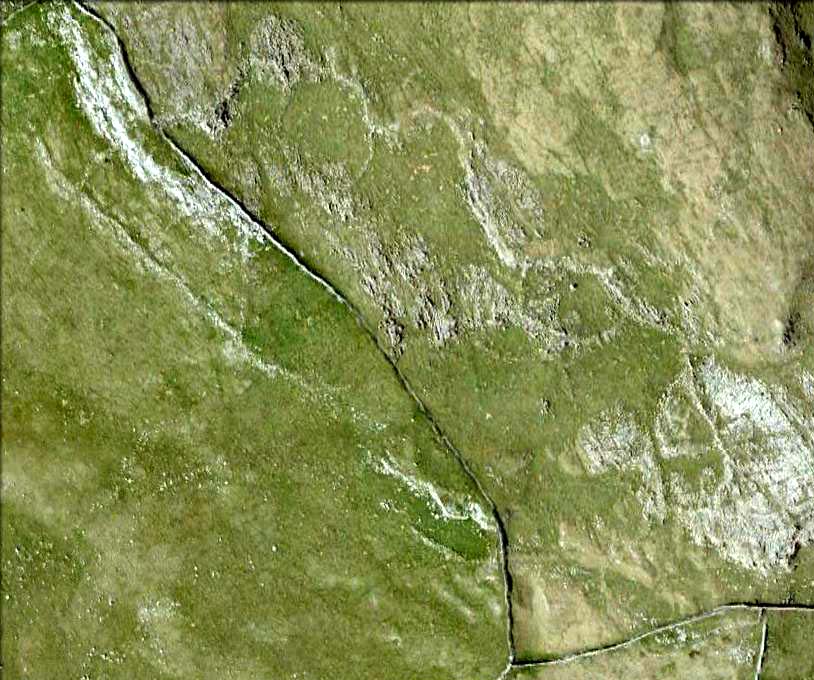
Aerial view of settlement

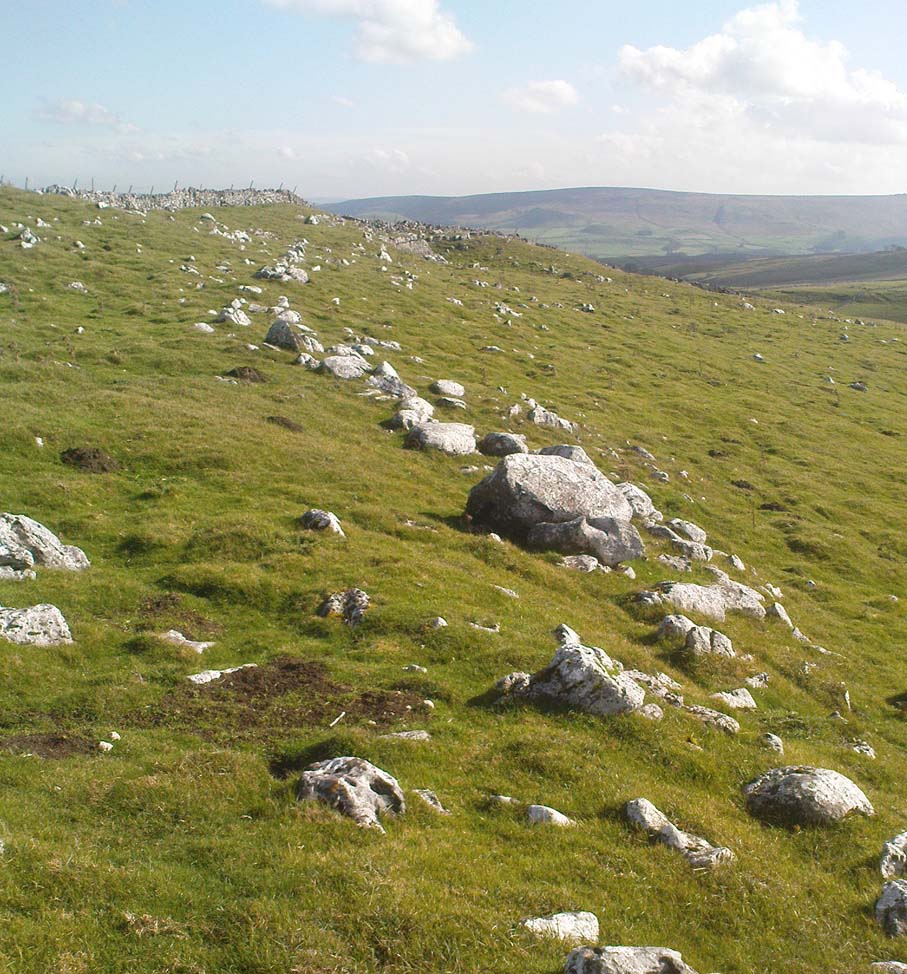
Follow the same directions to get to Bordley’s Druid’s Altar circle.  Where the little rough car-parky-bit happens to be by the cattle-grid, look up the sloping field where the wall runs up in a line and follow it up on foot.  A coupla hundred yards up you’ll see a small craggy outcrop in front of you and another line of drystone walling in the corner.  Just below this craggy outcrop you’ll notice a raised embankment comprising a line of small rocks running along the edge of the hill.  This is the first bitta prehistoric walling that makes up a part of the settlement system.  From hereon, follow y’ nose along and up the hill and look around.  The settlement’s all around here!

Archaeology & History

This is quite an extensive area of prehistoric (seemingly Iron Age) enclosures on the top and around the edges of the unnamed rocky peak at the top of the large open Lantern Holes field.  I’m not aware of any excavation work that may have taken place at this site, so please excuse me of any errors in the description that follows. (if anyone’s got an excavation report of the site, I’d love to read it!)

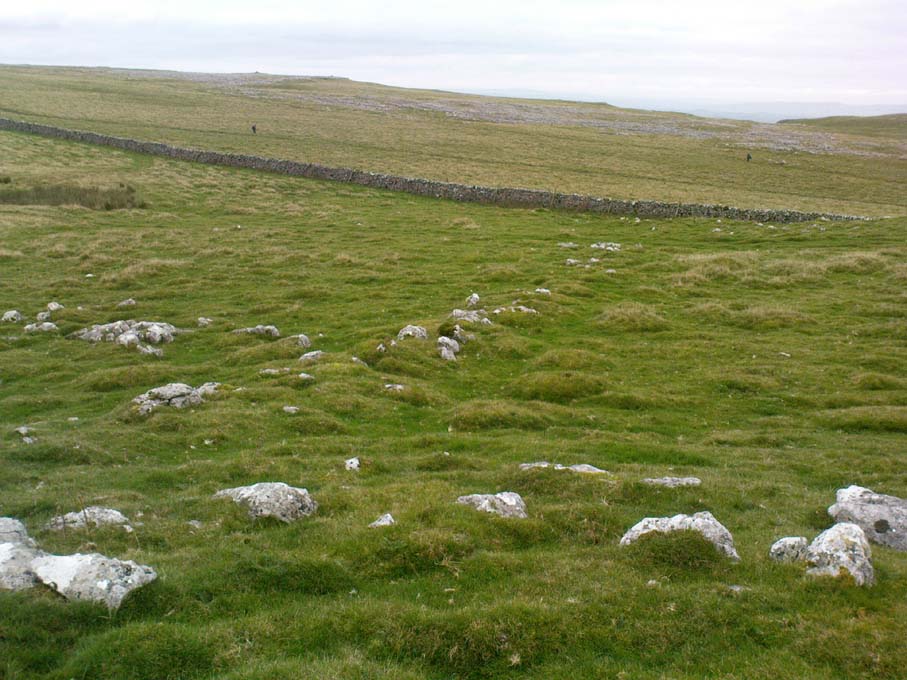
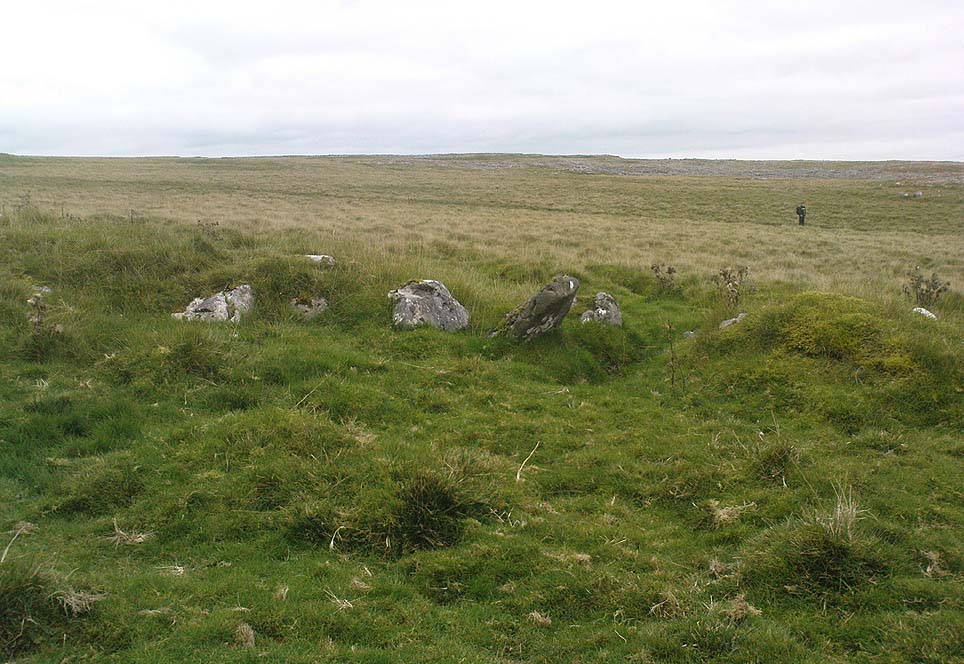
As with the many other settlements and enclosures in this region, much of it comprises of extensive stonework built up into and against the geological limestone bedrock either side of this hilltop site.  Huge lines of prehistoric walling, measuring anything between one and three yards across, runs for hundreds of yards in and around this set of enclosures.  We also find several distinct and well-preserved examples of old hut circles (one of which appears to have been re-used as a sheep shelter in more recent centuries) dotted around the edges and in the middle of larger sections of enclosed stone walls.  This is all very impressive when you consider it was done a coupla thousand years back!
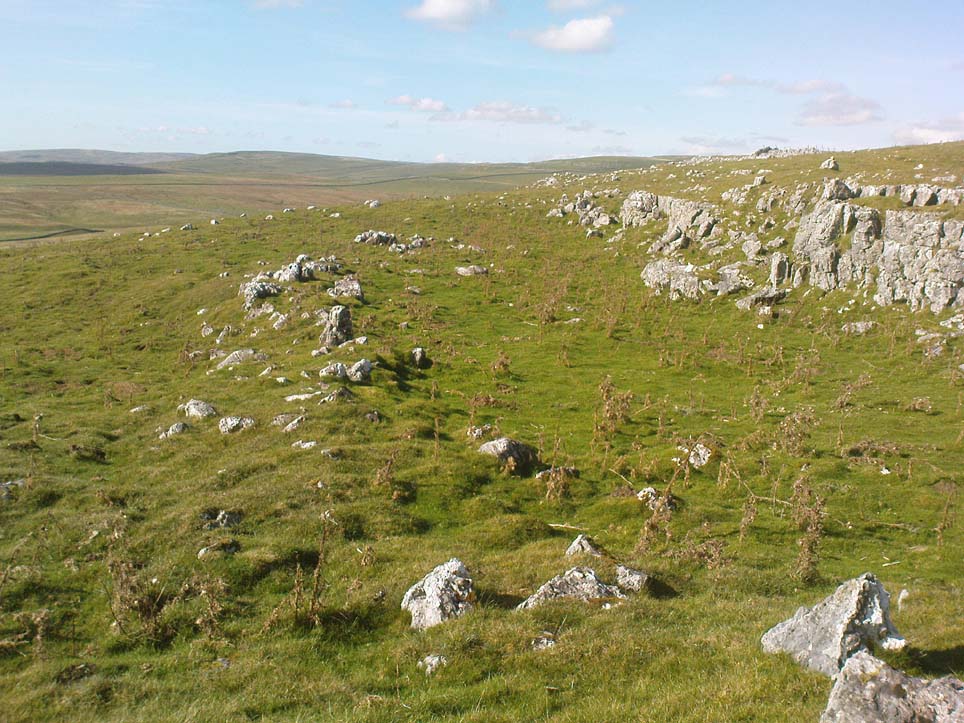
Walled enclosure on south side
Walling along SW edges

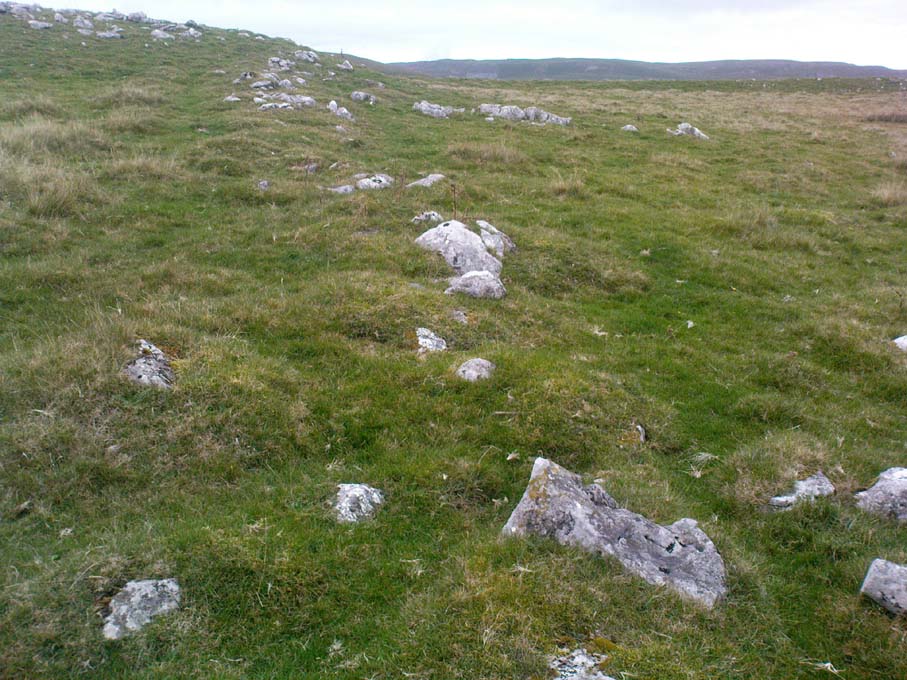
Very similar in design to the prehistoric settlement enclosures on the other (south) side of the valley at Hammond Close Pasture, above the Druid’s Altar, though more extensive.  Measuring roughly 340 yards (311m) along its longer southeast-northwest axis, and nearly 280 yards (254m) from east-to-west, the uppermost parts of the site have at least seven separate large elliptical ‘enclosures’ built within the rocky enclaves, made up of typical Iron Age wall systems: a series of large upright monoliths packed up by smaller packing stones all along the length of the walling (using a system that still prevails today in drystone walling techniques on our upland moors).  A couple of the photos here illustrated the walling very well and give you an idea of what to look out for if you’re out wandering the region, looking for old sites.

Although the walling we see today is barren and easy to spot, remember that in the time when people built these great structures, you wouldn’t have been able to see them, as they’d have been deliberately covered over and camouflaged with dressed earth and plants.  In watching people emerging from these enclosures, you’d have got the distinct impression that they literally came out of the hill itself: a motif well-known to folklorists in relation to the origin of faerie-folk and other ‘little people.’

We need to go back up here and explore this settlement a bit more, as there’s tons more to be seen.  And if anyone knows of any surveys that have already been done of this site, it’d be good to read the reports, preliminary or otherwise.  A rough-camping weekend is planned on the tops at the break of Spring – so contact us if you’re into joining us for the amble.  I reckon there’s gonna be other sites hidden in the landscape up here that even Arthur Raistrick missed out on!

…to be continued…

References:

  1. Raistrick, Arthur & Holmes, Paul F., Archaeology of Malham Moor, Headley Bros: London 1961.

© Paul Bennett, The Northern Antiquarian


Torlery Edge, Malham Moor, North Yorkshire

Settlement:  OS Grid Reference – SD 898 653

Getting Here

Torlery Edge from above

From Malham village, take the winding uphill road up Malham Rakes (not the Malham Cove road).  If you aint sure, ask a local.  Get to the top of the long winding road and,  a mile on, you meet with another single-track road on the top level known as Street Gate.  Stop here, then head across the grasslands on the left-side of the road, southwest.  There are a couple of footpaths running over the land here: I wouldn’t say it makes much difference which one you take as they take you in the right direction.  You’ll eventually meet the old craggy hilltop with the drystone walling down t’other side of it.  You’re here!

Archaeology & History

The history of this region seems to have been covered to a great deal by the likes of Arthur Raistrick and his mates, though I can’t find a specific entry in mi library about the remains we’re looking at here.  Surrounding the edges of the small hill, as can be seen in the aerial photo here, walling has clearly been built up around it, with considerable remains still visible at ground level, as indicated in the photos aswell.

Eastern edges of enclosure
Eastern walls, looking north

A settlement or large stone-walled enclosure, lying primarily on the north side of the drystone wall, measures approximately 82 yards north-to-south, and roughly 78 yards (72m) east-to-west, with a rough circumference around the outer edges of its rough elliptical outlines of more than 270 yards (250m).  Along the walled edges can clearly be seen several ‘hut circle’ remains: one in particular at the northeastern side and, more prominently, at the southeastern side, are in reasonably good states of preservation.  The northeasterly hut circle measures approximately six yards across.  The stone walls of this circle are more than a yard wide.  The ‘hut circle’ on the southeastern corner are more prominent and is in a better state of preservation, but much of the structure has of course been ruined to build the adjacent, more modern, drystone walls.  This circular structure is larger than its counterpart on the northeast, measuring some 13 yards across.

The southern edge of the main settlement walling has been built up against and onto a large length of bedrock running roughly east-to-west.  This inclusion of local geological features within man-made settlements and houses is a feature found all over Malham Moor and adjacent areas, for many miles around here. (see the Hammond Close settlement, for example)  The southernmost section of the Torlery Edge settlement is in a reasonable state of preservation, as is the length of walling along its eastern edge.  Along the northern section of the settlement it seems that an internal enclosure feature has been built (“perhaps for cattle?” would be the archaeologists usual query); whilst the western edges are the least visible part of this monument.

Hut circle on southern edges
Hut circle, looking north

If we now jump over the drystone wall running along the southern edges (and visible in the aerial photo above), we can see a series of six, perhaps seven, hut circles, all adjoining each other and running along the line of the wall.  Some of these are in a very good state of preservation and an excavation of these sites might prove fruitful. (unless it’s already been done – does anyone know?) Two of these hut circles have entrances clearly visible.  They are all roughly the same size and structure, with average diameters (from outer wall to outer wall) of 7 yards.  They consist of a rough ring of small upright stones, packed with smaller rocks and (in bygone times) peat and wood.  Sheltered from the north winds by the ridge above it and the extensive ancient enclosure walling (not the drystone, which in itself is very old), this row of prehistoric buildings were probably for members of the same tribal group.

Without excavation it’s difficult to date these hut circles, but they would probably have been used between the Bronze Age and Romano-British period.  There is every likelihood they were also used up to the medieval period, as this land was acquired (i.e. stolen) from local people by the Church and their law-bringers.  We know that much of the landscape hereabouts was possessed by Fountains Abbey in the 12th century, who made extensive use of the area for their cattle; and we find considerable evidence scattering these hills of medieval archaeological remains.

Although the site is catalogued as a separate site from, say, the settlement remains and enclosures we find at Combe Hill, Prior Rakes, New Close, and other field areas close by, this individual archaeological site must be assessed as part of a greater collective series of settlement remains hereby.  Instead of looking at this as an individual settlement, its relationship with the others in the vicinity needs re-evaluating and contextualizing and set within a wider and more realistic vision.  Whilst appreciating that detailed modern excavations have yet to be done in this region on a scale that is required (as with many of our northern archaeological landscapes), it is probable that this singular settlement was part and parcel of what was once a prehistoric city.

If you visit this particular site, spend a few days looking round at the many other settlements and prehistoric religious sites in the area.  And don’t forget to look and enquire as to why the Romans came and built a huge monument near the centre-edges of this domain of our prehistoric ancestors.  Tis a fascinating arena indeed…

References:

  1. Dixon, John & Phillip, Journeys through Brigantia – volume 2: Walks in Ribblesdale, Malhamdale and Central Wharfedale, Aussteiger: Barnoldswick 1990.
  2. Raistrick, Arthur & Holmes, Paul F., Archaeology of Malham Moor, Headley Bros: London 1961.

© Paul Bennett, The Northern Antiquarian