Clach na Croiche, Balnaguard, Perthshire

Standing Stones:  OS Grid Reference – NN 94624 52118

Also Known as:

  1. Balnaguard Farm
  2. Gallows Stone

Getting Here

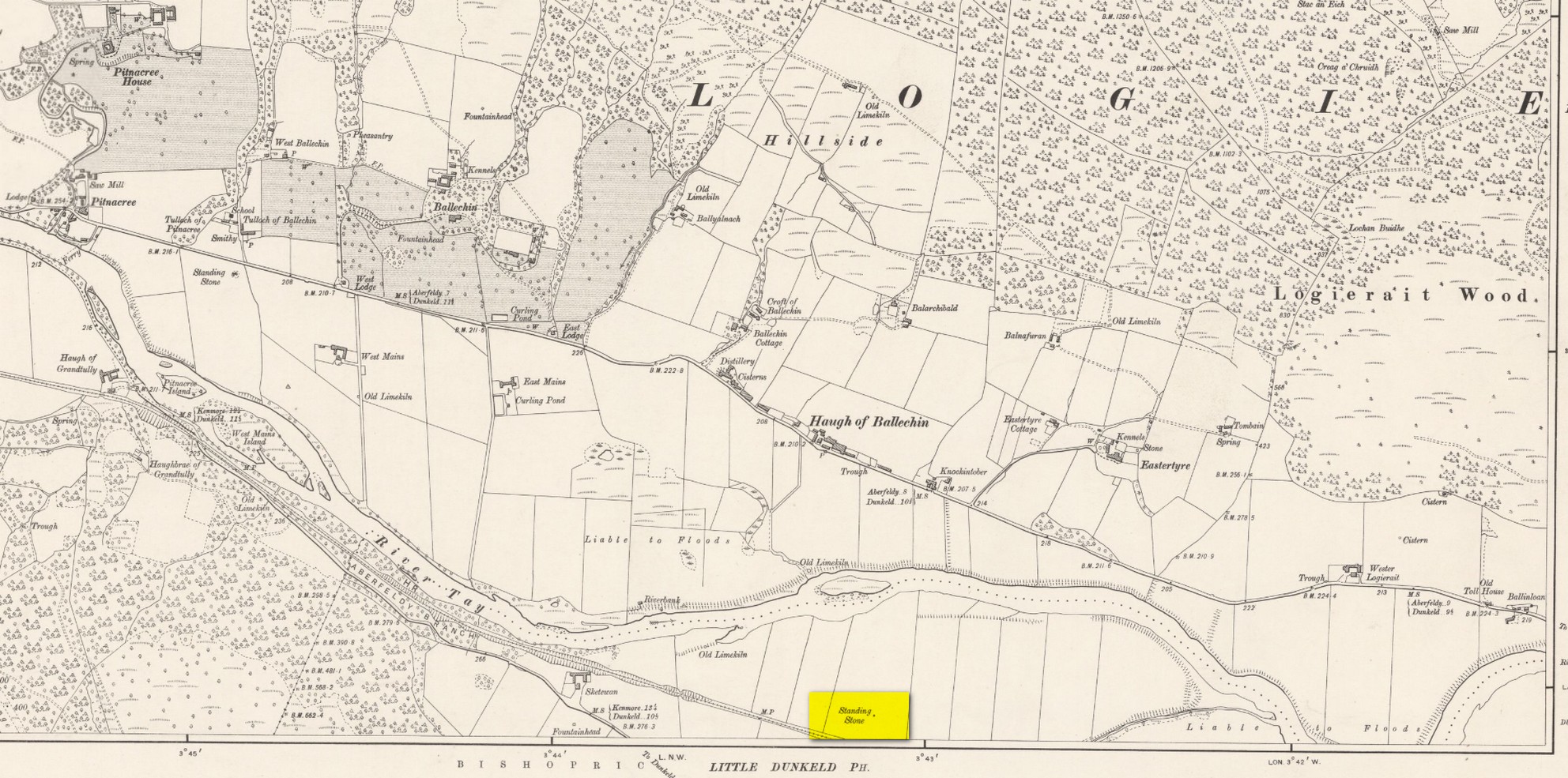
Site on the 1899 OS-map

Just as you’re coming into Balnaguard village on the B898 road from the eastern side (as if you’ve come via the A9 from near Pitlochry), just where the road crosses a small burn (stream), take the first farm-track on your right and walk down to the end where it meets the field.  Here, walk to your left left and you’ll see a gate that takes you into the field.  You should have already noticed the standing stone before you even open the gate!  It’s about 100 yards in front of you.  You can’t really miss it.

Archaeology & History
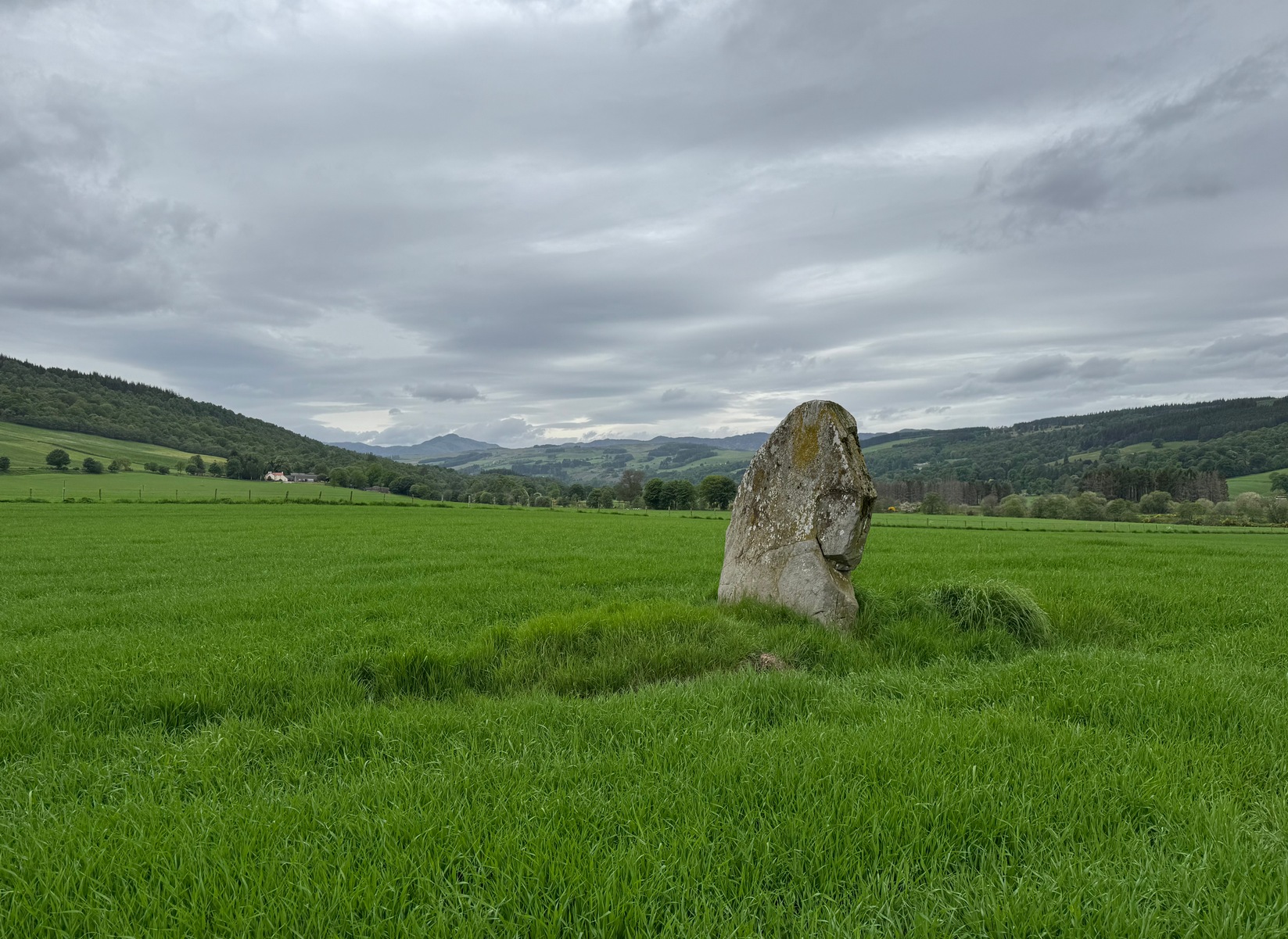
Clach na Croiche

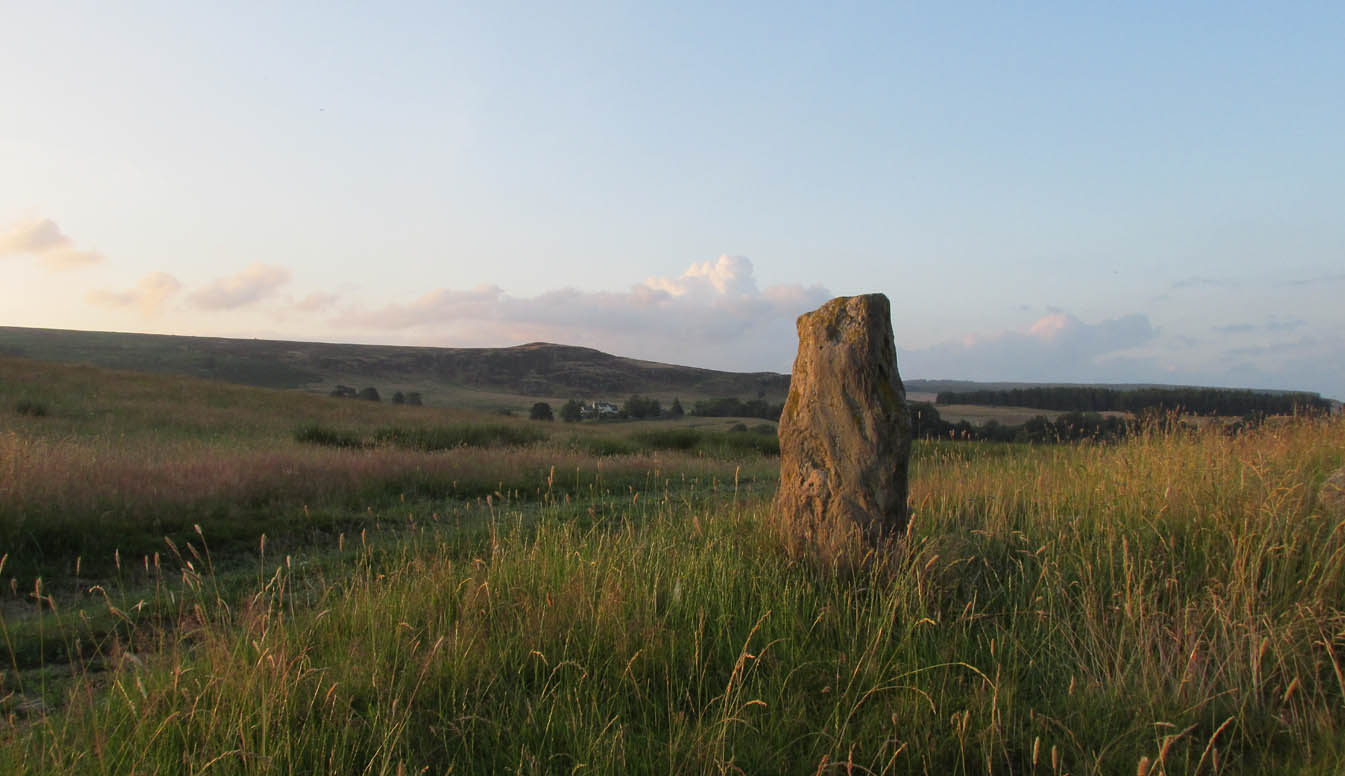
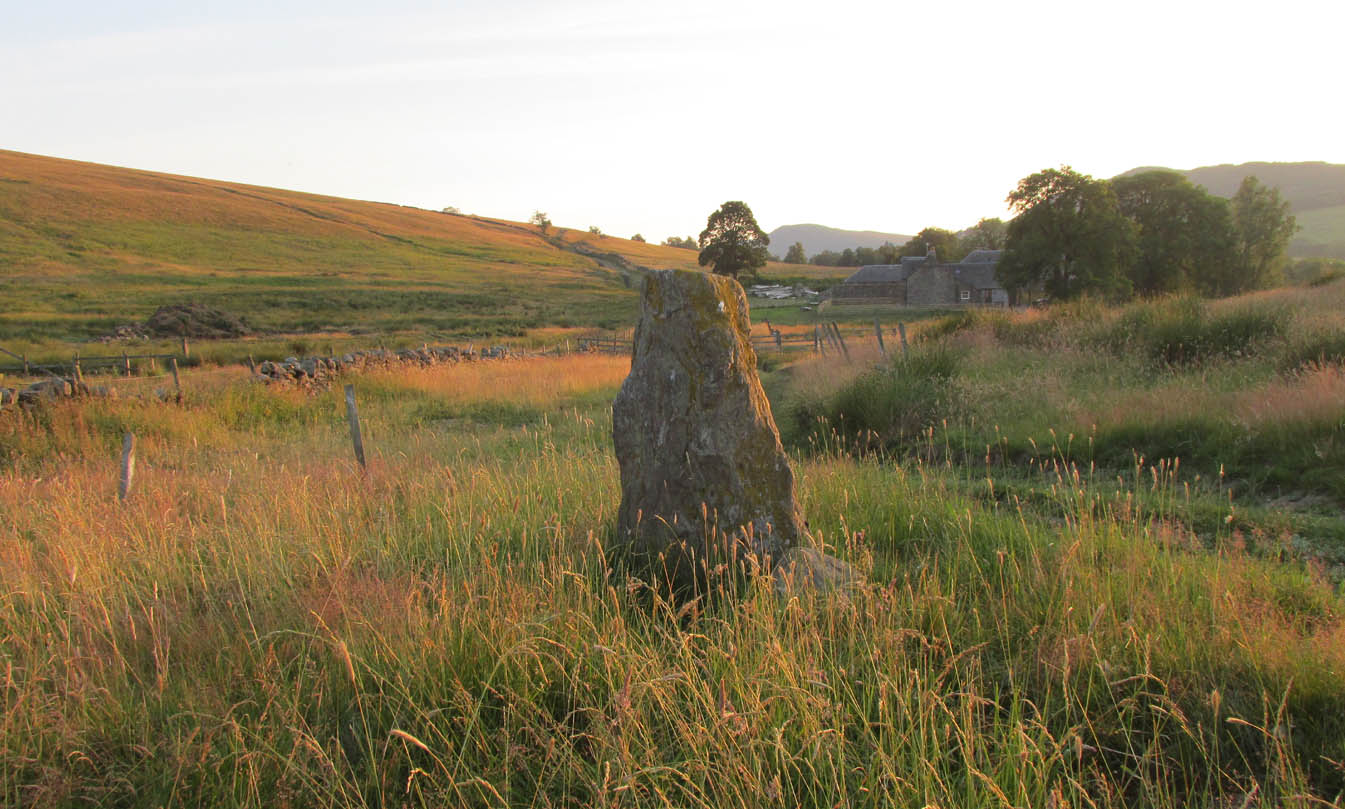
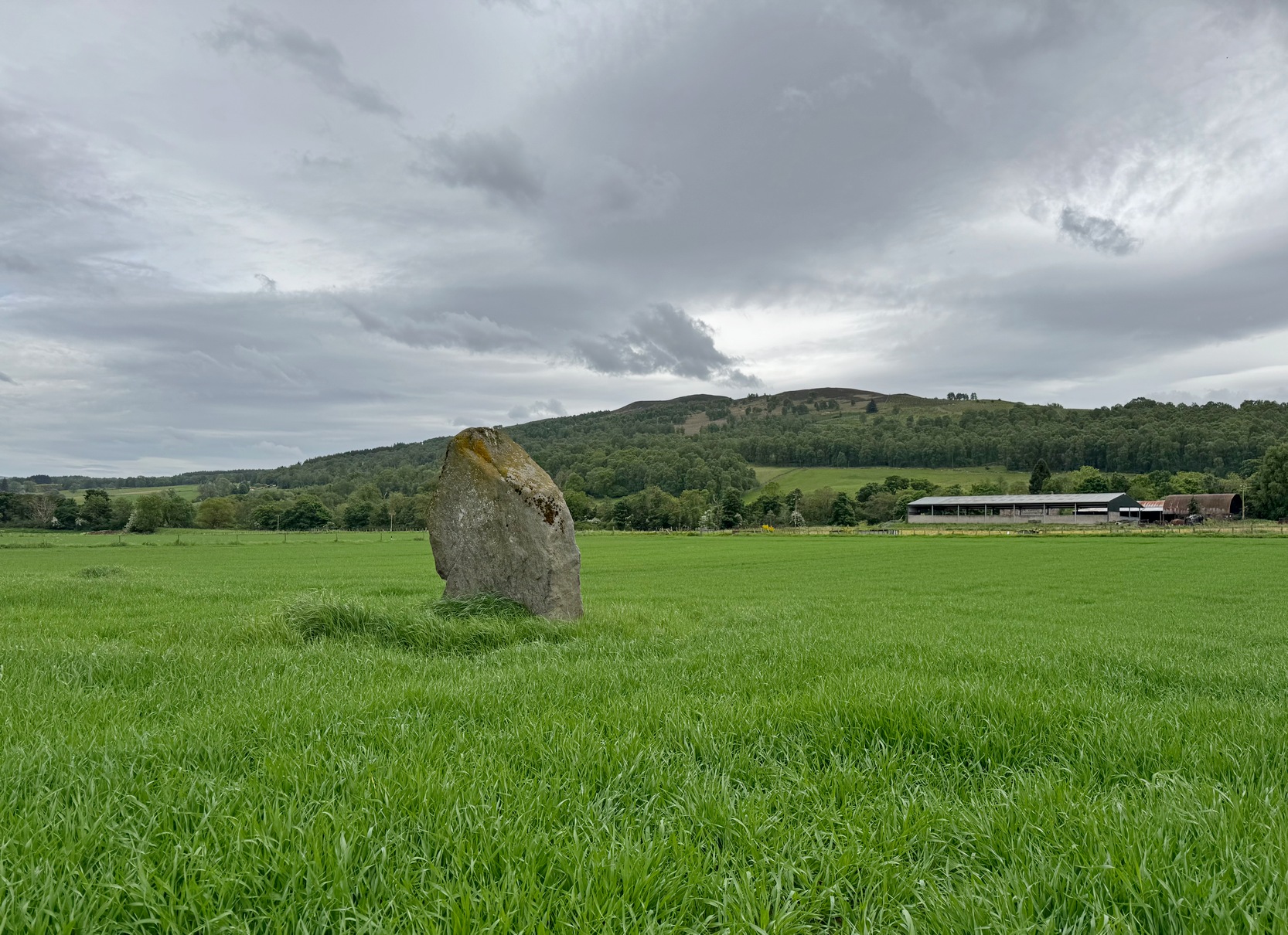
Standing alone in this field a short distance south of the River Tay is this fine old standing stone, nearly seven feet high, from whose locale we gaze west to the opening of the Perthshire mountains—but in times gone by it wasn’t alone.  Less than 10 yards east of the Clach na Croiche stood another seven-foot tall standing stone and, some six yards further east (and along the same axis) there may have stood another one, some 7½ feet high.  This alignment ran east-west in line with the rising and setting of the sun at the equinoxes. (whether that was deliberate or not is another matter altogether) and was first noticed by the great antiquarian Fred Coles (1904) in one of his many megalithic ventures.  He wondered “whether they (were) fallen Standing Stones, or the covers of cists” and when they were looked at by Margaret Stewart in 1971 she found that one of them laid beside “a shallow socket outlined with packing stones”—meaning that it had stood upright.  The other stone didn’t seem as certain, although Stewart did report finding “a single cupmark…on the eastern side of the upper surface.”  We’ve yet to see a photo of this carving.

The Clach na Croiche also has its own cup-markings, just above the bottom of the stone on its southern-face.  Margaret Stewart described them  as being “strung out irregularly across the face.”  Sounds about right!  Sadly, somehow, I didn’t get any photos of these when I last visited, but will grab some the next time I’m there.
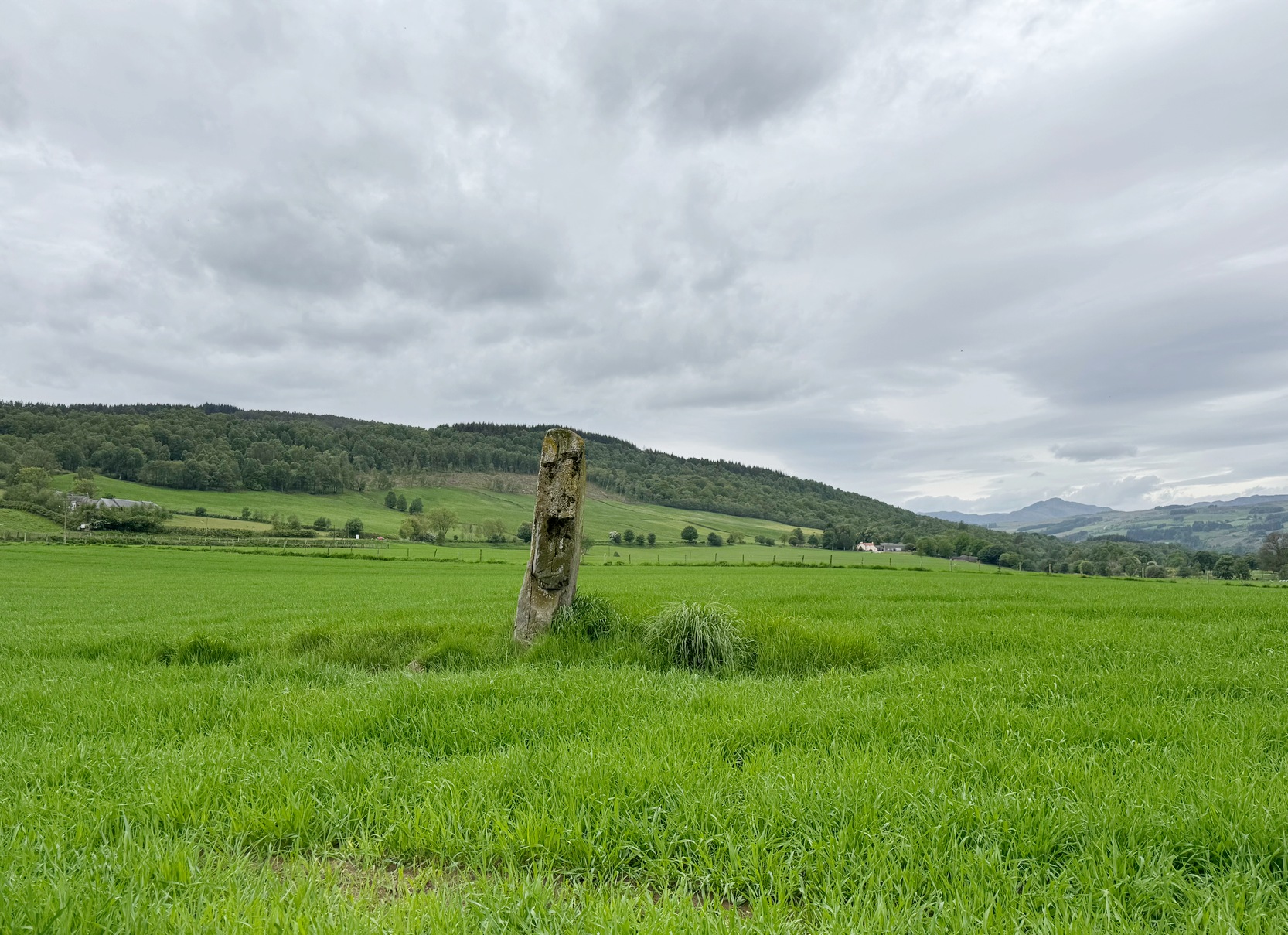
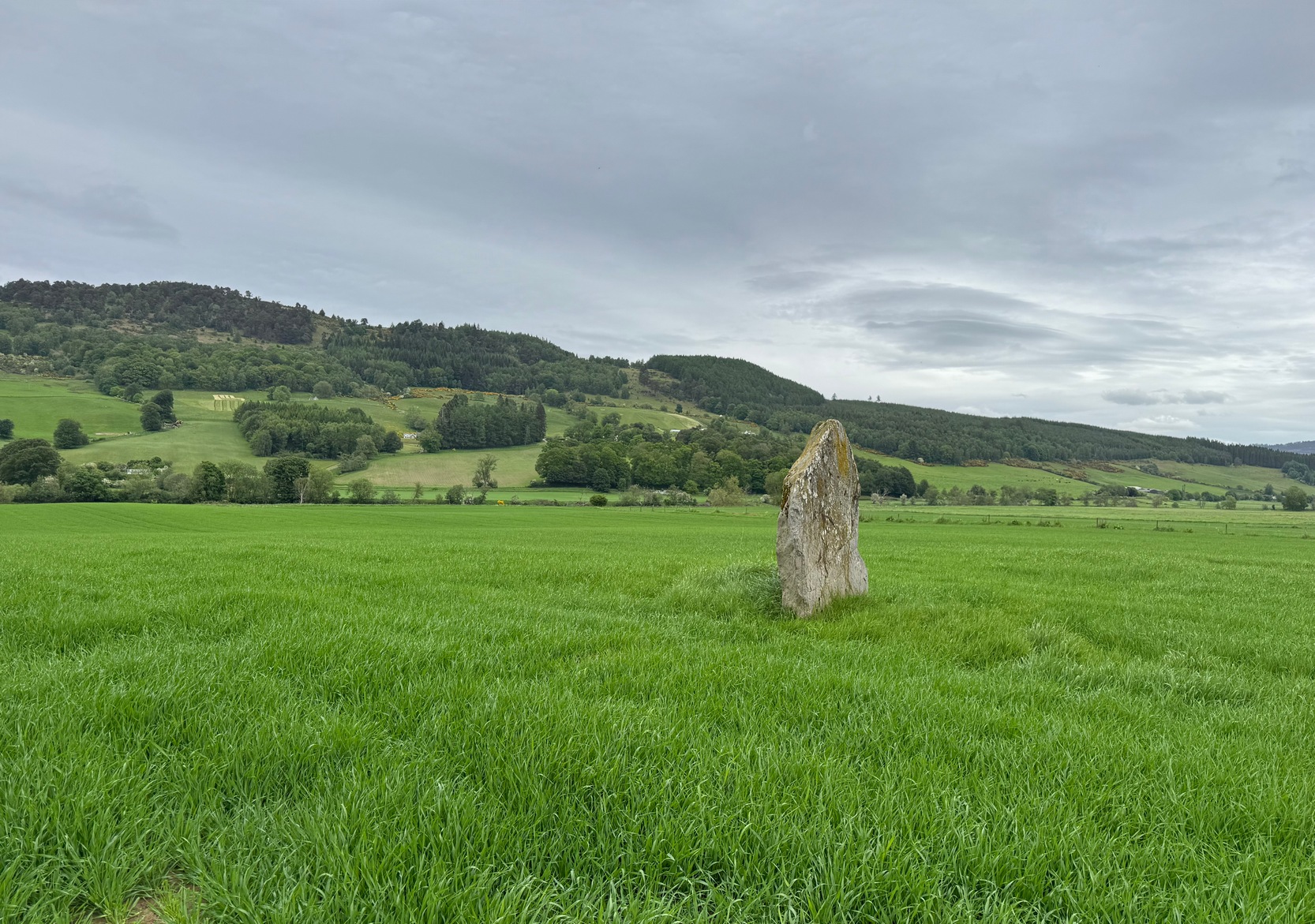
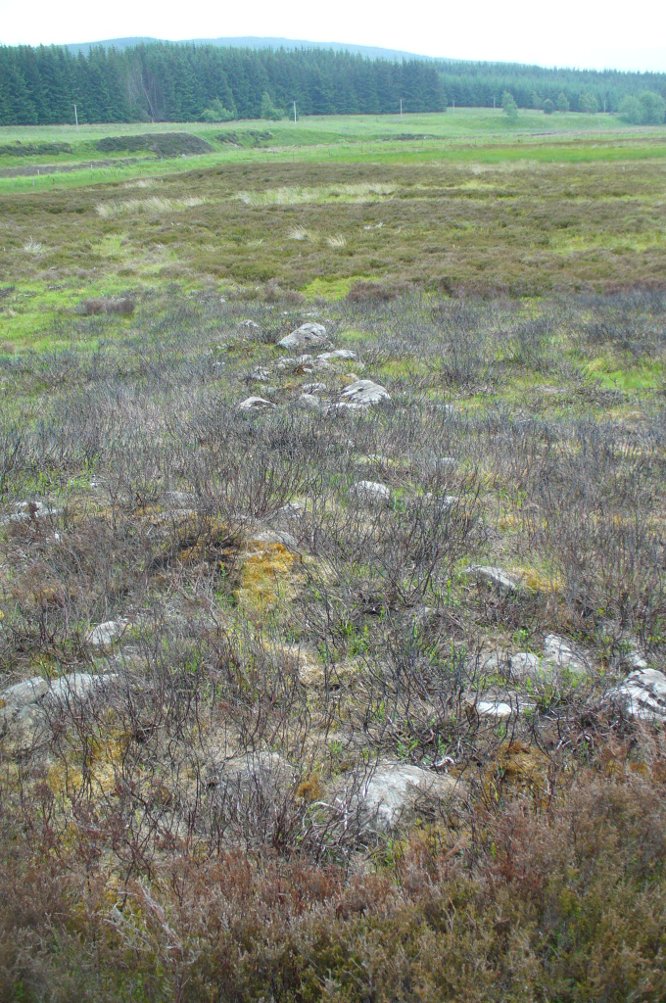
Looking to the west
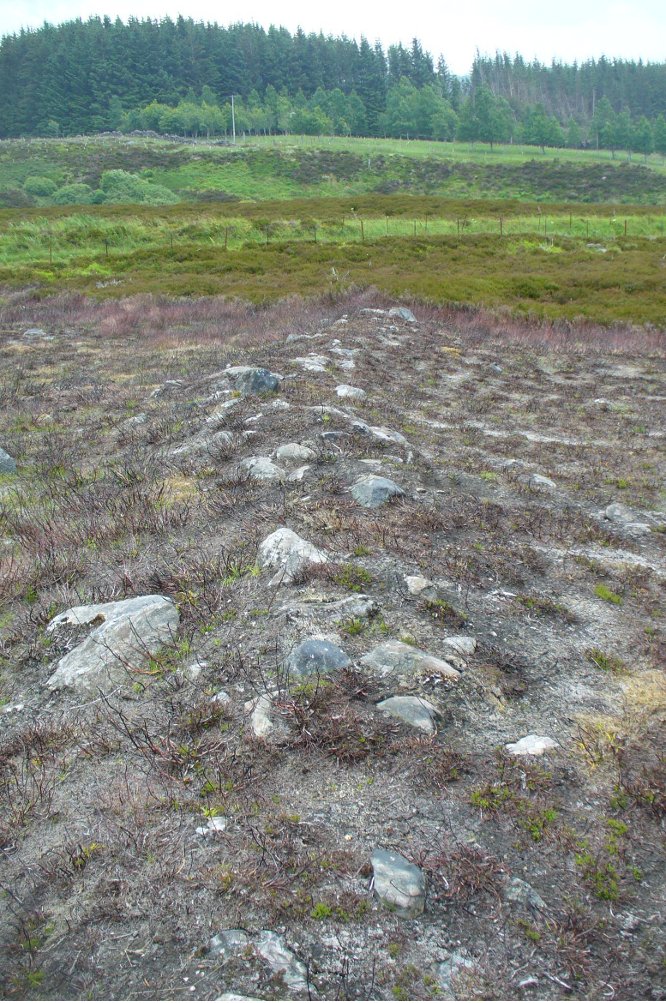
Looking to the northeast

In the fields either side of the stones, ancient tombs have been found.  Around 1887, the Duke of Atholl dug under some of the stones in the field and found a “cup” or urn which Coles reported “was found in a cist in the haugh near Tom-na-Croiche.”  Then, in 1969, the farmer John MacBeth was ploughing the field and unearthed another cist some 15 yards north-west of the present upright.  The base of the cist was cobbled and whilst whilst the tomb itself was filled-in, the farmer moved the covering stone to the fence at the west-side of the field (NN 9455 5205).  Also, on the eastern side of the field in 1971, Stewart reported finding what she thought were the remains of cremated bones that seemed to have been part of another prehistoric structure.
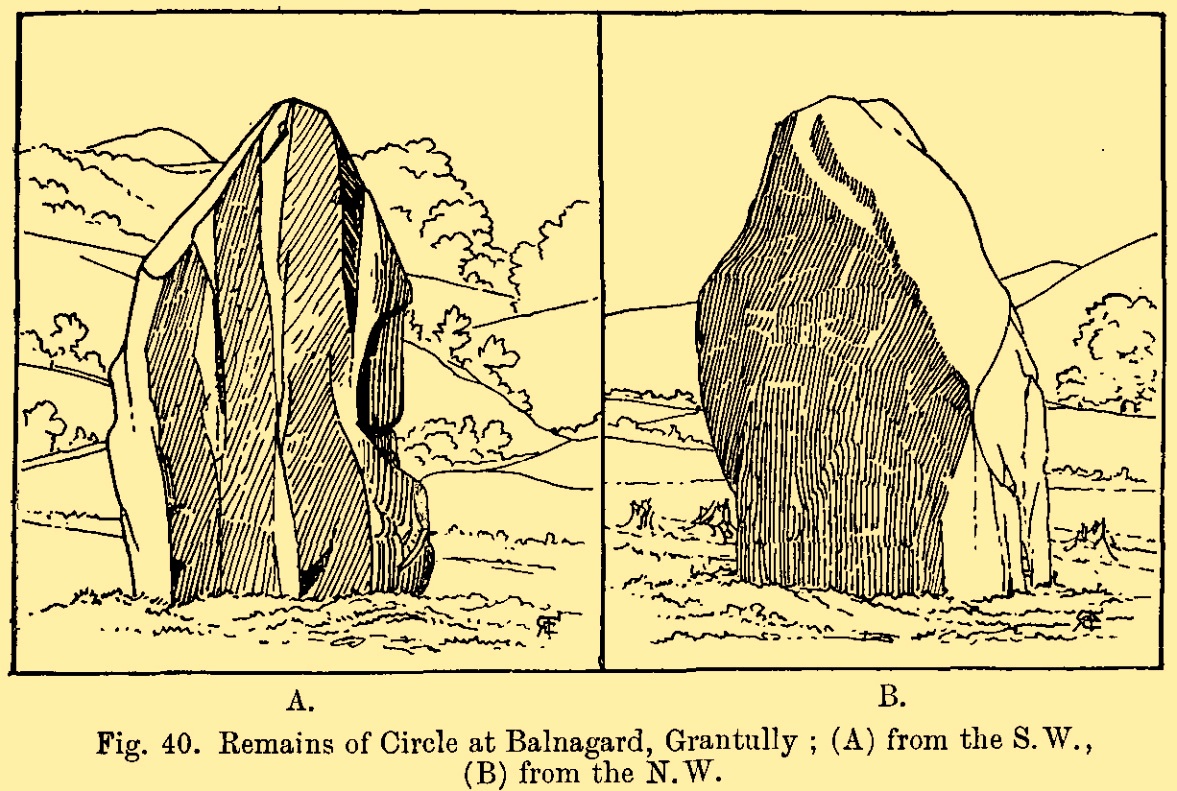
Fred Cole’s 1904 sketch
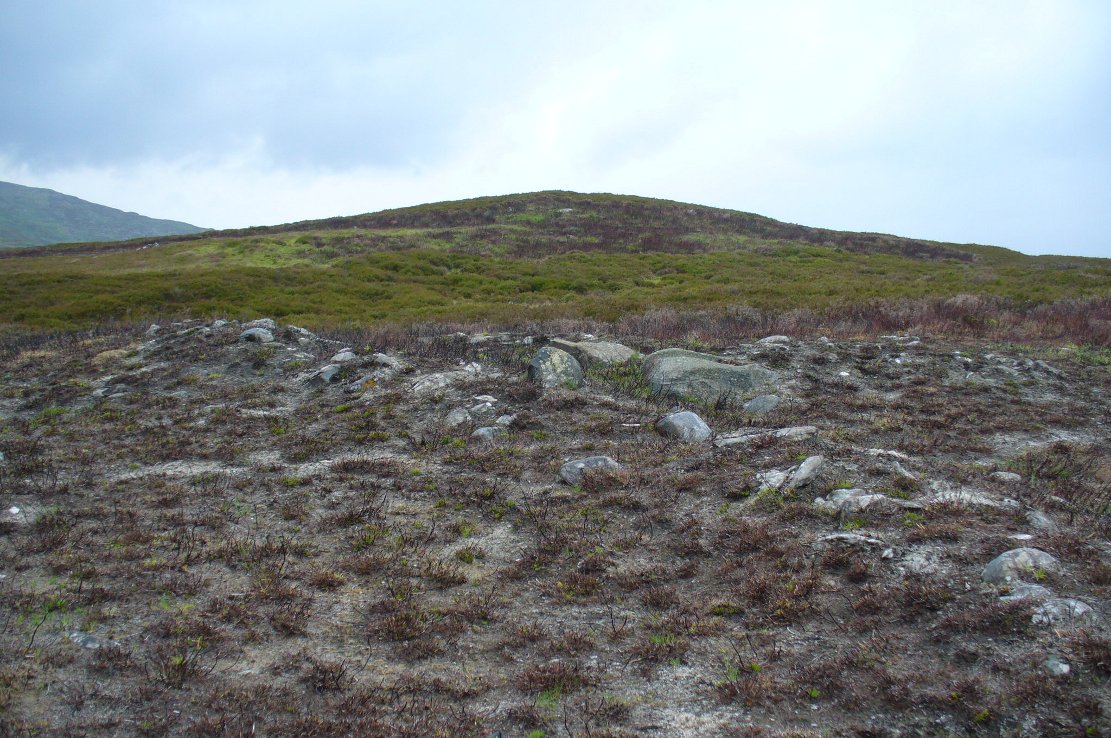
Looking to the southeast

Nearly 250 yards to the west of the stone, in the adjacent field, a huge prehistoric cairn—known as the Sketewan Cairn—was uncovered and fully excavated in the late 1980s.  It originally stood some four feet high and was nearly seventy feet across.  Within the cairn complex, a small standing stone accompanied some cremations.  Unfortunately this entire archaeological site has since been completely covered over.  You wouldn’t even know it was there if you stood right next to it!  But if you want to see Balnaguard’s remaining tombs, head for the Fairy Mound right in the heart of the village…

References:

  1. Coles, Fred, “Report on Stone Circles Surveyed in Perthshire – North Eastern Section,” in Proceedings Society Antiquaries Scotland, volume 42, 1908.
  2. Dixon, John H., Pitlochry, Past and Present, L. Mackay: Pitlochry 1925.
  3. Kennedy, James, Folklore and Reminiscences of Strathtay and Grandtully, Munro Press: Perth 1927.
  4. Omand, Donald (ed.), The Perthshire Book, Birlinn: Edinburgh 1999.
  5. Stevenson, J., “Prehistory,” in Omand’s The Perthshire Book, Edinburgh 1999.
  6. Stewart, Margaret E.C., “Perthshire: Balnaguard”, in Discovery & Excavation in Scotland, 1971.
  7. Swarbrick, Olaf, A Gazetteer of Prehistoric Standing Stones in Great Britain, BAR: Oxford 2012.
  8. Yellowlees, Sonia, Cupmarked Stones in Strathtay, Scotland Magazine: Edinburgh 2004.

Acknowledgements:  Huge thanks for use of the Ordnance Survey map in this site profile, reproduced with the kind permission of the National Library of Scotland.

© Paul BennettThe Northern Antiquarian 

Meikle Findowie, Little Dunkeld, Perthshire

Standing Stone:  OS Grid Reference – NN 96105 39143

Also Known as:

  1. Canmore ID 86434

Getting Here

Meikle Findowie stone

Along the A822 road between Dunkeld and Milton, 4.7 miles (7.6km) west of the A9, turn left down the track signposted ‘Meikle Findowie’.  About 700 yards along the track you’ll reach a modernised farmhouse and here, on your left, a track takes you eastwards (left).  Go along here for about 100 yards until, just before the modernised house on your right (it was just a pile of ruins when we came here), you’ll see the standing stone in front of it.

Archaeology & History

Looking westwards

Beside the old trackway that runs east-west past Meikle Findowie, above the ancient flood-plain of the breathing River Braan, a solitary stone lives by the more modern shadow of old sheep-folds.  Tis a quiet little fella, less than 5 feet tall, that you could almost pass as a forgotten gatepost if you chattered when walking by. But it’s much more ancient than any old gate…

It nestles below the old hill of Airlich, with its beautiful stone circle and huge ancient enclosures higher up: a chunky old stone with no carvings or other human marks upon it.   Tis a site site worth visiting before heading uphill, to the megalithic ring of enchantment.

Acknowledgements:  Huge thanks as always to Paul Hornby for getting us to this site.

© Paul BennettThe Northern Antiquarian


Glen Cochill 1, Little Dunkeld, Perthshire

Enclosure:  OS Grid Reference – NN 90732 41196

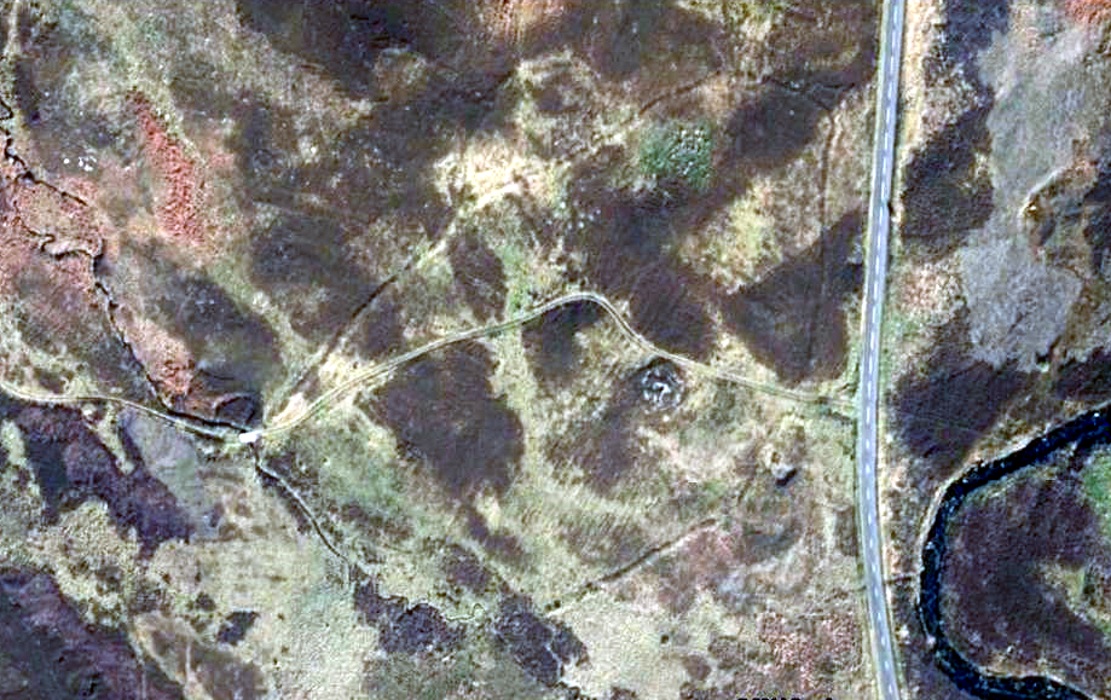
Aerial view shows outline of enclosure

Also Known as:

  1. Canmore ID 26252
  2. Southern Enclosure

Getting Here

Take the directions to find the Carn Ban giant cairn.  Once there, you’re in the middle of the enclosure—or near enough!

Archaeology & History

This is one of several very large extensive prehistoric enclosures that stretch across the undulating rocky plains of this wild moorland, high up below the mountain-tops south of Aberfeldy.   Although humans are scarce up here nowadays, in ancient times it was a very different ballgame.

Internal line of walling
Eastern edge walls
Eastern edge walls

Extensive and well constructed walling, measuring an average of 2-3 yards across and several feet high in places, encircles the giant White Cairn some distance away from it, running for a third-of-a-mile (0.5km) in a contorted oval shape.  The walling is pretty much continuous except for where the modern tracks have destroyed two sections of it (and other monuments within) and where entrances or ‘doors’ allowed access on the west, north and eastern sides.  The circuitous route of the walls  appears to start and end at a small unnamed stream at its southern end.

Outer northeastern walling

Inside the perimeter walls, there are scattered examples of simple hut circles and cairns—some singular, others for families, and others that may be clearance cairns. It’s difficult to say without excavations.  On the top northwestern side of the enclosure there is another, smaller enclosure attached to the main mass—seemingly earlier in construction than the giant creature its attached to—which overlooks the curious Shaman’s Lodge double hut-circle 75 yards to the west.  This and much of the internal area was, when we visited, covered in extensive and deep heather, so we couldn’t get a clear picture of the entire site.

We might never know exactly how many people used this site, but we can say with some certainty, due to the remains found inside and around the place, that it was used by lots of  people over many centuries, not just for what modern homo-profanus defines as ‘utilitarian’ purposes, but also important rituals were practised herein (though we are looking at an ahistorical period before the boundary of ‘sacred’ and ‘profane’ had been defined).

For antiquarians and explorers, this region is a must!  A weekend of sleeping rough up here might well be in order!

References:

  1.  Stewart, Margaret E.C., “Strath Tay in the Second Millenium BC – A Field Survey”, in Proceedings Society Antiquaries Scotland, volume 92, 1961

Acknowledgements:  Huge thanks again to Paul Hornby for his assistance with site inspection, and additional use of his photos.

© Paul Bennett, The Northern Antiquarian