Gowlane East (3), Dingle, County Kerry

Cup-and-Ring Stone (lost):  OS Grid Reference – Q 53 03?

Archaeology & History
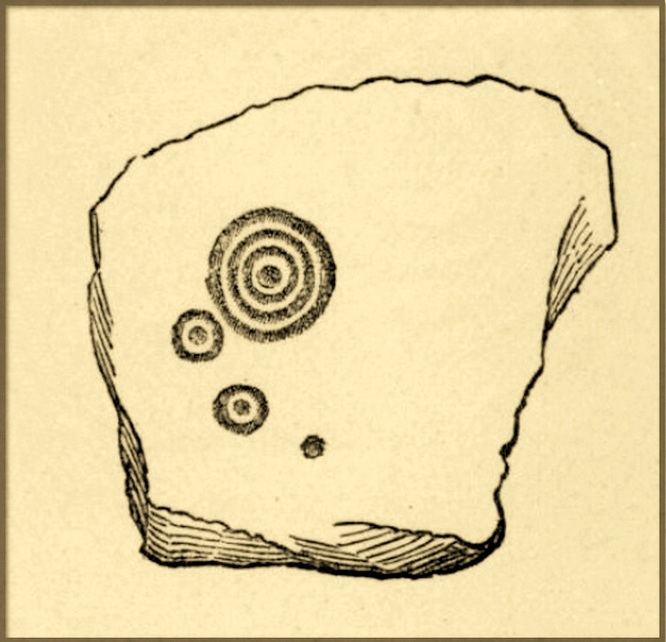
Gowlane East (3) stone (Graves 1877)

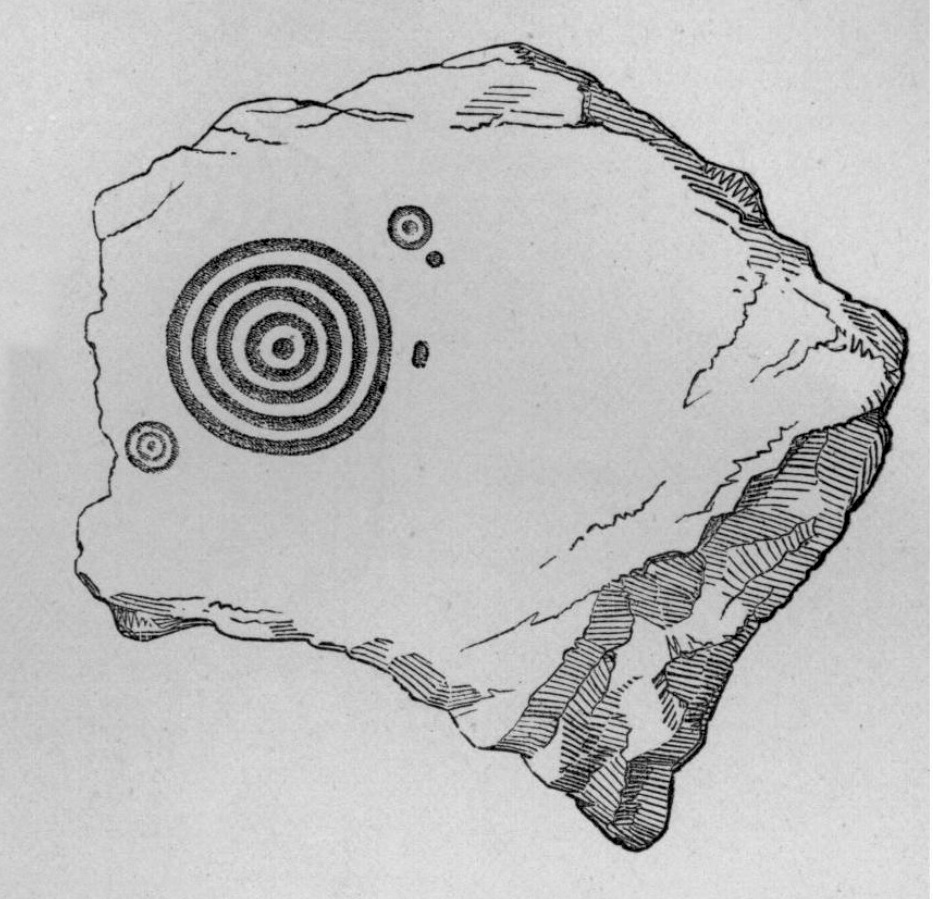
First discovered by Richard Hitchcock in 1848, this petroglyph (along with the Gowlane East (2) carving) was one of two missing stones in the area that James Graves (1877) thought were seemingly “fragments of a large monument,” although he said nothing more about it and, sadly, Mr Hitchcock’s sketch here is all that we have left to guide us.  The carving may have come from one of the nearby raths, souterrains, or have been part of a circle or cairn.  The stone looks to have been reasonably small in size and, hopefully, is residing in a wall somewhere or is just buried in a field.

There are several Gowlane place-names in the area, but Judith Cuppage (1986) told that the great 19th century artist and antiquarian George du Noyer “identified the townland as Gowlane East”, although the closest “neighbouring townland” would be Gowlin (Gualainn).  If any local folk know where this might be hiding, please let us know. (the grid reference cited here is a very vague guess!)

References:

  1. Cuppage, Judith, Archaeological Survey of the Dingle Peninsula, Oidhreacht Chorca Dhuibhne: Ballyferriter 1986.
  2. Graves, James, “On Cup and Circle Sculptures as Occurring in Ireland,” in Journal Royal Society Antiquaries, Ireland, volume 4 (4th series), April 1877.

Acknowledgements:  Huge thanks for use of the Ordnance Survey map in this site profile, reproduced with the kind permission of the National Library of Scotland

© Paul BennettThe Northern Antiquarian

Gowlane East (2), Dingle, County Kerry

Cup-and-Ring Stone (lost):  OS Grid Reference – Q 53 03?

Archaeology & History

Gowlane (2) carving (in Graves 1877)

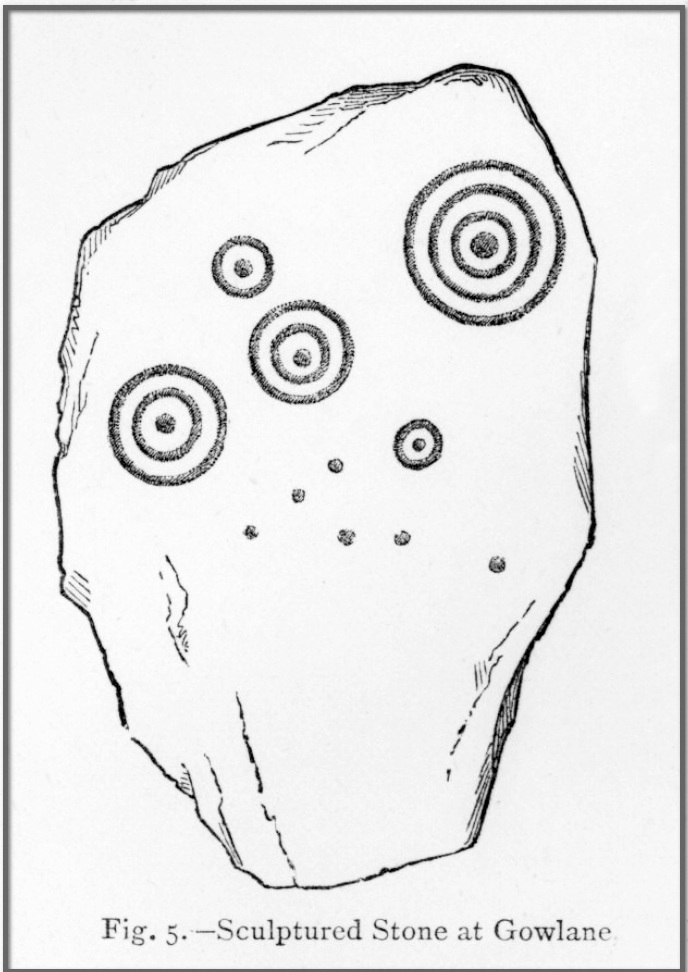
When James Graves (1877) described the gorgeous Aghacarrible petroglyph, he told that “in the neighbouring townland of Gowlane” were three other carvings—with this fine multi-ringed design being one of them.  It was first discovered and drawn by Richard Hitchcock in 1848 and was thought by Graves to have been broken from “a larger monument.” (like the Gowlane East [3] carving)  Whether it was from a cairn, a souterrain or a stone circle, we can but guess.  And we must also guess as to where it might be now, for no account of it has appeared since Mr Graves’ description.  With any luck it will be in a wall somewhere, or simply buried in a field.

There are several Gowlane place-names in the area, but Judith Cuppage (1986) told that the great 19th century artist and antiquarian George du Noyer “identified the townland as Gowlane East”, although the closest “neighbouring townland” would be Gowlin (Gualainn).  If any local folk know where this might be hiding, please let us know. (the grid reference cited here is a very vague guess!)

References:

  1. Cuppage, Judith, Archaeological Survey of the Dingle Peninsula, Oidhreacht Chorca Dhuibhne: Ballyferriter 1986.
  2. Graves, James, “On Cup and Circle Sculptures as Occurring in Ireland,” in Journal Royal Society Antiquaries, Ireland, volume 4 (4th series), April 1877.

© Paul BennettThe Northern Antiquarian

Gowlane East (1), Dingle, County Kerry

Cup-and-Ring Stone (lost):  OS Grid Reference – Q 53 03?

Archaeology & History

Hitchcock’s 1848 sketch

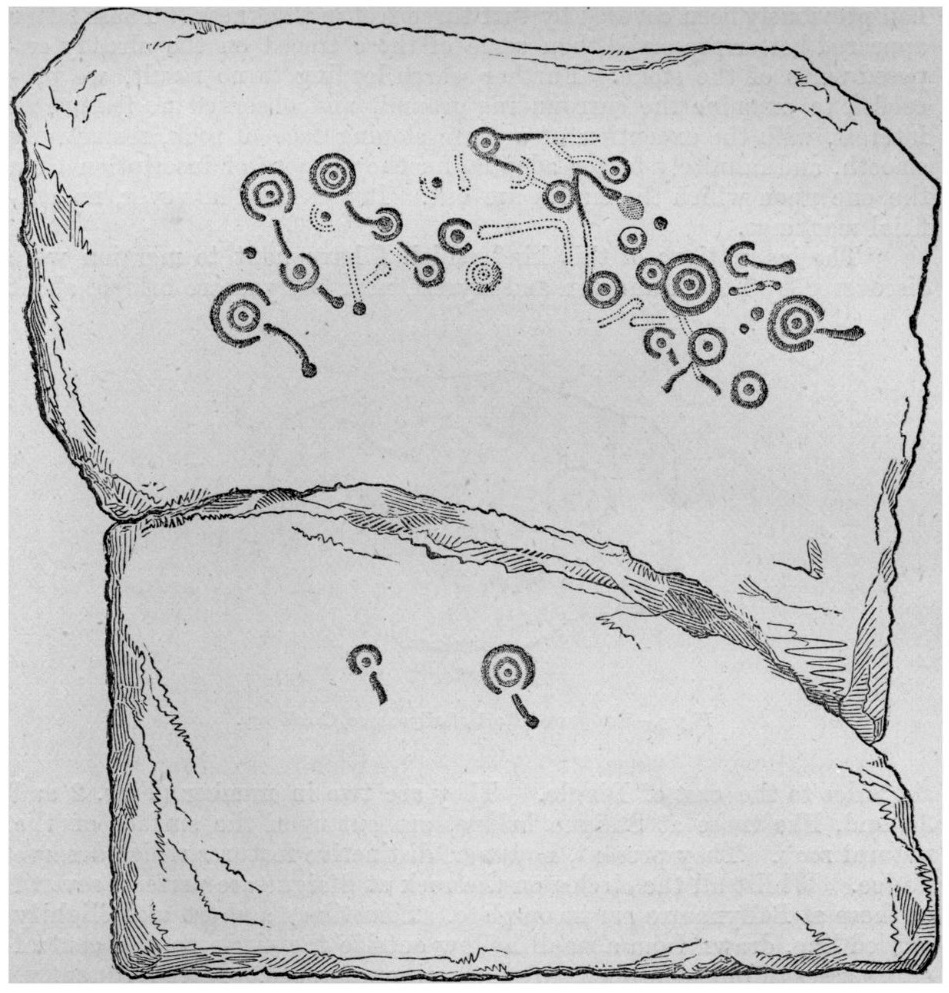
This is one of three carvings illustrated in James Graves’ (1877) essay on Irish petroglyphs that were first discovered by a Mr Hitchcock in 1848, but which hasn’t been seen since.  Graves described the impressive Aghacarrible carving and then told how, “in the neighbouring townland of Gowlane” this and other petroglyphs existed.  A series of multiple cup-and-rings and some lines of cup-marks are clearly illustrated on Hitchcock’s fine sketch, but no detailed notes were ever made of the place. It’s presumed that this carving is on an earthfast rock, as the other two others were broken pieces from what he said was a  “larger monument.”

There are several Gowlane place-names in the area, but Judith Cuppage (1986) told that the great 19th century artist and antiquarian George du Noyer “identified the townland as Gowlane East”, although the closest “neighbouring townland” would be Gowlin (Gualainn).  If any local folk know where this might be hiding, please let us know.

References:

  1. Cuppage, Judith, Archaeological Survey of the Dingle Peninsula, Oidhreacht Chorca Dhuibhne: Ballyferriter 1986.
  2. Graves, James, “On Cup and Circle Sculptures as Occurring in Ireland,” in Journal Royal Society Antiquaries, Ireland, volume 4 (4th series), April 1877.

© Paul BennettThe Northern Antiquarian

Ballynasare Bridge (2), Dingle, County Kerry

Cup-and-Ring Stone (lost):  OS Grid Reference – Q 547 012

Archaeology & History

Graves’s 1877 sketch

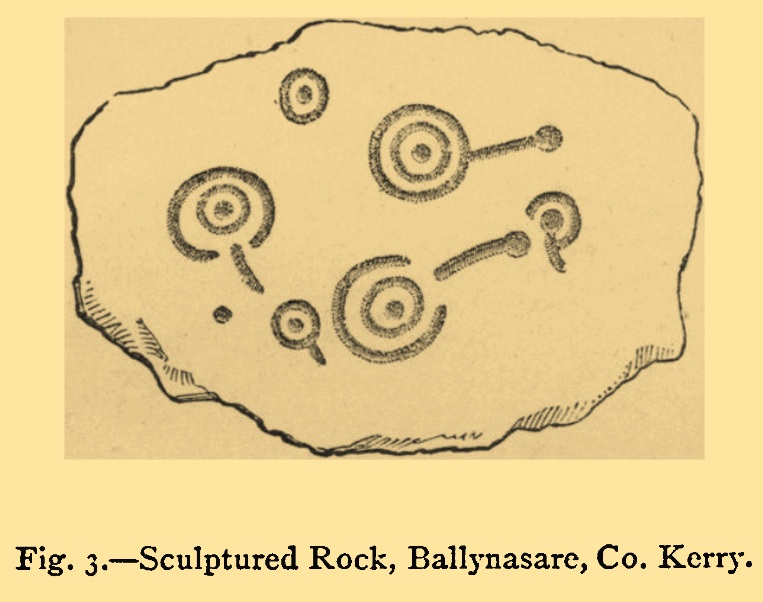
This was one of two cup-and-ring stones discovered in the mid-1870s by Lord Dunraven and Rev. James Graves (1877) “near Ballynasare bridge,” both of which are now lost.  It is much smaller than its compatriot, but sadly Mr Graves gave no notice as to its exact size nor its proximity to the other carving, although I presume they were pretty close to each other.  He told that the carving was “cut upon the surface of the natural rock,” meaning that unless it’s been quarried or built over, it should still be there somewhere.

The grid reference cited here is an approximation given in Cuppage’s (1986) excellent survey, who told that its “precise location is not now known and may have been in any of the four townlands which converge at the bridge.” Hopefully it’ll be hiding away in some undergrowth, awaiting the attention of an antiquarian explorer.  Are there any local folk who are able to help us out with this one?

References:

  1. Cuppage, Judith, Archaeological Survey of the Dingle Peninsula, Oidhreacht Chorca Dhuibhne: Ballyferriter 1986.
  2. Graves, James, “On Cup and Circle Sculptures as Occurring in Ireland,” in Journal Royal Society Antiquaries, Ireland, volume 4 (4th series), April 1877.

© Paul BennettThe Northern Antiquarian

Ballynasare Bridge (1), Dingle, County Kerry

Cup-and-Ring Stone (lost):  OS Grid Reference – Q 547 012

Archaeology & History

Ballynasare Bridge (1) (Graves 1877)

This is one of two impressive petroglyphs that were discovered by Lord Dunraven and Rev. James Graves in the mid-1870s, “near Ballynasare bridge”, but which are now lost (the other one is the Ballynasare Bridge (2) stone).  This carving is the larger and more impressive of the two that they found, on which he described some of the carved rings as “incomplete.”  Although Graves (1877) didn’t give a detailed description of the carving, this drawing (right) more than makes up for his lack of words.  One of the features that he did tell us about was one of the primary motifs in this design which modern students like to call radial grooves. “Sometimes,” he wrote, “a short and slightly curved line, drawn from a hollow outside the circle to the central cup, passes through the open part of the circumference.  More frequently, this line stops short just as it reaches the break in the circle.”

The grid reference here is an approximation given in Cuppage’s (1986) excellent survey, who told that its “precise location is not now known and may have been in any of the four townlands which converge at the bridge.” Hopefully it’ll be hiding away in some undergrowth, awaiting the attention of an antiquarian explorer.  Are there any local folk who are able to help us out with this one?

References:

  1. Cuppage, Judith, Archaeological Survey of the Dingle Peninsula, Oidhreacht Chorca Dhuibhne: Ballyferriter 1986.
  2. Graves, James, “On Cup and Circle Sculptures as Occurring in Ireland,” in Journal Royal Society Antiquaries, Ireland, volume 4 (4th series), April 1877.

© Paul BennettThe Northern Antiquarian

Brackloon (1), Annascaul, County Kerry

Cup-Marked Stone (lost):  OS Grid Reference – Q 6014 0226

Archaeology & History

A cup-marked stone that was reported at this position in the 1940s by the Kerry Archaeological Survey (KAS) had disappeared by the time Judith Cuppage (1986) wrote her survey.  She told that “there is no visible trace or local knowledge of the” carving.  It may well have been destroyed.  Seemingly KAS made no notes or sketches of the site. (WTF?!?!?)

References:

  1. Cuppage, Judith, Archaeological Survey of the Dingle Peninsula, Oidhreacht Chorca Dhuibhne: Ballyferriter 1986.

© Paul BennettThe Northern Antiquarian

Ballinvownig, Dingle, County Kerry

Cup-and-Ring Stone (lost):  OS Grid Reference – Q 46 00

Archaeology & History

This lost carving probably still exists, but in all likelihood is well overgrown by vegetation.  It was in that state of affairs when Rev. Orpen (1908) wrote about it more than a hundred years ago in  his essay on the petroglyphs between Lispole and Dingle.  After describing and illustrating several carvings in the area, he told:

“I may mention here that further west, near Ballintaggart, at Ballywoonig, there is another single cup and circle which I found on a rock, the last of which was covered with clay and grass. I had these removed, hut nothing further was disclosed.”

Sadly, he left us with no sketch.  His wording suggests that the carving is close to the southern boundary of Ballinvownig, pehaps near the souterrains near Ballintaggart house…?  Perhaps some local antiquarian explorers might be able to find out where it’s hiding—although it will doubtless be covered in vegetation.

References:

  1. Cuppage, Judith, Archaeological Survey of the Dingle Peninsula, Oidhreacht Chorca Dhuibhne: Ballyferriter 1986.
  2. Orpen, R., “Antiquities near Lispole, Co. Kerry,” in Kerry Archaeological Magazine, volume 1,  1908.

© Paul BennettThe Northern Antiquarian

Kinard East (2), Lispole, County Kerry

Cup-and-Ring Stone (destroyed):  OS Grid Reference – V 4967 9923

Archaeology & History

In Rev. Orpen’s (1908) description of the impressive Kinard East (1) carving, he told that before leaving the place:

“about 20 yards to the north of this…stone may be seen a single cup and circle on the corner of a rock.”

Judith Cuppage (1986) reported that this stone, “has apparently been broken up for use as road-metal.”  Gone!

References:

  1. Cuppage, Judith, Archaeological Survey of the Dingle Peninsula, Oidhreacht Chorca Dhuibhne: Ballyferriter 1986.
  2. Finlay, F., Rock Art of Cork and Kerry, unpublished MA thesis 1973.
  3. Orpen, R., “Antiquities near Lispole, Co. Kerry,” in Kerry Archaeological Magazine, volume 1,  1908.

© Paul BennettThe Northern Antiquarian

Ballinknockane, Kilquane, County Kerry

Cup-and-Ring Stone (lost):  OS Grid Reference – Q 43 11

Archaeology & History

Judith Cuppage (1986) recounted that in the unpublished Minutes of the County Kerry Field Club for 1944, mention was made of a multiple-ringed petroglyph that hasn’t been seen since.  It sounds quite impressive.  She told how they’d,

“discovered a stone bearing a cup-and-gapped circle and a cup-and-3 gapped circles, “on the fence opposite the church” at Camp.  Mortar still adhering to the stone as if it had been removed from a building.” Adding that, “neither its original provenance nor present whereabouts are known.”

Surely some good wise local still knows where this olde stone lives?  In a garden perhaps…?  It would be good to know that it’s still alive and well.

References:

  1. Cuppage, Judith, Archaeological Survey of the Dingle Peninsula, Oidhreacht Chorca Dhuibhne: Ballyferriter 1986.

Acknowledgements:  Huge thanks for use of the Ordnance Survey map in this site profile, reproduced with the kind permission of the National Library of Scotland

© Paul BennettThe Northern Antiquarian

Giant’s Grave, Cloghfin, County Donegal

Chambered Cairn (destroyed):  OS Grid Reference – H 277 998

Archaeology & History

Included in Eamon Cody’s (2002) magnum opus, this site has long since gone.  It was highlighted on the 1845-47 OS-map of the area and the only subsequent information about it was written in the 1903 Ordnance Survey Name Book, where it was described as a “supposed Giant’s Grave” that was marked by a large spread of boulders.

Perhaps the only thing we can ascertain here is from the name Giant’s Grave.  Invariably, giants are part and parcel of creation myths in early traditional societies.  Such giants, as well as being huge mythical creatures, can also be the progenitor of tribes and communities, i.e., the person who laid the initial foundation of where the tribe came to live, usually an early queen, king or shaman figure.  So, in the case of this Giant’s Grave, it was likely to have been known as the burial place of such a figure: mythical in importance as well as size.

References:

  1. Cody, Eamon, Survey of the Megalithic Tombs of Ireland: Volume VI – County Donegal, Duchas: Dublin 2002.

© Paul BennettThe Northern Antiquarian