Devil’s Stone, Addlebrough, Bainbridge, North Yorkshire

Legendary Rock:  OS Grid Reference – SD 94355 87997

Also Known as:

  1. Giant’s Stone

Getting Here

From the small town of Bainbridge, head south down the Carpley Green Road.  Less than a mile before the end, look to the west-facing slope of Addlebrough Hill and this huge Devil’s Stone can be seen resting halfway up the slope, just by the wall.  Y’ can’t miss it!

Archaeology & History
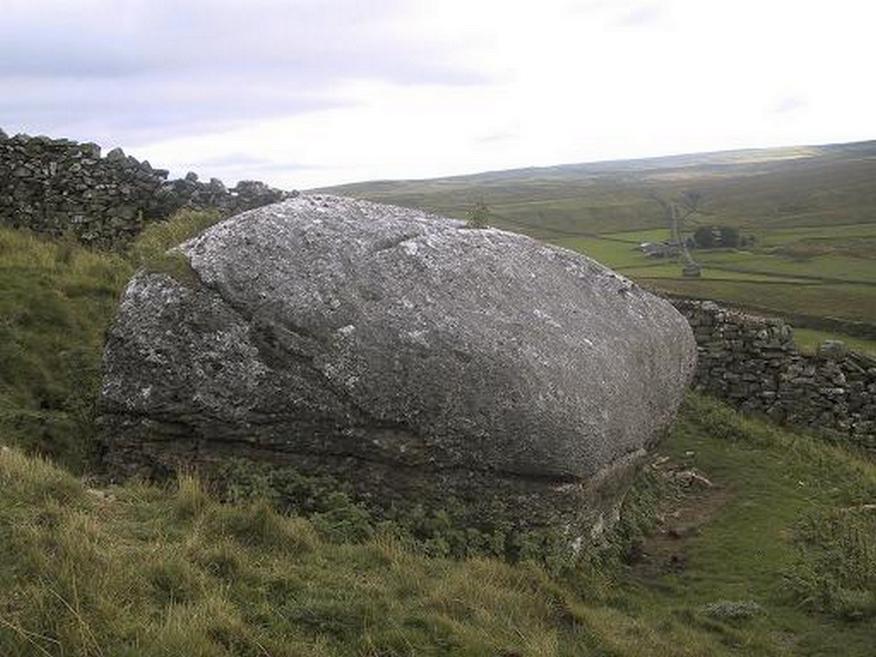
The Devil’s Stone

Highlighted on the 1856 Ordnance Survey map, one of the legends of this place suggested there might be cup-and-ring markings on the stone, but the curious markings on top of the rock seem to be natural.  It’s a superb stone though, dropped here no doubt by some great glacier as it retreated north, in ages truly olde…

There’s a lot of archaeology around here that’s yet to receive the attention of the archaeology textbooks.  But if you’ve ventured to see this, have a gander across to the massive prehistoric tomb known as Stony Raise, less than a mile southeast of here.

Folklore

One legend tells that long ago Addlebrough was the home of a great unnamed giant — but a friendly giant by all acounts.  However, one day the devil turned up and wanted possession of the giant’s hill and so a fierce row broke out between them.  Perched on the top of the crag — which is the rough ridge to the west of here — the giant who lived there hurled huge boulders down at the devil, but they fell short and landed at the side of Lake Semerwater (itself an important spot in local prehistory).  In return, Old Nick himself began throwing boulders back — and one of those which the devil threw landed here, halfway up the western flank of Addlebrough Hill (a couple of the large boulders which the giant threw can be seen on the edge of Semerwater and are known as the Carlow and Mermaid stones).  Hence it’s name of the Devil’s Stone!

In Edmund Bogg’s Richmondshire (1908), he told how, “the curious markings on (the Devil’s Stone) are accounted due to the pressure of the devil’s fingers” which were caused when he threw this giant stone from somewhere to here.

Site shown on 1856 map

This is a theme we find at countless other stone sites, i.e. the Devil burning holes into rock — and in some cases these devil’s “fingerprints” have turned out to be prehistoric cup-markings.  Such tales relate to the pre-christian Creation Myth of a place and would, before the “devil” was supplanted onto a site, have had wider significance in the landscape as a whole, in a manner known only to local people.  Devils usually replaced legendary giants, or the hero-figures who created the land in primordial times in the myths of our ancestors.  A greater examination of the nearby sites in association with the folklore of the region would no doubt be quite profitable…

References:

  1. Bogg, Edmund, Richmondshire, James Miles: Leeds 1908.
  2. Romney, Paul (ed.), The Diary of Charles Fothergill, 1805, Yorkshire Archaeological Society: Leeds 1984.

© Paul Bennett, The Northern Antiquarian

De’il’s Stane, Waltonhill, Craigrothie, Fife

Legendary Stone: OS Grid Reference – NO 36304 09352

Also Known as:

  1. Devil’s Stone

Getting Here

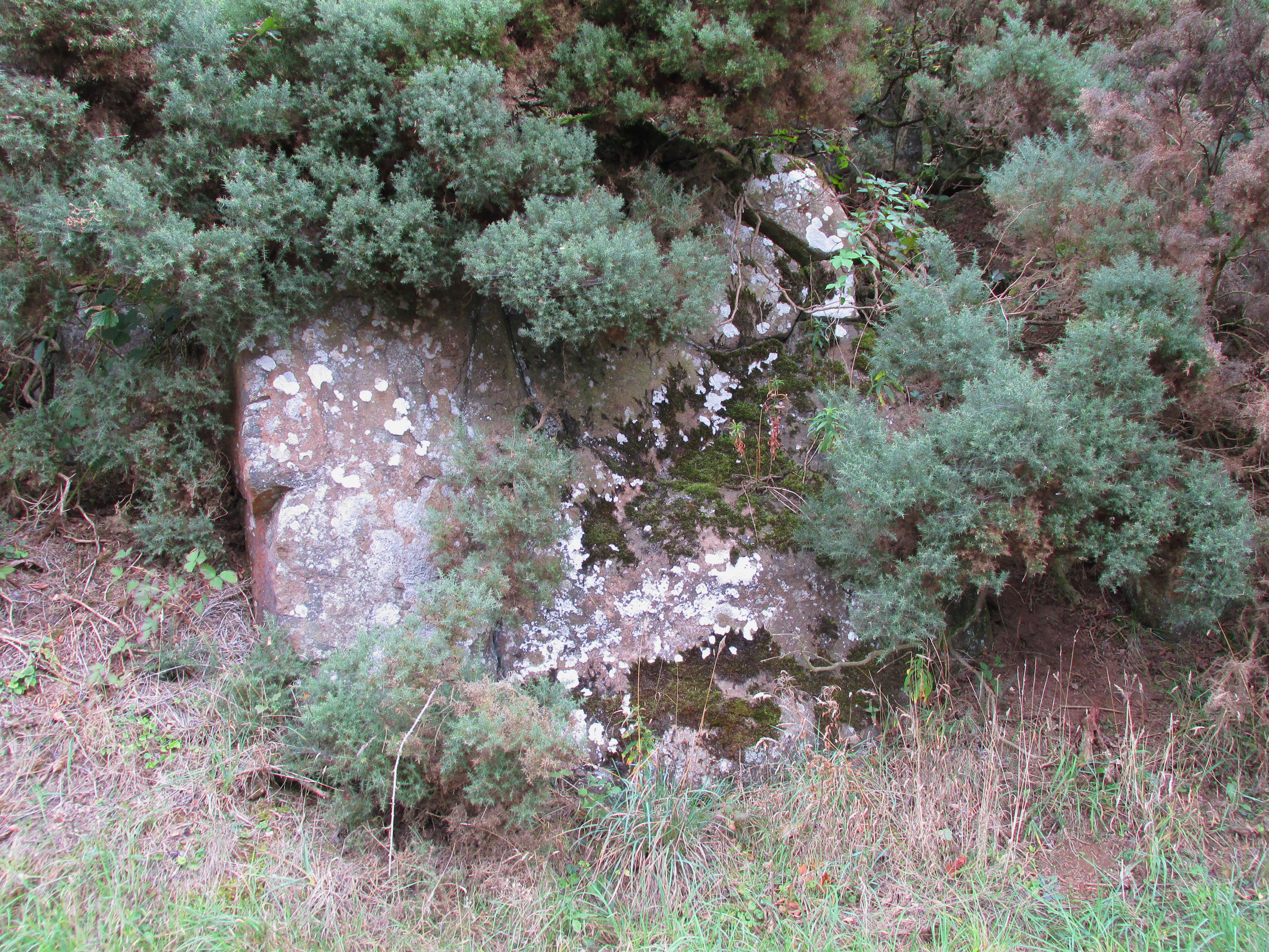
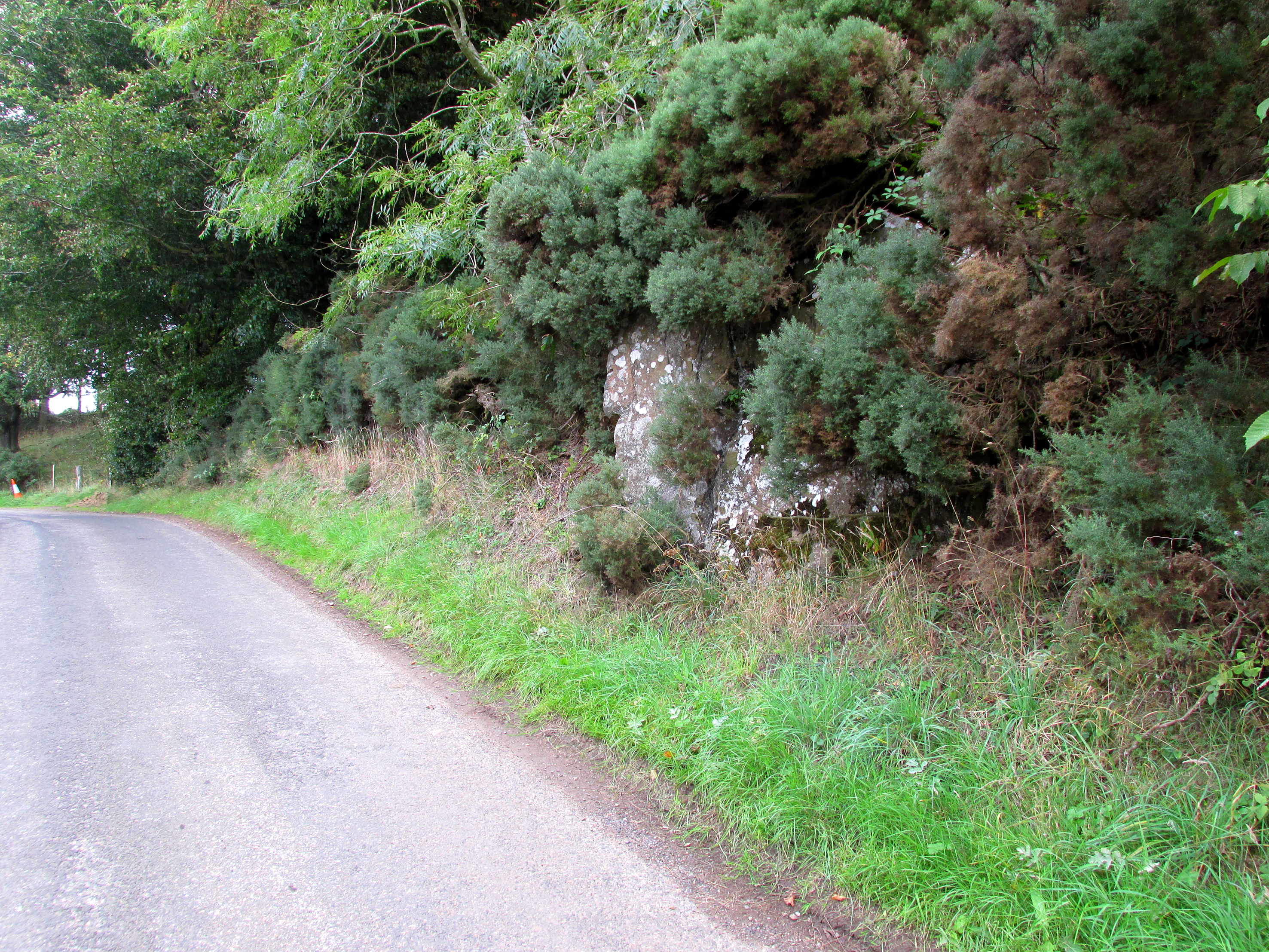
Travelling South along the A916 just past Craigrothie, turn right down to Chance Inn, and turn left at the T junction. and follow the road on to just past the left hand bend when Waltonhill Farm will be seen on the right. Continue south down the road a few hundred yards until it takes a slight right turn. The De’il’s Stane, a huge flat faced slab of rock, will be seen at the roadside on the left side of the road, partly obscured by gorse.

Archaeology & History

According to a piece published in the Fife Herald & Journal in 1905:-

“Once upon a time, so runs the legend, Samson challenged the devil to match him at boulder throwing. As challenger, Samson stood on the West Lomond; Satan stood on the East. The signal was given; two mighty rocks whistled through the air. ‘The De’ils Stane’ fell where it now lies, on the road-side about a quarter of a mile west [sic] from Waltonhill Farm. Samson, though handicapped by three miles greater distance, flung his stone fully four hundred yards beyond that of Satan, and with such force that it split into three parts; which parts are now built into Waltonhill barn”.

The roadside location, just south of the bend

The De’il’s Stane, a huge slab of rock!

This is of course a variant of a creation myth that is to be found throughout Britain, of an Age of Giants who hurled rocks around and strode the land quarrelling with each other and the mortal humans . The original names of the Waltonhill Giants have been lost in the aeons of oral transmission of the legend from pre-history, and replaced by that of a probably equally legendary Middle Eastern strong man from the Christian’s Bible, in combat with the Christian’s Naughty Man. And this was of course done to prove the point of Christianity’s superiority over the old animistic cults of the land, and the De’il had to be demonstrably the loser.

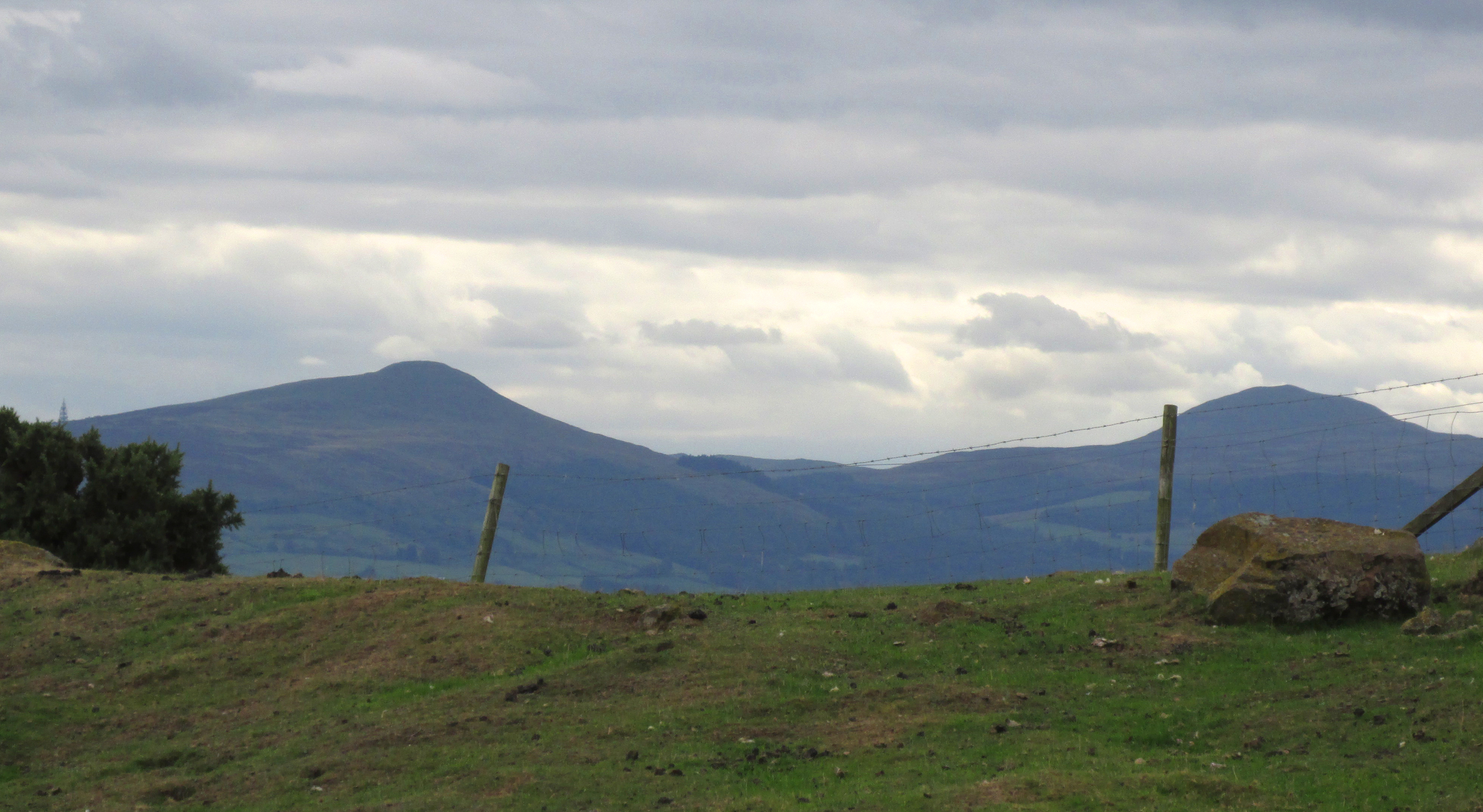
De’ils Stane thrown by the Man in the Red Velvet Suit from East Lomond (Left)

Owing to the Stone being partly hidden by gorse, it was not possible to make a close inspection of the rock for carvings etc. A further visit will no doubt be made to try to clear some of the gorse so a closer inspection can be made. The Stone’s size (approximately 15′ high by 20′ wide by 4′ thick) and the way it is resting against a natural bank, does give a credence to the legend of its having been slung by a giant from East Lomond, clearly visible nearly 7¾ miles away.

Reference:

  1. Fife Herald & Journal, 1st November 1905, quoted in John Ewart Simpkins’ County Folklore – Volume VII: Fife, with some notes concerning Clackmannan and Kinross-shires, Folk-Lore Society by Sidgwick& Jackson: London 1914.

© Paul T. Hornby, The Northern Antiquarian 2018