Cup-Marked Stone (removed): OS Grid Reference – NT 128 709
Archaeology & History
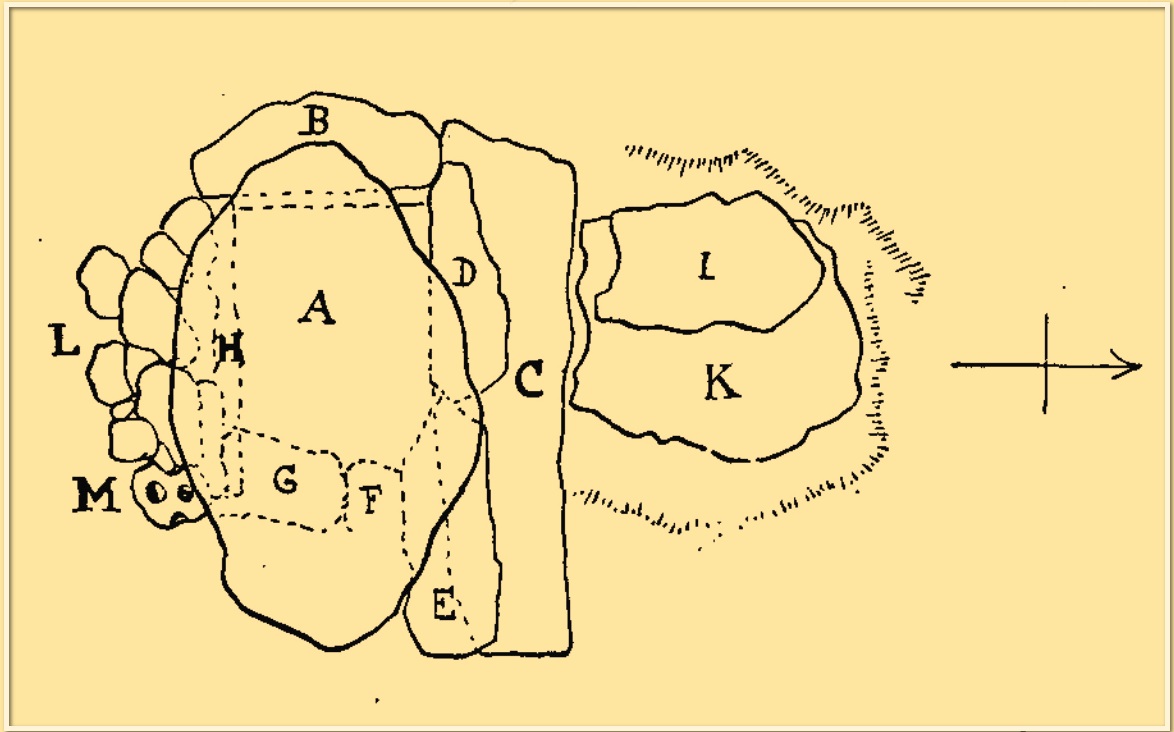
A simple cup-marked stone was located inside a prehistoric burial cist that was discovered by quarry workmen in November 1897. The cist was subsequently excavated by Fred Coles (1898) who found therein (amongst other things) a simple cup-marked stone whose present locale is a box somewhere in Edinburgh’s National Museum (could someone send us a photo please?). The carving comprises simply of two complete cups and portion of a third, all close to each other on a small stone that was located on the south-side of the cist (see ‘M’ in the attached diagram). Coles described the carving thus:
“During the removal of (some) small stones, one, when the damp soil was rubbed of, showed two cup-marks, about 1½ inch wide each and ½ inch apart. The stone itself measures 5 inches by 4¾, and appears to be but a fragment of a larger one, one edge showing part of a third cup. The cups all show the tool-marks usually noticed on these mysterious sculpturings.”
References:
- Coles, Fred, “Notice of the Discovery of a Cist with a Double Burial at Ratho Quarry”, in Proceedings Society Antiquaries, Scotland, volume 32, 1898.
- Morris, Ronald W.B., “The Cup-and-Ring Marks and Similar Sculptures of Scotland: A Survey of the Southern Counties – part 2,” in Proceedings of the Society of Antiquaries, Scotland, volume 100, 1969.
© Paul Bennett, The Northern Antiquarian