Cup-Marked Stone: OS Grid Reference – NN 90553 67894
Getting Here
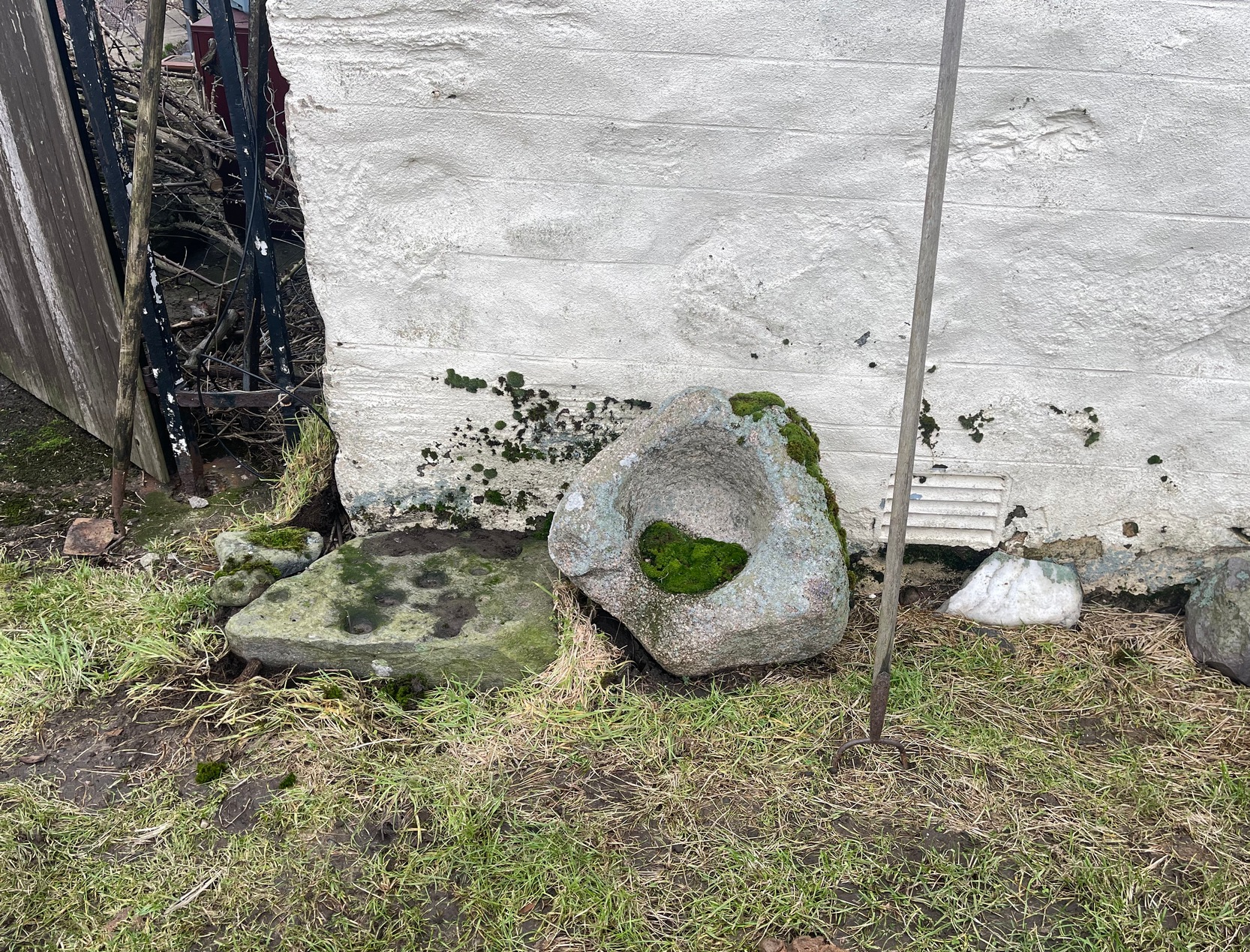
From Blair Atholl village along the B8079 road, take the minor road signposted to the Bridge of Tilt and go all the way to the top, taking the same directions as if you’re visiting the large prehistoric cairn of Monzie. As you walk towards Monzie farmhouse, you need to look at the large end-facing wall and on the ground at the bottom-left corner you’ll see this old cup-marked stone, next to an old bullaun. It’s probably polite to knock and ask the farmer—who we found to be very helpful indeed. (huge thanks fella!)
Archaeology & History
This is an intriguing carving, inasmuch as its present habitat isn’t it original home. When we visited the old stone recently, the farmer was very helpful and told us what he knew of it, which was, he said, “not much.” In pointing out where it had originally come from, he pointed south, “past the fields – somewhere over there. My dad knew about it,” he told, and thought that he may have been the one who found it. Anyhow, it was his dad who brought it to the place where it now sits: right up against the edge of the house on its southeast corner.
“It looks like it might have come from a tomb,” I said, but he didn’t know about that. The giant cairn in the fields past his farmhouse certainly wasn’t where it had come from. Quite the opposite direction… And so it transpired when I looked at the very menial archaeological notes that have been written about it.
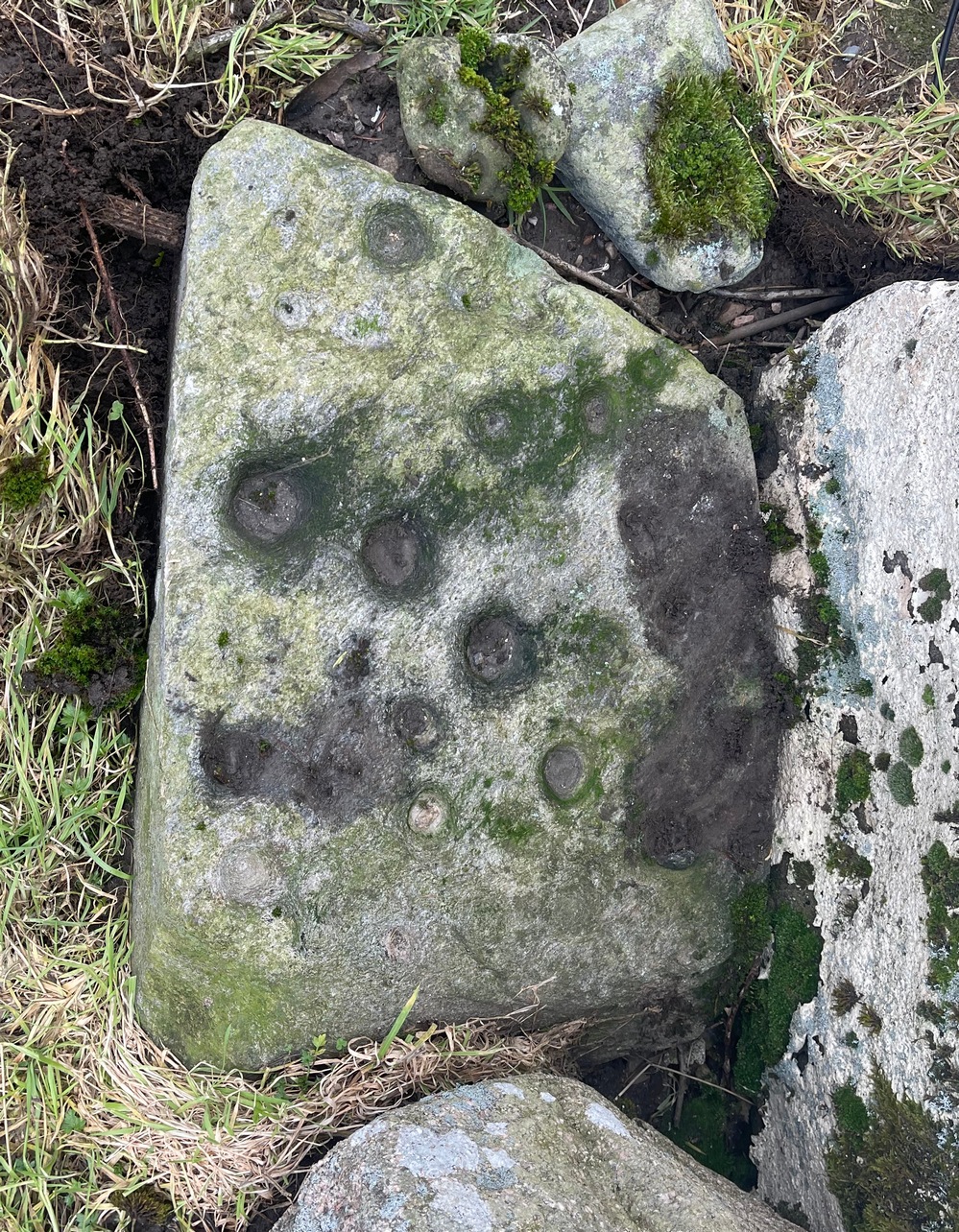
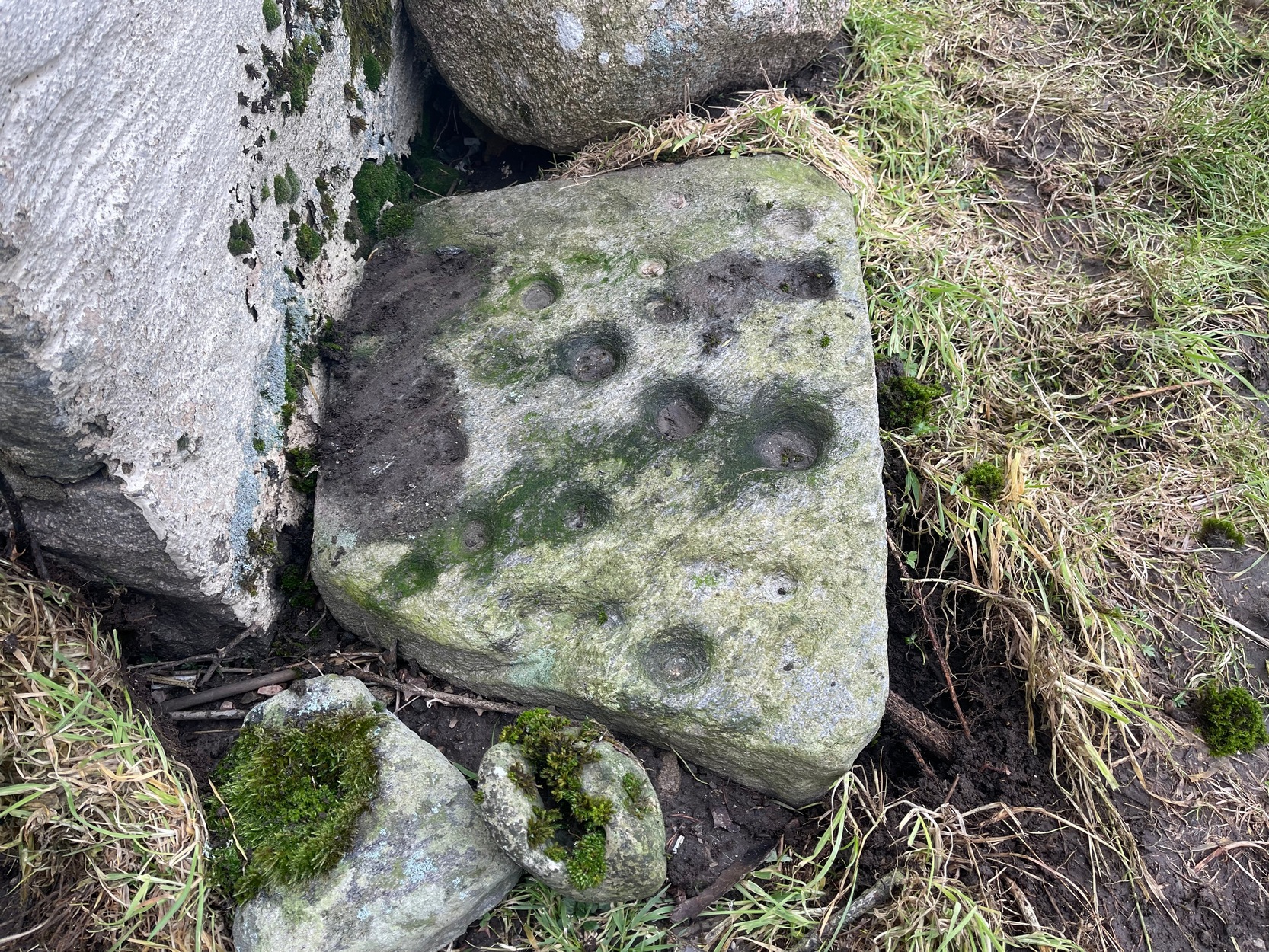 When archaeologist Margaret Stewart noted the carving in the 1960s, she told how the stone had reportedly been found in 1953 by the ruined lime-kiln (NN 9052 6672), just above the western shore of Loch Moraig. But what she didn’t know was that the lime-kiln was built at the edge of the prehistoric tomb that was known to local people as Carndeshal, or Cairn Deshal. The word deshal means sunwise, or the direction taken by the sun, clockwise, as in the word deosil. It is usually associated with a ceremonial procession. The cup-marked stone probably came from this cairn when it had been demolished and was thankfully saved by the farmer.
Altogether there are 24 or 25 mainly well-defined cup-marks on this thin slab, covering most of the surface. In a couple of places on the stone, two of the cups are conjoined. There are apparently no cup-marks on the other side of the stone.
Acknowledgements: To my awesome Naomi – for getting us up here.

© Paul Bennett, The Northern Antiquarian