Ballykean (Penrose) (2), County Wicklow

Cup-Marked Stone:  OS Grid Reference – SG 21584 42230

Also Known as:

  1. Ballykean ‘Stone M’ (Kinihan 1884)

Archaeology & History
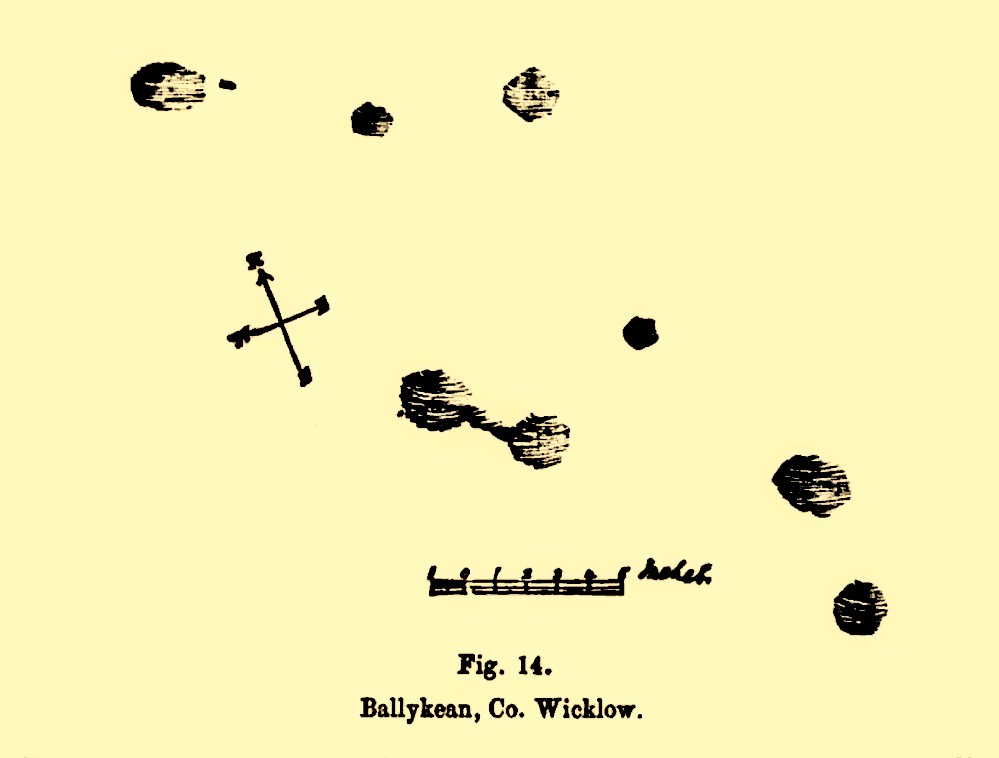
Ballykean (2) or “Stone M”

This is one of at least fourteen petroglyphs in this parish that have been either lost or destroyed since their initial description in the 19th century.  When the Archaeological Survey of Ireland looked for this carving in 1990, it could not be located.  It was first described by George Kinihan (1884), who told that it was, a “block about 6 by 5.5 feet, and 2.25 feet high.  The upper surface has eight cups, two of which are joined by a channel.”  The site was included in Corlett’s (2014) fine survey, who could add no additional data about the stone.

References:

  1. Corlett, Christiaan, Inscribing the Landscape: The Rock Art of South Leinster, Wordwell: Dublin 2014.
  2. Kinihan, George H., “Proceedings: Cup-marked and Inscribed Stones in the Counties of Wicklow and Wexford”, in Journal Royal Society Antiquaries Ireland, (4th series) volume 6, 1884.

© Paul BennettThe Northern Antiquarian

Ballykean (Penrose) (1), County Wicklow

Cup-Marked Stone (lost):  OS Grid Reference – SG 21648 42072

Also Known as:

  1. Ballykean ‘Stone N’ (Kinihan 1884)

Archaeology & History

This is one of at least fourteen petroglyphs in this parish that have been either lost or destroyed since their initial description in the 19th century.  The carving was, wrote Kinahan (1884) in his day, “in the field south of Ballykean House.” But when the Archaeological Survey of Ireland looked for the stone in 1990, it could not be located.  Kinihan told that it was,

“a large flattish stone, which slopes SW.  On the SW surface near the top margin is one cup.  In the vicinity of this block there are others, but on none of them were cups remarked.  Most of these have been split, while others are said to have been broken up to build Ballykean House, with the farm buildings and walls.”

References:

  1. Kinihan, George H., “Proceedings: Cup-marked and Inscribed Stones in the Counties of Wicklow and Wexford”, in Journal Royal Society Antiquaries Ireland, (4th series) volume 6, 1884.

© Paul BennettThe Northern Antiquarian