Cup-and-Ring Stone (removed): OS Grid Reference – NX 550 520
Archaeology & History
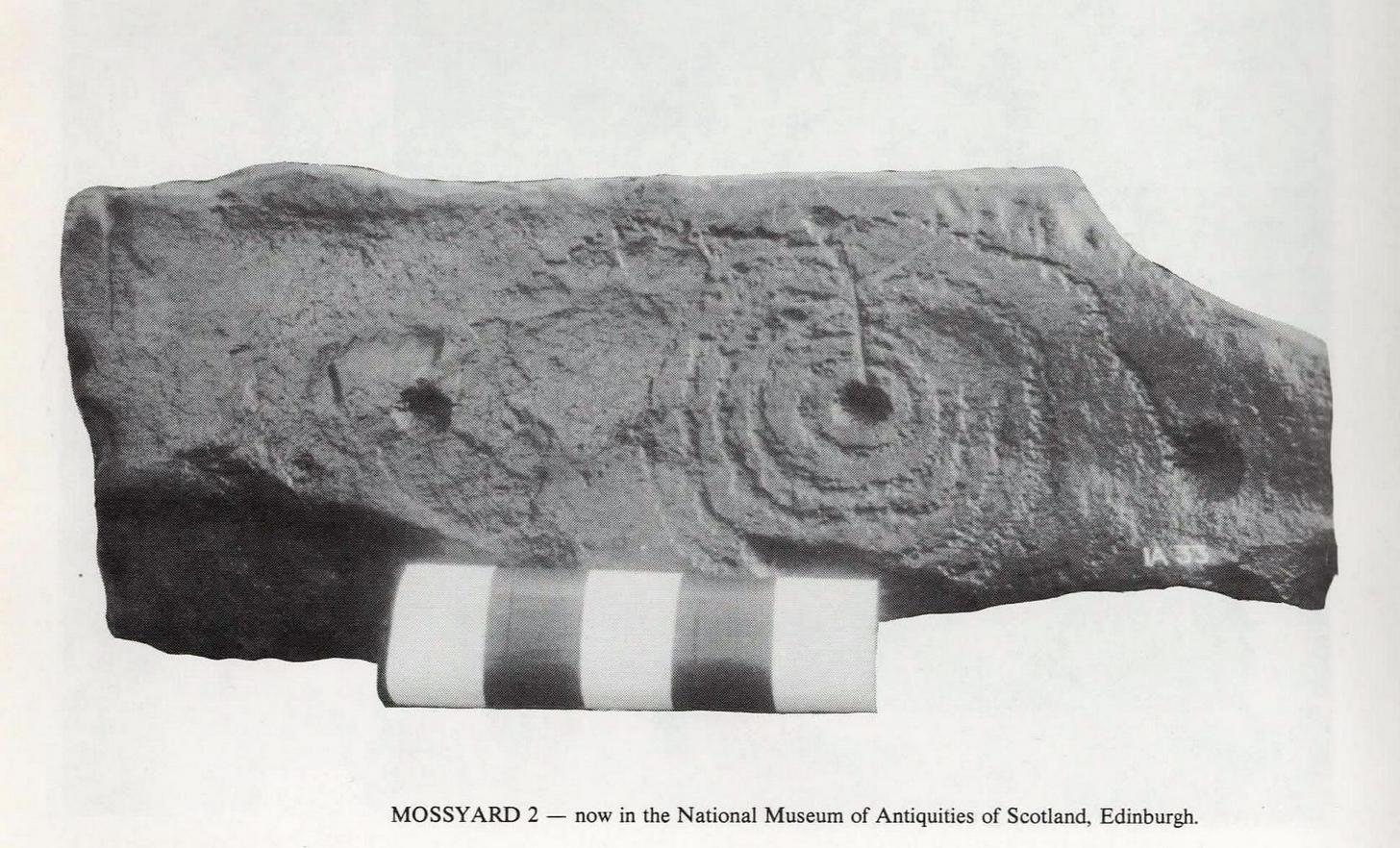
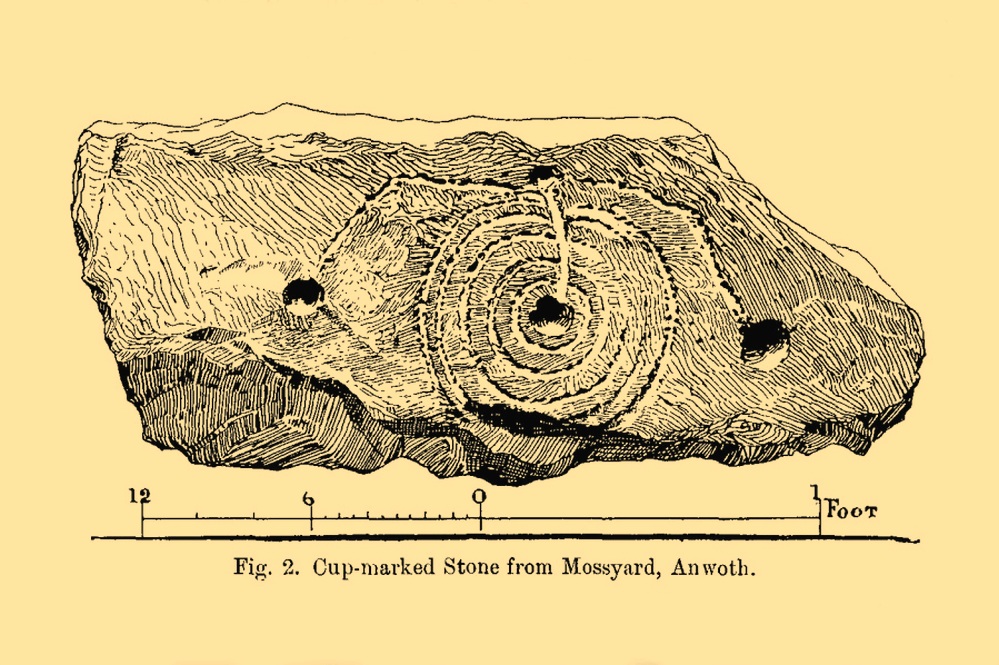
This impressive-looking carving was brought to the attention of the Scottish Society of Antiquaries by Sir Herbert H. Maxwell (1900), who thereafter moved it to the National Museum where, I presume, it still lives, in a box somewhere, sleeping gently. Maxwell’s brief resumé of the stone was as follows:
“Cup and Ring-marked Slab…found in a dyke on the farm of Mossyard, Anwoth, Kirkcudbrightshire. This cup-and ring-sculpturing is peculiar in having five rings round the central cup crossed by a gutter which ends in another cup from which gutters also proceed to right and left, each terminating in a cup.”
In Ron Morris’s (1979) survey he erroneously told how the carving had been found in a wall instead of the dyke from whence it came; but, that triviality aside, he described it as,
Morris’ 1979 photoMaxwell’s 1900 drawing
“A cup-and-five-rings, the rings slightly flattened where a radial groove from the cup passes through them. 23cm (9½in) diameter, grooves connecting this with 3 other cups. Carving depths up to ½cm (¼in). The rings are rather lightly pecked though quite wide and well preserved. All gapped, except the inner ring.”
If anyone is able to get any good photos of the carving, out from its museum hideaway, it would be good to see how it’s coping therein….
References:
Maxwell, Herbert R., “Donations to the Museum and Library,” in Proceedings Society Antiquaries, Scotland, volume 35, 1901.
Morris, Ronald W.B., The Prehistoric Rock Art of Galloway and the Isle of Man, Blandford: Poole 1979.