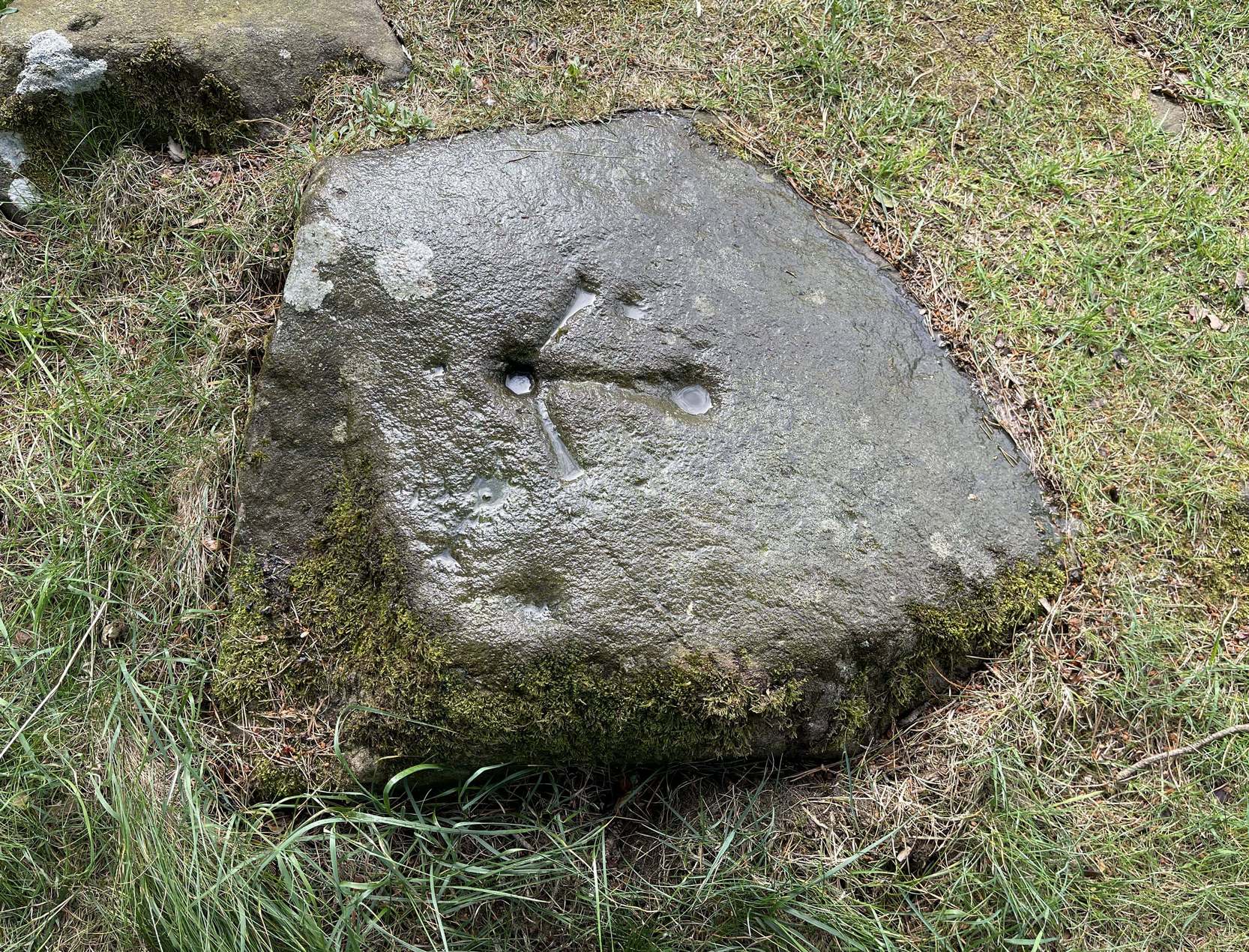
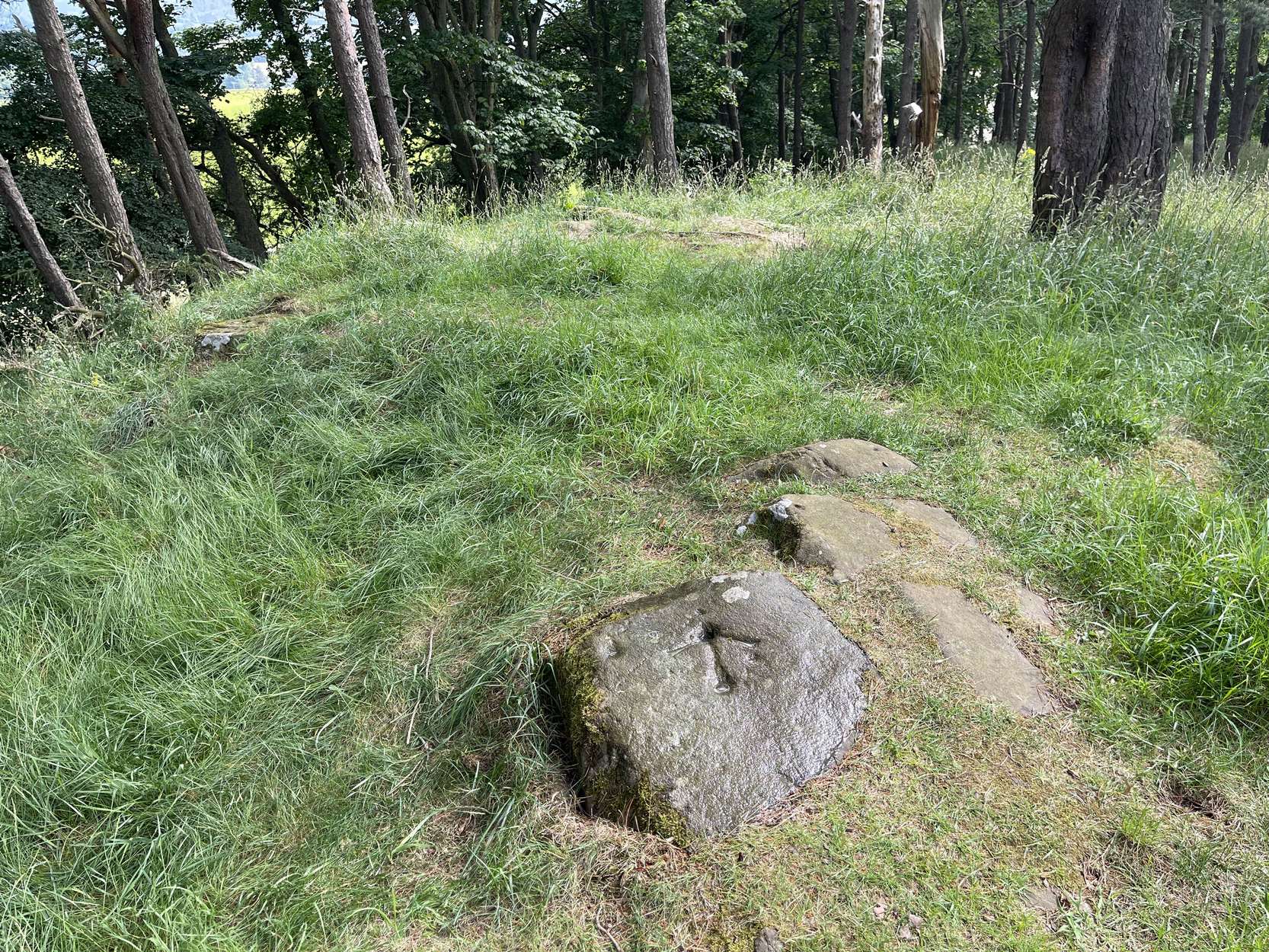
Take the same directions as if you’re visiting the impressive Tormain (1) carving. About ten yards before you reach it, just at the top of the hill itself, almost the first flat stone you come across is the one you’re after. You’ll find it easily enough.
Archaeology & History
This is a notable design by virtue of the Ordnance survey lads marking it with an unusually large benchmark, utilizing at least one of the prehistoric cup-marks on their much more modern symbol. You can clearly see it in all the photos. The stone itself may have had a section of it cut or split from a once larger piece, probably in the 19th century when a lot of quarrying was being undertaken round here.
This carving was first described, albeit briefly, in John Smith’s (1874) piece on the nearby Witch’s Stone, where he told:
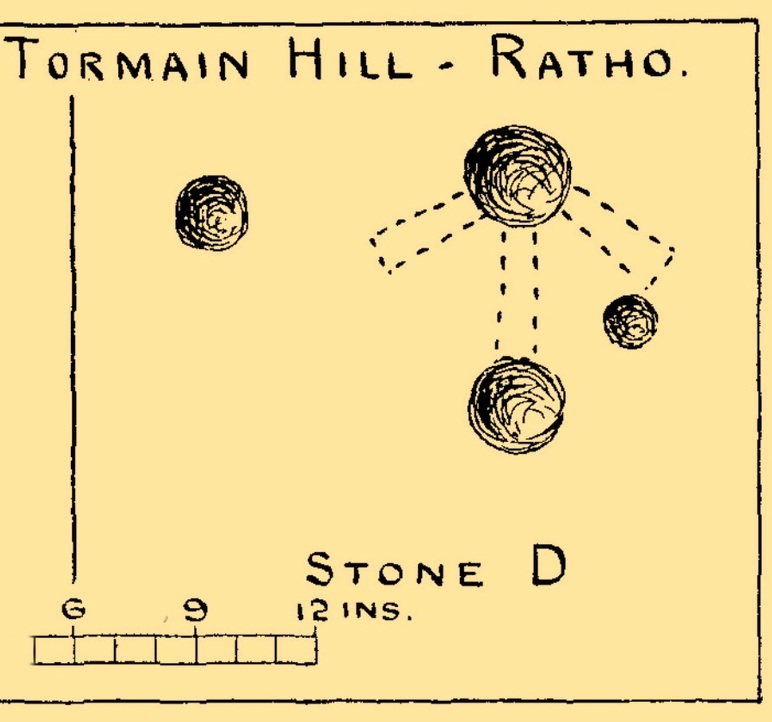
Allen’s 1882 sketch
“there is a group of three cup-like hollows near the highest summit of the hill; this last has, however, been altered in our own day by the officials of the Government Ordnance Survey combining them into one figure, by drawing from cup to cup their well-known and characteristic mark of the Queen’s ‘broad arrow.’”
To be honest, there’s not much more that can be said of it. A few years later when Romilly Allen (1882) surveyed all the Tormain stones, he simply wrote that,
“Stone D…lies 30 feet from stone A, and is the most northerly of the group; it is also the highest as regards level, and has an Ordnance bench mark cut on it… Round the bench mark will be found four cups, varying in diameter from 1 to 2½ inches.”
Not all of the cup-marks on this stone are prehistoric, as is obvious when you look at them close-up. Two, perhaps three of them are OK, with at least one of those that are attached to the Ordnance Survey mark widened and deepened when they came here in the 19th century.
Morris, Ronald W.B., “The Cup-and-Ring and Similar Early Sculptures of Scotland; Part 2 – The Rest of Scotland except Kintyre,” in Transactions of the Ancient Monuments Society, volume 16, 1969.
Morris, Ronald W.B., The Prehistoric Rock Art of Southern Scotland, BAR: Oxford 1981.
Royal Commission Ancient & Historical Monuments of Scotland, Inventory of Monuments and Constructions in the Counties of Midlothian and West Lothian, HMSO: Edinburgh 1929.
“there is a group of three cup-like hollows near the highest summit of the hill; this last has, however, been altered in our own day by the officials of the Government Ordnance Survey combining them into one figure, by drawing from cup to cup their well-known and characteristic mark of the Queen’s ‘broad arrow.’”